Western Diamondback Rattlesnake Guide
Keep Track of What You See
Create a free Wild Things Guide membership to record this Western Diamondback Rattlesnake in My Sightings and build your personal wildlife list.
Join to Add This SightingIntroduction
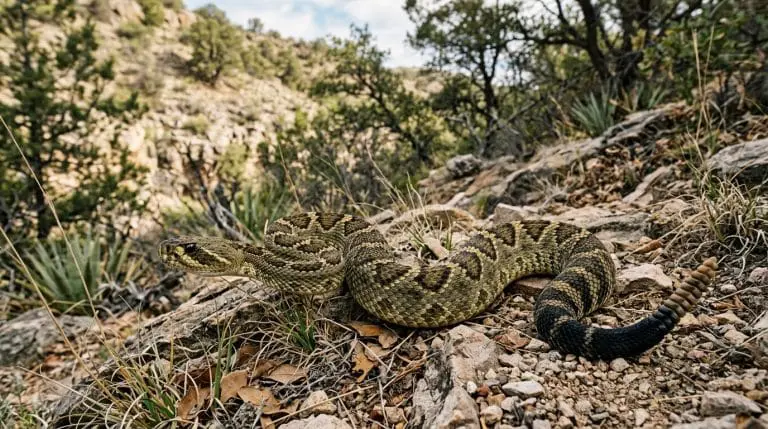
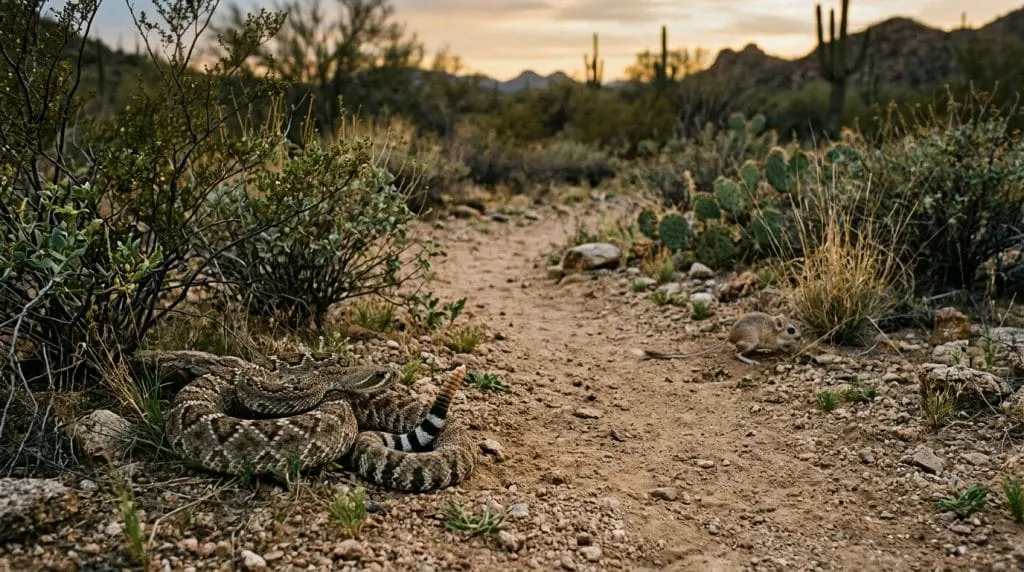
The western diamondback rattlesnake (Crotalus atrox) is a large, heavy-bodied pit viper of the southwestern United States and Mexico. Its North American range extends from southeastern California across Arizona, New Mexico, and Texas to parts of Oklahoma and Arkansas. It is best known for the dark, pale-edged diamonds along its back, strongly contrasting black-and-white tail bands, and segmented rattle. Although medically significant, it usually relies on camouflage and withdrawal rather than confrontation.
Quick Identification
- Heavy body with a broad, somewhat angular head and narrow neck.
- Gray, tan, brown, pinkish, or reddish ground color.
- Row of dark brown dorsal diamonds bordered by pale scales.
- Bold black-and-white rings immediately before the rattle.
- Dark facial stripe extending from behind the eye toward the jaw.
- Heat-sensing pit between each eye and nostril.
- Vertically elliptical pupils and strongly keeled body scales.
The tail rings are especially conspicuous, but no single mark should be used alone. View the snake from a safe distance and consider pattern, build, location, and habitat together.
Appearance and Identification
The western diamondback is stout and muscular, with a body that appears thick relative to its length. The head is broad and distinct from the neck, although head shape can change with posture and should not be treated as a stand-alone test of venomousness. The body scales are keeled, producing a rough, matte appearance rather than a smooth shine.
The eyes have vertical pupils under normal viewing conditions. A heat-sensitive facial pit lies between the eye and nostril on each side. Pale lines often border a dark stripe running diagonally from the rear of the eye toward the corner of the mouth. The back typically carries a chain of dark diamonds, while the sides may show smaller blotches.
The tail ends in alternating pale and dark rings followed by a keratinous rattle. Newborns possess a single button rather than a functional multi-segmented rattle. A segment is generally added during shedding, but segments break and shedding frequency varies, so rattles cannot reliably indicate age. Adult males tend to grow larger and have proportionally longer tails than females, though these differences are unsuitable for field sexing.

Size
Most western diamondback adults are about 3–5 feet (0.9–1.5 m) long. Large individuals may approach or occasionally exceed 6 feet (1.8 m), but such snakes are uncommon. Treat reports of substantially greater lengths cautiously. Males generally attain greater average lengths and body masses than females.
Color and Pattern
Background coloration commonly ranges from dusty gray and yellowish tan to brown, pinkish brown, or brick red, often matching local soil and rock. A series of dark brown or gray-brown diamonds runs down the back. Each diamond is usually outlined by cream, buff, or pale gray scales, although the borders may be narrow, broken, or faded in older individuals.
Near the tail, the diamonds give way to transverse bands. The final black-and-white rings are usually sharply defined and approximately similar in width, creating the familiar “coon-tail” appearance. Pattern contrast varies geographically and individually. Desert snakes may be very pale, while animals from red-soil or rocky regions can appear reddish. Recently shed snakes generally look brighter than individuals nearing a shed.
Similar Species
The Mojave rattlesnake can overlap with the western diamondback in Arizona, New Mexico, Texas, and adjoining Mexico. Mojave rattlesnakes often have relatively large dorsal blotches and tail rings in which the pale bands are wider than the dark bands; western diamondbacks more often have equal-width black and white rings. This distinction is useful but variable, so consider location and several visible marks together.
Prairie rattlesnakes are usually slimmer and show rounded or oval dorsal blotches rather than strongly outlined diamonds. Red diamond rattlesnakes of southern California and Baja California are often reddish, with less boldly contrasting pale tail rings. Speckled rattlesnakes have irregular, finely mottled patterns adapted to rocky backgrounds rather than an orderly chain of bordered diamonds.
Nonvenomous gopher snakes may hiss, coil, and vibrate their tails, but they have no true segmented rattle and usually display dark saddle-shaped blotches. Never approach a snake to inspect its pupils, facial pits, or tail; these details should be assessed only from a safe distance or from a photograph.
Geographic Range
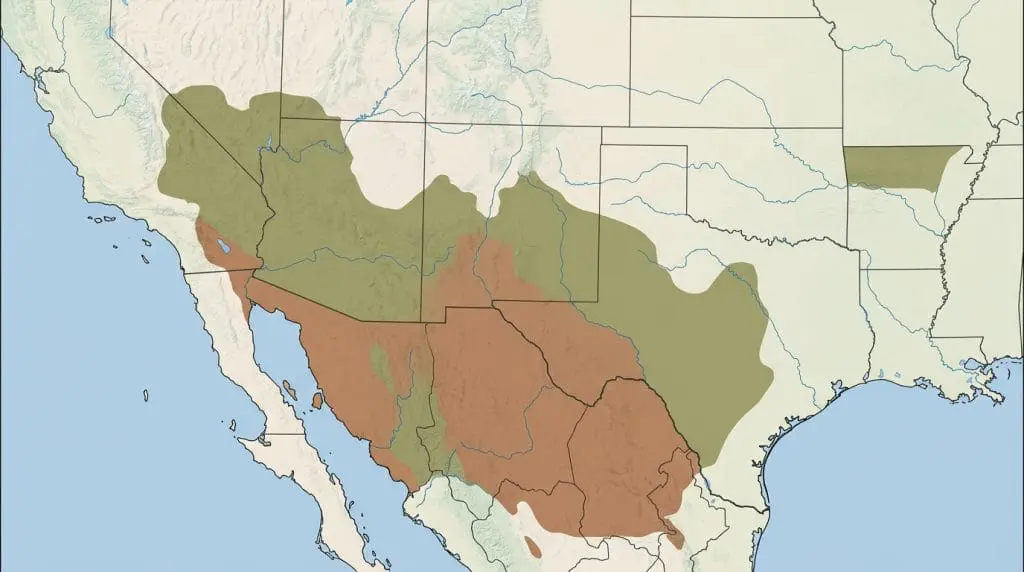
In the United States, the western diamondback occurs from southeastern California and southern Nevada eastward through Arizona, New Mexico, and most of Texas, reaching parts of Oklahoma and Arkansas. Its range continues south through extensive areas of northern and central Mexico. Distribution is not uniform: local occurrence depends on suitable climate, shelter, prey, and overwintering sites. It is not the widespread rattlesnake of most of California’s coast or the central and northern Great Plains.
Habitat
This adaptable snake inhabits Sonoran and Chihuahuan deserts, semidesert grassland, thornscrub, open woodland, rocky foothills, canyon country, and dry ranchland. It may occur on sandy flats as well as broken limestone, volcanic rock, and brush-covered slopes. Elevation ranges from low desert to uplands, although it becomes less common in cold, high terrain.
Shelters include rodent burrows, rock fissures, caves, dense vegetation, debris, and spaces beneath logs or human structures. Reliable winter refuges are particularly important near the colder limits of the range.
Behavior and Activity
Activity changes with temperature. Western diamondbacks may be active by day during mild spring and autumn weather, then become crepuscular or nocturnal during hot summer months. They bask near shelter, travel across open ground, and can swim when necessary. Although mainly terrestrial, they may climb low shrubs or angled surfaces.
When threatened, a snake may freeze, move toward cover, coil, or vibrate its rattle. Rattling is a warning, not an indication that an attack is inevitable. Some individuals remain silent, and a damaged or very small rattle may make little sound. A strike is generally a defensive response to close approach, attempted capture, or accidental contact.
Diet and Hunting
Western diamondbacks feed mainly on mammals, including mice, rats, kangaroo rats, woodrats, rabbits, and ground squirrels. Birds, lizards, and occasionally other small vertebrates are also taken; younger snakes tend to consume proportionally more lizards and small rodents.
The snake is primarily an ambush predator. Heat-sensing pits help it detect warm prey, especially in dim light. It strikes quickly and injects venom through hinged front fangs, commonly releasing mammalian prey and following its chemical trail after the animal is incapacitated. It does not constrict prey.
Reproduction and Life Cycle
Mating occurs principally in spring, with some courtship or mating also reported in late summer or autumn in parts of the range. Males may engage in ritualized combat in which they raise and press against one another; this is competition rather than an attempt to bite or kill the opponent.
The species is viviparous, giving birth to live young rather than laying eggs. Litters commonly contain roughly 6–20 young, although smaller and larger litters occur, and female size influences reproductive output. Birth usually takes place from late summer into early autumn. Newborns are patterned like adults and are venomous from birth. Females do not necessarily reproduce every year. Wild lifespan is difficult to measure, but survivors may live well over a decade and perhaps approach 20 years.
Seasonal Activity
In warmer portions of the range, activity can occur during much of the year, interrupted by cold spells and extreme heat. Elsewhere, snakes emerge from winter refuges in spring, bask nearby, and later disperse to feeding and mating areas. Summer surface activity often shifts toward evening and nighttime.
During autumn, individuals return to suitable overwintering shelters. Several snakes—and sometimes other snake species—may use the same rocky den area without forming a permanent social group. Winter dormancy is commonly described as brumation, during which activity and feeding are greatly reduced.
Venom and Medical Significance
Western diamondback venom is a complex mixture used to immobilize prey and begin digestion. Its effects are predominantly tissue-damaging and blood-related, although venom composition and clinical effects vary. The snake delivers venom through long, hinged fangs at the front of the upper jaw. A bite can cause severe pain, swelling, bruising, tissue injury, bleeding abnormalities, systemic illness, and, without appropriate care, death.
Any suspected bite is a medical emergency. Move away from the snake, keep the person calm and as still as practical, remove constricting jewelry, and contact emergency medical services promptly. Do not cut or suck the wound, apply ice, use an electric shock, or place a tight tourniquet. Do not attempt to capture or kill the snake for identification. Additional natural-history information is available from the University of Michigan’s Animal Diversity Web western diamondback account.
Predators and Threats
Hawks, roadrunners, kingsnakes, mammals, and other predators may take young western diamondbacks. Adults have fewer natural enemies but remain vulnerable to large raptors, mammalian carnivores, and kingsnakes.
Human-related mortality is substantial in many areas. Snakes are killed on roads, deliberately persecuted near homes, collected, or lost when desert and grassland habitat is converted or fragmented. Organized killing events and indiscriminate control can remove breeding adults from local populations. Entrapment in erosion-control netting and outdoor materials is another avoidable hazard.

Encounters With People
Encounters are most likely on warm roads after sunset, beside desert trails, around rock piles or brush, and near buildings that provide shelter or attract rodents. Hikers should watch where they place hands and feet, use a light after dark, and avoid stepping over logs or rocks without seeing the far side. Keep dogs leashed in rattlesnake habitat.
If you encounter a western diamondback, stop, locate the snake, and give it ample room to leave. Do not poke, move, photograph at close range, or attempt to make it rattle. Most bites occur when a snake is accidentally contacted or deliberately handled, harassed, or killed. A rattlesnake seen near an occupied building should be addressed by a qualified local wildlife professional, not an untrained resident.
Conservation Status
The western diamondback is commonly assessed as Least Concern because it remains widespread and occupies varied habitats. That global category does not mean every local population is secure. Urban expansion, intensive road networks, habitat fragmentation, persecution, and commercial collection can produce regional declines. Regulations on possession, collection, relocation, and killing differ among states and in Mexico, so check applicable wildlife laws locally.
Identification Summary
Look for a large, heavy-bodied rattlesnake with pale-edged dark diamonds, a diagonal facial stripe, rough keeled scales, and bold black-and-white rings immediately ahead of the rattle. Range and habitat provide important support: the species is characteristic of dry and semiarid country from the southwestern United States into Mexico. Observe from a safe distance, remembering that patterns vary and rattlesnakes do not always rattle.
Frequently Asked Questions
How can I recognize a western diamondback quickly?
The most useful combination is a stout body, a chain of pale-bordered dorsal diamonds, and strongly contrasting black-and-white tail rings. Confirm the general range and habitat without moving closer.
Are western diamondbacks aggressive?
They are defensive rather than habitually aggressive. A cornered or closely approached snake may coil, rattle, and strike, but one given space will often remain still or retreat toward shelter.
Do they always rattle before striking?
No. A snake may remain silent, and young snakes or individuals with damaged rattles may produce little sound. The absence of rattling should never be interpreted as safety.
What do western diamondbacks eat?
Adults eat mainly rodents and rabbits, with birds and other small vertebrates taken less frequently. Juveniles commonly include lizards and small rodents in their diet.
Are juvenile western diamondbacks more dangerous than adults?
Juveniles are venomous and should be treated with the same caution as adults. Claims that young rattlesnakes are necessarily more dangerous because they cannot control venom delivery are oversimplified; bite severity varies with many factors.
Where are people most likely to see one?
Typical locations include desert trails, rocky slopes, ranchland, canyon bottoms, and warm roads at dusk or after dark. Around homes, they may investigate shade, water, shelter, or areas supporting rodents.
Can the number of rattle segments reveal its age?
No. Segments are added during shedding rather than once per year, and older segments frequently break off. The rattle provides no dependable age count.