Broad-banded Copperhead Guide
Keep Track of What You See
Create a free Wild Things Guide membership to record this Broad-banded Copperhead in My Sightings and build your personal wildlife list.
Join to Add This SightingIntroduction
The broad-banded copperhead (Agkistrodon laticinctus) is a stout pit viper of the south-central United States. Long treated as a subspecies of the copperhead (Agkistrodon contortrix laticinctus), it is now widely recognized as a separate species, though some references still use the older arrangement. It is named for the wide, rich reddish-brown crossbands that wrap a paler tan or light copper body.
The broad-banded copperhead occupies rocky woodlands, canyon slopes, and stream margins from central Texas through Oklahoma into south-central Kansas. It is best known for its coppery head, even saddles, and leaf-litter camouflage. Like other copperheads, it is venomous and medically significant, yet it usually relies on stillness rather than pursuit. The Animal Diversity Web summarizes broader copperhead natural history.
Quick Identification
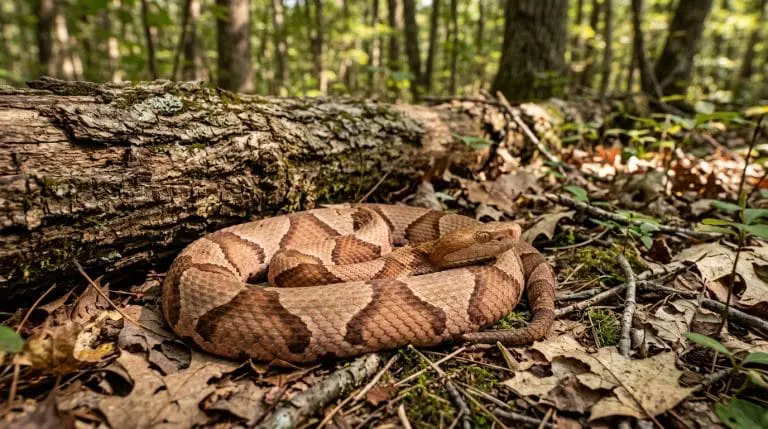
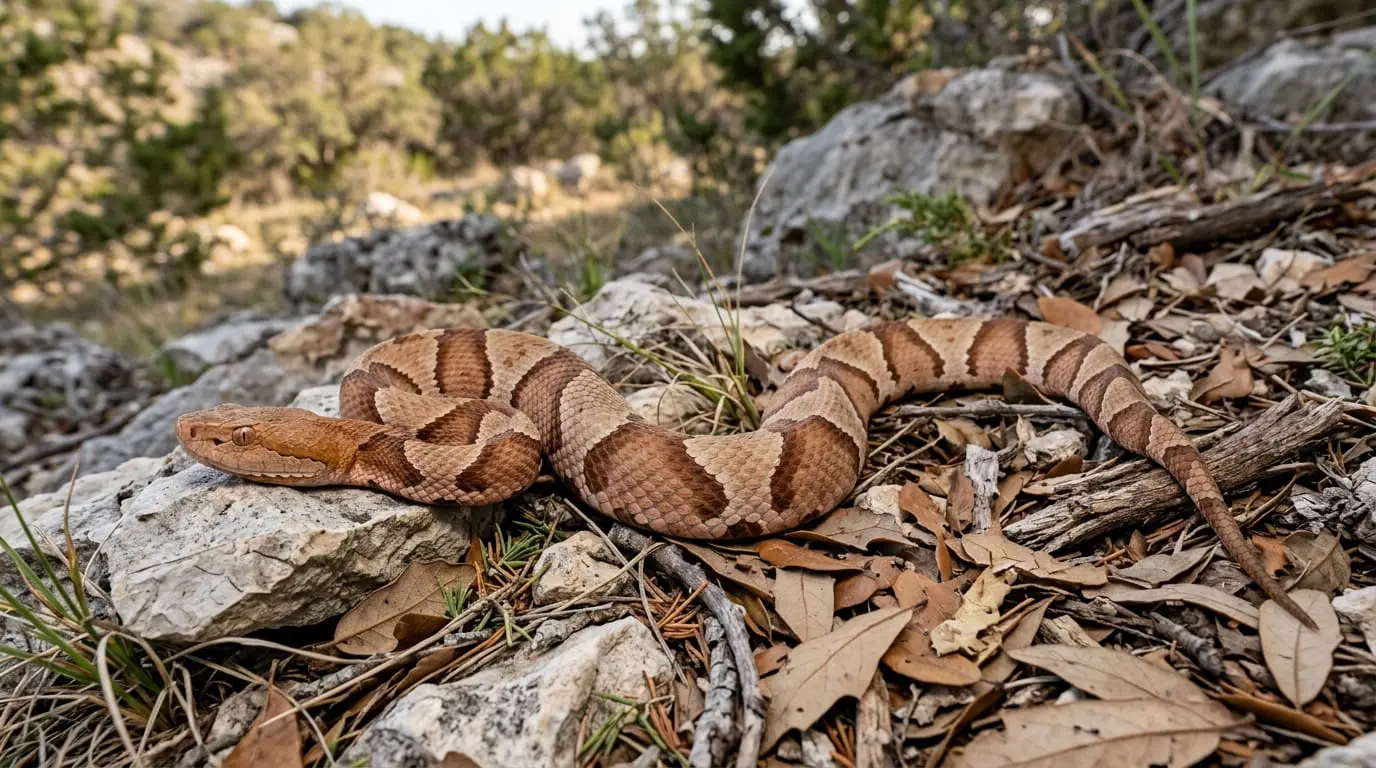
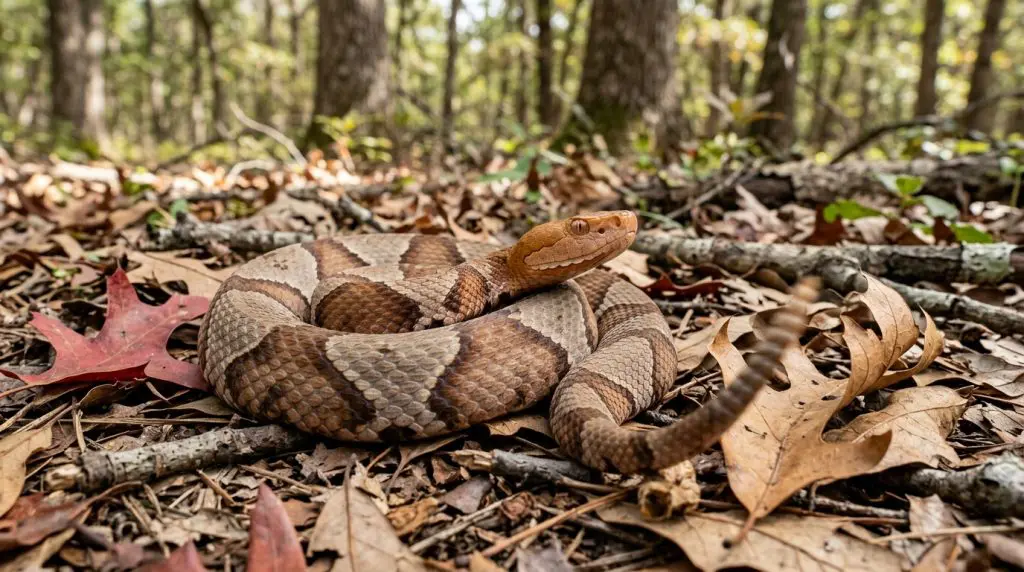
From a safe distance, look for a thick-bodied snake with a copper or pale reddish-tan head and wide chestnut to coppery-red crossbands on a cleaner tan or pinkish-brown ground color. The bands stay relatively broad down the sides and often reach, or nearly reach, the belly. The head is wider than the neck, the pupils are vertically elliptical, and a heat-sensing pit sits between each eye and nostril.
Broad-banded copperhead: Body scales are keeled. Adults have no rattle, though a startled snake may buzz its tail in dry leaves. Young snakes match the adult pattern but have a bright sulfur-yellow or greenish-yellow tail tip. The combination of a plain copper head, wide even bands, and lightly marked pale interspaces is the most useful first impression.

Appearance and Identification
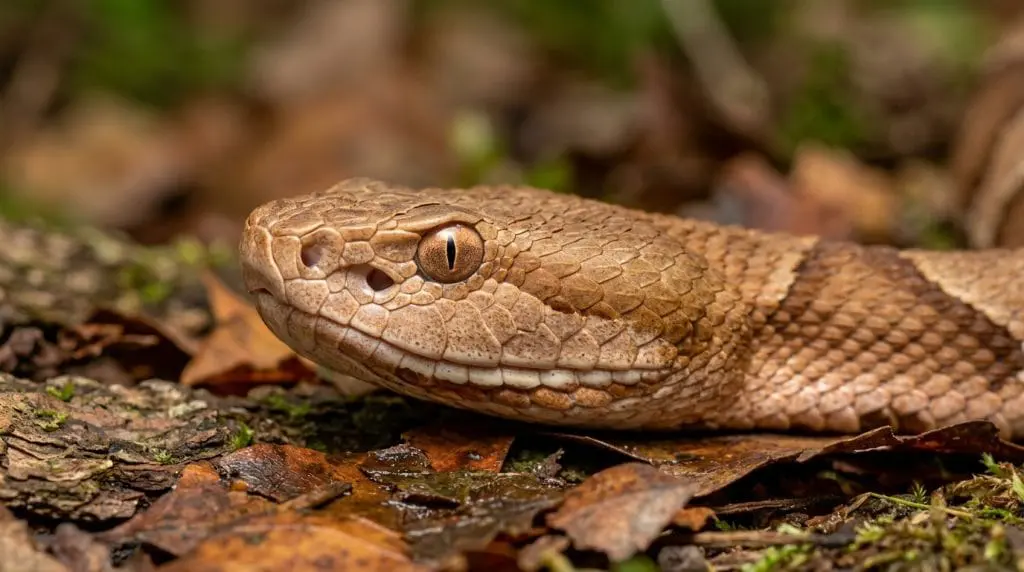
This is a heavy-bodied viper with a moderately short tail and a head clearly set off from the neck. The snout is bluntly rounded. The eyes are copper, bronze, or amber. Large scales shade them, and the pupils appear vertical in typical light. Facial pits are a family character, not something to confirm at close range.
Dorsal scales are strongly keeled. As in other North American pit vipers, the anal plate is typically undivided, and most subcaudals are undivided. The tail tapers evenly and is not rattlesnake-like. The head is usually unmarked or only faintly marked and may show a thin pale line along the lip. Dark face stripes, when present, are weaker than those of cottonmouths.
Broad-banded copperhead males and females are similar in color. Males often have a proportionally longer tail; gravid females can look heavier through the body. Those differences are subtle at a distance. Newborns already show the banded pattern; their brightest extra mark is the yellow tail tip used as a caudal lure, which fades with age.
Size
Most broad-banded copperhead adults measure about 20–30 inches (51–76 cm) in total length. Snakes approaching 36 inches (91 cm) are uncommon. Newborns are typically near 7–10 inches (18–25 cm). Length overlaps widely between the sexes and is not a field mark for telling males from females.
Color and Pattern
The ground color is tan, light brown, pale rust, or pinkish gray. Broad reddish-brown to chestnut crossbands run across it, often with darker edges. In typical adults, the bands remain wide along the lower sides instead of pinching into a narrow hourglass on the midline. The pale spaces between bands are comparatively clean, with less heavy stippling than in some other copperheads.
Bands commonly continue onto the sides of the belly, so the underside is not a plain cream. The belly is pale with darker mottling toward the edges. Snakes from drier Texas rock country may look paler or more rust-washed. Near contact zones with other copperheads, band shape can be intermediate. Appearance also changes with age, shed cycle, and whether the skin is dry or damp.
Similar Species
Identify broad-banded copperheads from a safe distance. Do not approach it to check scales, the anal plate, or the belly.
Other copperheads are the closest match. Eastern and Osage copperheads usually show more strongly constricted hourglass bands and darker pigment in the pale spaces. The Trans-Pecos copperhead of western Texas is also richly banded but typically has a much bolder belly pattern. Where ranges meet, some snakes look intermediate, and not every individual can be named with certainty from a photograph.
Cottonmouths are darker as adults, often with a stronger dark facial mask, a blockier head, and a closer tie to permanent water. They frequently gape when alarmed. Banded young cottonmouths can be confusing but usually look duskier, with a more pronounced face stripe. Broad-banded watersnakes and other Nerodia may wear reddish or brown bands, yet they have round pupils, no facial pits, and a slimmer, more aquatic look. Ratsnakes and kingsnakes in the same country lack the copper head and even saddles. If identification is uncertain, leave the snake alone.
Geographic Range
This is a south-central species. Its core range covers much of central Texas, including the Edwards Plateau and Cross Timbers, then runs north through Oklahoma into south-central Kansas. It belongs to the wooded hills and prairie margin of the southern Great Plains, not the humid southeastern forests occupied by the eastern copperhead.
Drier western Texas marks much of the southwestern limit. The eastern edge approaches other copperhead populations, and the boundary is not sharp. County records are best confirmed with current state or museum data. The Texas Parks and Wildlife Department provides a useful statewide overview of copperheads in Texas.

Habitat
Broad-banded copperhead: Typical habitat mixes rock, broken shade, and nearby cover: limestone or sandstone slopes, oak-juniper woodland, wooded ravines, and riparian benches with oak, pecan, or other hardwoods. Prairie edges, canyon floors, old stone walls, and brushy fencerows are used when prey and shelter are present.
The snake is not aquatic, but it often stays near seeps, creek terraces, or shaded outcrops that stay cooler in summer. Daytime retreats include rock crevices, logs, leaf litter, stumps, and surface debris. Elevation is generally low to moderate. Around people, it may persist at woodpiles, rural outbuildings, and unmanicured creek lots.
Behavior and Activity
Broad-banded copperheads are mainly ambush hunters and spend long periods coiled and still. In spring and autumn they may move by day, especially in mild or overcast weather. In hot summer, they shift toward dusk, night, and early morning. They climb only occasionally, usually into low cover or along rock, and they swim adequately but do not hunt as watersnakes do.
The first response to discovery is often to freeze. If pressed, the snake may vibrate its tail, musk, coil, or strike. It has no rattle. Strikes are a last resort. Individuals move between summer foraging sites and repeated winter shelters but are not long-distance migrants.
Diet and Hunting
The usual prey for the broad-banded copperhead is small vertebrates, especially mice and other rodents, along with lizards and frogs. Young snakes take cicadas and other large insects more often. Birds are reported less often. Hunting is mostly sit-and-wait along rodent runways, log edges, or rock margins.
Prey is subdued with a venomous bite, not constriction. Broad-banded copperhead juveniles may twitch the yellow tail tip to lure frogs or lizards, a habit that fades as the tail color dulls.

Reproduction and Life Cycle
Mating occurs mainly in spring after emergence; some pairing also takes place in autumn. Females are viviparous and give birth to live young. Litters commonly number about four to eight, with smaller and larger broods recorded. Births concentrate in late summer and early autumn, often August and September.
Neonates are independent and already venomous. They shed soon after birth and begin taking small prey. Broad-banded copperhead. Maturity comes in a few years, depending on food and climate. Wild longevity is imperfectly known; many copperheads probably live around 15 years, and longer lives are documented, especially in captivity.
Seasonal Activity
Surface activity usually begins in late winter or early spring, often March or April depending on latitude and weather. Spring is a time of basking, feeding, and mating. Summer activity becomes more nocturnal, and broad-banded copperhead snakes may stay close to cool rock or riparian retreats during heat. Late summer and early fall bring births and another pulse of movement.
As nights cool, broad-banded copperhead snakes feed and then enter frost-free winter shelters such as deep rock crevices or burrows. Several individuals may share a den, sometimes with other snake species. Brumation lasts through the cold months. Brief midwinter emergence on unusually warm days is possible but irregular.
Venom and Medical Significance
The broad-banded copperhead is venomous. Its venom subdues prey and is primarily hemotoxic and tissue-damaging. It is delivered through hinged front fangs. Most bites to people happen when a snake is stepped on, reached for, or pressed in a woodpile, garden, or rocky path.
Bites are painful and can cause swelling, bruising, and local tissue injury. Systemic effects are possible. Deaths are uncommon in the United States when modern care is available, but that is not a reason to delay. Any suspected bite is a medical emergency. Move out of striking range, keep the person as calm and still as practical, and seek emergency care immediately. Do not cut the wound, apply a tourniquet, ice the bite, or try to capture the snake.
Predators and Threats
Hawks, owls, coyotes, foxes, kingsnakes, and other predators take broad-banded copperheads, and newborns are especially vulnerable. People cause substantial mortality through habitat conversion, roadkill, and intentional killing. Collection appears limited compared with some other pit vipers but can add local pressure.
Loss of rocky woodland and riparian cover removes both prey and winter dens. Clearing brush, stacking rocks, and clearing wooded edges around homes also eliminates concealment. Because copperheads are often killed on sight, persecution continues even where habitat remains.
Encounters With People
Most meetings with broad-banded copperheads occur around woodpiles, stone walls, rural buildings, rocky trails, creek crossings, and leaf-littered yards at the woodland edge. Sightings rise in spring and early fall, and on summer nights near roads or buildings. The pattern blends with oak leaves and weathered stone, so you often notice the snake only after it moves.
Give it space and let it leave. Watch from a distance; do not try to move, kill, or photograph it at arm’s length. Keep hands and feet out of cavities, stacked wood, and blind spots along rocks. Copperheads are not eager to chase people. They are far more likely to freeze or withdraw. A yellow-tailed young snake is not a different, harmless species.
Conservation Status
The broad-banded copperhead is not listed as threatened or endangered under the U.S. Endangered Species Act. Copperheads assessed as a broader group are generally regarded as secure or of Least Concern. A separate global assessment for A. laticinctus is not always available, so read status with that taxonomic caveat.
The species can be locally common in suitable rocky woodland. Main concerns are habitat loss, road mortality, and unnecessary killing. State rules on take vary and should be checked locally. Protecting outcrops, riparian woodland, and denning sites matters more than focusing on individual snakes.
Identification Summary
From a safe distance, look for a stout pit viper with a copper or pale reddish head and wide, even chestnut saddles on a relatively clean tan or light-rust body. Bands often run well down the sides. There is no rattle. Broad-banded copperhead juveniles add a bright yellow tail tip. Rocky oak or juniper country from central Texas through Oklahoma into south-central Kansas supports the identification. Strongly hourglass bands, a vividly checkered belly, or a location well outside this region points to another copperhead or a different snake.
Frequently Asked Questions
How can I recognize one without getting close?
Use the overall look: a thick, copper-headed snake with wide reddish-brown saddles that do not strongly pinch at the spine, in rocky south-central woodland. Do not rely on scale counts or belly checks.
Is the broad-banded copperhead dangerous to people?
It is venomous, and a bite needs prompt professional medical care. It is not typically aggressive, and serious outcomes are uncommon with timely treatment. Distance is the practical safeguard.
When is it most active?
By day in cooler spring and fall weather, and more at dusk and night in hot summer. Winter is spent in sheltered brumation sites.
What does it eat?
Mainly small mammals, plus lizards and frogs. Young snakes also take large insects such as cicadas. It hunts mostly by ambush and uses venom, not constriction.
Do juveniles look different from adults?
The banded pattern is already present, but the tail tip is bright yellow or greenish yellow. That lure color fades as the snake grows.
Are they protected?
They are not federally listed as threatened or endangered. State regulations may still restrict capture or killing. Leaving the snake undisturbed is the simplest course.