Eastern Copperhead Guide
Keep Track of What You See
Create a free Wild Things Guide membership to record this Eastern Copperhead in My Sightings and build your personal wildlife list.
Join to Add This SightingIntroduction
The Eastern Copperhead (Agkistrodon contortrix) is a medium-sized pit viper of deciduous woods, rocky hillsides, and wooded edges across much of the eastern and central United States. It is best known for a copper-toned, largely unmarked head and a series of darker hourglass-shaped crossbands that are narrow along the spine and wide on the sides. The species is venomous, but it is also secretive and often relies on camouflage rather than flight or display. For most observers, a copperhead is more likely to be overlooked in leaf litter than to be seen crossing open ground.
This guide emphasizes characters that can be judged from a safe distance. It is intended for field identification in North America and does not replace guidance from local agencies. Additional natural-history notes are available from the Savannah River Ecology Laboratory.
Quick Identification
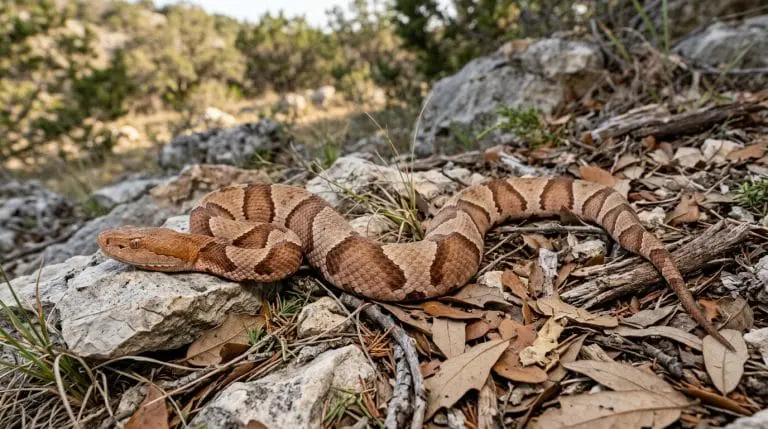
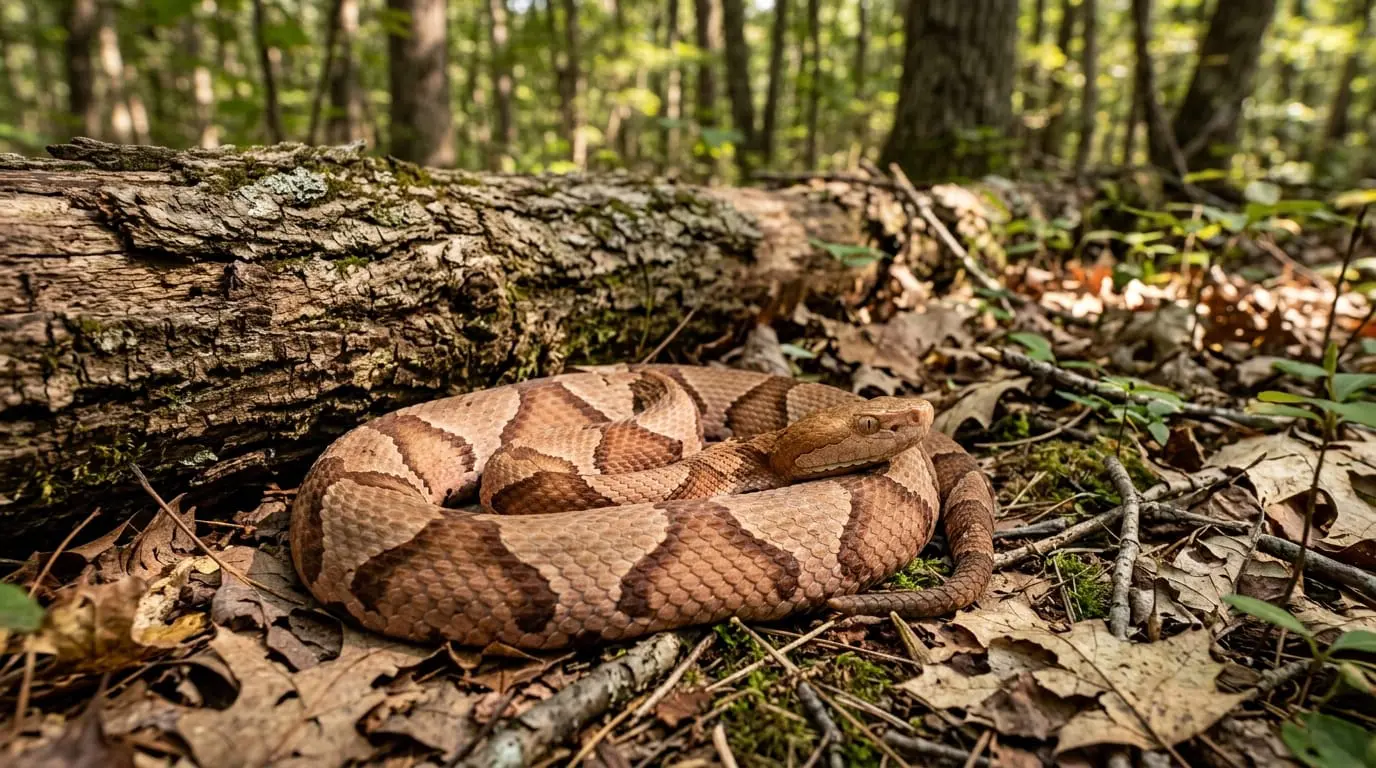
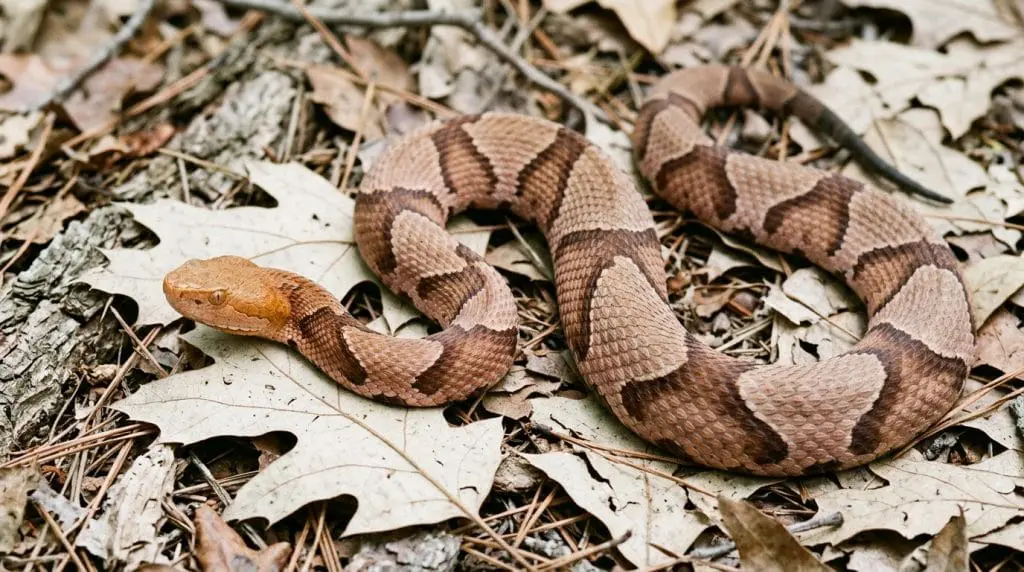
From several feet away, look first at overall color and the shape of the dark markings. Most adults are tan, pinkish tan, light brown, or grayish brown, with chestnut to reddish-brown crossbands. Those bands typically pinch in at the midline, producing the familiar hourglass or dumbbell outline. The head is usually a richer copper or orange-brown and lacks the bold dark facial stripe seen on many cottonmouths.
The body is relatively stout for a snake of this length. The head is distinctly wider than the neck, and the pupils are vertically elliptical in ordinary daylight. A heat-sensing pit lies between the eye and the nostril on each side of the face. Juveniles resemble adults in pattern but often show a bright sulfur-yellow or greenish-yellow tail tip. Do not confirm any of these traits by handling or by leaning in close.
Appearance and Identification
Eastern Copperheads have a heavy, slightly flattened body and a short, tapering tail. Dorsal scales are keeled, which gives the skin a dull rather than glossy look. The anal plate is typically undivided, and most subcaudal scales are undivided as well, characters used by specialists rather than by casual observers. The head is broad and covered with large plates on the crown. Eyes are moderate in size, with elliptical pupils and a copper to golden iris that blends into the head color.
Facial pits are a pit-viper feature shared with rattlesnakes and cottonmouths; they are not unique to copperheads and are difficult to see unless the snake is already close. There is usually no strong dark postocular stripe, or only a faint one, which helps separate many copperheads from cottonmouths when the head is clearly visible. The belly is pale, often pinkish or cream, with dark lateral mottling that may show along the lower sides.
Males and females are similar in color and pattern. Males tend to have longer tails relative to body length. That difference is rarely useful in the field and is not a safe identification method. Older adults may become darker or more uniformly coppery, and the hourglass outlines can blur. Freshly shed snakes show the pattern most clearly.
Size
Most adults measure about 24–36 inches (61–91 cm) in total length. Individuals near 40 inches (102 cm) are large, and lengths approaching 4 feet (122 cm) are exceptional. Neonates are commonly about 7–10 inches (18–25 cm) long. Males average somewhat larger than females in many samples, but size alone does not identify sex or distinguish copperheads from several harmless snakes of similar length.

Color and Pattern
The ground color ranges from pale pinkish tan and light copper to gray-brown. Crossbands are darker chestnut, rust, or medium brown. Each band is typically widest on the lower sides and narrowest across the back, so neighboring bands may almost meet at the midline, leaving pale, oval, or bow-tie spaces between them. Band edges are often finely outlined in a slightly darker or paler tone.
Geographic and individual variation is noticeable. Northern and upland animals are frequently grayer or darker, while many southern and lowland snakes look pinker or more coppery. Some adults, especially older ones, have faded or broken bands. A minority of individuals are unusually pale or richly reddish. The unmarked or lightly marked copper head remains one of the more consistent field marks when lighting is good. Juveniles are patterned like adults but often contrast more sharply and retain the bright tail tip for many months.
Similar Species
Several harmless snakes are regularly mistaken for copperheads, and two venomous species overlap parts of the range. Identification should be made from a distance; do not approach, pin, or handle a snake to check pupils, pits, or scale characters.
Watersnakes, especially the Common Watersnake (Nerodia sipedon), are the most frequent source of confusion near creeks, ponds, and river woods. Their dark bands or blotches are usually widest on the back, not pinched into hourglasses, and they often darken with age. The head is not copper-colored in the same way; the pupils are round, and the body often looks rougher and more blotched. Watersnakes also flee to water more readily.
Juvenile Eastern Ratsnakes and some milksnakes have brown blotches on a gray or tan ground. Their blotches are typically rounded or squarish rather than hourglass-shaped, and the head pattern differs: many milksnakes show a light Y- or V-shaped nape mark. Both have round pupils and more slender necks.
Where ranges meet, the Northern Cottonmouth is usually darker as an adult, often with a broad dark facial stripe through the eye and a heavier, more blocky head. Cottonmouths are more strongly tied to wetlands. The Broad-banded Copperhead (Agkistrodon laticinctus), now treated as a separate species, occupies parts of Texas and nearby areas to the west; its crossbands are wider and more evenly spaced. Timber Rattlesnakes are larger, usually have a rattle, and show different blotch or chevron patterns. If you cannot identify a snake confidently, leave it alone and treat it as potentially venomous.
Geographic Range
The Eastern Copperhead occurs widely in the eastern and east-central United States. The range extends from southern New England and southeastern New York south through the mid-Atlantic and Southeast to the Florida Panhandle and southern Georgia, and west across the Ohio and Mississippi valleys to parts of Illinois, Missouri, Arkansas, Louisiana, eastern Oklahoma, eastern Kansas, southeastern Nebraska, and eastern Texas. It is absent from most of the Florida peninsula and from large parts of the upper Midwest.
Local distribution is patchy. The species can be common on rocky, wooded slopes and scarce on intensive farmland or in densely urban cores. Elevation limits vary by latitude; copperheads occupy lowlands and many Appalachian valleys and foothills but are less frequent on the coldest high ridges. Western limits abut the range of the Broad-banded Copperhead. State wildlife accounts, including the Virginia Department of Wildlife Resources copperhead profile, provide useful regional detail.

Habitat
Typical habitat is deciduous or mixed woodland with abundant leaf litter, fallen logs, and rock. Copperheads use south-facing rocky hillsides, talus, wooded creek bottoms, forest edges, old fields reverting to woods, and wetland margins. In settled landscapes, they persist in woodlots, overgrown fencerows, stone walls, brush piles, and the edges of suburban yards that adjoin forest.
Moisture and cover matter more than a single plant community. The snakes often sit in shaded litter by day in warm weather and may use rodent burrows, rotting stumps, rock crevices, or abandoned foundations as shelters. They occur from near sea level to moderate mountain elevations where winter dens are available. Open agricultural fields and closely mowed parks are used mainly as travel lanes, if at all.
Behavior and Activity
Eastern Copperheads are primarily ambush hunters and spend long periods motionless. In spring and fall, they are often active by day, especially in sun-flecked woods and on warm rocks. During hot summer weather, they become mainly crepuscular and nocturnal. They occasionally climb low vegetation or stonework and can swim, but they are not strongly aquatic.
When discovered, many individuals freeze, relying on the broken pattern to disappear against leaves. If pressed, a copperhead may vibrate the tail in dry litter, release musk, or coil with the head raised. Strikes are usually a last resort. The species is not known for unprovoked pursuit. Tail vibration can sound faintly like a rattle in leaves, which sometimes leads people to assume a rattlesnake is present.
Diet and Hunting
Prey includes small mammals such as mice and voles, frogs, lizards, large insects, and occasionally small birds or other snakes. Cicadas are important seasonal food in some eastern forests when emergences are heavy. Juveniles take a higher proportion of amphibians, lizards, and insects than adults do.
Hunting is mostly by sit-and-wait ambush. The snake selects a concealed station along a rodent runway, log, or wetland edge and strikes when prey comes within range. Venom immobilizes and begins to digest the animal, which is then swallowed. Neonates and young juveniles may twitch the bright tail tip as a caudal lure, a behavior that can attract frogs and lizards. Copperheads do not kill by constriction.

Reproduction and Life Cycle
Mating occurs mainly in spring, often April and May, with additional courtship in late summer and fall in some populations. Females can store sperm, so fall mating may result in spring fertilization. The species is viviparous: young are born in utero, not laid as eggs.
Births are concentrated from about August through early October. Litter size is commonly four to eight, with published extremes ranging from a single young to well over a dozen. Neonates are patterned like adults and are venomous at birth. In cooler parts of the range, females may reproduce every other year rather than annually. Wild lifespan is often cited near 15 years; some individuals likely live longer where they escape roads and persecution. Captive longevity can be substantially greater and is not a reliable guide to wild age.
Seasonal Activity
Emergence from winter shelter usually begins in March or April, later at higher elevations and in the north. Spring is a period of basking, dispersal from dens, and mating. Early summer activity remains fairly high. By midsummer, many copperheads shift to night movement and spend daylight hours in cooler, moister cover.
Late summer and early fall bring births and a second pulse of surface activity, including some mating. As nights cool, snakes move toward winter dens in rock outcrops, deep crevices, rodent burrows, or old masonry. They may share dens with other copperheads and sometimes with rattlesnakes or harmless species. Brumation lasts through the cold months, with occasional brief appearances on unusually warm winter days near den sites.
Venom and Medical Significance
The Eastern Copperhead is venomous. Its venom subdues prey and begins the digestive process. It is generally described as hemotoxic and cytotoxic, producing local pain, swelling, and tissue injury in people. Systemic effects can occur, but deaths in healthy adults are uncommon when prompt medical care is obtained. Bite severity varies with the amount of venom injected, bite location, and the person’s health.
Most bites happen when a snake is stepped on, reached for in leaves or woodpiles, or deliberately handled. A copperhead may deliver a dry bite with little or no venom, but that cannot be judged in the field. If a bite is suspected, move a safe distance from the snake, keep the affected limb still and below heart level if practical, remove rings or tight items, and seek emergency medical care immediately. Do not cut the wound, apply a tourniquet, ice the bite, or attempt to suck out venom. Do not try to capture or kill the snake for identification.
Predators and Threats
Natural predators include hawks, owls, opossums, coyotes, foxes, and other snakes, notably kingsnakes and racers. Feral and free-ranging domestic cats also kill smaller individuals. Neonates are especially vulnerable.
Human-related losses are substantial in many areas. Road mortality is frequent along wooded highways. Habitat fragmentation, removal of rock cover and coarse woody debris, and conversion of mixed woods to lawn or intensive agriculture reduce local populations. Intentional killing remains common because the species is venomous and easy to misidentify. Collection for the pet trade is a lesser but documented pressure in some regions.

Encounters With People
People most often meet copperheads on woodland trails, near woodpiles and stone walls, in leafy yards beside forest, around old outbuildings, and on warm roads at dusk. Because the snake freezes, hikers may pass within a step of one without seeing it. Gardeners turning boards, mulch, or leaf piles account for many surprise encounters.
The safest response is to stop, give the snake plenty of space, keep children and pets back, and let it move on. Do not attempt to move the animal with a stick or shovel. Clearing clutter from doorways and watching where you place your hands and feet reduces unwanted encounters. A widespread misconception is that copperheads are aggressive chasers; observed behavior is usually stillness or a short defensive strike at close range. Another misconception is that every banded brown snake in the East is a copperhead. Many are watersnakes or juvenile ratsnakes.
Conservation Status
The Eastern Copperhead is generally regarded as secure across its broad range and is listed as Least Concern on the IUCN Red List. It is not federally listed as threatened or endangered in the United States. Local declines occur where habitat is fragmented or where snakes are systematically killed. Legal status varies by state; some jurisdictions protect all native snakes, including venomous species, from collection or wanton killing. Checking current state wildlife regulations is the best way to confirm local protections.
Identification Summary
From a safe distance, an Eastern Copperhead is a stout, medium-sized snake of eastern woods and rocky edges, usually tan to coppery, with darker hourglass crossbands that narrow on the back. The head is typically unmarked copper, the pupils elliptical, and the body dull-scaled. Juveniles add a bright yellow tail tip. The species is most often found in leaf litter, along stone cover, and at forest edges from southern New England west to the eastern Plains and south to the Gulf Coast. If the pattern is unclear, do not close the distance to decide.
Frequently Asked Questions
How can I tell a copperhead from a watersnake without getting close?
Look at band shape and habitat together. Copperhead bands usually pinch in along the spine and widen on the sides. Many watersnakes show the opposite, with dark markings broader on the back. Watersnakes also tend to be right at the waterline and lack the even copper head tone. If you are unsure, leave the snake alone.
Are Eastern Copperheads active during the day?
Yes, especially in spring and fall. In hot weather, they more often move at dusk and at night and remain hidden by day.
Do copperheads have rattles?
No. They may vibrate the tail in dry leaves, which can produce a buzz, but they do not grow a rattle.
What do they eat?
Small mammals are staple prey for adults. Frogs, lizards, cicadas, and other large insects, and occasional birds or snakes are also taken. Young snakes use a yellow tail tip to lure small prey.
How dangerous is a bite?
A bite is a medical emergency and can cause significant local injury. Fatalities are rare with modern care, but that is not a reason to delay treatment. Seek professional medical help immediately.
Will a copperhead chase me?
Documented behavior does not support chasing. Most snakes remain still or try to withdraw. Giving the animal space ends the encounter.
Where in North America do they live?
They occupy much of the eastern United States, from southern New England through the Southeast and west to the eastern Great Plains. They are not native north of that region or in most of Florida’s peninsula.