Timber Rattlesnake Guide
Keep Track of What You See
Create a free Wild Things Guide membership to record this Timber Rattlesnake in My Sightings and build your personal wildlife list.
Join to Add This SightingIntroduction
The timber rattlesnake (Crotalus horridus) is a large, heavy-bodied pit viper native to eastern and central North America. Its distribution extends from parts of New England and the Appalachian region south into the Southeast and west through portions of the Midwest to eastern Kansas, Oklahoma, and central Texas. Populations are often localized, especially near communal winter dens.
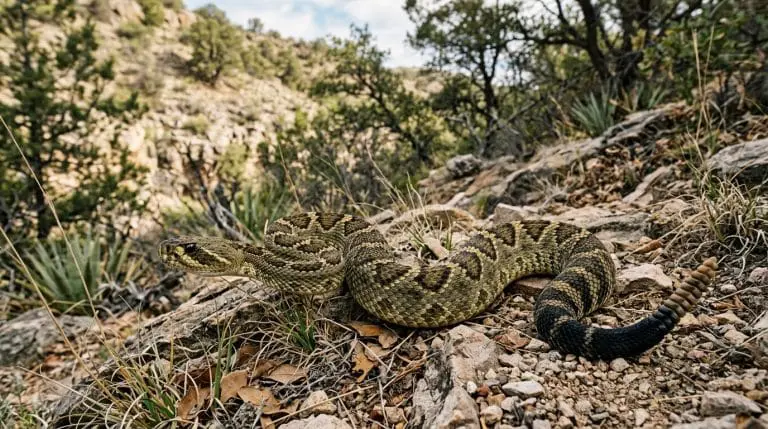
This species is best known for its dark crossbands, black tail, segmented rattle, and use of wooded, rocky landscapes. Although venomous, timber rattlesnakes are generally secretive and rely first on camouflage and stillness. They may remain silent when approached, so a lack of rattling does not mean that a nearby snake is harmless.
Quick Identification
- Large, thick-bodied rattlesnake, usually 3–5 feet long.
- Series of dark brown or black crossbands over a yellow, tan, brown, gray, or nearly black background.
- Crossbands often become more strongly V-shaped or chevron-like toward the rear.
- The tail is usually dark brown or black immediately before the rattle.
- Broad head with a narrow neck, vertical pupils, and a heat-sensing pit between each eye and nostril.
- Strongly keeled dorsal scales that give the body a rough, matte appearance.
- A narrow rust-colored stripe may run along the center of the back, although it is absent or inconspicuous in many individuals.
Color varies considerably, and dark snakes may show little pattern at a glance. Identification should therefore combine body proportions, crossbands, the dark tail, the presence of a rattle, habitat, and geographic location.
Appearance and Identification
The timber rattlesnake has a robust body with a relatively short tail. Its dorsal scales are strongly keeled, while the head is broad and distinct from the neck. The top of the head is covered mostly by small scales rather than a symmetrical set of large plates. A dark stripe commonly extends from behind the eye toward the rear of the jaw.
The eyes have vertically elliptical pupils. Between each eye and nostril is a heat-sensitive facial pit used to detect warm-blooded prey. These details should never be sought by approaching a wild snake; they are most useful in a safely obtained photograph.
The segmented rattle consists of loosely interlocking keratin sections added when the snake sheds. Rattle length does not reliably indicate age because segments break and snakes may shed more than once a year. Newborns have a single button and cannot produce the full buzzing sound of an older snake.
Males and females look similar, but adult males are generally longer and heavier and have proportionally longer tails. Sex cannot be determined reliably from a normal field observation.

Size
Most adults measure about 3–5 feet (0.9–1.5 m) in total length. Large specimens can approach or slightly exceed 6 feet (1.8 m), although such individuals are uncommon. Adult males typically grow larger than females. Body mass varies greatly with length, sex, season, and recent feeding.
Color and Pattern
Ground color ranges from pale yellow, tan, and golden brown to gray, dark brown, or nearly black. The traditional terms “yellow phase” and “black phase” describe broad color tendencies rather than sharply separated forms. Intermediate snakes are common.
Dark dorsal blotches near the neck usually transition into crossbands along the body. These bands often narrow near the spine and widen down the sides, producing a V-shaped or zigzag appearance when viewed from above. Some individuals have a thin rusty, orange-brown, or reddish mid-dorsal stripe.
The rear of the body and tail often darken noticeably, ending in a nearly uniform black or dark brown “velvet tail” before the rattle. In heavily melanistic animals, the crossbands and tail may blend into the ground color. Young timber rattlesnakes generally resemble adults but are smaller, often grayer, and have only a button or a short developing rattle.
Similar Species
Eastern massasauga: This smaller rattlesnake normally has rounded or irregular dorsal blotches rather than the timber rattlesnake’s strong rear crossbands and black tail. It is more closely associated with wetlands, wet prairies, and adjacent uplands. Their ranges overlap only in limited areas.
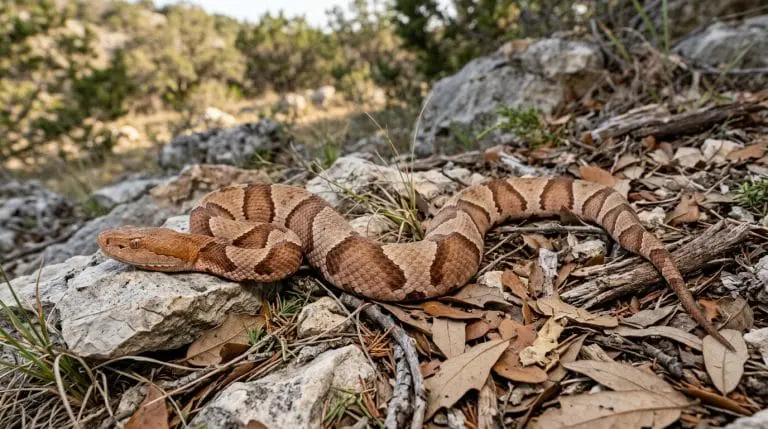
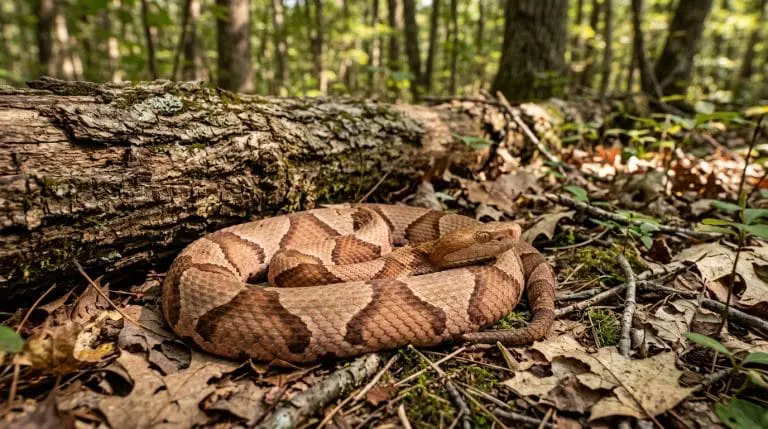
Eastern copperhead: Copperheads have chestnut hourglass-shaped bands that are narrow across the spine and broad along the sides. They lack a rattle and do not normally have the timber rattlesnake’s solid dark tail. Both are venomous, so give uncertain snakes ample space.
Northern cottonmouth: In areas of overlap, a dark cottonmouth can resemble a dark timber rattlesnake. Cottonmouths lack a rattle, often have less distinct adult patterning, and are strongly associated with aquatic habitats. Never attempt to provoke an open-mouth display for identification.
Nonvenomous watersnakes and rat snakes: These may be banded or blotched, but they lack a true segmented rattle. Head shape alone is unreliable because harmless snakes can flatten their heads defensively. The safest identification is made from a distant overall view or a zoomed photograph.
Geographic Range
The timber rattlesnake occurs in a broad but discontinuous area of the eastern and central United States. Its northern range includes parts of New England, New York, Pennsylvania, the upper Midwest, and neighboring regions. It extends south through the Appalachian Mountains and Southeast, and west into portions of Iowa, Kansas, Oklahoma, and Texas.
Distribution is patchy because suitable denning sites, summer habitat, and protected movement corridors must occur together. The species has disappeared from some developed or heavily persecuted areas and is considered extirpated from Canada, where it formerly occurred in southern Ontario.

Habitat
Timber rattlesnakes occupy deciduous and mixed forests, rocky hillsides, wooded ridges, talus slopes, cliffs, and mountain valleys. Northern populations frequently overwinter in south- or southwest-facing rocky dens where deep crevices remain above freezing. In the southern part of the range, snakes may also use lowland forests, cane thickets, river corridors, pine-hardwood woodland, and swamp margins.
Summer habitat can include forest edges, canopy gaps, brushy fields, fallen logs, rock outcrops, and sunny openings. Females carrying developing young often select exposed rocks or ledges that provide warm basking conditions. Shelters include rock fissures, root cavities, hollow logs, and spaces beneath woody debris.
Behavior and Activity
This is primarily a terrestrial snake, although it can climb low shrubs or fallen timber and can swim when necessary. It spends much of its time concealed or motionless. Activity is commonly diurnal in cool spring and autumn weather, becoming more crepuscular or nocturnal during hot summer conditions.
When threatened, a timber rattlesnake may freeze, retreat, coil, or vibrate its rattle. Rattling is a warning, not evidence that the snake is pursuing a person. Some individuals remain silent, and a startled snake may defend itself if stepped on, cornered, or handled. Given an open escape route, it will usually move away or remain concealed.
Diet and Hunting
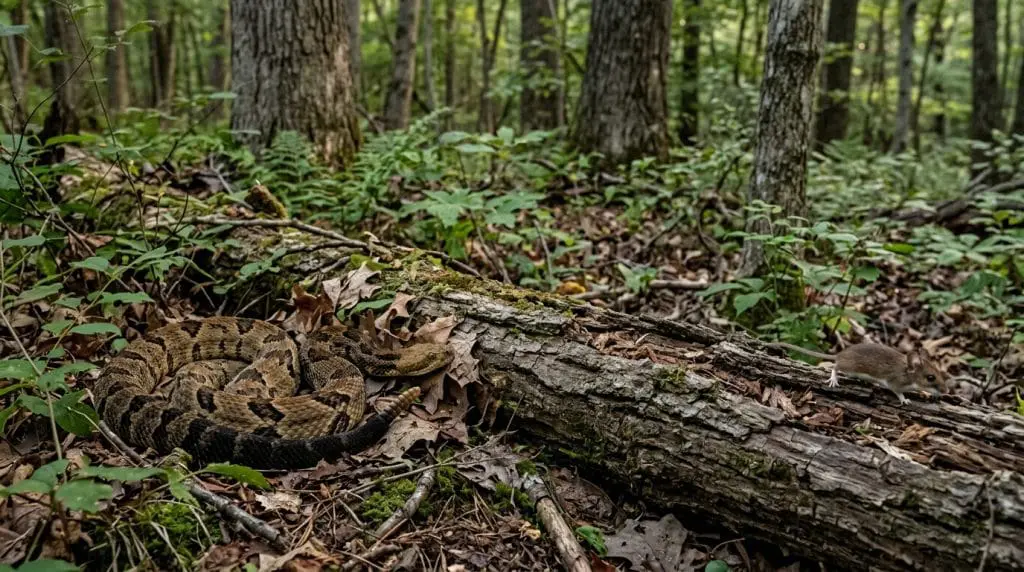
Timber rattlesnakes primarily eat small and medium-sized mammals, including mice, rats, chipmunks, squirrels, shrews, and young rabbits. Birds are taken occasionally, especially by smaller or younger snakes, which may also consume small reptiles.
The snake is mainly an ambush predator. It waits beside logs, mammal trails, burrows, or other travel routes and strikes passing prey. Hinged front fangs inject venom that subdues the animal and begins digestion. The snake may release mobile prey after the strike and follow its chemical trail before swallowing it whole.
Reproduction and Life Cycle
Mating occurs most often from midsummer into early autumn, although spring mating has also been reported. Timber rattlesnakes give birth to live young rather than laying eggs. Females generally reproduce at intervals of several years because producing a litter requires substantial energy.
A typical litter contains about 5–14 young, but smaller and larger litters occur. Birth usually takes place from late summer into early autumn at a protected rookery or basking site. Newborns receive no food from the mother, but females and young may remain near the birth site for a short period before dispersal or moving toward a den.
Growth and maturity are relatively slow, especially in northern populations. Wild individuals may live 20–30 years, and some likely survive longer where persecution and road mortality are limited. Slow maturation and infrequent reproduction make populations vulnerable to adult snake loss.
Seasonal Activity
In northern and upland regions, timber rattlesnakes emerge from communal dens in spring and bask nearby before moving to summer ranges. Males may travel considerable distances in search of mates, while gravid females often remain near warm, rocky gestation sites.
During summer, activity shifts toward cooler parts of the day and night. In autumn, snakes return to traditional denning areas, sometimes following routes used for many years. They overwinter below the frost line in rock fissures, often sharing a den complex with other timber rattlesnakes and sometimes with other snake species. The inactive period is shorter in warmer southern climates.
Venom and Medical Significance
Timber rattlesnake venom immobilizes prey and begins breaking down tissue. Its composition varies among populations but commonly affects blood, tissue, and cardiovascular function; some populations have additional neurotoxic components. Venom is delivered through long, hinged fangs at the front of the mouth.
A bite is a medical emergency, even if symptoms initially seem limited. Move away from the snake, keep the person as calm and still as circumstances allow, remove rings or constricting items near the affected area, and obtain emergency medical care promptly. Do not cut the wound, apply ice, use a tourniquet, attempt suction, or try to capture the snake. A photograph taken from a safe distance may help document the animal, but identification should never delay care.
Predators and Threats
Hawks, owls, wild turkeys, mammalian carnivores, and other snakes may take young timber rattlesnakes. Adults have fewer natural predators but remain vulnerable while exposed or traveling.
Major human-related threats include deliberate killing, illegal collection, destruction of den sites, road mortality, forest fragmentation, and development around rocky ridges. Recreational disturbance near dens and maternity areas can also be harmful. Because snakes repeatedly return to traditional dens and reproduce slowly, removal of only a few adults may have lasting local effects.

Encounters With People
Hikers, hunters, forestry workers, and landowners are most likely to encounter timber rattlesnakes near rocky trails, ledges, fallen logs, forest edges, or denning slopes. Watch where you place your hands and feet, step onto rather than blindly over logs, keep dogs leashed, and use a light when walking after dark.
If you see one, stop at a respectful distance and allow it an escape route. Do not touch, move, harass, or kill it. Timber rattlesnakes do not chase people, but a cornered or closely approached snake may hold its ground or strike defensively. Warn other visitors without crowding the animal, and contact local wildlife authorities if a snake must be removed from an occupied building or similarly high-risk location.
Conservation Status
The timber rattlesnake is commonly assessed globally as Least Concern, but that broad category masks substantial regional losses. It is rare, declining, extirpated, or legally protected in several parts of its historical range. Regulations vary by state and may prohibit killing, possession, collection, or disturbance of dens.
Conservation priorities include protecting den and rookery sites, maintaining connected forest habitat, reducing road deaths, discouraging persecution, and keeping exact den locations confidential. Additional natural-history information is available through the University of Michigan’s Animal Diversity Web timber rattlesnake account.
Identification Summary
Look for a large, heavy-bodied snake with dark crossbands, a dark or black tail, keeled scales, and a segmented rattle. The bands often become chevron-shaped toward the rear, and some snakes have a rusty stripe along the spine. Rocky forests, wooded ridges, talus slopes, and nearby summer foraging habitat provide useful context. Because coloration is variable and rattles may be silent or damaged, use several visible traits and observe only from a safe distance.
Frequently Asked Questions
Are timber rattlesnakes aggressive?
They are defensive rather than aggressive toward people. Most depend on camouflage, remain still, retreat, or rattle when disturbed. Bites are most likely when a snake is stepped on, cornered, deliberately approached, or handled.
Do timber rattlesnakes always rattle before striking?
No. A snake may remain silent, and the rattle can be wet, damaged, or too small to make a strong sound. Never use the absence of rattling as evidence that approaching is safe.
How can I recognize the pattern?
Dark blotches near the neck usually become crossbands or chevrons farther down the body. A uniformly dark tail before the rattle is another useful feature. Some individuals are so dark that the pattern is difficult to see.
Where are they most often found?
They are associated mainly with wooded landscapes containing rocky dens, ledges, talus, or deep fissures. In summer they may move into forest edges, valleys, fields, and lowland woodland to hunt.
What do timber rattlesnakes eat?
Most prey consists of rodents and other small mammals, including mice, chipmunks, squirrels, rats, and young rabbits. Birds and small reptiles are occasional prey.
Can the number of rattle segments reveal a snake’s age?
No. A segment is generally added with each shed, but snakes may shed multiple times per year and older segments frequently break off. Rattle count is not a dependable age measurement.
What should I do if I find one near a trail?
Stop, keep well back, restrain pets, and give the snake room to leave. Do not attempt to move it or pose beside it. If necessary, alert other trail users from a safe location.