Texas Coral Snake Guide
Keep Track of What You See
Create a free Wild Things Guide membership to record this Texas Coral Snake in My Sightings and build your personal wildlife list.
Join to Add This SightingIntroduction
The Texas coral snake (Micrurus tener) is a small, secretive venomous snake of the southern United States and northeastern Mexico. In the United States, it occurs primarily in Texas, with its range extending into neighboring parts of Louisiana, Arkansas, and Oklahoma. It is best known for its complete red, yellow, or cream and black rings, small black head, and medically significant neurotoxic venom.
Despite its bright warning coloration, this member of the cobra family is neither conspicuous nor routinely encountered. It spends much of its time beneath leaf litter, soil, logs, and other cover. Most observations occur when rain, seasonal movement, yard work, or road crossings bring an individual into the open.
Quick Identification
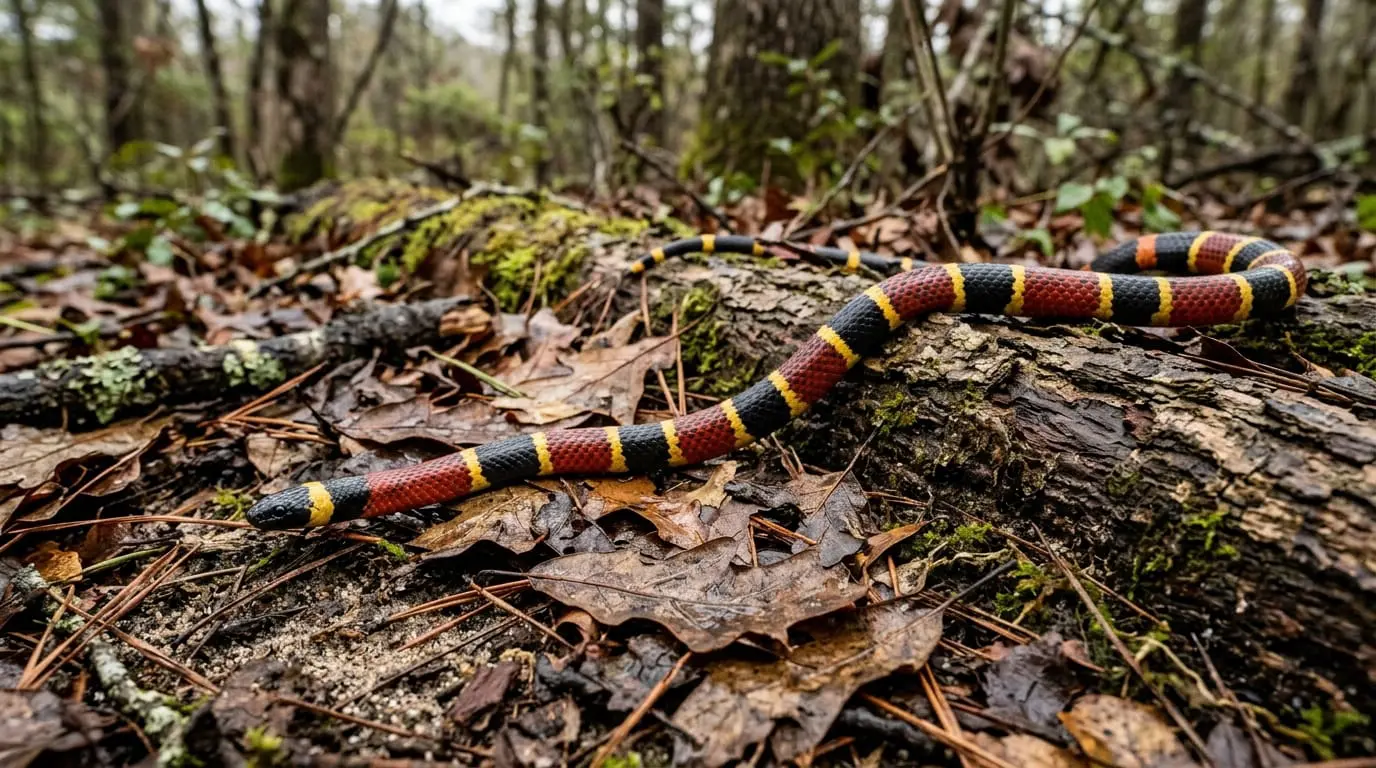
- Alternating rings of red, yellow, or cream, and black encircle the body.
- Broad red areas are bordered by narrow yellow rings, which are bordered by black.
- The snout and most of the small, rounded head are black.
- The tail usually has alternating black and yellow rings without red.
- The body is slender and nearly cylindrical, with smooth, glossy scales.
- The head is only slightly wider than the neck and lacks the broad profile associated with many pit vipers.
Color rhymes such as “red touches yellow” are not reliable enough to be universal safety rules. Patterns can vary, colors may be difficult to see, and escaped exotic snakes do not necessarily follow the rhyme. Never approach a banded snake to test a mnemonic.
Appearance and Identification
The Texas coral snake has an elongated, cylindrical body covered with smooth scales. Its head is short and rounded rather than strongly triangular. Because the head is not much wider than the neck, the snake may appear almost uniformly thick from the neck through much of the body. The eyes are relatively small, with round pupils, but pupil shape should never be used for field identification because seeing it requires an unsafe viewing distance.
A typical individual has a black snout and crown, followed by a pale yellow or cream collar and another black ring. Along the body, broad red rings alternate with black rings, separated by narrower yellow or cream rings. The rings generally continue across the belly rather than ending on the sides. The tail is short and usually patterned only in black and yellow or cream.
The scales often give the snake a polished appearance. Its body is not as heavy as that of a similarly long cottonmouth or rattlesnake, and it lacks a rattle, facial pits, and a distinctly broad neck. Males generally have proportionally longer tails, but this subtle difference is not practical to identify from a safe distance. The sexes otherwise look similar.

Size
Most adults are about 20–30 inches (51–76 cm) long. Large individuals may exceed 36 inches (91 cm), and exceptional specimens have been reported at approximately 48 inches (122 cm). Adults remain comparatively slender even at the upper end of the size range. Differences in total length between males and females vary and are not useful as a field mark.
Color and Pattern
The classic pattern consists of broad red rings separated from black rings by narrow yellow or cream rings. Black rings are usually wider than the pale rings, while the red sections occupy substantial portions of the body. The black head and black-and-yellow tail provide additional identification clues.
Color intensity varies. Red may appear scarlet, orange-red, or muted, while pale rings can range from bright yellow to ivory or cream. Mud, poor light, shedding skin, injury, or individual variation may obscure the pattern. Rare atypical individuals may have incomplete, irregular, or unusually colored bands. Identification should therefore use several features together: complete rings, band sequence and proportions, a black head, a ringed tail, body form, and geographic location.
Similar Species
Harmless snakes commonly mistaken for the Texas coral snake include scarlet kingsnakes, milk snakes, long-nosed snakes, and some variable ground snakes. Depending on the species and locality, these snakes may have red, black, white, yellow, or cream markings.
Many native mimics have red areas touching black rather than pale rings, but this distinction is not infallible. Their markings may be saddles rather than complete rings, the head may be red or patterned instead of predominantly black, and the underside may be pale, checkered, or less regularly banded. Long-nosed snakes often have black saddles with pale speckling and a noticeably pointed snout.
The safest practice is to treat any unidentified red, yellow, and black snake within coral-snake range as potentially venomous. Observe only from a substantial distance, use a zoom lens if needed, and allow the animal to leave. Do not handle, pin, trap, or closely inspect it.
Geographic Range
The species is centered in Texas, where it occurs across much of the eastern, central, and southern portions of the state. Its U.S. distribution reaches western Louisiana, southwestern Arkansas, and southeastern Oklahoma. It is absent from much of the arid far west and the High Plains, although local records should be consulted because range boundaries are irregular.
South of the international border, the range continues into northeastern and parts of east-central Mexico. The Texas Parks and Wildlife Department species account provides additional identification and state-level natural-history information.

Habitat
Texas coral snakes inhabit a broad mixture of wooded and partly open environments. Typical settings include pine and hardwood forest, post-oak savanna, wooded creek corridors, brushland, thornscrub, prairie margins, and landscaped areas near suitable natural cover. Loose or sandy soils can be especially favorable because they allow the snake to move beneath litter and into shallow underground retreats.
Individuals shelter under rotting logs, boards, rocks, bark, leaf litter, and other surface debris. They also use rodent burrows, stump cavities, root channels, and spaces within loose soil. Moisture often influences surface activity, but the species can occupy seasonally dry habitats where adequate cover remains available.
Behavior and Activity
This is primarily a terrestrial and partly fossorial snake. It often travels under litter or through existing underground passages rather than remaining exposed. It can climb low obstacles and swim when necessary, but neither behavior defines its usual lifestyle.
Surface activity varies with temperature and moisture. Individuals may be active during the day in mild spring or autumn weather, while warm-season movement is more likely around dusk, at night, or after rain. Basking is generally brief and less conspicuous than in many familiar diurnal snakes.
When disturbed, a Texas coral snake commonly tries to escape or burrow into cover. It may hide its head beneath a coil, raise or curl its tail, move abruptly, flatten part of its body, or produce popping sounds by expelling air from the cloaca. These behaviors should not be interpreted as harmlessness. The snake can bite if restrained, stepped on, or handled.
Diet and Hunting
The diet consists mainly of elongated reptiles, especially small snakes. Threadsnakes, earth snakes, juvenile snakes, and other slender species are frequent prey where available. Small lizards, including skinks, may also be taken, and occasional consumption of other appropriately sized vertebrates has been reported.
The Texas coral snake searches actively through litter, loose soil, and concealed passages. It uses fixed front fangs to deliver venom that immobilizes prey by disrupting nervous-system function. The snake swallows prey whole and does not rely on constriction.

Reproduction and Life Cycle
Texas coral snakes are oviparous, meaning females lay eggs rather than giving birth to live young. Courtship and mating generally occur in spring, although timing can vary with latitude and weather. Females deposit eggs in protected, humid sites such as decaying vegetation, loose soil, or cavities beneath cover.
Reported clutches are usually small, often about 3–12 eggs. Hatching generally occurs in late summer or early autumn. Hatchlings already possess the characteristic ringed pattern and functional venom-delivery system, so they should be given the same distance and caution as adults.
Juveniles feed on very small snakes and lizards and gradually take larger prey as they grow. Reliable estimates of typical lifespan in the wild are unavailable. Like many secretive snakes, individuals may live for several years, but precise wild longevity is poorly documented.
Seasonal Activity
Activity usually increases in spring as soil temperatures rise. Spring is an important period for surface movement and breeding. During the hottest part of summer, snakes often remain underground or under cover during the day and emerge during cooler evenings, at night, or after rain.
A second period of visible activity may occur during mild autumn weather, including hatchling dispersal. In colder parts of the range, individuals overwinter in burrows, root systems, or other insulated shelters. Southern populations may have a shorter inactive period and can occasionally move during warm winter conditions.
Venom and Medical Significance
Texas coral snake venom is primarily neurotoxic and is used to subdue reptile prey. The snake delivers it through short, fixed fangs at the front of the upper jaw. Bites are uncommon because the species is secretive and generally avoids confrontation, but envenomation can be medically serious. Early pain or swelling may be limited, while weakness, difficulty speaking or swallowing, drooping eyelids, and breathing problems can develop later.
Any suspected bite requires prompt professional medical evaluation, even if symptoms are initially absent. Call emergency services, keep the person calm and still, and move away from the snake without trying to capture or kill it. Do not cut the wound, apply suction, use a tourniquet, or handle the snake for identification.
Predators and Threats
Likely predators include kingsnakes and other snake-eating snakes, birds of prey, and opportunistic mammals. Bright banding may warn some predators, but it does not eliminate predation.
Human-related threats include habitat clearing, removal of ground cover, road mortality, intentional killing, pesticide-related changes to prey communities, and collection. Because coral snakes spend much of their lives hidden, population changes are difficult to measure. Individuals found around homes are often killed unnecessarily despite posing little risk when left undisturbed.

Encounters With People
People are most likely to encounter this species while moving logs, boards, rocks, garden debris, or firewood. Snakes may also cross roads and trails after warm rain or appear in shaded yards adjoining woodland or brush. Outdoor workers should wear gloves and avoid placing bare hands where visibility is poor, but gloves do not make snake handling safe.
If you see a coral snake, keep children and pets away and give it a clear escape route. A snake inside a building or trapped in a high-use area should be removed only by a qualified wildlife professional. Coral snakes do not chase people, and most bites result from deliberate handling or accidental direct contact.
Conservation Status
The Texas coral snake is commonly assessed as Least Concern across its broad range. It remains locally widespread, although its concealed habits make abundance difficult to estimate. Habitat fragmentation, roads, persecution, and unauthorized collection can affect local populations.
Wildlife regulations and collection rules vary among states and in Mexico. Even where possession is allowed under specific regulations, observing the snake in place is safer and avoids removing a native predator from the ecosystem.
Identification Summary
Look for a slender, smooth-scaled snake with complete red, yellow, or cream and black rings; a small black head; and a short tail ringed mainly in black and yellow. The species occurs chiefly in Texas and adjoining parts of Louisiana, Arkansas, Oklahoma, and Mexico, especially in wooded, brushy, or savanna habitats with loose soil and abundant cover.
Its secretive, ground-dwelling behavior and tendency to appear after rain are useful supporting clues. No single rhyme or color relationship is completely dependable. Identify from a safe distance using the full combination of pattern, body form, range, and habitat.
Frequently Asked Questions
Is the Texas coral snake venomous?
Yes. It has medically significant neurotoxic venom. Bites are uncommon, but every suspected bite should receive prompt emergency medical evaluation.
Does “red touches yellow” always identify a coral snake?
No. The rhyme describes many normally patterned native U.S. coral snakes, but it is not universal and may fail with atypical individuals or non-native species. Never approach a snake to inspect its band order.
Are Texas coral snakes aggressive?
They are generally secretive and attempt to escape or hide. They may bite when handled, restrained, stepped on, or trapped, so avoidance is the appropriate response.
Where are they most often found?
They are usually found in woodland, savanna, brush, or prairie edges with leaf litter, loose soil, logs, and other shelter. Encounters often follow rain or occur when ground cover is moved.
What do Texas coral snakes eat?
They primarily eat other small snakes, including burrowing species, and also take small lizards. Venom immobilizes the prey before it is swallowed.
Can juvenile coral snakes deliver venom?
Yes. Hatchlings have functional fangs and venom. Their small size should not be interpreted as an indication that they are safe to handle.
How can one be removed from a yard?
Keep people and pets indoors and allow the snake time and space to leave. If it cannot leave safely or has entered a building, contact a qualified local snake-removal or wildlife professional.