Red Diamond Rattlesnake Guide
Keep Track of What You See
Create a free Wild Things Guide membership to record this Red Diamond Rattlesnake in My Sightings and build your personal wildlife list.
Join to Add This SightingIntroduction
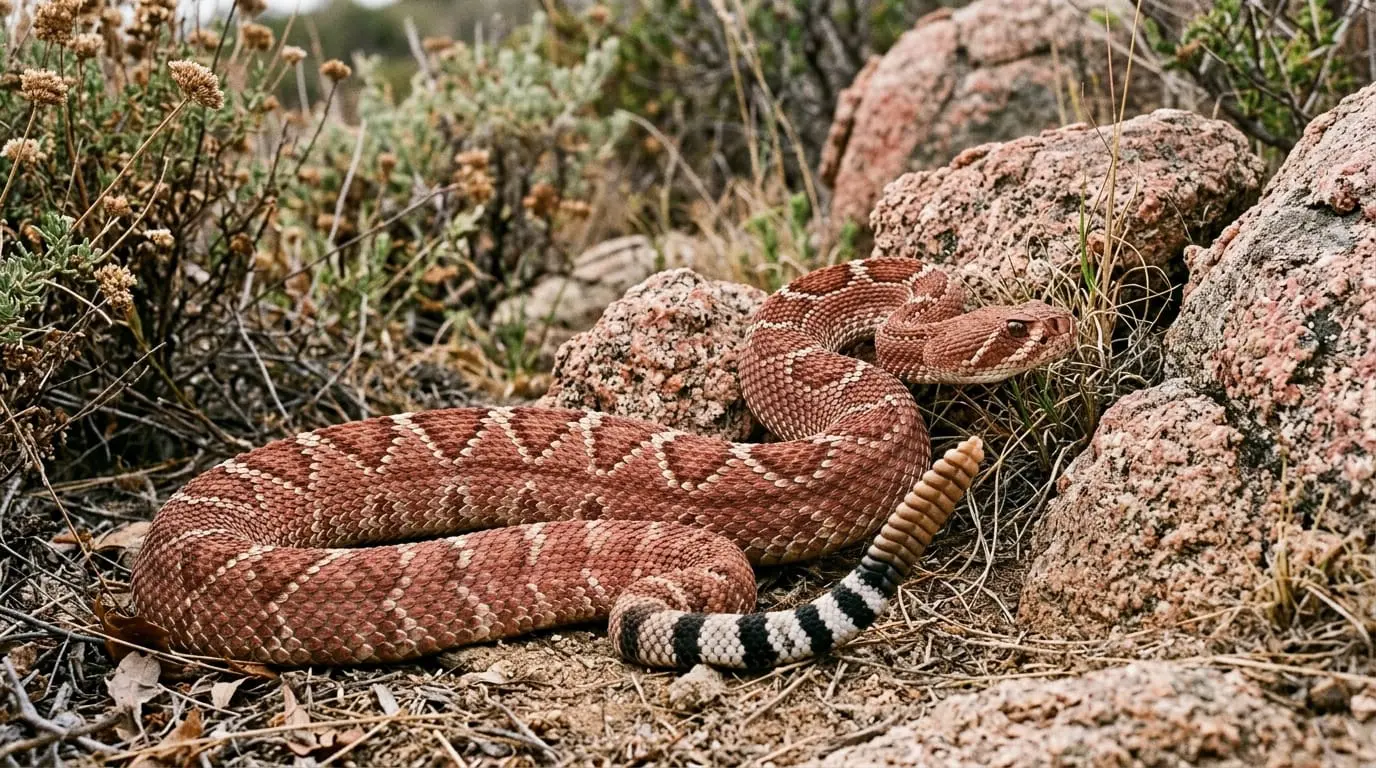
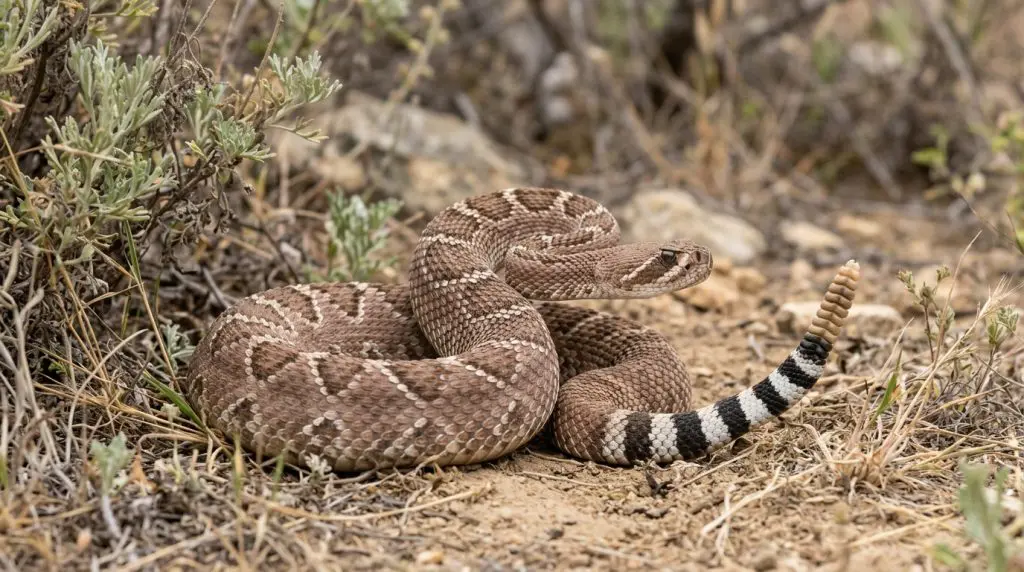
The red diamond rattlesnake (Crotalus ruber) is a large, heavy-bodied pit viper of southwestern California and the Baja California Peninsula. It is best known for its muted reddish or brick-brown color, pale-edged dorsal diamonds, and strongly contrasting black-and-white rings immediately ahead of the rattle. Although venomous, it generally relies on camouflage and withdrawal rather than confrontation.
This rattlesnake inhabits dry coastal, foothill, chaparral, and desert-edge landscapes. Its restricted distribution makes location an important part of identification. The University of Michigan’s Animal Diversity Web account for Crotalus ruber provides additional taxonomic and natural-history information.
Quick Identification
- Overall color: Usually reddish brown, rust, pinkish tan, or muted brick red.
- Back pattern: A row of broad diamonds or angular blotches with pale cream or buff borders.
- Tail: Several sharply contrasting black-and-white rings followed by a segmented rattle.
- Build: Thick-bodied, with a relatively short tail and an adult length commonly exceeding 3 feet.
- Head: Broad and distinct from the neck, with pale facial lines and a heat-sensing pit between each eye and nostril.
- Range clue: Southwestern California and much of Baja California.
Never approach a rattlesnake to confirm small details. Color can vary with lighting, soil, age, and an individual’s condition, so observers should combine pattern, proportions, location, and habitat.
Appearance and Identification
The red diamond rattlesnake has a muscular, moderately stout body covered with strongly keeled dorsal scales. Its widest point is normally near the middle of the body, tapering toward a relatively narrow neck and short tail. Adults often appear less vividly patterned than western diamondbacks because the red-brown ground color and dorsal diamonds may blend together.
The head is broad and somewhat angular when viewed from above, but head shape alone is not a safe identification feature. The eyes have vertically elliptical pupils, and a heat-sensitive loreal pit lies on either side of the face between the eye and nostril. Pale diagonal lines may extend across the side of the head. The top of the head commonly matches the body’s reddish or brownish coloration.
The tail ends in an interlocking keratin rattle. A complete rattle does not indicate age: segments are added when the snake sheds, and terminal pieces frequently break away. Males and females look broadly similar. Mature males may average longer or have a proportionally longer tail, but these differences are not dependable at field distance.

Size
Most adults are approximately 30–50 inches (76–127 cm) long, although large individuals may approach or slightly exceed 5 feet (about 1.5 m). Reports near 5.5 feet occur, but such snakes are exceptional. Hatchlings are generally around 12–15 inches (30–38 cm) long.
Body mass varies substantially with length, sex, season, and recent feeding. The species can look especially heavy because of its broad body, but do not use apparent thickness to estimate size from a photograph.
Color and Pattern
The characteristic ground color ranges from pale pinkish tan through rust and reddish brown to deep brick red. A series of darker dorsal diamonds or diamond-like blotches runs along the back. Each marking is usually outlined by pale buff, cream, or off-white scales, although the borders may become subdued in older or dark individuals. Smaller markings occur along the sides.
The most conspicuous field mark is often the tail pattern: alternating pale and black rings form a contrasting “coontail” immediately before the rattle. Pattern contrast varies, and dusty snakes may look surprisingly uniform. Juveniles generally show crisper dorsal markings and may be grayish or tan rather than strongly red. Population and individual variation means that not every red diamond rattlesnake is distinctly red.
Similar Species
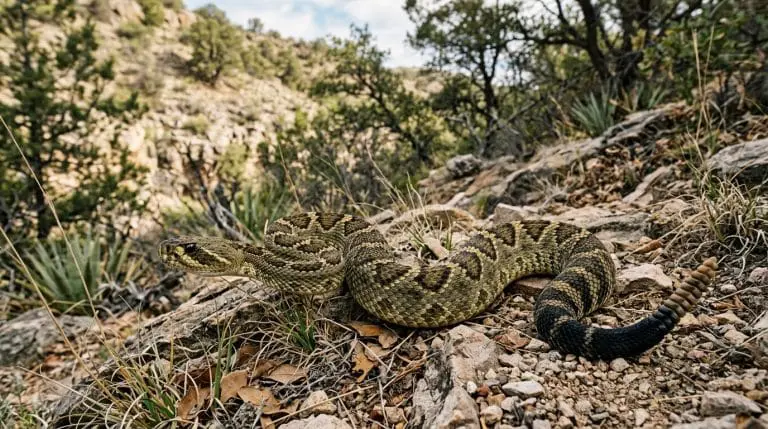
Western diamondback rattlesnake: This species also has dorsal diamonds and a black-and-white banded tail. Western diamondbacks usually have bolder, darker diamonds and a grayer or browner background; their facial stripes and tail rings may also appear more sharply defined. Range is essential because the species overlap locally near desert margins.
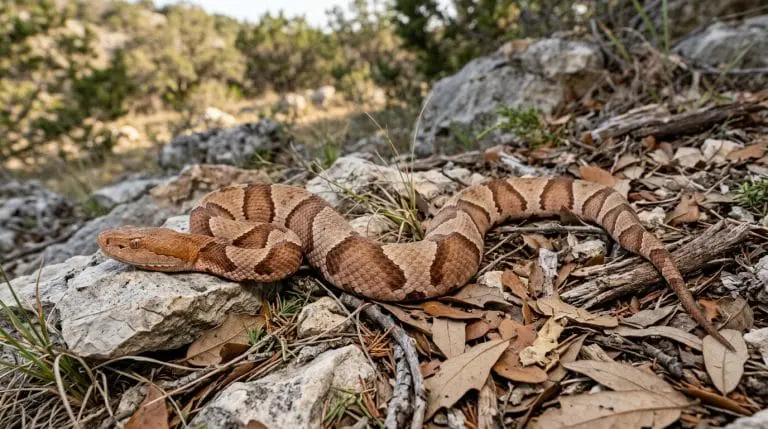
Southern Pacific rattlesnake: This widespread southern California snake usually has rounded or angular dorsal blotches rather than pale-bordered diamonds. Its tail generally lacks the red diamond’s strong, evenly alternating black-and-white rings. Southern Pacific rattlesnakes can nevertheless be brown, reddish, or nearly black.
Speckled rattlesnake: Speckled rattlesnakes tend to have irregular bands and fine speckling that closely match local rock. They lack the orderly row of pale-edged diamonds typical of a red diamond rattlesnake.
These distinctions should be evaluated from a safe distance or from a zoomed photograph. Do not move closer, block the snake’s escape, or attempt to inspect its tail.
Geographic Range
In the United States, the red diamond rattlesnake is confined to southwestern California. It occurs principally in parts of San Bernardino, Riverside, Orange, and San Diego counties, with a distribution associated with coastal and peninsular mountain systems and adjoining valleys and desert slopes.
Its range continues south through much of Mexico’s Baja California Peninsula, including portions of both Baja California and Baja California Sur. It also occurs on some offshore islands. Distribution is patchy where unsuitable sandy desert, dense development, intensive agriculture, or other habitat barriers interrupt rocky uplands and scrub.

Habitat
Red diamond rattlesnakes occupy coastal sage scrub, chaparral, open woodland, cactus and agave scrub, rocky foothills, canyon slopes, and desert-transition habitats. They are commonly associated with boulder fields, rock outcrops, brushy washes, and slopes containing abundant rodent cover.
Rock crevices, mammal burrows, dense shrubs, fallen vegetation, and spaces beneath natural debris provide daytime retreats and protection from temperature extremes. In developed landscapes, snakes may also shelter near retaining walls, wood piles, irrigation structures, or outbuildings when suitable cover and prey remain nearby. They occur from near sea level into mountain foothills, although local abundance varies greatly.
Behavior and Activity
Activity changes with weather. During mild spring conditions, snakes may bask or travel by day. As summer temperatures rise, movement shifts toward evening, night, and early morning. Coastal individuals may remain active during a broader part of the day than snakes in hot inland settings.
The species normally moves on the ground but can cross shallow water and climb low rocks or vegetation. It does not dig extensive burrows, instead using existing crevices and animal burrows. When detected, a snake may freeze, retreat, coil, or rattle. Rattling is a warning rather than evidence that an attack is imminent, and some individuals remain silent. A strike is most likely when a snake is approached closely, restrained, stepped on, or otherwise threatened.
Diet and Hunting
Red diamond rattlesnakes feed mainly on small mammals, including mice, woodrats, ground squirrels, rabbits, and other appropriately sized rodents or lagomorphs. Lizards and occasionally birds may also be taken, especially by younger snakes.
Like other pit vipers, the snake combines chemical cues with heat-sensitive facial pits to locate warm-blooded prey. It commonly waits beside a travel route and delivers a rapid venomous bite. Mammalian prey is often released and then followed by scent after the venom takes effect. The snake swallows prey whole and does not constrict it.

Reproduction and Life Cycle
Courtship and mating are reported primarily in spring, although timing may vary with region and weather, and some fall reproductive activity may occur. Red diamond rattlesnakes are viviparous: embryos develop within the female, and she gives birth to live young rather than laying eggs.
Births usually occur in late summer or early fall. Litters commonly contain several young and may range from roughly 3 to more than 20, with larger females generally capable of producing larger litters. Females do not necessarily reproduce every year because developing young requires substantial stored energy.
Newborns are venomous and must hunt for themselves after a brief period near the birth site. Wild longevity is not well quantified, but large rattlesnakes may survive 15 years or longer when they avoid vehicles, persecution, and predation.
Seasonal Activity
In much of southern California, emergence and surface activity increase during late winter or spring as temperatures become favorable. Spring is an important period for basking, feeding, and reproductive movement. Snakes may travel between seasonal shelters and foraging areas during this period.
Summer activity becomes increasingly nocturnal or crepuscular, particularly inland. Warm nights following suitable weather can produce noticeable movement across roads and trails. Activity often increases again during moderate autumn conditions before snakes return to protected crevices or burrows. Winter dormancy is less prolonged near the coast and in southern Baja California than at cooler inland or higher-elevation sites. Several snakes may use the same favorable overwintering area without otherwise being social.
Venom and Medical Significance
The red diamond rattlesnake delivers venom through long, hinged front fangs. Its venom helps immobilize prey and begin digestion, with components that can damage tissue and disrupt blood and other physiological processes. Venom yield and bite severity vary, and the absence of immediate severe symptoms does not establish that a bite was harmless.
A suspected bite is a medical emergency. Move away from the snake, call emergency services, keep the affected person as still and calm as practical, and obtain prompt hospital evaluation. Do not cut the wound, apply suction, use ice, or place a tight tourniquet. Never attempt to capture or kill the snake for identification; doing so creates another opportunity for a bite.
Predators and Threats
Young red diamond rattlesnakes may be taken by raptors, roadrunners, kingsnakes, mammals, and other predators. Adults have fewer natural enemies but remain vulnerable when crossing open ground.
Major human-related threats include loss and fragmentation of coastal scrub and foothill habitat, road mortality, deliberate killing, and unauthorized collection. Roads can separate feeding, breeding, and overwintering areas, while expanding development removes shelters and increases encounters with people and pets. Wildfire may temporarily alter cover and prey populations, although effects depend on severity, frequency, and post-fire habitat recovery.
Encounters With People
People most often encounter this snake on warm trails, rocky slopes, rural roads, canyon edges, or around properties adjoining natural scrub. Nighttime road crossings are common in hot weather. Around homes, rodents, dense ground cover, debris piles, and openings beneath structures can create attractive conditions.
Remain several body lengths away and give the snake an unobstructed retreat. Keep children and pets back, use a zoom lens for observation, and contact a qualified local wildlife professional if a snake must be removed from an occupied area. Rattlesnakes do not chase people as a normal behavior; a snake moving in someone’s direction is usually seeking cover or following its existing route.
Conservation Status
The red diamond rattlesnake is commonly listed as Least Concern on the IUCN Red List because it remains broadly distributed in Baja California and occurs in numerous protected landscapes. In California, however, it is designated a Species of Special Concern because of habitat loss, fragmentation, road mortality, and pressure on populations near rapidly developing areas.
Legal rules concerning capture, possession, and killing vary by jurisdiction. Conservation is best supported by protecting connected scrub and rocky upland habitats, reducing unnecessary road deaths, controlling rodents without broadly poisoning predators, and allowing undisturbed snakes to move away.
Identification Summary
Look for a large, heavy-bodied rattlesnake with a reddish tan to brick-brown background, pale-edged diamonds along the back, and bold black-and-white rings ahead of the rattle. Southwestern California or Baja California location, combined with rocky chaparral, coastal scrub, foothill, or desert-edge habitat, strongly supports identification. Juveniles may be grayer and more sharply patterned than adults. Confirm these traits only from a safe distance.
Frequently Asked Questions
Is every red diamond rattlesnake red?
No. Individuals range from pinkish tan and rust to brown or muted gray-red. Young snakes may show little obvious red coloration.
How can it be separated from a western diamondback?
Red diamond rattlesnakes generally have a warmer reddish ground color and less sharply contrasting dorsal diamonds. Geographic location is important, and identification should never depend on approaching the tail or head.
Does it always rattle before striking?
No. A snake may remain motionless, retreat silently, or rattle. Lack of sound should never be interpreted as evidence that a nearby rattlesnake is safe to approach.
What does the species eat?
Its diet consists mainly of rodents and other small mammals. Lizards and birds are occasional prey, particularly for younger snakes.
Is the red diamond rattlesnake dangerous?
It is medically significant and capable of inflicting a serious bite. Bites are uncommon when people maintain distance and do not attempt to touch, capture, or kill the snake.
Where is it found in the United States?
Its U.S. distribution is limited to southwestern California, especially parts of Riverside, San Bernardino, Orange, and San Diego counties. The larger portion of its range extends through Baja California.
Can the rattle reveal the snake’s age?
No. A segment may be added with each shed rather than once per year, snakes can shed multiple times annually, and older rattle segments commonly break off.