Northern Cottonmouth Guide
Keep Track of What You See
Create a free Wild Things Guide membership to record this Northern Cottonmouth in My Sightings and build your personal wildlife list.
Join to Add This SightingIntroduction
The northern cottonmouth (Agkistrodon piscivorus) is a heavy-bodied, semiaquatic pit viper of the southeastern and south-central United States. It occurs around wooded wetlands, floodplains, swamps, slow waterways, and nearby uplands. Best known for the bright white lining displayed when it opens its mouth defensively, the species is venomous but generally relies on camouflage, stillness, or escape before biting.
“Water moccasin” is another widely used name, although that term is sometimes applied incorrectly to harmless watersnakes. Taxonomic work now recognizes the Florida cottonmouth (Agkistrodon conanti) as a separate species, so older sources may show a broader range for A. piscivorus.
Quick Identification
- Build: Thick, muscular body with a relatively short tail.
- Pattern: Broad, dark crossbands that often resemble hourglasses or irregular saddles when viewed from above; the pattern may become obscure on dark adults.
- Head: Broad and somewhat blocky, with a sharply defined neck and a dark cheek stripe bordered by paler lines.
- Eyes: Vertical pupils and a facial heat-sensing pit between each eye and nostril, though neither feature should be approached closely to examine.
- Juveniles: More strongly patterned than many adults and usually equipped with a yellow or greenish-yellow tail tip.
- Defensive display: May hold its ground, coil, vibrate the tail, or gape to expose the white mouth lining.
No single feature should be used alone. Identify from a safe distance by combining body proportions, pattern, facial markings, habitat, and geographic range.

Appearance and Identification
Northern cottonmouths have robust bodies covered in strongly keeled dorsal scales, which give the back a textured rather than glossy appearance. The body is deepest near the middle and narrows into a comparatively short tail. Adults often look heavier than similar-length watersnakes, although body thickness varies with age, feeding, pregnancy, and posture.
The head is broad, flat-topped, and distinct from the neck. Large plates cover the top of the head, while smaller scales occur toward the sides and rear. A dark stripe extends through or behind the eye and is usually edged above and below by cream or tan. The snout can appear blunt from the side. As a pit viper, the snake has a heat-sensing loreal pit on each side of the face.
The eyes typically have vertical pupils, but pupil shape is difficult to see at a safe viewing distance and can appear different under changing light. It is not a practical first-line field mark. The pale mouth interior is conspicuous during an open-mouth display, but a closed or retreating cottonmouth will not show it.
Young cottonmouths are usually brighter and more sharply marked than adults. Their contrasting bands and yellow tail tip help them lure small prey. The tail color fades with age. Adult males average larger and have relatively longer tails than females, but sex usually cannot be determined reliably during an ordinary field observation.

Size
Most adults measure about 24–48 inches (61–122 cm) in total length. Large individuals can exceed 5 feet (1.5 m), and exceptional records approach 6 feet (about 1.8 m), although snakes of that size are unusual. Mature males commonly grow longer and heavier than females.
Color and Pattern
The ground color ranges from tan, brown, and olive to dark gray or nearly black. Darker crossbands run across the back with irregular borders. These bands are often narrower along the spine and wider on the sides, creating an hourglass-like pattern that can contain spots or patches of lighter color.
The pattern is generally clearest on juveniles and young adults. Older snakes, especially in some populations, may become so dark that the bands are visible only in favorable light. The belly is cream, yellowish, gray, or brown, with dark mottling and blotches. The underside of the tail is often darker than the forward belly.
Color alone is unreliable. Cottonmouths may be pale or dark, while harmless watersnakes can also be dark, banded, and heavy-bodied.
Similar Species
Harmless watersnakes in the genus Nerodia cause most identification confusion. Banded, brown, plain-bellied, and diamond-backed watersnakes may flatten their heads when alarmed, making “triangular head” an unreliable test. Watersnakes generally have longer, less blocky heads, round pupils, no facial pits, and band or blotch arrangements that differ from the cottonmouth’s broad side bands. Judge these details from photographs or a safe distance rather than by approaching the animal.
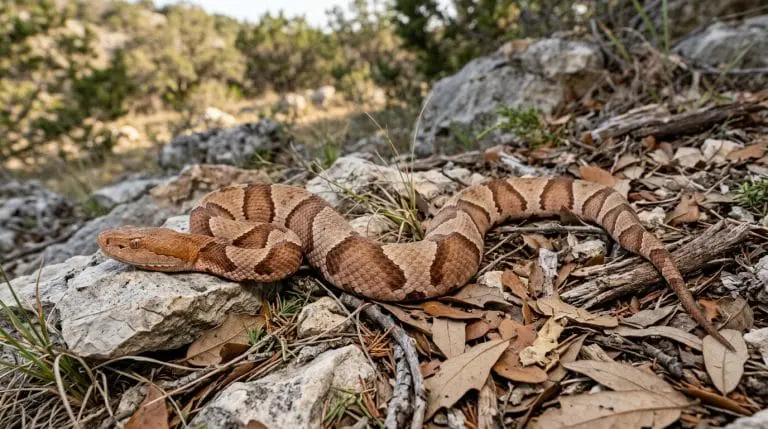
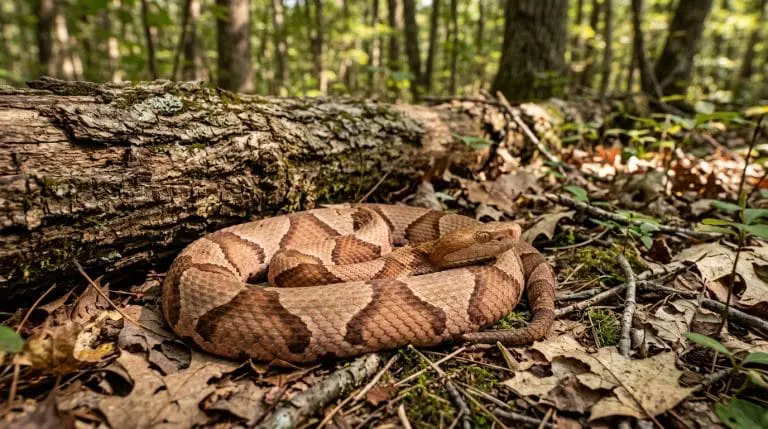
Copperheads have a similar hourglass pattern but usually possess a copper-colored head, a more regular pattern, and a less aquatic association. Where their ranges meet, hybrids have occasionally been reported, further discouraging identification from one feature alone.
Dark ratsnakes and racers may also be mistaken for cottonmouths near water. They are typically more slender, with proportionally longer tails. None of these comparisons justifies handling or crowding an unknown snake. If the view is poor, treat the identification as uncertain and give the animal space.
Geographic Range
The northern cottonmouth is native to the southeastern and south-central United States. Its range extends from southeastern Virginia and the Carolinas west through portions of the lower Mississippi Valley and adjacent Midwest, then south to the Gulf Coastal Plain and eastern Texas. It occurs in states including Arkansas, Louisiana, Mississippi, Alabama, Tennessee, Kentucky, Missouri, southern Illinois, and neighboring parts of the Southeast, although distribution can be patchy near the range margins.
Under current species limits, peninsular Florida and parts of the far southeastern coastal region are primarily associated with the Florida cottonmouth. Boundaries and contact zones are more complicated than a simple state line, and older maps may combine both species. Northern cottonmouths do not naturally occur across most of the northern or western United States or in Canada.

Habitat
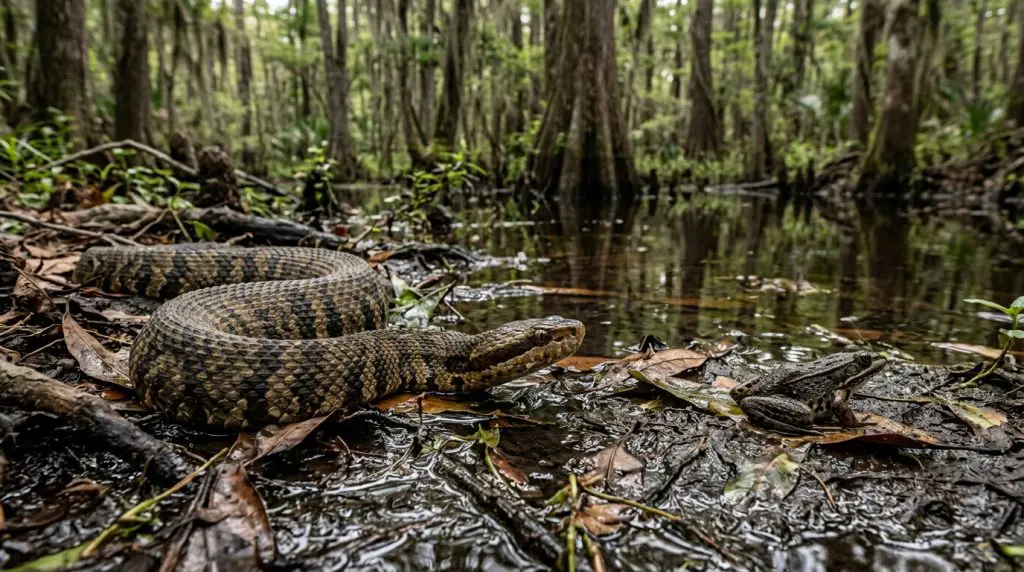
Northern cottonmouths favor lowland environments with dependable water and abundant cover. Typical habitats include cypress and tupelo swamps, wooded sloughs, river margins, oxbows, marshes, wet prairies, floodplain forests, drainage ditches, ponds, reservoirs, and slow creeks. In some areas, they also use brackish coastal wetlands.
The species is not restricted to the water’s edge. Individuals may move through bottomland woods, fields, rocky hillsides, or other uplands while feeding, breeding, dispersing, or traveling to overwintering shelters. Logs, root tangles, debris, vegetation mats, mammal burrows, rock crevices, and elevated ground provide resting or refuge sites.
Behavior and Activity
Cottonmouths swim well, often keeping much of their body near the surface, but swimming posture alone does not identify a snake. They bask on banks, logs, low branches, or vegetation over water and may climb modestly when suitable supports are available.
Activity varies with weather. In spring and autumn, snakes may be active during daylight and bask in mild sun. During hot summer conditions, movement often shifts toward evening, nighttime, and early morning. Hunting may involve prolonged stillness near prey routes, followed by a rapid strike.
When disturbed, a cottonmouth may remain motionless, retreat toward cover, flatten its body, vibrate its tail, coil, or open its mouth. The white-mouth display is a warning, not proof that the snake is preparing to chase or attack. Cottonmouths do not routinely pursue people; apparent “chasing” often occurs when a person blocks the snake’s route to water or shelter.
Diet and Hunting
Northern cottonmouths are opportunistic predators. Their diet includes fish, frogs, salamanders, small turtles, other snakes, lizards, birds, bird eggs, and small mammals. Young snakes consume small fish, amphibians, lizards, and invertebrates, sometimes using the bright tail tip as a lure.
The snake hunts both on land and near water, using ambush and short-range active searching. It delivers venom through hinged front fangs. Depending on the prey and circumstances, it may hold a captured animal or release it and follow the chemical trail after the venom takes effect. Cottonmouths also consume carrion when available.
Reproduction and Life Cycle
Mating occurs mainly in spring, with some courtship also reported in late summer or autumn. Males may travel while searching for receptive females and can engage in ritualized combat with other males.
The species is viviparous, giving birth to live young rather than laying eggs. Birth generally occurs from late summer into early autumn. Litters commonly contain about 5–10 young, although smaller and larger litters (roughly 1–20) have been recorded. Reproduction may not occur every year in all females because producing a litter requires substantial energy.
Newborns are independent and already venomous. Their bold pattern and bright tail tip gradually fade as they grow. Wild lifespan is not well documented, but survivors may live for more than a decade; captive pit vipers can live considerably longer.
Seasonal Activity
Emergence generally begins in early spring, with timing controlled by latitude and weather. Spring brings basking, feeding, and much of the breeding activity. During summer, snakes remain active but may avoid exposed areas during the hottest part of the day.
Autumn activity includes feeding, movement toward winter shelters, and occasional mating. In colder parts of the range, cottonmouths brumate in protected sites such as stump holes, burrows, rock crevices, or elevated refuges that avoid flooding and severe freezing. Several individuals—and sometimes other snake species—may use suitable shelter in the same area. Southern populations can remain intermittently active during warm winter periods.
Venom and Medical Significance
Northern cottonmouth venom is primarily adapted to immobilize prey and begin tissue breakdown. A bite can cause severe pain, swelling, bruising, tissue injury, and systemic effects. Serious complications are possible, although fatalities are uncommon when modern medical care is obtained promptly.
Treat any suspected bite as a medical emergency. Move away from the snake, remain as calm and still as practical, and seek professional emergency care immediately. Do not attempt to catch or kill the snake for identification, and do not cut the wound, apply ice, suck out venom, or use a tourniquet. A photograph taken from a safe distance can be useful only if it does not delay care or create another exposure.
Predators and Threats
Young cottonmouths are vulnerable to wading birds, raptors, larger fish, snapping turtles, predatory mammals, and other snakes. Large birds, mammals, kingsnakes, and alligators may take adults.
Human-related threats include wetland drainage, alteration of floodplains, road mortality, deliberate killing, and disturbance of shelter sites. Persecution is especially significant because harmless watersnakes are often killed alongside cottonmouths. Water pollution and reductions in healthy aquatic prey communities may also degrade local habitat.

Encounters With People
People most often encounter cottonmouths while fishing, paddling, walking near wetland margins, clearing storm debris, or working around ditches, boat ramps, pond edges, and floodplain properties. Snakes may also cross roads on warm, humid nights.
Observe from several body lengths away and allow the snake an open escape route. Keep children and pets back, use a light when walking outdoors at night, and never place hands or feet into vegetation, root cavities, or debris that cannot be inspected. A snake near a building should be removed only by a qualified wildlife professional.
Despite persistent folklore, cottonmouths do not seek confrontations with people and cannot leap toward a person. Most bites occur when a snake is handled, stepped on, trapped, or deliberately harassed.
Conservation Status
The northern cottonmouth is commonly listed as Least Concern because it remains widespread and occupies many wetland systems. The University of Michigan’s Animal Diversity Web species account provides additional natural-history context, although readers should remember that some older treatments included the Florida cottonmouth within the same species.
Local populations can still decline where wetlands are filled, waterways are heavily altered, or snakes are routinely killed. Collection and possession laws differ by state, and protected lands may prohibit disturbing any wildlife.
Identification Summary
Look for a heavy-bodied pit viper with dark, broad crossbands, a blocky head, a dark eye stripe edged in pale color, and a relatively short tail. Juveniles are brightly patterned and usually have a yellow tail tip; older adults may appear almost uniformly dark. Wetland habitat and southeastern or south-central range support the identification, while an open mouth may reveal the namesake white lining.
Because harmless watersnakes can look remarkably similar, base identification on several visible traits and accept uncertainty when details are unclear. Never approach an unknown snake to inspect its pupils, facial pits, or mouth.
Frequently Asked Questions
Are northern cottonmouths aggressive?
They can defend themselves vigorously when cornered or restrained, but they do not normally seek out people. Remaining still, gaping, or coiling is usually defensive behavior intended to prevent closer contact.
Do cottonmouths live only in water?
No. They are strongly associated with wetlands but regularly bask and travel on land. Individuals may be found some distance from water during seasonal movements.
How can I distinguish one from a watersnake?
Use a combination of the cottonmouth’s heavy build, short tail, broad side bands, blocky head, and pale-bordered dark cheek stripe. Watersnakes can flatten their heads and may be equally defensive, so head shape alone is not reliable.
Do all cottonmouths show a white mouth?
No. The white lining is visible only when the snake opens its mouth. A cottonmouth may instead remain still or retreat without displaying.
Are juvenile cottonmouths venomous?
Yes. Newborns can deliver venom and should be given the same distance as adults. Their yellow tail tip and stronger pattern do not make them harmless.
What should I do if I see one?
Stop, step back slowly, and give the snake room to leave. Keep pets and other people away. Do not touch, move, corner, or attempt to kill it.
What do northern cottonmouths eat?
They take fish, amphibians, reptiles, small mammals, birds, eggs, and occasional carrion. Diet varies with age, habitat, and available prey.