Mojave Rattlesnake Guide
Keep Track of What You See
Create a free Wild Things Guide membership to record this Mojave Rattlesnake in My Sightings and build your personal wildlife list.
Join to Add This SightingIntroduction
The Mojave rattlesnake (Crotalus scutulatus) is a venomous pit viper of the deserts, grasslands, and open scrublands of the southwestern United States and Mexico. Its North American range includes parts of California, Nevada, Utah, Arizona, New Mexico, and Texas, continuing south through substantial portions of Mexico.
This species is best known for its diamond-like dorsal pattern, strongly banded tail, and medically significant venom. Because it closely resembles the western diamond-backed rattlesnake, identify it based on several visible features rather than a single mark. Any unidentified rattlesnake should be observed only from a safe distance.
Quick Identification
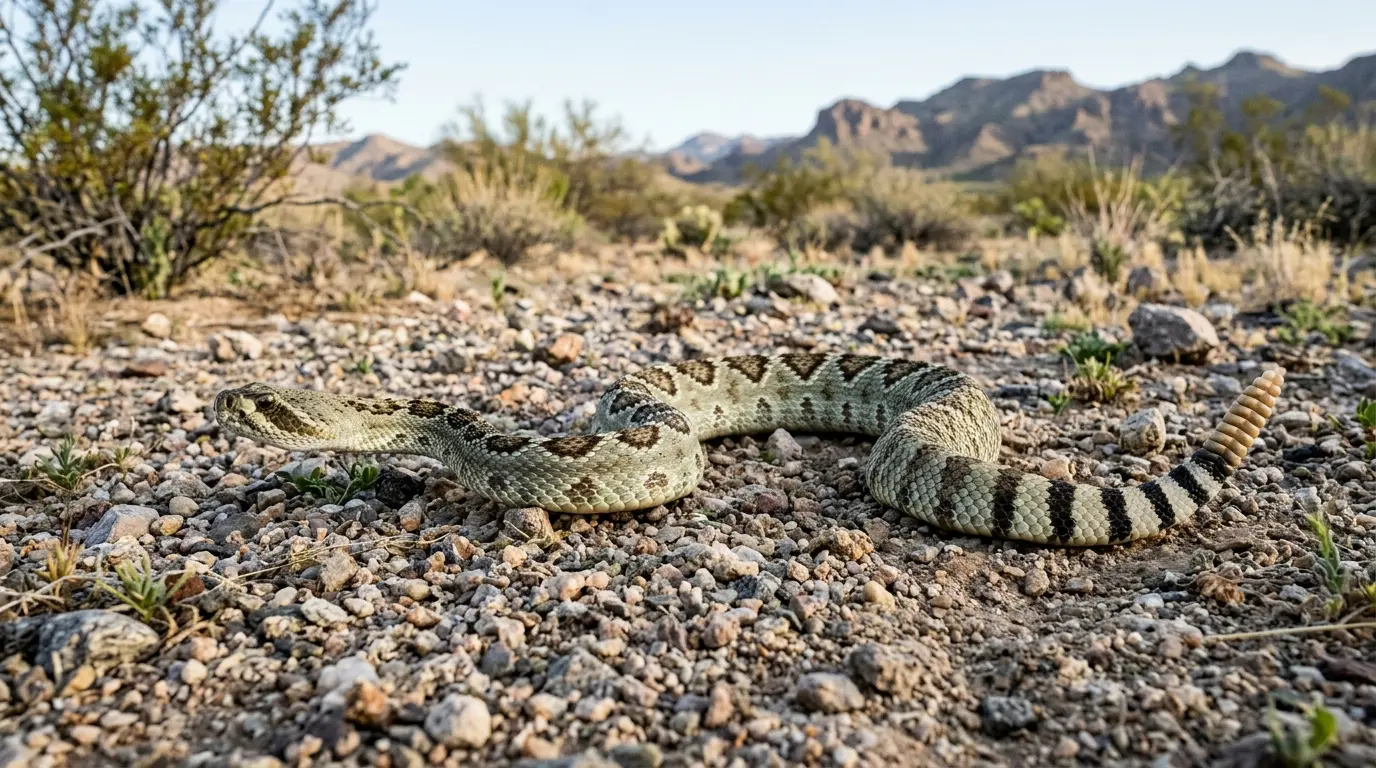
- Color: Usually pale gray, greenish gray, tan, olive, or light brown, often matching desert soil.
- Back pattern: A row of dark brown to gray-brown diamonds or angular blotches with pale borders.
- Body: Moderately heavy, but often less bulky than a large western diamond-backed rattlesnake.
- Head: Broad and distinct from the neck, with a dark stripe extending from behind the eye toward the rear corner of the mouth.
- Tail: Contrasting black and pale rings before the rattle; the pale rings are often noticeably wider than the black rings.
- Habitat clue: Commonly associated with open desert flats, sparse scrub, and semidesert grassland.
Tail-band proportions can be useful, but variation occurs. Photographs taken from a safe distance are more useful than attempting to approach the animal for closer examination.
Appearance and Identification
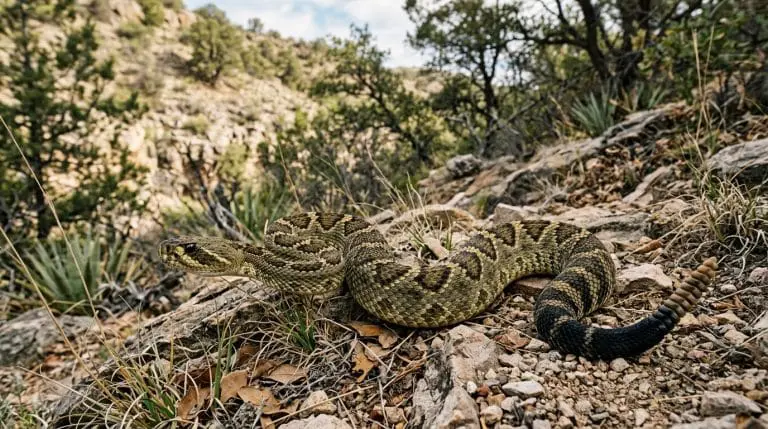
The Mojave rattlesnake has a sturdy body, narrow neck, and broad head typical of rattlesnakes. Its body is generally moderate in thickness, although mature adults, well-fed individuals, and gravid females can appear robust. The dorsal scales are keeled, giving the skin a textured rather than glossy appearance.
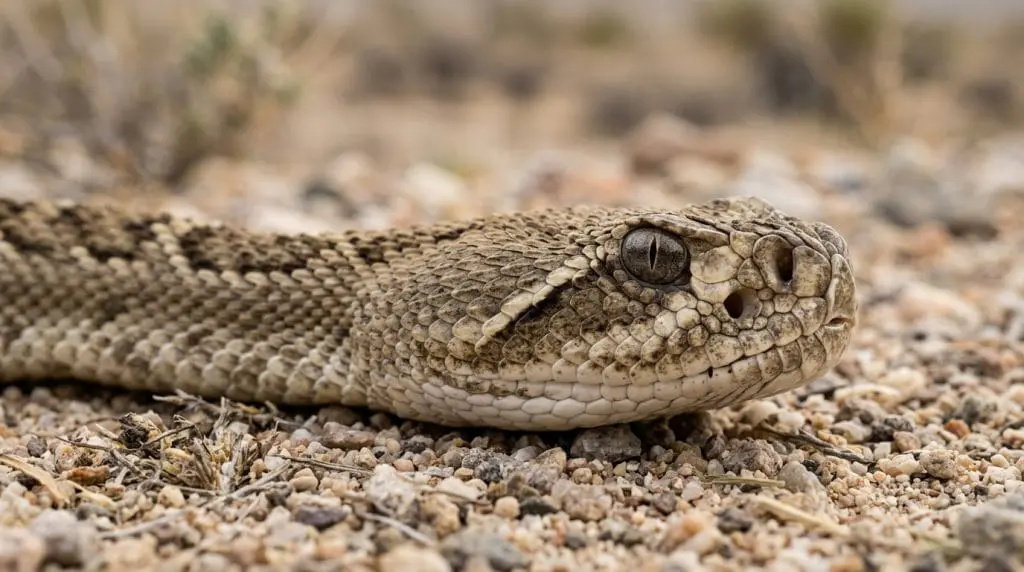
The head is somewhat triangular when viewed from above, but head shape alone is not a dependable identification feature. The eyes have vertically elliptical pupils, and a heat-sensing pit lies between each eye and nostril. A pale-bordered dark stripe usually runs diagonally from behind the eye toward the mouth. Smaller markings may occur on the crown and sides of the face.
Dark diamonds or angular blotches run down the center of the back. These markings may become narrower or more band-like toward the tail. A series of contrasting pale and dark tail rings precedes the segmented rattle. The rattle grows by adding a segment when the snake sheds, but segments can break off; they cannot be used to determine age.
Juveniles resemble adults in general pattern but are smaller and more slender. Newborns possess a single terminal button rather than a developed multi-segmented rattle. Males commonly have proportionally longer, thicker tail bases than females, but sex cannot usually be determined safely in a field encounter.

Size
Most adult Mojave rattlesnakes are approximately 2–3.5 feet (61–107 cm) long. Large individuals may approach 4–4.5 feet (122–137 cm), although snakes near the upper end of that range are uncommon. Males may average somewhat larger or have longer tails in some populations, but size overlaps substantially between the sexes.
Color and Pattern
Background color varies with soil and geography. Individuals may be greenish gray, silver-gray, beige, yellowish tan, olive, or brown. The often-mentioned green cast is not present in every Mojave rattlesnake and should never be treated as a required field mark.
The back carries dark, pale-edged diamonds, rhombs, or connected blotches. The centers may be brown, gray-brown, olive, or nearly black. Pale borders are usually cream, off-white, or light tan. Pattern contrast ranges from sharp to subdued, especially in dusty or recently shed snakes.
Near the rattle, alternating black and white or cream rings form a conspicuous banded tail. In many Mojave rattlesnakes, the pale bands are wider than the dark bands. This tendency helps separate the species from the western diamond-backed rattlesnake, whose black and pale tail bands are more often similar in width, but neither pattern is universal.
Similar Species
Western diamond-backed rattlesnake: This is the most frequent source of confusion. Western diamondbacks are often heavier-bodied and commonly have approximately equal-width black and white tail bands. Their dark facial stripe generally intersects the mouth rather than continuing behind its corner. Mojave rattlesnakes often have wider pale tail rings and a facial stripe that reaches behind the mouth. Individual variation makes distant photographs and location information important.
Prairie rattlesnake: Prairie rattlesnakes can have similar dorsal blotches but usually lack the sharply contrasting black-and-white tail rings. Their pattern often changes into narrower, less contrasting bands near the tail.
Panamint and southwestern speckled rattlesnakes: These species generally have irregular crossbands or speckled patterns rather than an orderly row of strongly outlined diamonds. They are also frequently associated with rocky slopes and canyons rather than broad, open flats.
Color, head shape, or rattle appearance alone cannot confirm an identification. Never handle, restrain, or closely approach a rattlesnake to inspect scales or facial markings.
Geographic Range
In the United States, the Mojave rattlesnake occurs in southeastern California, southern Nevada, extreme southwestern Utah, much of Arizona, southern New Mexico, and western Texas. Its distribution continues into Mexico, including Baja California and across northern and central mainland regions, with limits that vary locally according to habitat and elevation.
The species is strongly associated with the Mojave, Sonoran, and Chihuahuan desert regions, but it is not confined to the Mojave Desert. Local gaps occur where mountains, dense woodland, intensive development, or unsuitable climate interrupt otherwise suitable country.

Habitat
Mojave rattlesnakes favor arid and semiarid landscapes with open ground. Typical settings include creosote-bush flats, desert scrub, mesquite grassland, thorn scrub, sandy plains, alluvial fans, low rolling hills, and semidesert grassland. They may also occupy agricultural margins, washes, and lightly vegetated foothills.
Although they can occur in rocky terrain, they are often found on flatter, more open ground than several neighboring rattlesnake species. Shelter sites include rodent burrows, spaces beneath shrubs, rock crevices, erosion cavities, and other protected underground retreats. The University of Michigan’s Animal Diversity Web species account provides additional natural-history context.
Behavior and Activity
Activity changes with temperature. During mild spring weather, Mojave rattlesnakes may be active by day and may bask near shelter. In summer, they become mainly crepuscular or nocturnal, moving after sunset and during warm nights. Daytime activity can resume during cooler autumn conditions.
The species is primarily terrestrial. It can cross loose sand, gravel, roads, and shallow water, and may occasionally climb low vegetation, but it is not strongly arboreal. Individuals often shelter in mammal burrows during periods of extreme heat or cold.
When approached, a Mojave rattlesnake may remain motionless, crawl toward cover, coil, or rattle. Rattling is a defensive warning, not a sign that the snake is hunting people. Some individuals do not rattle, particularly if surprised or relying on camouflage. Defensive reactions depend on temperature, cover, distance, and the circumstances of the encounter.
Diet and Hunting
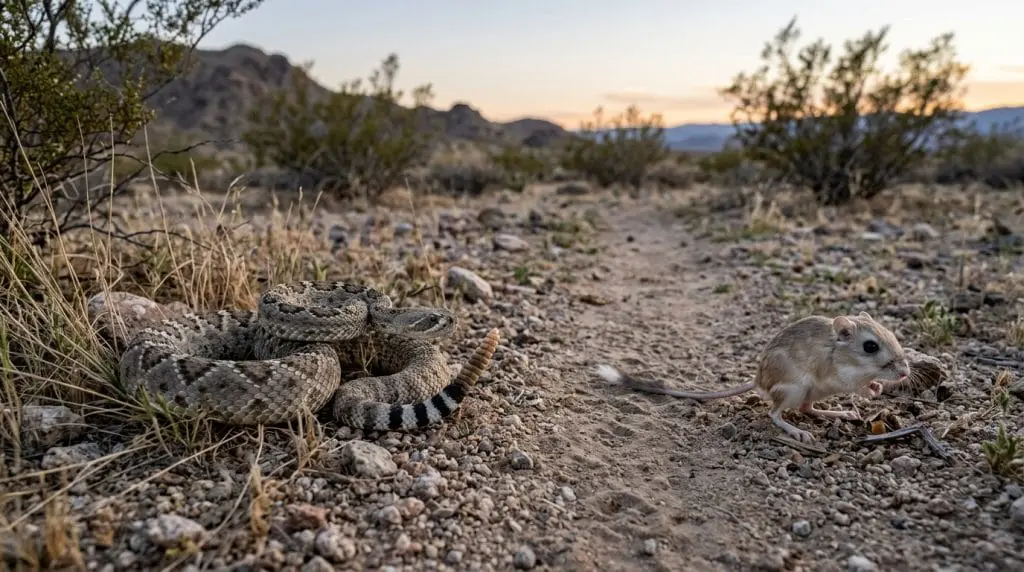
Small mammals form most of the diet, including mice, rats, kangaroo rats, pocket mice, and young rabbits. Lizards are particularly important to juveniles, while birds and other small vertebrates may be taken opportunistically.
The Mojave rattlesnake is a venom-using ambush predator. It waits near rodent paths, burrow entrances, or other areas of prey activity, strikes rapidly, and injects venom through hinged hollow fangs. The snake commonly releases mammalian prey after the strike and follows its chemical trail with the tongue and vomeronasal system. Venom begins immobilizing prey and assists digestion.
Reproduction and Life Cycle
Mojave rattlesnakes are viviparous: females retain developing young internally and give birth to live offspring. Mating has been reported primarily in late summer and early fall, although timing can vary with region and climate. Females may store sperm, and not every mature female reproduces annually.
Births generally occur from midsummer into early autumn. Litters commonly contain several young, often roughly 2–11, although larger litters have been reported. Newborns are independent immediately and receive no extended parental care. They are venomous from birth, though they deliver much less venom than large adults.
Growth and age at maturity vary with food, climate, and length of the active season. A precise typical wild lifespan has not been firmly established; survival beyond 10 years is plausible, and some rattlesnakes can live considerably longer under favorable conditions.
Seasonal Activity
In northern or higher-elevation parts of the range, emergence usually occurs in spring after temperatures moderate. Snakes bask, feed, and move between seasonal shelters. Spring movement may be concentrated near overwintering sites.
Summer heat shifts surface activity toward dusk, night, and early morning. Monsoon humidity and warm rain can increase activity in Arizona and neighboring regions. Autumn movement includes feeding, mating in some populations, and travel toward winter shelters. During cold weather, snakes enter brumation in burrows, rock fissures, or communal den sites. Activity may continue intermittently during warm winter periods in the southernmost and mildest parts of the range.
Venom and Medical Significance
Mojave rattlesnake venom is medically significant, but its composition varies geographically. Some populations produce venom containing potent presynaptic neurotoxins, commonly discussed as Mojave toxin, while others have venom with stronger tissue-damaging and blood-disrupting components. Some populations show mixtures of these characteristics. Appearance does not reveal a snake’s venom profile.
A bite may cause pain, swelling, bruising, weakness, neurological effects, breathing difficulty, abnormal bleeding, or other systemic illness. Early local symptoms can sometimes be limited despite serious envenomation. Claims that this is universally the “most venomous” North American snake oversimplify variable venom, dose, bite location, and medical outcome.
A suspected bite is a medical emergency. Move away from the snake, remain as calm and still as practical, remove rings or other constricting items, and seek emergency medical care immediately. Do not attempt to capture the snake, cut or suction the wound, apply ice, or use a tourniquet. A distant photograph may help if it can be obtained without delaying care or approaching the animal.
Predators and Threats
Natural predators may include hawks, owls, roadrunners, kingsnakes, other snake-eating reptiles, and mammalian carnivores. Juveniles face especially high predation risk.
Human-related threats include road mortality, deliberate killing, expanding development, habitat fragmentation, and some collection. Desert roads can be particularly hazardous on warm evenings when snakes cross pavement or use its retained heat. Climate-driven changes in drought, vegetation, and prey communities may alter local habitat suitability, although effects will differ across the broad range.

Encounters With People
People most often encounter Mojave rattlesnakes while hiking, working around desert properties, driving quiet roads after dark, or moving materials stored near the ground. Around buildings, rodents and shelter beneath lumber, equipment, brush, or debris can attract snakes.
Give any rattlesnake several yards of unobstructed space and allow it to leave. Keep children and pets back, use a flashlight outdoors at night, and avoid placing hands or feet where visibility is poor. If a snake remains near an occupied building, contact a qualified local wildlife professional or trained snake relocator. Most bites occur when snakes are accidentally stepped near, deliberately handled, harassed, or killed.
Conservation Status
The Mojave rattlesnake is commonly assessed as Least Concern on the IUCN Red List because it has a broad distribution and is not considered globally at immediate risk of extinction. That status does not mean every population is secure. Urban growth, roads, persecution, and loss of connected desert habitat can reduce local numbers.
Legal rules governing killing, possession, and collection differ among U.S. states, tribal lands, protected areas, and Mexico. Visitors should follow local wildlife regulations and leave wild snakes undisturbed.
Identification Summary
Look for a moderately heavy rattlesnake with a pale gray, tan, olive, or greenish background; dark pale-edged diamonds; a dark eye stripe; and strongly contrasting tail rings. Pale tail bands are often wider than black bands, but use this in combination with body pattern, facial markings, habitat, and geographic location. Open desert flats and semidesert grasslands are especially characteristic settings. Confirm identification through distant observation or a zoomed photograph, never by approaching or handling the snake.
Frequently Asked Questions
Is every Mojave rattlesnake green?
No. Some have a greenish or olive cast, but others are gray, tan, brown, or beige. Color alone is unreliable.
How can I distinguish it from a western diamondback?
Mojave rattlesnakes often have pale tail bands wider than the black bands, a slimmer build, and an eye stripe extending behind the corner of the mouth. Western diamondbacks often have nearly equal black and white tail bands and a facial stripe intersecting the mouth. Variation and overlap require caution.
Where is the species most likely to be found?
It is most typical of open desert scrub, creosote flats, alluvial fans, and semidesert grasslands in the southwestern United States and Mexico.
Are Mojave rattlesnakes aggressive?
They are defensive rather than aggressive. A threatened snake may coil, rattle, or strike, but it generally avoids contact when given space and an escape route.
What does a Mojave rattlesnake eat?
Adults feed mainly on small mammals, including mice, rats, and kangaroo rats. Juveniles consume more lizards, and birds are occasionally taken.
Is a bite dangerous?
Yes. Venom composition varies, but every suspected bite requires immediate professional medical evaluation. Serious effects may develop even when early pain or swelling seems limited.
Can the number of rattle segments reveal the snake’s age?
No. A segment is added during shedding; snakes may shed more than once a year, and older segments frequently break off.