Hooded Oriole Guide
Keep Track of What You See
Create a free Wild Things Guide membership to record this Hooded Oriole in My Sightings and build your personal wildlife list.
Join to Add This SightingIntroduction
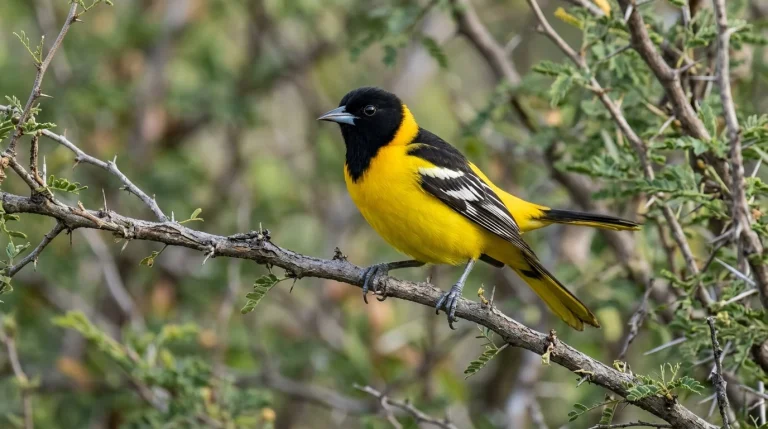
The Hooded Oriole (Icterus cucullatus) is a slender, long-tailed songbird of the southwestern United States, Mexico, and parts of Central America. Adult males combine a bright yellow-to-orange body with a sharply contrasting black face, throat, wings, and tail. Females are less boldly patterned, wearing olive-yellow plumage that can disappear surprisingly well among sunlit foliage.
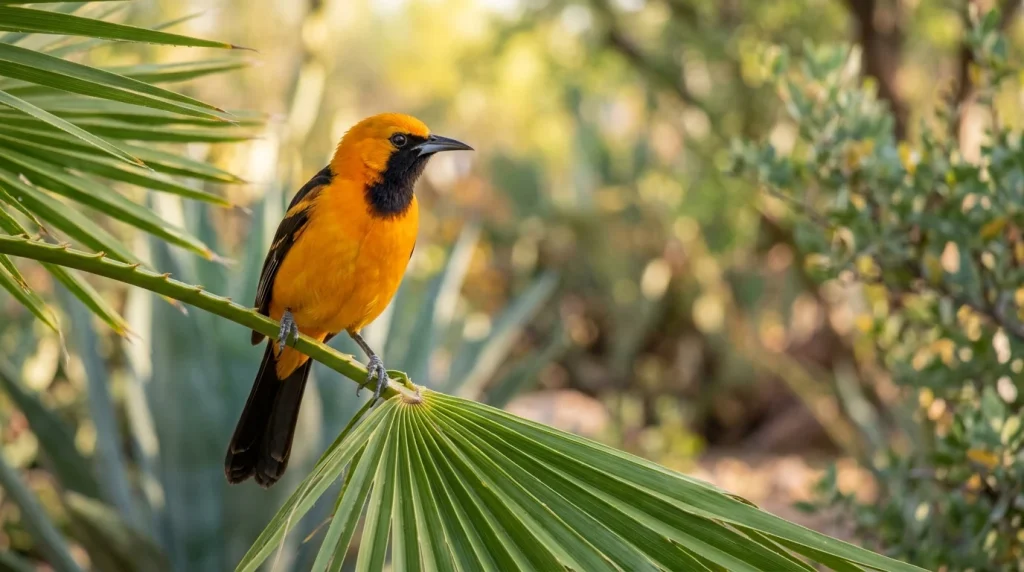
Despite its tropical appearance, this Oriole has adapted readily to parks, neighborhoods, ranches, and desert settlements. Tall ornamental palms are especially attractive because their drooping fronds provide sheltered nest sites. Many northern populations are migratory, making the Hooded Oriole primarily a spring and summer bird in the United States.
Quick Identification
- Shape: Slender body, long tail, pointed wings, and a long, narrow bill with a slight downward curve.
- Adult male: Yellow or orange underparts and hood, with a black face, throat, upper back, wings, and tail.
- Female: Olive-yellow to yellow-green overall, grayer above, with dusky wings and two pale wingbars.
- Flight: Direct to gently undulating, often between trees, palms, flowering shrubs, and feeding stations.
- Typical setting: Palm-lined neighborhoods, desert washes, open woodland, riparian groves, and scattered shade trees.
- Voice: A varied mixture of clear whistles, nasal notes, chatter, and scratchy phrases.
Appearance
Adult male Hooded Orioles are unmistakable when seen well, but their body color varies geographically. Males in California and parts of the western range are generally deep yellow-orange to flame orange. Many males farther east, particularly in Texas and northeastern Mexico, are brighter yellow. Intermediate colors occur, so body color alone should not be used to determine subspecies or origin.
The male’s dark hood is not complete: black covers the face, bib, throat, upper back, wings, and much of the tail, while the crown and nape remain yellow or orange. White wing edging forms a noticeable patch or wingbar on the otherwise black wing. The bill is silver-gray to dark gray, narrow, and slightly decurved.
Females are yellowish below and olive-yellow on the head and back, sometimes with a grayer cast across the upperparts. Their wings are gray-brown with two pale wingbars, and the tail is dusky. Some older females may develop darker throat or facial feathers, but they seldom approach the male’s strong black-and-orange pattern.
Immature birds resemble females. Young males gradually acquire black feathers on the face, throat, back, and wings, producing a mottled or uneven appearance during transition. In every plumage, the slim shape, long tail, pointed bill, and pale wing markings are valuable field clues.

Size and Wingspan
Hooded Orioles are medium-sized orioles, noticeably longer and more slender than most warblers or finches.
- Length: About 7.1–7.9 inches (18–20 centimeters)
- Wingspan: Approximately 9.1–11 inches (23–28 centimeters)
- Build: Slim-bodied, long-tailed, and relatively narrow-winged
They are similar in overall length to Bullock’s Orioles, although proportions and posture can make Hooded Orioles appear especially sleek. Size is difficult to judge in a treetop, so observers should emphasize bill shape, wing pattern, and distribution.
Range and Distribution
In the United States, Hooded Orioles breed mainly across the Southwest, including much of California, southern Nevada, Arizona, New Mexico, and Texas. Their breeding range continues through Mexico, with populations extending into parts of Central America. Distribution is not uniform; the species follows suitable lowland habitat, flowering vegetation, riparian corridors, and planted palms.
Most Hooded Orioles breeding in the northern part of the range migrate south for winter. Spring arrivals in the United States commonly begin in March or April, while southbound movement becomes evident in late summer. Some populations in Mexico and farther south are resident or make shorter seasonal movements.
Vagrants occasionally appear beyond the expected range, but a brightly colored Oriole outside the Southwest should be identified carefully. Photographs of the face, back, wings, and tail are particularly helpful for documenting an unusual record. The Cornell Lab of Ornithology’s Hooded Oriole account provides additional identification and distribution information.

Habitat
Hooded Orioles favor open or semi-open country with scattered tall trees. Natural habitats include desert washes, arid foothill canyons, open woodland, riparian groves, mesquite country, and areas containing sycamores, cottonwoods, or fan palms. Dense, unbroken forest is generally less suitable.
The species also thrives in human-modified landscapes. Residential neighborhoods, golf courses, ranches, parks, orchards, and roadside plantings can support breeding pairs when flowering plants and nest trees are available. California fan palms and introduced ornamental palms are frequently used for nesting, although the birds also weave nests into broad-leaved trees.

Behavior
Hooded Orioles usually forage alone, in pairs, or in small family groups. They move deliberately through foliage, stretching to inspect leaves, flowers, and hanging seed heads. Birds may cling upside down beneath leaves or palm fronds while searching for insects.
At flowers, an Oriole may insert its bill normally or pierce the flower base to reach nectar without contacting the pollen-bearing structures. The pointed bill is also used in a behavior called gaping: the bird pushes the closed bill into fruit or plant tissue and then opens it to expose food.
Males often sing from exposed perches during the breeding season, but feeding birds can remain hidden in foliage. Territorial disputes may involve rapid chases, scolding calls, and short fluttering displays. Outside the breeding season, individuals may join loose mixed feeding groups where resources are concentrated.
Diet
The Hooded Oriole has a varied diet dominated by insects, nectar, and fruit. Animal prey is especially important while adults are feeding young.
- Caterpillars and other insect larvae
- Beetles, ants, grasshoppers, wasps, and small bugs
- Spiders and other small invertebrates
- Nectar from tubular and flowering plants
- Wild berries, cultivated fruit, and soft plant material
In gardens, Hooded Orioles may visit nectar feeders, orange halves, or grape jelly, but feeders should supplement rather than replace natural foods. Keep nectar feeders clean, use plain white sugar and water without dye, and remove spoiled fruit promptly.

Vocalizations
The song is variable and can be difficult to describe. It commonly combines mellow whistles with abrupt, nasal, scratchy, or chattering notes. A phrase may sound fluid at first and then break into irregular squeaks or chatters. Individual males can have distinctive songs, and local dialects may occur.
Calls include a sharp or nasal wheet, dry chatter, and scolding notes. Young birds give persistent begging calls near the nest or while following adults. Because the song can resemble fragments from other orioles, wrens, or mockingbirds, visual confirmation is advisable whenever possible.
Breeding and Nesting
Breeding generally occurs in spring and summer, with timing influenced by latitude, weather, and food availability. The male sings and displays around a territory, while the female performs most or all of the nest construction.
The nest is a deep, suspended pouch woven from plant fibers, grasses, strips of palm leaf, hair, and other flexible material. It is attached beneath a leaf, cluster of leaves, or drooping palm frond. Palm nests can be difficult to see because the pouch hangs in the shade and moves with the surrounding fibers. In broad-leaved trees, the female may stitch fibers through the edges of living leaves to anchor the structure.
A clutch often contains three to five eggs, although clutch size varies. The eggs are pale bluish-white or grayish-white with dark scrawls, spots, or blotches. The female incubates, and both parents generally help feed the nestlings. Brown-headed and Bronzed Cowbirds may parasitize Hooded Oriole nests in parts of the range.

Young and Development
Hatchlings are helpless and depend entirely on their parents for warmth and food. Adults deliver insects and other protein-rich prey throughout the nestling period. Development is rapid, but fledglings remain inexperienced after leaving the pouch.
Recently fledged birds have short-looking tails, soft-looking plumage, and prominent pale gape edges. They may sit quietly within dense cover while calling for food. A young bird found on a branch or shrub should usually be left where it is unless it is injured or in immediate danger; attentive parents are often nearby but remain inconspicuous around people.
Where to See
In the United States, productive areas include southern California’s palm-lined communities, Arizona’s desert cities and riparian corridors, southern New Mexico, and central to southern Texas. Search from early spring through late summer, when males sing and pairs make repeated feeding trips.
Good places to check include:
- The undersides of shaggy or drooping palm fronds
- Flowering desert trees, aloes, agaves, and ornamental shrubs
- Sycamores and cottonwoods along washes or streams
- Parks, ranch yards, orchards, and quiet residential streets
- Nectar feeders near mature trees and protective cover
Early morning is often best. Listen for whistles and chatter, then watch for movement through the outer foliage rather than waiting for a bird to perch in full view.
Similar Species
- Bullock’s Oriole: Adult males have a black crown, black eye line, orange face, and a large white wing patch. Male Hooded Orioles show a black face and throat but retain a yellow or orange crown. Female Bullock’s Orioles often look whiter below and have a different head pattern.
- Scott’s Oriole: Adult males have a completely black head, breast, and back with lemon-yellow underparts. They are larger and more strongly associated with yucca and arid uplands. Female Scott’s Orioles are usually duller and more gray-olive.
- Altamira Oriole: This large South Texas species has a heavier bill, an orange shoulder, an extensive black back, and a bold white wing patch. It is generally more robust than a Hooded Oriole.
- Orchard Oriole: Adult males are black and chestnut rather than orange-yellow and black. Females can resemble female Hooded Orioles but are smaller, shorter-billed, and less elongated.
- Streak-backed Oriole: Where ranges approach in Mexico or southern Arizona, look for obvious dark streaking across the back. Hooded Orioles have a plain dark upper back in adult males and lack strong back streaks in female-type plumage.
Conservation
The Hooded Oriole is commonly classified as Least Concern globally. It remains widespread and can benefit locally from planted palms, flowering ornamentals, and irrigated urban greenery. Its willingness to nest around people has allowed it to occupy some landscapes that were historically unsuitable.
Local risks include pesticide exposure, removal or aggressive trimming of occupied palms, collisions, outdoor cats, and loss of native riparian habitat. Schedule palm maintenance outside the nesting season when practical, and do not disturb active nests. Native flowering plants and reduced insecticide use can improve feeding conditions for adults and young.
Field Identification Tips
- Start with shape. Look for a slender Oriole with a long tail and narrow, slightly curved bill.
- Check the crown. A male Hooded Oriole has a yellow or orange crown above the black face, unlike the fully black-headed Scott’s Oriole.
- Study the back. The dark upper back helps separate males from Bullock’s Orioles, while a lack of heavy streaking distinguishes them from Streak-backed Orioles.
- Do not rely on orange color. Adult males range from rich orange to bright yellow across different parts of the range.
- Use habitat as supporting evidence. Palms, desert washes, open riparian woodland, and flowering suburban plantings are especially promising.
- Watch flight paths. Repeated trips to one palm frond or leafy branch may reveal a nest, but observe from a respectful distance.
- Record multiple features. For female or immature birds, note bill shape, wingbars, tail length, calls, location, and date.
Frequently Asked Questions
Why are some male Hooded Orioles orange and others yellow?
Color varies geographically among populations and subspecies. Western males are often orange, whereas many males in Texas and northeastern Mexico are yellow. Lighting, feather wear, age, and individual variation can also affect apparent color.
Do Hooded Orioles migrate?
Many breeding in the United States migrate to Mexico for winter. Populations farther south may be resident or move shorter distances. Arrival and departure dates vary with region and annual conditions.
Do Hooded Orioles always nest in palm trees?
No. Palms are widely used, particularly in developed areas, but nests may also hang from sycamores, cottonwoods, walnuts, eucalyptus, and other trees with suitable leaves or suspended twigs.
How can I attract Hooded Orioles?
Provide native flowering plants, insect-rich vegetation, mature nest trees, clean water, and pesticide-free cover. A clean Oriole nectar feeder or fresh orange half may draw visiting birds during migration and breeding.
Are Hooded Orioles aggressive?
They defend nesting and feeding areas from rivals, but they are not generally aggressive toward people. Their apparent boldness around homes usually reflects familiarity with reliable food or nest sites.
Is a female Hooded Oriole easy to identify?
Females can be challenging because several orioles are yellow-green. The best identification combines the long, slightly curved bill, elongated shape, pale wingbars, habitat, season, voice, and geographic range.
Related Guides