

Audubon’s Oriole Guide
Keep Track of What You See
Create a free Wild Things Guide membership to record this Audubon’s Oriole in My Sightings and build your personal wildlife list.
Join to Add This SightingIntroduction
Audubon’s Oriole (Icterus graduacauda) is a striking but often inconspicuous songbird of South Texas and Mexico. Adults combine a black hood, wings, and tail with a yellow to yellow-green body. Unlike orioles that often perch in the open, this species usually stays within dense foliage, where its deliberate movements and mellow whistles may reveal it before its colors do.
Audubon’s Oriole belongs to the blackbird family, Icteridae. It is primarily a permanent resident rather than a long-distance migrant, although it may move locally as food and seasonal conditions change. The Cornell Lab of Ornithology species account provides additional photographs, recordings, and regional observations.

Quick Identification
- Overall pattern: Yellow body contrasting with a black hood, wings, and tail.
- Shape: Medium-sized Oriole with a fairly long tail and a sturdy, pointed bill.
- Male: Bright yellow below and across much of the back, with a strongly defined black head and throat.
- Female: Similar in pattern but generally duller, often with a greener or more olive-yellow cast.
- Immature: Olive-yellow overall, with less extensive or incomplete black plumage.
- Voice: Slow, rich whistles and short, varied phrases delivered from cover.
- Behavior: Usually found singly or in pairs, moving quietly through woodland and brush.
Appearance
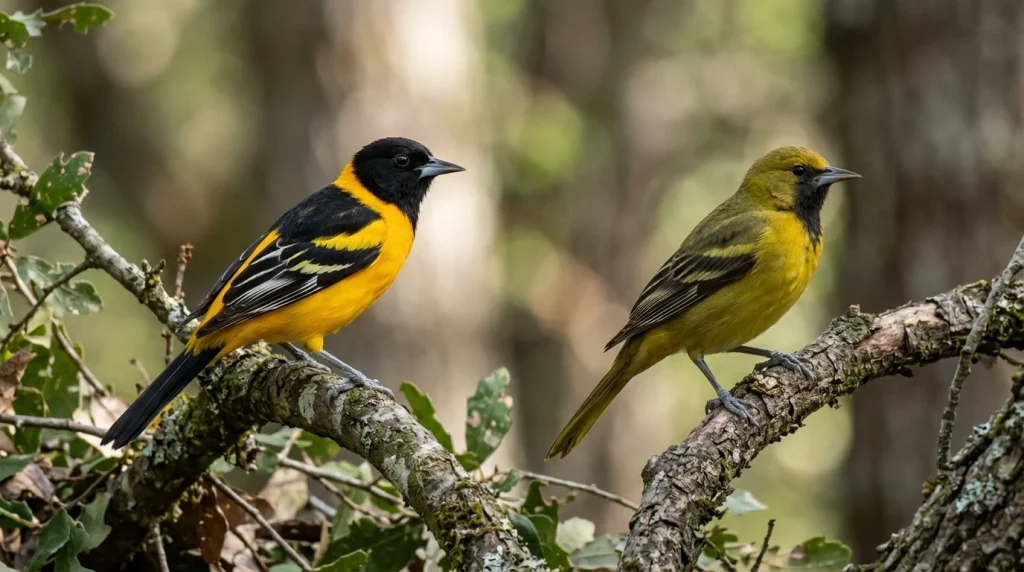
An adult male has a black hood covering the head, face, throat, and upper breast. The wings and tail are also predominantly black. Most of the remaining plumage is yellow, ranging from bright lemon-yellow to a slightly greenish shade. Pale yellow edging on some wing feathers can soften the otherwise dark wing.
Females show essentially the same broad pattern, an important distinction from strongly dimorphic orioles such as Baltimore or Orchard Orioles. A female Audubon’s Oriole is usually less saturated than a male, with olive or greenish tones on the back and underparts and black areas that may appear somewhat duller. Plumage differences can be subtle, so sex should not always be assigned from a distant view.
Young birds lack the sharply finished appearance of adults. Their heads and backs are generally olive-green to yellow-green, while the underparts are yellowish. Dusky feathers on the face and throat gradually develop into the darker adult hood. The bill is pointed and usually grayish to dark, and the legs are blue-gray.
Size and Wingspan
Audubon’s Oriole is a medium-sized member of its family, larger and more robust than a typical warbler but smaller than a grackle.
- Length: About 7.5–9.4 inches (19–24 centimeters).
- Wingspan: Approximately 12.6 inches (32 centimeters).
- Weight: Commonly about 1.1–1.9 ounces (31–53 grams).
Its long tail can make a perched bird appear larger than expected. In flight, the body looks compact, with rounded wings and a fairly direct, slightly undulating flight path.
Range and Distribution
In the United States, Audubon’s Oriole is restricted mainly to southern Texas. It occurs in the Lower Rio Grande Valley and extends locally north and west through suitable brush country and wooded river corridors. Its distribution is broader in Mexico, where resident populations occur from the northeast through parts of the interior, western regions, and southern Mexico.
The species is not evenly distributed throughout that range. It can be locally regular in mature woodland while absent from nearby open or heavily altered country. Most populations remain within the same general region year-round, but individuals may shift locally in response to drought, flowering plants, fruit crops, or breeding conditions. Document records well outside the normal range carefully.

Habitat
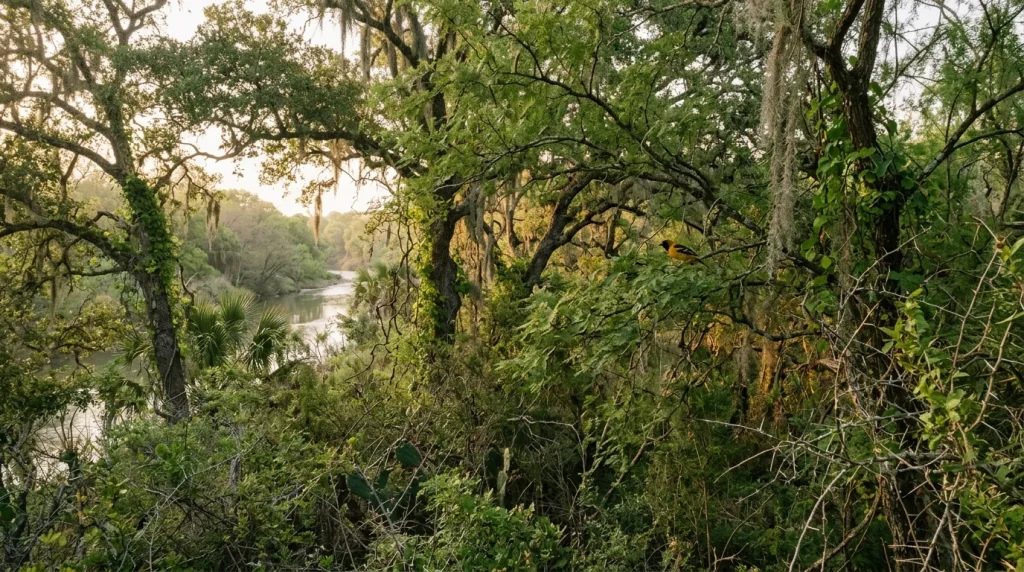
Audubon’s Orioles favor habitats that combine trees, dense cover, and productive edges. In Texas, they are associated with native thorn forest, riparian woodland, mesquite groves, live-oak woodland, and brushy ranch country. They also use parks, large gardens, citrus plantings, and other lightly developed areas when adequate tree cover remains.
In Mexico, they occupy a wider range of wooded settings, including subtropical forest edges, dry woodland, foothill forest, plantations, and shaded agricultural land. They are often found below the highest mountain elevations. Palms can be important nesting plants in some regions, but they are not required wherever the species occurs.
Behavior
This Oriole is often described as quiet or secretive. It tends to forage beneath the outer canopy rather than remaining on exposed treetops. A bird may sit motionless behind leaves, move through several branches, and then disappear across an opening with little warning.
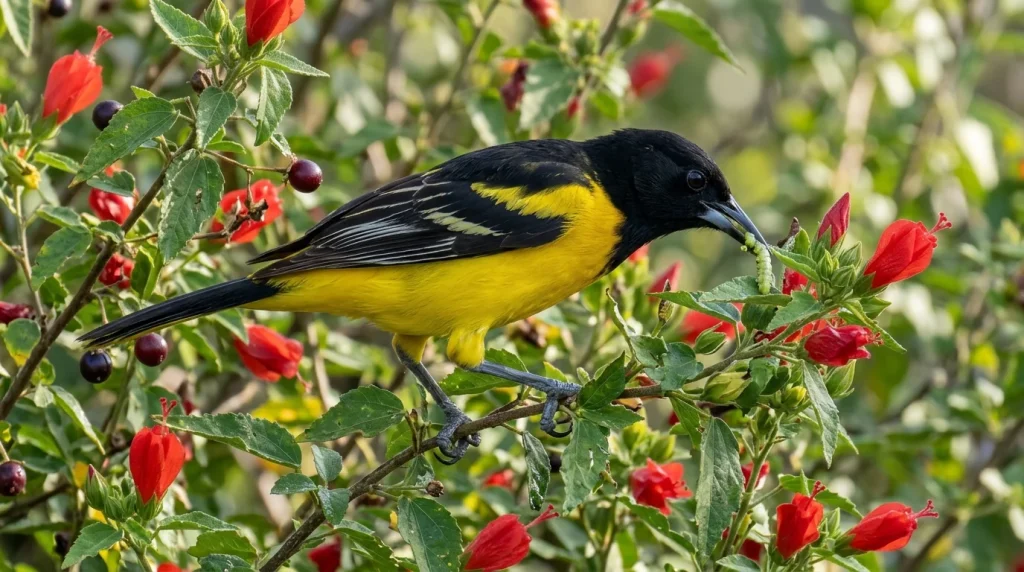
Audubon’s Orioles search leaves, twigs, bark, flowers, and hanging vegetation for food. They may probe into blossoms, inspect rolled leaves, or hang briefly at an awkward angle to reach prey. Birds are commonly encountered alone, in pairs, or as small family groups. Large flocks are unusual.
At feeders, they may take orange halves, jelly, nectar, or sugar-water solutions, although visits are less predictable than those of some migratory orioles. Native flowering and fruiting plants provide safer long-term food resources than relying entirely on feeders.
Diet
Audubon’s Oriole has a varied omnivorous diet. Animal prey is especially important during the breeding season, when adults must supply growing nestlings with protein.
- Caterpillars and other insect larvae
- Beetles, grasshoppers, crickets, and true bugs
- Spiders and other small arthropods
- Nectar from flowering trees, shrubs, and cultivated plants
- Wild fruits and berries
- Occasionally soft fruit offered at feeding stations
The bird usually gleans insects from vegetation rather than catching them in prolonged aerial pursuits. Its pointed bill can also separate flowers or probe natural crevices to reach hidden food.
Vocalizations
The song consists of mellow, flutelike whistles arranged in short, unhurried phrases. Notes may rise, fall, or alternate in pitch, sometimes sounding conversational rather than musical. Individual songs vary, and pauses between phrases can be long enough to make the singer difficult to locate.
Calls include nasal notes, soft chatter, harsh scolds, and short whistled sounds. Alarmed adults may become more vocal around a nest or recently fledged young. Because the species often sings from within foliage, learning its rich, measured whistle is one of the most effective ways to find it.
Breeding and Nesting
Breeding timing varies by latitude and local rainfall, but nesting generally occurs during spring and summer. Pairs defend a breeding area, although much of their territorial activity can be difficult to observe in dense vegetation.
The female is believed to perform most of the nest construction. The nest is a woven cup or shallow hanging basket made from plant fibers, grasses, bark strips, and similar materials. It may be suspended from slender branches or attached beneath a palm frond, where surrounding vegetation provides shade and concealment.
A clutch commonly contains about three to five eggs. The eggs are pale, often bluish-white or gray-white, with dark spots, streaks, or irregular scrawls. Incubation lasts roughly two weeks, although published figures vary. Both parents may be observed carrying food once the eggs hatch.
Bronzed Cowbirds and, in some areas, other cowbirds can lay eggs in Audubon’s Oriole nests. Such brood parasitism may reduce the number of Oriole young produced successfully.

Young and Development
Nestlings hatch with little protective down and depend completely on their parents for food and warmth. Adults bring small insects and other soft prey repeatedly throughout the day. Nest sanitation and brooding behavior help protect the developing young.
The nestling period is approximately two weeks, but weather, food supply, and disturbance can affect development. Recently fledged birds have short wings and loosely textured olive-yellow plumage. They remain near cover and may continue begging from their parents after leaving the nest.
Young birds acquire darker feathers gradually. A patchy or incomplete hood is therefore more consistent with immaturity than with a separate species. Family groups can remain together for a time after fledging, moving quietly through nearby woodland.
Where to See
In the United States, the best opportunities are in South Texas, particularly the Lower Rio Grande Valley and wooded portions of the brush country farther north. Wildlife refuges, state parks, private birding preserves, ranch roads, and mature residential plantings can all support the species.
Search in places with native thorn scrub, mesquite, live oaks, palms, or woodland along rivers and irrigation corridors. Early morning is often most productive because birds are more likely to sing and forage actively before midday heat develops.
Walk slowly and listen for isolated mellow whistles. Scan inside the canopy rather than concentrating only on exposed perches. In Mexico, local guides and recent community-science reports can help identify reliable locations because abundance varies greatly across short distances.
Similar Species
- Hooded Oriole: Usually slimmer, with a longer, more curved bill. Adult males have an orange or yellow body and a black face and throat rather than Audubon’s more complete black hood. Hooded Orioles also show conspicuous pale wingbars.
- Scott’s Oriole: Adult males have extensive black across the head, upper breast, and back, producing a larger black mantle than on Audubon’s. Bold white wingbars are also useful. Females are much duller and lack Audubon’s adult female pattern.
- Altamira Oriole: Larger, longer-billed, and brighter orange. It has an orange shoulder patch in the otherwise black wing and generally appears more elongated. Its nest is typically a conspicuous, long hanging pouch.
- Yellow-backed Oriole: A mainly Mexican species with a related black-and-yellow pattern. Distribution, back pattern, wing markings, and vocalizations should all be considered where ranges approach one another.
Do not rely on yellow color alone. The extent of the black hood, wing pattern, bill shape, body proportions, voice, and location provide a more dependable identification.
Conservation
Audubon’s Oriole is commonly classified as Least Concern on the IUCN Red List because it has a broad range and is not considered globally threatened. That category does not mean all populations are secure. The species is uncommon and localized in the United States, and declines have been reported in portions of Texas.
Potential pressures include clearing of native thorn forest and riparian woodland, fragmentation of mature tree cover, pesticide exposure, drought, and brood parasitism by cowbirds. Because the bird can persist in some agricultural and residential landscapes, retaining connected native vegetation may be especially helpful.
Landowners can support orioles by protecting mature trees, allowing native understory plants to grow, limiting broad-spectrum insecticides, and planting locally appropriate flowering and fruiting species. Observe nest sites from a distance to avoid attracting predators or interrupting adults during care.
Field Identification Tips
- Listen first. A slow series of rich whistles often provides the first indication that an Audubon’s Oriole is present.
- Look within the foliage. Search shaded inner branches rather than waiting for the bird to perch prominently.
- Confirm the hood. Adults should show black across the entire head and throat, contrasting with a yellow body.
- Check the back and wings. A yellow back with largely black wings helps separate it from a male Scott’s Oriole.
- Allow for dull females. A greenish-yellow bird with the same basic black-hooded pattern may be an adult female.
- Use geography carefully. Range supports an identification, but plumage, structure, and voice should still agree.
- Photograph unusual birds. Images of the head, back, wings, and tail are especially useful for reviewing out-of-range reports.
Frequently Asked Questions
Is Audubon’s Oriole found in the United States?
Yes. Its regular U.S. range is largely confined to southern Texas, especially the Lower Rio Grande Valley and neighboring brush country. It is much more widespread in Mexico.
Do male and female Audubon’s Orioles look different?
They share the same basic black-and-yellow pattern. Females are generally duller and greener, but the difference can be subtle and may not be reliable in poor light.
Does Audubon’s Oriole migrate?
Most populations are considered resident. Birds may make local or short seasonal movements in response to food, rainfall, or breeding conditions, but they are not typical long-distance migrants.
Will Audubon’s Orioles visit feeders?
They sometimes visit nectar feeders or take oranges and jelly, particularly where the species already occurs nearby. Native flowers, fruiting plants, and insect-rich vegetation provide more complete and dependable resources.
Why is the bird difficult to see?
Audubon’s Orioles frequently remain under dense foliage and move quietly. Their yellow-green body can blend surprisingly well with sunlit leaves, despite the contrasting black hood.
What is the best single identification feature?
On an adult, look for the combination of a full black hood, black wings and tail, and a yellow or yellow-green body. The measured, flutelike voice and South Texas or Mexican location strengthen the identification.


