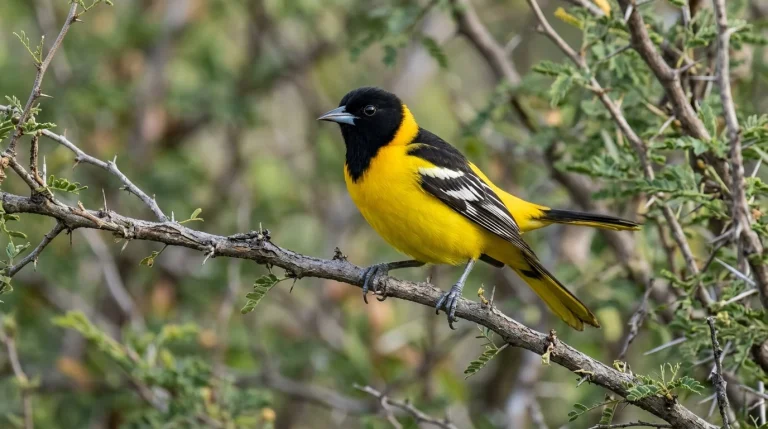
Bullock’s Oriole Guide
Keep Track of What You See
Create a free Wild Things Guide membership to record this Bullock’s Oriole in My Sightings and build your personal wildlife list.
Join to Add This SightingIntroduction
Bullock’s Oriole (Icterus bullockii) is a brightly colored songbird of western North America. Breeding males combine flame-orange underparts with a black crown, throat, eye line, and back, while females and immature birds are softer yellow-orange and gray. Both sexes show pale wing markings that can be conspicuous in flight.
These orioles are most often associated with tall deciduous trees, especially in stream corridors, open woodlands, shelterbelts, parks, and wooded residential areas. Although their plumage may attract the first attention, their rich whistles, harsh chatter, hanging nests, and habit of searching among leaves are equally useful identification clues.
Quick Identification
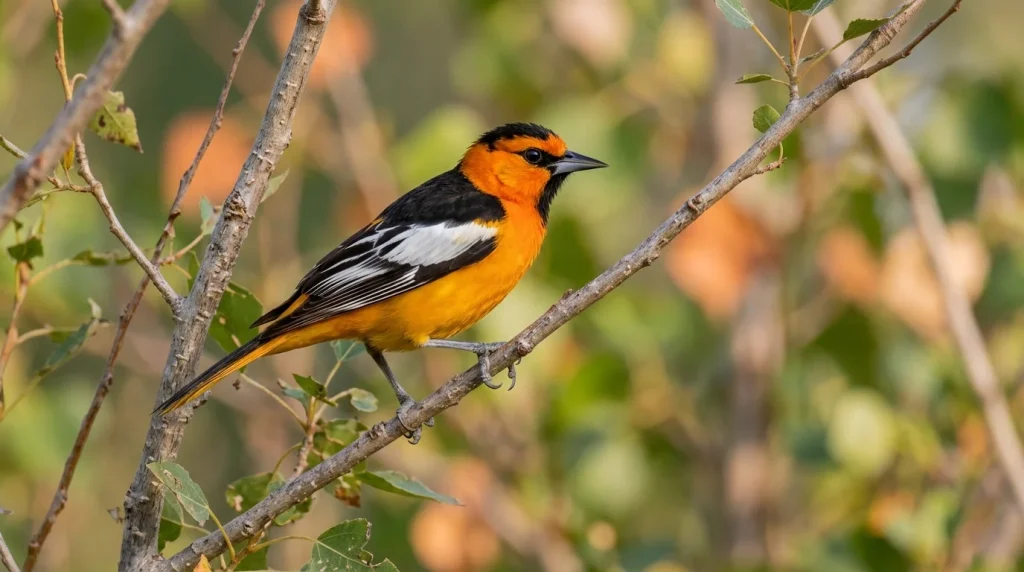
- Adult male: Orange face and underparts; black crown, eye line, throat, back, and central tail; large white wing patch.
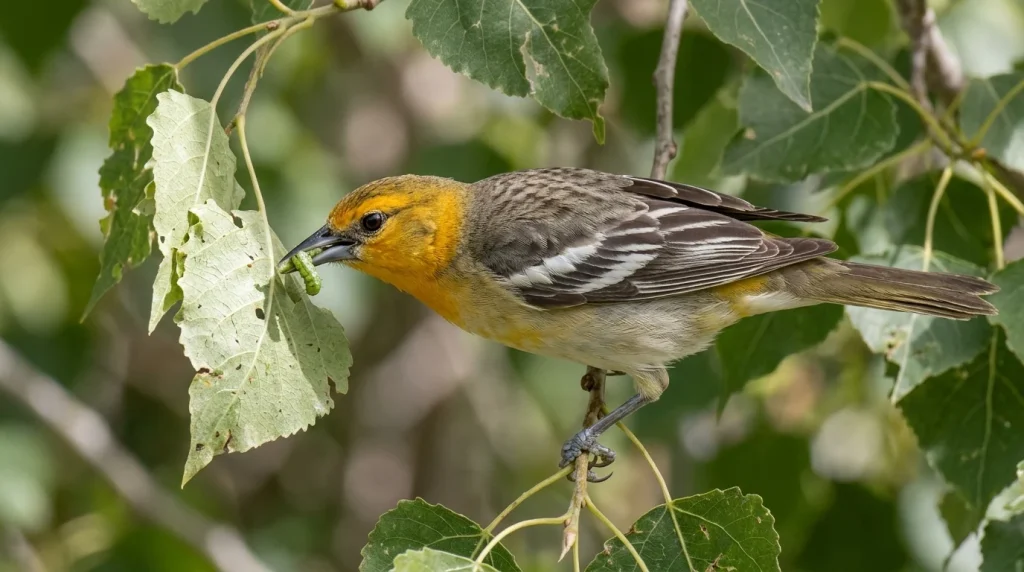
- Adult female: Yellow to orange-yellow head and tail, grayish back, pale underparts, and two whitish wing bars.
- Shape: Slim-bodied, long-tailed songbird with a straight, sharply pointed bill.
- Behavior: Forages in foliage, probes flowers, hangs from twigs, and makes direct flights between trees.
- Voice: Variable whistles mixed with chuckling, rattling, or scratchy notes.
- Best habitat clue: Mature deciduous trees near water or in open country across the West.
Appearance
The adult male is unmistakably patterned at close range. Its face, eyebrow area, breast, belly, and rump are orange, contrasting with a black crown, eye line, throat patch, back, and wings. The black wings carry a bold white patch, with additional pale edging sometimes visible. The tail is mainly black centrally, with orange-yellow outer portions.
Females are less sharply patterned and vary in color. Most have a yellow-orange face, throat, and tail; grayish or olive-gray upperparts; and whitish to pale yellow underparts. Their darker wings show two pale wing bars rather than the male’s broad white patch. Some older females may develop stronger orange coloration or scattered dark feathers around the throat.
Juveniles generally resemble females but look duller and may have loosely textured plumage. Immature males acquire adult colors gradually, so patchy black and orange birds are expected during transitional molts. In every plumage, look for the pointed bill, relatively long tail, and contrasting wing markings.

Size and Wingspan
Bullock’s Orioles are medium-sized songbirds: larger and longer-tailed than most warblers but smaller-bodied than an American Robin.
- Length: About 6.7–7.5 inches (17–19 centimeters)
- Wingspan: Approximately 12.2 inches (31 centimeters)
- Build: Slender, with a long tail and narrow, pointed bill
Size can be difficult to judge in a treetop. Proportions, wing pattern, color placement, and behavior are usually more dependable than an estimated measurement.
Range and Distribution
This is primarily a western North American species. Its breeding distribution extends from southwestern Canada through much of the western United States and into northern Mexico. It occurs east to parts of the Great Plains, where its range approaches or overlaps that of the Baltimore Oriole.
Bullock’s Orioles are migratory across most of their breeding range. Many spend the nonbreeding season in Mexico, with some reaching northern Central America. Spring arrivals commonly occur from April into May, while southbound movement begins in late summer. Exact timing varies with latitude, weather, and annual food conditions.
In the central Plains, Bullock’s and Baltimore Orioles may hybridize. Birds showing intermediate face, wing, or underpart patterns should be documented carefully rather than assigned solely from one plumage mark.

Habitat
Bullock’s Orioles favor open habitats containing tall trees rather than extensive, closed-canopy forest. Productive places include cottonwood and willow corridors, oak woodland edges, ranch shelterbelts, orchards, farmsteads, city parks, campgrounds, and mature neighborhoods.
Riparian woodland is especially important in dry western landscapes because it supplies nesting branches, insects, flowers, and cover. The birds may also use isolated groves or rows of trees crossing otherwise open grassland, farmland, or shrubland.

Behavior
Bullock’s Orioles spend much of their time in the middle and upper portions of trees. They hop along branches, inspect clusters of leaves, stretch to reach prey, and occasionally hang upside down while feeding. Their movements can seem deliberate while searching foliage, followed by fast, direct flights across openings.
Males often sing from exposed upper branches during the breeding season. Females may remain less conspicuous while collecting plant fibers or tending a nest. Outside the nesting period, individuals may join loose feeding concentrations where fruit, flowers, or abundant insects are available.
Diet
The diet is varied and changes with season and opportunity. Bullock’s Orioles commonly eat:
- Caterpillars, beetles, grasshoppers, wasps, and other insects
- Spiders and similar small invertebrates
- Wild berries and soft cultivated fruits
- Nectar from flowers
They glean insects from leaves and bark, capture some prey in short aerial movements, and probe blossoms with the bill. Orioles may visit feeders offering orange halves, suitable nectar, or small amounts of jelly, but feeders should be kept clean and should supplement—not replace—natural foods and native vegetation.
Vocalizations
The male’s song is a variable series of clear, rich whistles interspersed with rattles, chatters, or rougher notes. It is often less evenly flowing than a robin’s song and may sound improvised. Females also sing, particularly around nesting territories.
Common calls include sharp chuck, chack, or rattling sounds. Learning these calls is valuable because a feeding Oriole can remain hidden behind leaves, even when its bright plumage seems obvious.
Breeding and Nesting
The nest is a deep, flexible pouch suspended from slender branches, often near the outer edge of a deciduous tree. Placement varies from relatively low trees to high canopy branches. Cottonwoods, willows, sycamores, and other mature shade trees are frequently used where available.
The female performs most nest construction, weaving plant fibers, grasses, strips of bark, hair, and sometimes human-made fibers into a hanging basket. The structure is attached at its rim to twigs and lined with softer material. Construction may take more than a week, depending on weather and access to suitable fibers.
A typical clutch contains three to seven eggs, often pale bluish or gray-white with dark lines or blotches. The female undertakes most or all incubation, which lasts roughly two weeks. Both parents usually feed the nestlings. Because nests are easily disturbed and difficult to view safely, observers should remain well back and avoid lingering beneath the nest tree.
Young and Development
Young Bullock’s Orioles hatch in an altricial condition: poorly developed, with closed eyes and little protective plumage. Their parents deliver insects and other protein-rich food during the rapid nestling period.

Young generally leave the nest at about two weeks of age, although development varies. Recently fledged birds have short, developing tails and uncertain flight. They may remain nearby and continue receiving food from adults, so an apparently unattended fledgling should usually be observed from a distance rather than moved.
Where to See
Within the breeding range, search tree-lined rivers, cottonwood groves, mature parks, quiet campgrounds, orchards, and rural shelterbelts. Late spring and early summer are especially productive because males are singing and pairs are making repeated trips around nesting areas.
Listen first, then scan exposed treetops and the outer canopy. Flowering trees and shrubs can attract feeding birds, as can fruiting plants later in the season. At migration stopovers, look in leafy parks and wooded stream corridors even where the species does not breed. The Cornell Lab of Ornithology’s Bullock’s Oriole account provides additional identification media and seasonal range information.
Similar Species
- Baltimore Oriole: Adult males usually have an entirely black head and orange shoulders, unlike the orange face and black eye line of a typical male Bullock’s. Females and immature birds can be difficult to distinguish, particularly in the Great Plains hybrid zone.
- Hooded Oriole: Usually has a longer, more noticeably downcurved bill and lacks the maleBullock’ss large white wing patch. Hooded Orioles are often associated with palms and arid or suburban settings.
- Scott’s Oriole: Adult males show lemon-yellow underparts with a black hood and chest rather than an orange face. They are strongly associated with yucca and arid slopes.
- Western Tanager: Adult males have a red-orange head, yellow body, and black wings, but they lack the Oriole’s black throat and long, pointed bill. Females have a broader-based bill and a different wing pattern.
When identifying females or immature birds, combine bill shape, wing bars, tail pattern, calls, range, and habitat. A single yellow or orange color patch is rarely enough.
Conservation
Bullock’s Oriole is commonly classified as Least Concern by the IUCN, reflecting its broad range and substantial overall population. That status does not mean the species is free from regional pressures. Long-term monitoring has indicated declines in some areas.
Loss and degradation of riparian woodland are important concerns, especially where mature cottonwoods and willows are removed, or natural stream processes are altered. Pesticides can reduce insect prey, while poorly placed synthetic string may create a nest-entanglement hazard. Protecting native streamside trees, maintaining diverse flowering and fruiting plants, and reducing unnecessary pesticide use can benefit orioles and other migratory songbirds.
Field Identification Tips
- Begin with structure: Look for a slim body, long tail, and sharply pointed bill.
- Check the face: A maleBullock’ss has an orange face crossed by black, not a completely black hood.
- Study the wing: Adult males show a broad white patch; females generally show two distinct pale wing bars.
- Watch the canopy: Orioles frequently feed near branch tips and beneath leaf clusters.
- Use sound: Rich whistles interrupted by rough chatters are often the first clue.
- Allow for variation: Females, immature males, worn birds, and hybrids may not match a simple field-guide illustration.
- Document unusual birds: In the Great Plains, photograph the face, back, wings, tail, and underparts when possible.
Frequently Asked Questions
Is Bullock’s Oriole the western version of the Baltimore Oriole?
It is a close western relative, but the two are recognized as separate species. They were formerly combined as the “Northern Oriole.” Their breeding ranges meet in parts of the Great Plains, where hybridization can occur.
Are female Bullock’s Orioles orange?
Females are usually yellow to orange-yellow on the head and tail, with a grayish back and pale body. Color intensity varies, and some females are much brighter than others.
Do Bullock’s Orioles visit feeders?
Yes. They may take orange halves, nectar, or jelly, particularly during migration and early in the breeding season. Clean nectar feeders frequently, replace spoiled food promptly, and avoid offering large quantities of jelly.
Where do Bullock’s Orioles go in winter?
Most migrate to Mexico, while some continue into northern Central America. They are absent from most of the United States and Canada during the core winter months.
How can I find a Bullock’s Oriole nest?
Watch for an adult carrying long fibers into the outer branches of a deciduous tree. The finished nest resembles a hanging pouch. Observe from a respectful distance and avoid repeated approaches, branch manipulation, or prolonged activity beneath an active nest.