Altamira Oriole Guide
Keep Track of What You See
Create a free Wild Things Guide membership to record this Altamira Oriole in My Sightings and build your personal wildlife list.
Join to Add This SightingIntroduction
The Altamira Oriole (Icterus gularis) is a large, striking songbird of tropical and subtropical woodlands. In the United States, it is closely associated with the Lower Rio Grande Valley of southern Texas, where its brilliant orange plumage, deliberate movements, and long hanging nest make it a sought-after regional specialty.
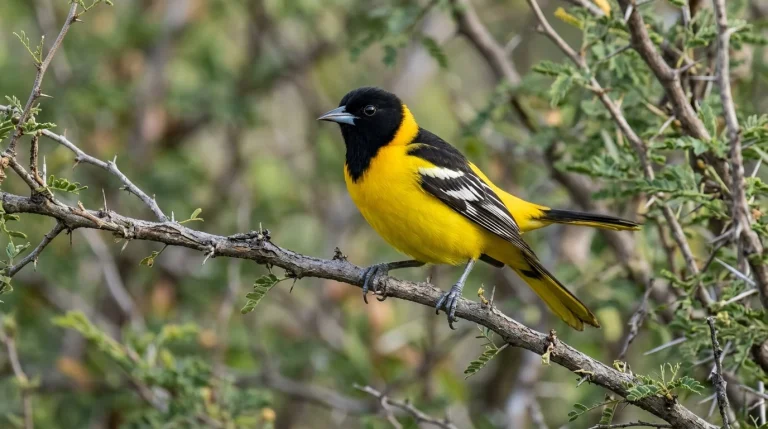
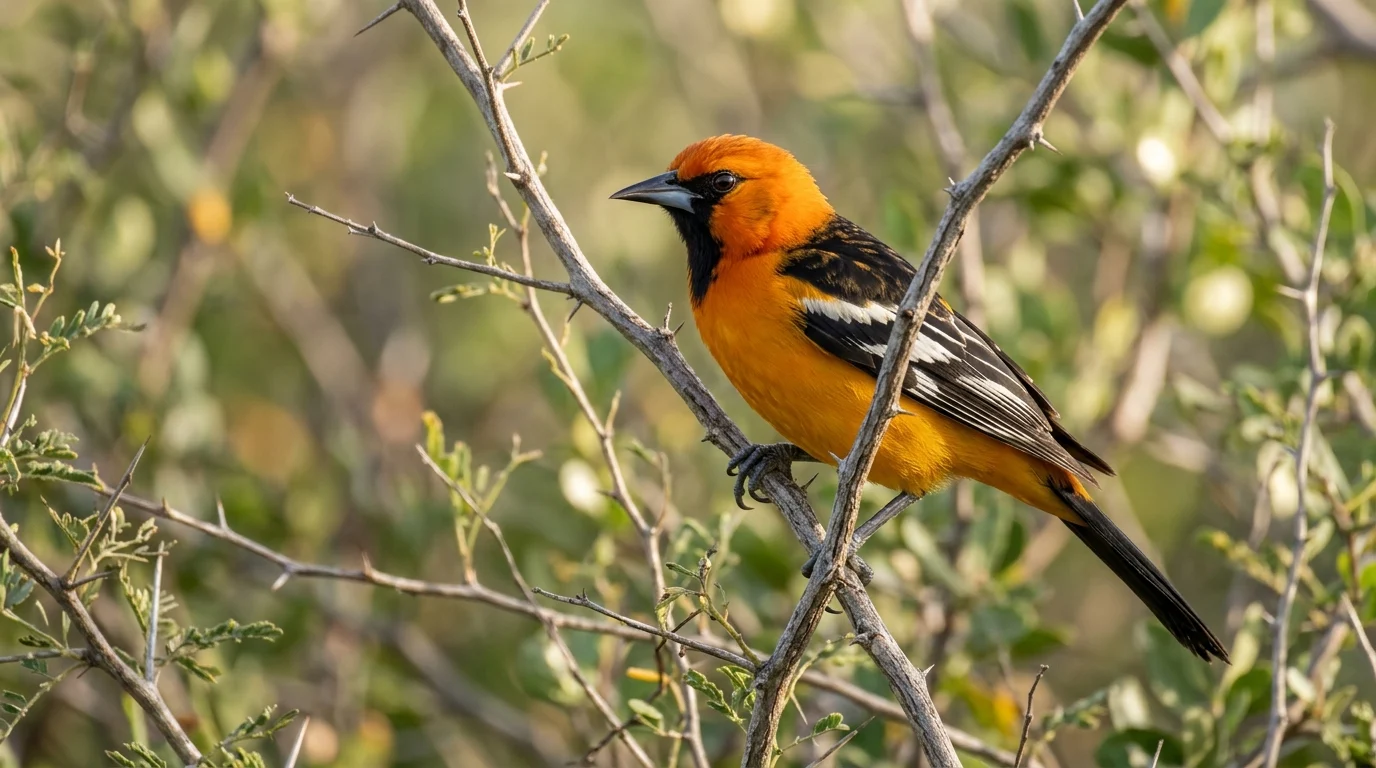
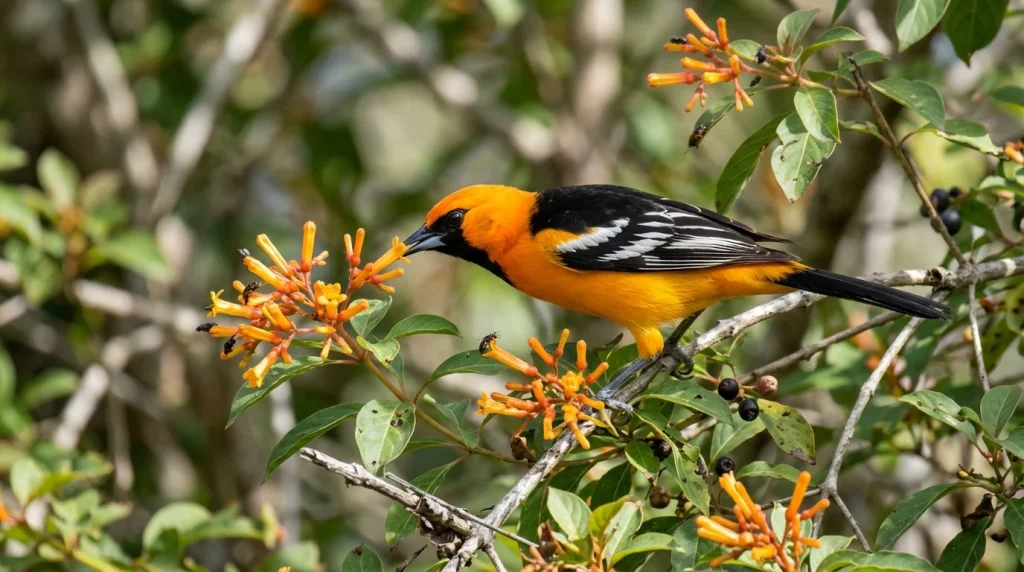
Adults combine an orange head and body with a black throat, back, wings, and tail. A bold white wing bar is often visible even when the bird is partly hidden by foliage. Unlike several North American orioles, adult males and females look broadly alike. The Cornell Lab of Ornithology species account provides additional photographs, sounds, and identification details.

Quick Identification
- Large oriole: Noticeably bigger and heavier-billed than a Hooded Oriole.
- Orange-and-black adults: The head, shoulders, and underparts are rich orange, contrasting with a black throat and upperparts.
- White wing marking: A prominent white wing bar or patch stands out on the otherwise black wing.
- Similar sexes: Adult males and females have much the same general plumage pattern.
- Long hanging nest: The deep, woven pouch may hang conspicuously from the end of a high branch or another exposed support.
- Restricted U.S. range: In North America north of Mexico, look primarily in the Lower Rio Grande Valley of Texas.
Appearance
Adult Altamira Orioles are unmistakably colorful when seen well. The head and most of the underparts are vivid orange. Black covers the throat, lores, upper back, much of the wings, and the central portion of the tail. Orange shoulder feathers interrupt the dark upperparts, while a broad white wing bar provides another strong field mark.
The bill is stout, straight, and pointed, with a grayish or pale bluish base often contrasting with a darker tip. The legs and feet are gray. The long tail and substantial bill contribute to a powerful appearance compared with smaller orioles.
Males and females are similar enough that field sexing is usually unreliable. Some individuals may differ slightly in color saturation or the extent of black, but these differences are not dependable without close study. Young birds are duller and more yellow-orange, with an olive-toned back and reduced black on the throat. Their muted plumage can make them look surprisingly different from adults.

Size and Wingspan
Altamira Orioles are among the largest orioles regularly encountered in the United States.
- Length: Approximately 21–25.5 cm (8.3–10 in)
- Wingspan: Roughly 34–36 cm (13.5–14 in)
- Build: Long-bodied and long-tailed, with a relatively heavy bill
A direct comparison with a Hooded Oriole usually reveals the Altamira’s greater bulk, larger head, and stronger bill. It may approach the apparent size of a small Jay when viewed at close range, although it remains more slender.
Range and Distribution
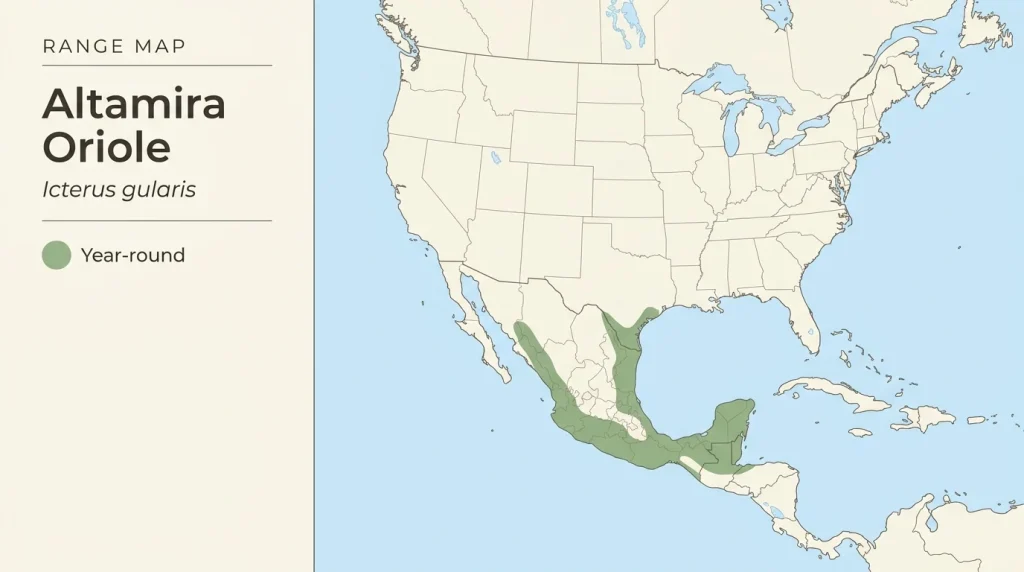
The species is primarily resident from extreme southern Texas through eastern and southern Mexico and into northern Central America. Its broader distribution includes parts of Belize, Guatemala, Honduras, El Salvador, and Nicaragua, although abundance and habitat use vary geographically.
Within the United States, established populations are concentrated in the Lower Rio Grande Valley. Records farther north should be evaluated carefully because Hooded and Bullock’s Orioles are more widespread. Altamira Orioles generally remain within their home region year-round rather than undertaking the long seasonal migration typical of many temperate orioles.
Habitat
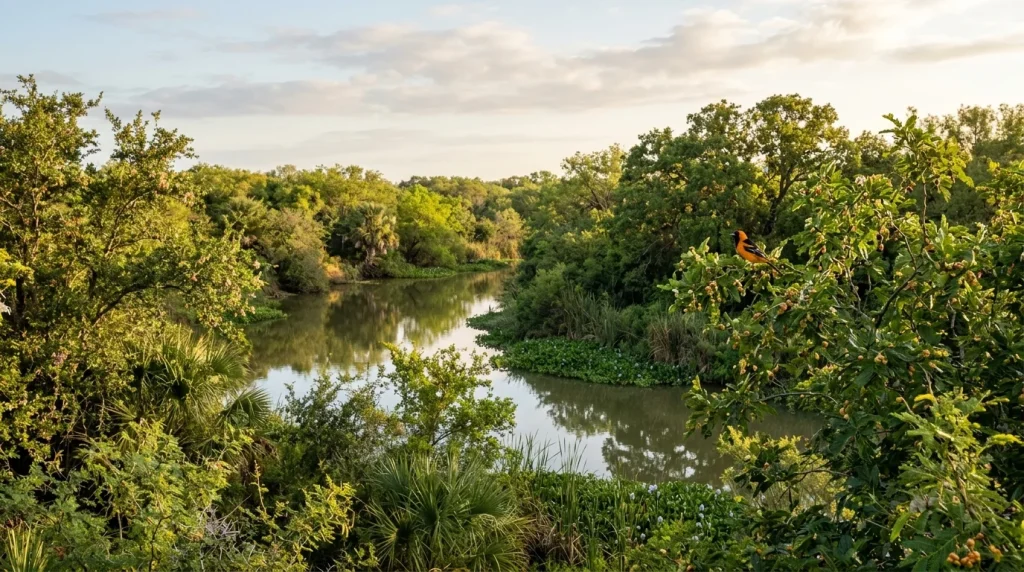
Altamira Orioles occupy open woodland, thorn forest, riparian groves, forest edges, brushy ranchland, plantations, parks, and settled areas with mature trees. In southern Texas, they are especially associated with native thornscrub, resaca woodlands, palms, and wooded corridors along the Rio Grande.
The species often tolerates moderately altered landscapes if tall trees and productive feeding areas remain. Flowering trees, fruiting shrubs, palms, and scattered woodland edges can all attract feeding birds. Dense, unbroken forest is generally less useful for observation because Altamira Orioles frequently forage near edges and in the upper portions of trees.
Behavior
Altamira Orioles usually forage alone, in pairs, or in small family groups. They move methodically through the canopy, stretching or hanging to inspect leaves, flowers, and fruit. Their movements can appear slower and heavier than those of smaller orioles.
Pairs often remain together through much of the year and may defend an area around feeding or nesting sites. A bird crossing an opening typically flies directly with quick wingbeats. When perched, it may sit upright and quietly scan its surroundings before disappearing into foliage.
Because the species spends considerable time in the canopy, detection often begins with a call, a flash of orange, or the white wing bar. Flowering trees and fruiting vegetation offer the best opportunities to watch natural feeding behavior.
Diet
Altamira Orioles have a varied diet that changes with local availability. Important foods include:
- Insects, spiders, and other small invertebrates
- Caterpillars and insects gleaned from leaves or bark
- Wild fruits and berries
- Flower nectar
- Occasionally cultivated fruit or food offered at bird-feeding stations
Their pointed bills can probe flowers, pick insects from vegetation, and open soft fruit. They sometimes visit nectar feeders, halved oranges, or jelly, but native flowering and fruiting plants provide a more natural and dependable food source.
Vocalizations
The song consists of clear, deliberate whistles, often delivered as short, separated phrases. Notes may sound mellow or flutelike, but songs vary among individuals and regions. Pauses between phrases can make a singing bird difficult to locate.
Calls include harsh, nasal, or chattering notes that contrast with the smoother whistles. Listen for these rough calls when a pair is moving through dense foliage. Vocal activity is often strongest in the morning and during the breeding season, although resident birds may call at any time of year.
Breeding and Nesting
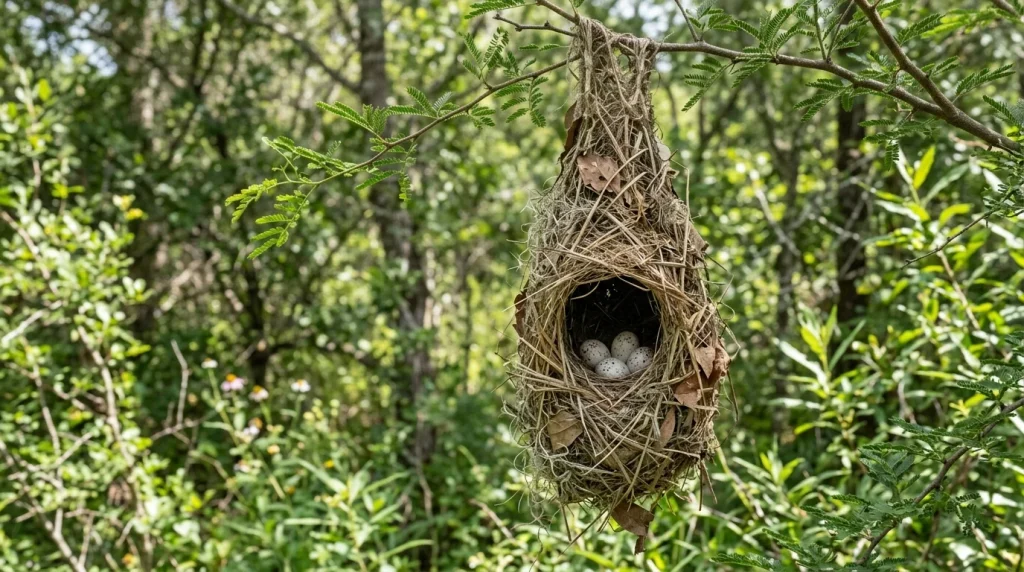
The Altamira Oriole builds one of the most impressive nests made by any North American songbird. The nest is a deep, elongated pouch woven from plant fibers, grasses, strips of bark, and other flexible material. It hangs from a branch tip, palm structure, or occasionally an artificial support, where its suspended position may discourage some climbing predators.
The female is believed to do most of the nest construction, weaving and knotting fibers into a durable structure with an entrance near the upper portion. Finished nests can approach 60 cm (about 2 feet) in length, although dimensions vary. Old nests may remain visible after the breeding attempt has ended.
Clutches commonly contain several pale eggs marked with darker lines, spots, or scrawls. The female incubates, while both parents may help feed nestlings. Timing varies across the broad tropical range, and rainfall and local food abundance can influence breeding.
Young and Development
Newly hatched chicks are helpless and depend entirely on their parents for warmth and food. Adults bring soft-bodied insects and other protein-rich prey during the nestling period. The depth of the pouch helps shelter the young, though nests remain vulnerable to severe weather, predators, and brood parasites.
After leaving the nest, juveniles retain dull yellow-orange and olive plumage. They may follow their parents while giving food-begging calls and gradually learning to forage. The full orange-and-black adult appearance develops as immature feathers are replaced. Family groups can remain together for a time after fledging.
Where to See
In the United States, focus on protected woodlands and birding sites in the Lower Rio Grande Valley. Reliable areas have included Bentsen-Rio Grande Valley State Park, Estero Llano Grande State Park, Resaca de la Palma State Park, Santa Ana National Wildlife Refuge, and other wooded preserves near the Rio Grande.
Search mature trees around woodland edges, visitor areas, resacas, and flowering vegetation. Scan high exposed branches for hanging nests, but never approach or disturb an active nest. Local sightings can shift with flowering cycles, fruit availability, drought, storms, and habitat conditions, so recent reports are valuable.
Similar Species
- Hooded Oriole: Smaller and slimmer, with a thinner, slightly curved-looking bill. Adult females are yellowish or olive rather than bright orange and black. Males lack the exact combination of an orange head, extensive black back, and bold white wing bar.
- Bullock’s Oriole: Usually shows a black crown and eye line, a bright orange face, and a large white wing patch. Females and immatures are much paler. Bullock’s Orioles are mainly migrants or winter visitors in parts of the region.
- Audubon’s Oriole: Predominantly yellow and black rather than rich orange. Its black hood covers much more of the head and upper breast, and the body pattern differs substantially.
- Spot-breasted Oriole: Shows black spotting on the orange breast and typically has a different facial and wing pattern. In the United States, it is associated mainly with introduced populations in Florida.
- Streak-backed Oriole: Where ranges overlap in Mexico or Central America, look for dark streaking across an orange back rather than the Altamira’s solid black upper back.
Conservation
The Altamira Oriole is commonly classified as Least Concern globally because it has a broad range and is not considered close to extinction. Nevertheless, local populations can be affected by clearing of thorn forest and riparian woodland, removal of mature nesting trees, pesticide use, prolonged drought, and severe freezes.
Conservation in southern Texas depends in part on protecting and reconnecting native thornscrub, resaca woodland, and river corridors. Maintaining tall trees, native flowering plants, and fruit-bearing vegetation can benefit orioles as well as many other Lower Rio Grande Valley birds.
Field Identification Tips
- Start with location. In the United States, an Altamira Oriole is most likely in the Lower Rio Grande Valley.
- Judge structure before color. Look for a large body, long tail, substantial head, and heavy pointed bill.
- Confirm the pattern. Seek an orange head and underparts, black throat and back, and a bold white wing bar.
- Do not rely on sex differences. Adult males and females look very similar.
- Watch the canopy. Birds often remain high and partly concealed while feeding.
- Listen for separated whistles. A few deliberate notes may reveal a bird before it comes into view.
- Check juveniles carefully. Young Altamira Orioles can be yellow-orange and olive, with little black on the throat.
- Use nests only as clues. A long woven pouch suggests an oriole, but identify the attending bird and observe from a respectful distance.
Frequently Asked Questions
Is the Altamira Oriole found in the United States?
Yes. Its regular U.S. distribution is largely confined to the Lower Rio Grande Valley of southern Texas. It is much more widespread in Mexico and northern Central America.
Do male and female Altamira Orioles look different?
Not noticeably in most field situations. Both adult sexes show the same basic orange, black, and white pattern, so sex usually cannot be assigned reliably from appearance alone.
Does the Altamira Oriole migrate?
It is generally considered a resident species. Individuals may make local movements in response to flowering, fruiting, rainfall, or weather, but they do not normally undertake long-distance seasonal migrations.
How can I distinguish it from a Hooded Oriole?
Altamira Orioles are larger and heavier-billed. They have a solid black upper back, a rich orange head and body, a black throat, and a prominent white wing bar. Female Hooded Orioles are much duller, while male Hooded Orioles have a slimmer build and different upperpart pattern.
What does an Altamira Oriole nest look like?
It is a deep, elongated woven pouch suspended from a branch or similar support. Some nests approach 2 feet in length and remain visible after use.
Will Altamira Orioles visit feeders?
They may visit nectar, orange, or jelly feeders within their range, but visits are not guaranteed. Native flowering trees, fruit-bearing shrubs, clean water, and reduced pesticide use offer broader long-term benefits.