Great Basin Rattlesnake Guide
Keep Track of What You See
Create a free Wild Things Guide membership to record this Great Basin Rattlesnake in My Sightings and build your personal wildlife list.
Join to Add This SightingIntroduction
The Great Basin rattlesnake (Crotalus lutosus) is a venomous pit viper of the dry interior West. Its principal range covers Nevada and western Utah, with extensions into eastern California, southeastern Oregon, southern Idaho, and northern Arizona. It is closely associated with sagebrush country, rocky slopes, open woodland, and desert mountain terrain.
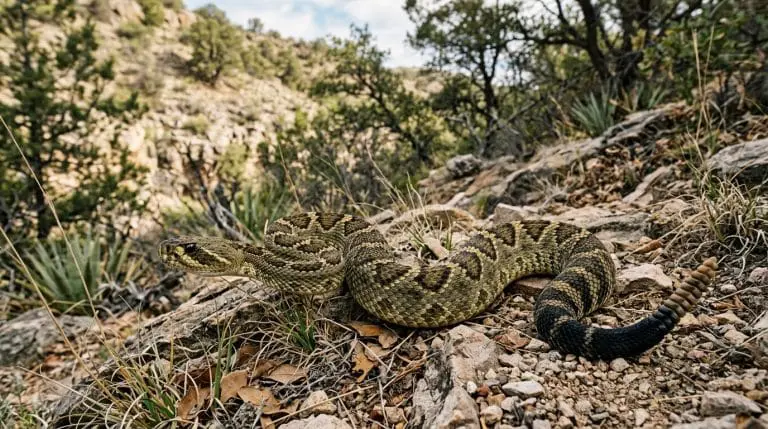
This rattlesnake is best known for its muted gray, tan, or olive coloration, dark dorsal blotches, banded tail, and segmented rattle. Its colors often match local rock and soil remarkably well. Taxonomically, it was long classified as a subspecies of the western rattlesnake as Crotalus oreganus lutosus; many modern authorities recognize it as the separate species Crotalus lutosus.
Quick Identification
- Heavy-bodied rattlesnake, usually about 24–36 inches long.
- Gray, pale brown, tan, yellowish, or olive ground color.
- Series of dark brown to nearly black blotches along the back.
- Blotches often have pale borders and may become crossbands toward the tail.
- Alternating dark and pale tail bands ending in a segmented rattle.
- Broad head, narrow neck, vertical pupils, and heat-sensing facial pits.
- Strongly keeled scales that give the body a matte, rough-textured appearance.
Color and pattern vary, so do not rely on any single feature. The rattle, dorsal blotches, tail bands, geographic location, and overall proportions provide the most useful combination of field marks. Observe from a safe distance rather than attempting to confirm pupils, facial pits, or small-scale details.

Appearance and Identification
The Great Basin rattlesnake has a moderately stout to heavy body, a relatively short neck, and a broad head. The head is wider than the neck when viewed from above, although head shape alone is not a dependable identification character. Nonvenomous snakes can flatten their heads defensively, and a relaxed rattlesnake may not look strongly triangular.
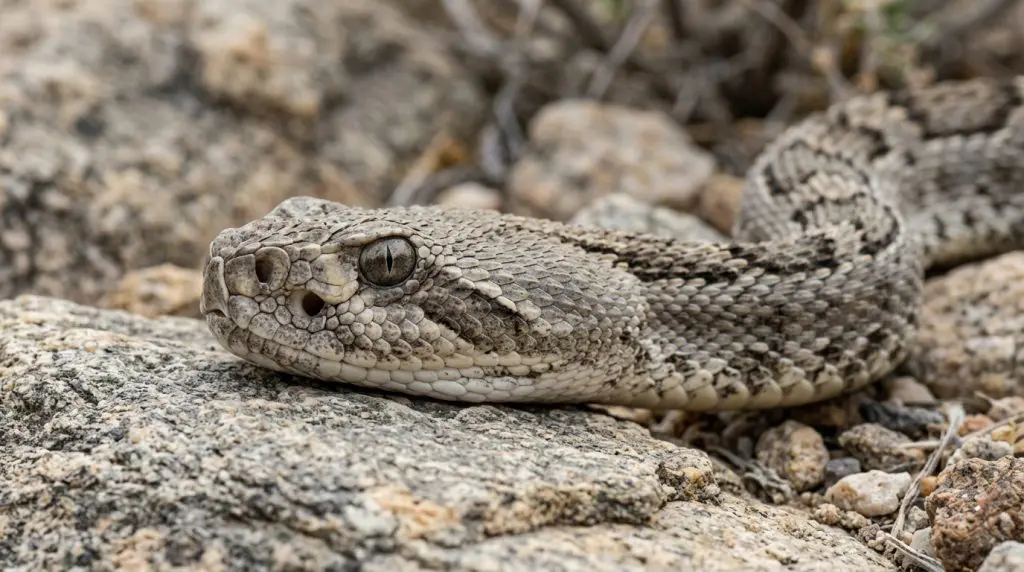
The dorsal scales are keeled, with a raised ridge running along each scale. These keels produce a dull, textured surface rather than a smooth, glossy appearance. The underside is usually cream, grayish, or pale yellow and may carry scattered darker marks.
A dark stripe commonly extends from behind the eye toward the rear corner of the jaw. A paler line may border it. The eyes have vertically elliptical pupils, and a heat-sensitive pit lies between each eye and nostril. Never approach these features closely to identify them.
The tail is relatively short and usually marked with contrasting bands. Adults carry a keratinous rattle composed of interlocking segments, but rattles may be broken, worn, wet, or too small to produce a strong sound. Newborns have a single terminal button and cannot make the familiar buzzing rattle until additional segments develop through shedding.
Males generally have proportionally longer tails beyond the vent and may attain somewhat greater lengths, but these differences are not practical field marks. Females can appear especially thick-bodied during pregnancy.
Size
Most adult Great Basin rattlesnakes are approximately 24–36 inches (61–91 cm) long. Large individuals may approach 4 feet (1.2 m), although snakes of that size are uncommon and published maximum measurements vary. Males often average slightly longer than females, while adult females may appear heavier.
Young are usually around 8–12 inches (20–30 cm) at birth. They resemble adults in basic pattern but are slimmer, have proportionally prominent heads, and possess only a button or a very small rattle.
Color and Pattern
The ground color may be light gray, brownish gray, tan, cream, yellow-brown, olive, or occasionally pinkish. Individuals living among pale desert soils may be lightly colored, while snakes from dark volcanic or wooded terrain can be much darker.
A row of dark brown, reddish brown, or blackish blotches runs down the back. These markings are usually broader than the spaces separating them and often have pale cream or white borders. Smaller lateral spots occur along the sides. Near the rear of the body, the blotches tend to narrow or merge into crossbands.
The tail commonly shows alternating dark and light rings. The final dark band before the rattle may be conspicuous, but tail-band width and contrast vary. Recently shed snakes can appear bright and sharply patterned; individuals nearing a shed often look faded, cloudy, or bluish around the eyes.
Similar Species
The gopher snake is the nonvenomous species most often mistaken for a Great Basin rattlesnake. It also has dark dorsal blotches and may hiss, flatten its head, coil, or vibrate its tail in dry vegetation. Gopher snakes are generally more slender and have a long, gradually tapering tail without a true segmented rattle. Because rattles can be damaged or concealed, the apparent absence of one should not be treated as proof that a snake is harmless.
Prairie rattlesnakes occur mainly east and northeast of the Great Basin rattlesnake’s core range. They can look extremely similar, although prairie rattlesnakes often have narrower dorsal blotches and more contrasting tail bands. Western rattlesnakes occur to the north and northwest, while Mojave rattlesnakes and sidewinders occupy warmer deserts to the south. Geographic location is often more useful than subtle color differences.
Identification near range boundaries can be difficult, particularly within the closely related western rattlesnake complex. Photographs taken with a zoom lens, together with an accurate location, are safer and more useful than approaching a snake to inspect scales or facial features.
Geographic Range
The species is centered on the Great Basin of the western United States. It is widespread in Nevada and western Utah and also occurs in parts of eastern California, southeastern Oregon, southern Idaho, and northern Arizona. Its distribution follows suitable dry valleys, plateaus, foothills, and mountain systems rather than political boundaries.
At the margins of its range, it meets or approaches other members of the western rattlesnake group. Exact identification may therefore require locality information and expert review. Visitors can find additional regional context in the National Park Service overview of reptiles at Great Basin National Park.

Habitat
Great Basin rattlesnakes occupy sagebrush steppe, salt-desert shrubland, pinyon-juniper woodland, open pine forest, grassland, canyon country, rocky foothills, and mountain slopes. They occur from low desert valleys to elevations above 9,000 feet (2,740 m) where climate and shelter remain suitable.
Rock outcrops, talus, ledges, lava flows, rodent burrows, fallen logs, and dense shrubs provide cover. South- or west-facing rocky slopes are especially important in cooler regions because deep crevices can serve as communal winter dens. During hot weather, snakes may remain beneath rocks, inside burrows, or in shaded vegetation during the day.
Behavior and Activity
Activity depends strongly on temperature. In spring and autumn, Great Basin rattlesnakes are often diurnal and may bask near shelter. During hot summer weather, they become primarily crepuscular or nocturnal, moving in the evening and after dark when surface temperatures are safer.
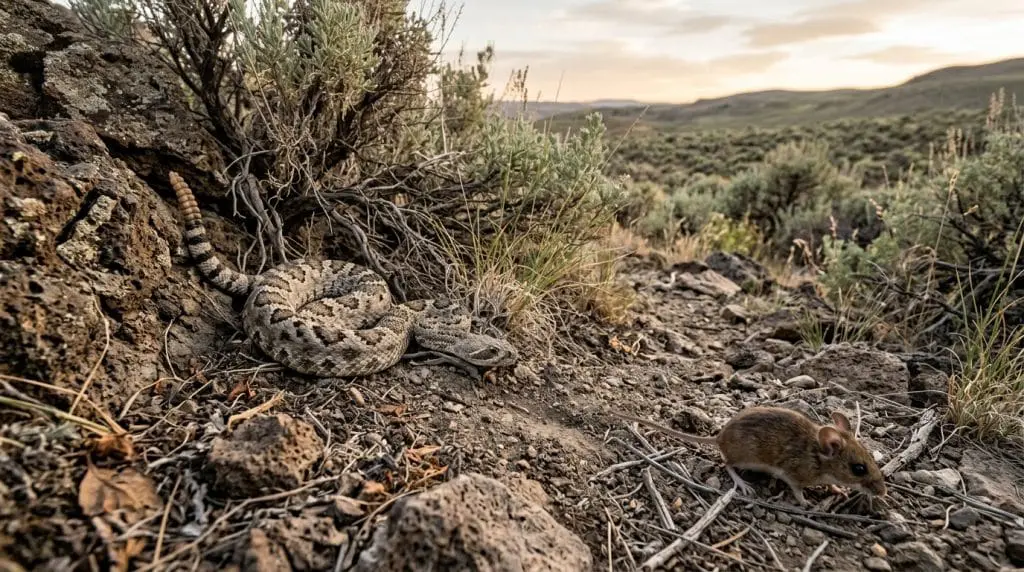
The species usually travels on the ground but can climb low shrubs, ledges, and fallen timber. It can also swim when necessary. Individuals often remain motionless beside rodent paths or cover objects, relying on camouflage rather than immediately retreating.
When disturbed, a snake may freeze, move toward cover, coil, or rattle. Rattling is a warning behavior, not evidence that the snake is pursuing a person. Some individuals remain silent. If given room and an open escape route, most attempt to avoid further confrontation.
Diet and Hunting
Small mammals form most of the diet. Common prey includes mice, voles, young ground squirrels, chipmunks, pocket gophers, and other appropriately sized rodents. Lizards are particularly important to juveniles, while birds and nestlings are taken occasionally.
The Great Basin rattlesnake is primarily an ambush predator. It waits near a burrow, runway, rock edge, or other location used by prey. A rapid strike injects venom through hinged hollow fangs. After striking, the snake may release a mammal and then follow its chemical trail with its tongue and vomeronasal system. It swallows prey whole and does not constrict it.
Reproduction and Life Cycle
Mating can occur after spring emergence and again in late summer or early autumn. Females are viviparous, giving birth to live young rather than laying eggs. Reproduction is energetically demanding, and females in cool or food-limited environments may breed only every second or third year.
Birth generally occurs from late summer into early autumn. Litters often contain roughly 4–10 young, although smaller and larger litters are possible. Newborns are independent and possess functional venom from birth. They remain near protected birth sites for a short period before dispersing.
Growth is fastest during the first several years and slows after maturity. Reliable wild longevity data specifically for Crotalus lutosus are limited, but individuals may live for more than a decade, and survival approaching 15–20 years is plausible where adult mortality is low.
Seasonal Activity
Emergence usually occurs in spring after daytime temperatures rise, with timing varying by elevation and latitude. Snakes often remain near den entrances at first, basking and making short movements before dispersing to summer ranges.
Spring activity may include mating and movement to feeding areas. In midsummer, activity shifts toward dusk, night, and early morning. Pregnant females may stay near warm, sheltered rocks that provide stable conditions for developing young.
During autumn, individuals return toward traditional winter shelters. Several snakes—and sometimes multiple snake species—may share suitable den systems. They spend winter in brumation below the frost line, occasionally shifting position within the den as underground temperatures change.
Venom and Medical Significance
The venom immobilizes prey and begins breaking down tissue. It is delivered through long, hinged fangs at the front of the upper jaw. Its effects are generally dominated by tissue-damaging and blood-related components, although venom composition and bite severity vary among snakes and circumstances.
A bite can cause severe pain, swelling, bruising, tissue injury, nausea, weakness, and potentially serious systemic effects. Treat any suspected bite as a medical emergency. Move away from the snake, keep the affected person calm and as still as practical, and seek prompt professional emergency care. Do not attempt to capture the snake. Cutting, suction, ice, electric shock, and tourniquets can cause additional harm.
Predators and Threats
Natural predators include hawks, eagles, owls, coyotes, foxes, badgers, and other snakes. Young rattlesnakes are vulnerable to a broader range of mammals and birds.
Major human-related threats include deliberate killing, road mortality, loss or fragmentation of denning and foraging habitat, and unauthorized collection. Development near rocky winter dens can have disproportionate effects because many individuals may depend on the same shelter over multiple years. Wildfire and invasive annual grasses can also alter sagebrush habitats and prey communities.

Encounters With People
People most often encounter this snake on warm trails, rocky slopes, rural roads, campsites, or around buildings bordering natural habitat. Snakes may enter yards where rodents, woodpiles, debris, shade, or water provide suitable conditions. Nighttime encounters increase during hot weather.
Watch where you place your hands and feet, use a light after dark, and keep dogs close on trails. If a rattlesnake is seen, stop, locate it without moving closer, and give it several yards of space and an escape route. Never handle, corner, or attempt to move it. A motionless or silent rattlesnake is not necessarily calm, harmless, or dead.
Conservation Status
The Great Basin rattlesnake is generally considered widespread and secure across much of its range and is commonly treated as a species of low conservation concern. It is not federally listed under the U.S. Endangered Species Act. State classifications, collection rules, and protections vary, however, and local populations can decline where dens are destroyed or persecution is intense.
Conservation priorities include protecting communal den sites, maintaining connected sagebrush and rocky habitats, reducing intentional killing, and limiting illegal collection. The snake also provides an important ecological service by consuming rodents.
Identification Summary
Look for a stout rattlesnake with gray, tan, brown, or olive coloring; dark pale-edged dorsal blotches; a banded tail; keeled scales; and a segmented rattle. Range and habitat are important clues: the species is characteristic of the Great Basin’s sagebrush valleys, rocky foothills, canyon slopes, and open woodland.
Color is variable, rattles may be damaged, and related rattlesnake species can be difficult to separate near range boundaries. Identification should be based on distant observation, photographs made with a zoom lens, and location—not on approaching or handling the snake.
Frequently Asked Questions
Is the Great Basin rattlesnake venomous?
Yes. It is a venomous pit viper capable of causing a medically serious bite. Bites are uncommon when snakes are given space and are not handled or harassed.
How can I distinguish it from a gopher snake?
A Great Basin rattlesnake is typically heavier-bodied, has a short banded tail ending in a rattle, and carries heat-sensing facial pits. A gopher snake has a longer tapering tail and no true rattle. Do not approach to inspect these features.
Will it always rattle before striking?
No. A snake may remain silent, flee, or strike without audible rattling. A broken or newly formed rattle may also produce little sound.
Where is this species most commonly found?
It is most characteristic of Nevada, western Utah, and neighboring portions of eastern California, southeastern Oregon, southern Idaho, and northern Arizona. Rocky sagebrush country is especially typical habitat.
What does it eat?
Its diet consists mainly of mice, voles, ground squirrels, chipmunks, and other small mammals. Juveniles consume more lizards, and birds are occasional prey.
Are young Great Basin rattlesnakes dangerous?
Young snakes possess functional venom and should be treated with the same caution as adults. Claims that juveniles are always more dangerous or cannot regulate venom delivery are oversimplified.
Do Great Basin rattlesnakes chase people?
No. They generally rely on camouflage, retreat, or defensive warning. A snake moving toward nearby cover may appear to approach a person, but pursuit is not normal behavior.