Florida Cottonmouth Guide
Keep Track of What You See
Create a free Wild Things Guide membership to record this Florida Cottonmouth in My Sightings and build your personal wildlife list.
Join to Add This SightingIntroduction
The Florida cottonmouth (Agkistrodon conanti) is a large, heavy-bodied pit viper native to Florida and southern Georgia. It occurs mainly around wetlands, slow-moving waterways, and other moist habitats, although individuals may travel over dry ground between feeding, basking, and shelter sites.
This venomous snake is best known for the pale white lining of its mouth, which may be exposed during a defensive gape. That display gives cottonmouths their common name, but it is not shown during every encounter and should never be provoked for identification. Dark crossbands, a bold facial stripe, a broad head, a stout body, and an association with wet environments provide more useful field clues.
Quick Identification
- Build: Stout and muscular, with a relatively short, tapering tail.
- Color: Olive, brown, gray-brown, or nearly black; young and moderately colored adults usually have dark crossbands.
- Head: Broad and angular, with a noticeably narrower neck and a dark cheek stripe bordered by paler lines.
- Scales: Strongly keeled dorsal scales give the body a textured, matte appearance.
- Young snakes: More sharply patterned than adults and equipped with a bright yellow or greenish-yellow tail tip.
- Defensive display: May coil, flatten the body, vibrate the tail, or gape to expose the white mouth lining.
Head shape alone is not reliable because harmless watersnakes can flatten their heads when alarmed. Identify it based on several features observed from a safe distance.

Appearance and Identification
The Florida cottonmouth has a thick body, a broad head, and a neck that often appears distinctly narrower than the head. Its dorsal scales are keeled, producing a rough texture rather than a glossy surface. The underside is generally cream, tan, or grayish with irregular dark blotches, especially toward the tail.
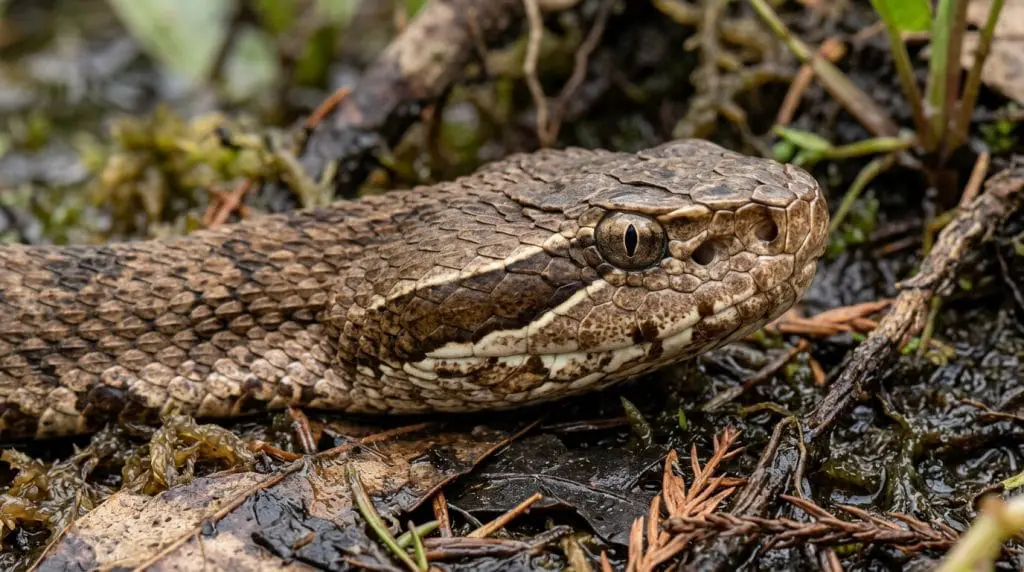
The head is usually brown to very dark brown. One of the most useful markings is a broad, dark stripe extending from the eye toward the rear of the jaw. Narrow cream or pale tan lines commonly border this stripe, making the facial pattern conspicuous in younger or lighter individuals. The top of the head may be nearly uniform or marked with darker pigment.
As a pit viper, the snake has a heat-sensitive facial pit between each eye and nostril. The eyes have vertically elliptical pupils, although pupil shape is rarely visible at a prudent viewing distance and changes with lighting. Neither pits nor pupils should be used as reasons to approach a snake.
The tail is comparatively short. Juveniles have a yellow to greenish-yellow tail tip, which they may wiggle to attract frogs and small lizards. This color becomes duller with age and is usually lost in mature adults. Adult males tend to grow larger and have proportionally longer tails than females, but sex generally cannot be determined during an ordinary field observation.
Size
Most adult Florida cottonmouths are approximately 30–48 inches (76–122 cm) long. Large males may exceed 5 feet (1.5 m), and exceptional individuals can approach 6 feet (1.8 m), although snakes of that size are uncommon. Females are generally smaller and less massive than the largest adult males.
Color and Pattern
The ground color ranges from olive-brown and reddish brown to gray, charcoal, or black. Dark crossbands run across the back and sides, often with uneven edges, internal spots, or darker borders. The bands can appear broken or blotched rather than forming clean rings.
Juveniles and young adults usually show the pattern most clearly. They often have a warm brown ground color, bold dark bands, strong facial stripes, and contrasting tail tips. With age, dark pigment may obscure the crossbands. Some large adults look almost uniformly black at first glance, especially when wet, though traces of pattern may remain visible in good light.
Color varies among individuals, across local habitats, and after shedding. Mud, wet scales, shadows, and tannin-stained water can also alter apparent color, so consider pattern and facial markings alongside body proportions and range.
Similar Species
Banded watersnakes are the most frequent source of confusion. They can be heavy-bodied, strongly banded, aquatic, and defensive. Watersnakes usually lack the cottonmouth’s sharply defined dark cheek stripe bordered by pale lines, but distance and lighting can hide this distinction. Their heads may flatten when threatened, making a triangular-looking head unreliable.
Florida green watersnakes and brown watersnakes may also be mistaken for dark cottonmouths. Brown watersnakes typically show squarish dorsal blotches, while Florida green watersnakes are often plainer and lack the characteristic cottonmouth facial pattern. Both may bite if handled, but neither is venomous.
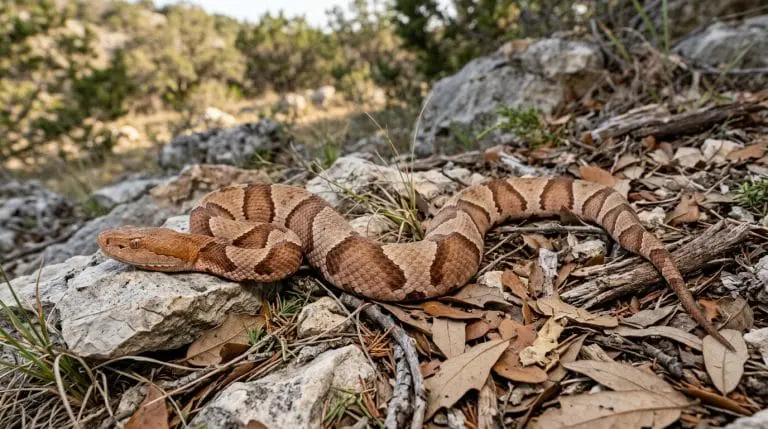
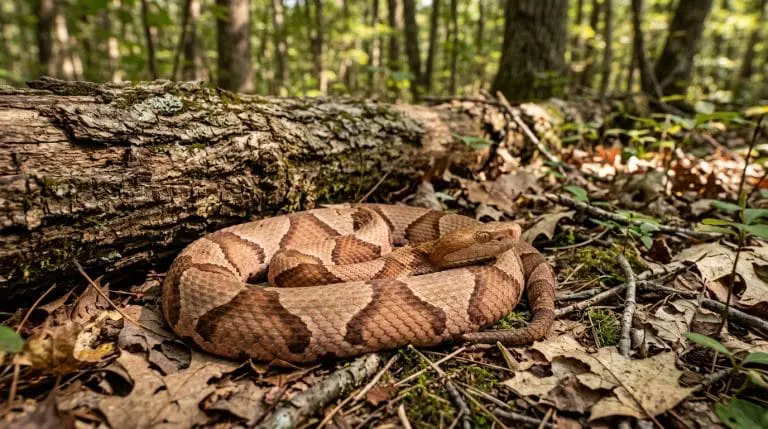
Copperheads have cleaner hourglass-shaped bands that are narrow across the back and broad on the sides. Their pale copper-colored heads generally lack the Florida cottonmouth’s bold, dark cheek stripe. Copperheads have a much more limited distribution in Florida, principally in the western Panhandle.
No single feature—including head shape, swimming posture, or willingness to remain still—is completely dependable. Never handle, corner, or approach an unknown snake to inspect its eyes, facial pits, or underside.
Geographic Range
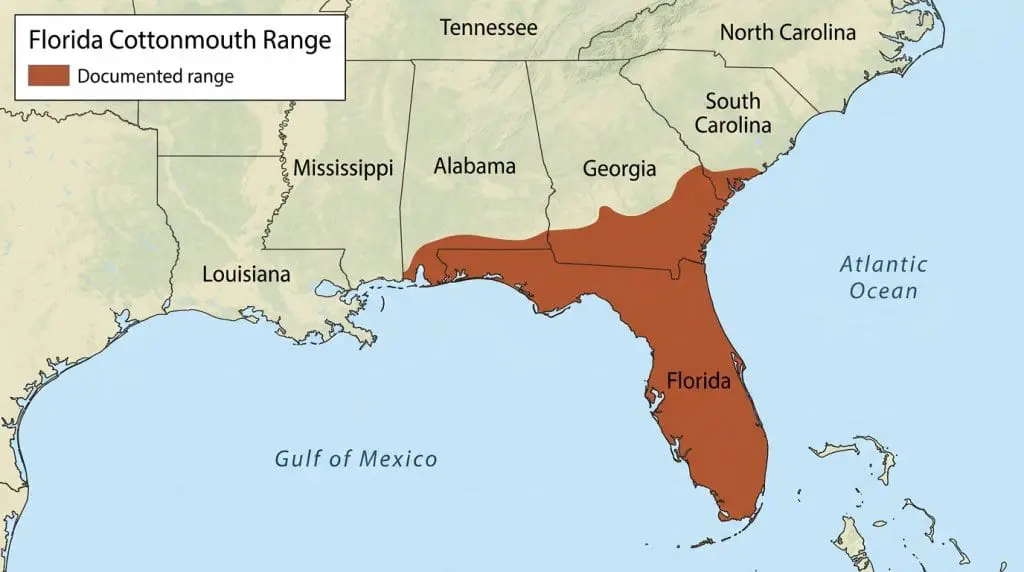
The Florida cottonmouth occurs throughout much of Florida, including the peninsula and Panhandle, and extends into southern Georgia. Its northern boundary meets or approaches the range of the northern cottonmouth (Agkistrodon piscivorus), and identification based only on geography may be uncertain near the contact zone.
Within Florida, cottonmouths occur in both inland and coastal wetland systems and on some islands. The Florida Museum’s Florida cottonmouth account provides additional state-specific identification and distribution information.
Habitat
Florida cottonmouths are closely associated with freshwater and brackish wetlands. Typical habitats include cypress swamps, marshes, wet prairies, floodplains, ponds, lakeshores, canals, drainage ditches, slow rivers, spring runs, and the margins of mangrove or salt-marsh systems.
They use vegetation, root tangles, fallen logs, debris piles, hollow stumps, mammal burrows, and spaces beneath banks as cover. Individuals often bask on logs, low branches, exposed banks, or patches of dry ground near water. They also enter pine flatwoods, hammocks, agricultural edges, and suburban areas, particularly where ponds, canals, or seasonal wetlands are nearby. Most populations occupy low elevations, reflecting Florida’s generally low-lying landscape.
Behavior and Activity
Florida cottonmouths swim readily and may cross ponds, canals, and streams. They also travel overland, especially after heavy rain, during breeding movements, or when wetlands shrink. Although primarily terrestrial and semiaquatic, they occasionally climb low limbs, roots, or shrubs near water.
Activity varies with temperature. In mild spring and autumn weather, snakes may move or bask during the day. During hot summers, they become more crepuscular or nocturnal, sheltering through the warmest hours. In southern Florida, activity can occur during suitable weather in almost any month.
When approached, a cottonmouth may remain motionless, retreat, or assume a defensive posture. A disturbed snake can coil, flatten its body, vibrate its tail, release musk, or open its mouth to reveal the pale lining. These behaviors are warnings, not evidence that the snake is pursuing a person. Give it space and a clear escape route.
Diet and Hunting
Florida cottonmouths are opportunistic predators. Their diet includes frogs, salamanders, fish, small turtles, lizards, snakes, birds, bird eggs, and small mammals. Carrion is sometimes consumed. Juveniles rely more heavily on frogs, small fish, and lizards and may use their bright tail tips as lures.
The snake hunts by ambush and by active searching. It strikes with folding hollow fangs that inject venom, then may hold small prey or release larger prey and follow its scent trail. The venom begins immobilizing prey and breaking down tissues; cottonmouths do not constrict their food.

Reproduction and Life Cycle
Mating occurs mainly in spring, with some courtship possible in autumn. Males may travel in search of females and engage in ritualized combat with rival males, raising and pressing against one another without typically using their fangs.
Florida cottonmouths give birth to live young rather than laying eggs. Births usually occur from late summer into early autumn. Litters often contain roughly 5–10 young, although smaller and larger litters occur. Reproduction may not happen every year, particularly where food or body condition is limited.
Newborns are independent and receive no prolonged parental care. Their contrasting bands and bright tail tips differ noticeably from the subdued appearance of many old adults. Wild lifespan is not well documented, but individuals may survive for more than a decade if they avoid predation, roads, and persecution.
Seasonal Activity
Activity increases during warm periods in late winter and spring. Spring movements include travel between winter shelters, feeding areas, basking sites, and breeding habitat. Summer heat often shifts surface activity toward evening, night, and early morning.
Autumn brings renewed daytime basking and, in some areas, additional breeding activity. In northern Florida and southern Georgia, snakes become less active during cold weather and shelter in burrows, root systems, stumps, bank cavities, or other protected retreats. This winter dormancy is usually described as brumation. Farther south, warm spells may permit intermittent winter movement and basking.
Venom and Medical Significance
The Florida cottonmouth is venomous. Its venom is primarily tissue-damaging and can cause substantial pain, swelling, bruising, blistering, and local injury; systemic effects and blood-clotting abnormalities are also possible. Severity varies, and even a bite that initially appears minor requires professional assessment.
After a suspected bite, move away from the snake, keep the person calm and as still as practical, remove constricting jewelry, and obtain emergency medical care promptly. Call 911 or the appropriate emergency service. Do not cut or suck the wound, apply ice, use an electric shock, or place a tight tourniquet. Do not attempt to catch or kill the snake for identification; a photograph taken from a safe distance is sufficient if one is already available.
Predators and Threats
Young cottonmouths may be eaten by large fish, wading birds, raptors, turtles, other snakes, and mammals. Adults face fewer predators but can be killed by kingsnakes, large birds, alligators, and mammalian carnivores.
Major human-related threats include wetland drainage, shoreline alteration, road mortality, intentional killing, and entanglement or injury around developed waterways. Cottonmouths are often killed because harmless watersnakes are mistaken for them, or because their defensive reputation is interpreted as aggression.

Encounters With People
People most often encounter Florida cottonmouths near pond margins, canals, boat ramps, fishing sites, trails through wetlands, flooded roads, and yards bordering water. Snakes may also shelter beneath outdoor materials or cross roads after rain.
Remain several body lengths away, keep children and pets back, and allow the snake to leave. Wear closed footwear when walking through dense vegetation and use a light at night. Never place hands where visibility is poor around logs, roots, or shoreline debris.
Cottonmouths do not routinely chase people. A snake moving in the same direction may be seeking nearby cover or water, and defensive advances can occur when escape is blocked. Back away slowly rather than testing its response or attempting to relocate it. For a snake in a building or high-use area, contact a qualified wildlife professional.
Conservation Status
The Florida cottonmouth is not federally listed as threatened or endangered and is generally considered secure across much of its range. Nevertheless, local populations can decline when wetlands are filled, fragmented, polluted, or isolated by roads and development.
State wildlife regulations may govern killing, possession, or collection. Protecting connected wetlands, reducing unnecessary persecution, and learning to distinguish cottonmouths from harmless watersnakes benefit both the species and the broader wetland community.
Identification Summary
Look for a stout wetland snake with keeled scales, irregular dark crossbands, a broad head, a narrowed neck, and a dark cheek stripe edged with pale lines. Juveniles are brightly patterned and have yellow or greenish tail tips; old adults may be nearly black. A white-mouth display supports identification but is not always performed and should never be provoked. Range, habitat, facial pattern, and overall build are most useful when considered together from a safe distance.
Frequently Asked Questions
Is every dark snake near water a cottonmouth?
No. Several harmless Florida watersnakes are dark, heavy-bodied, and aquatic. Use multiple visible features, especially facial markings, pattern, proportions, and geographic location, without approaching the animal.
Do Florida cottonmouths chase people?
They do not normally pursue people as prey or seek confrontation. A cornered snake may move defensively, while one heading toward water or cover may appear to follow someone standing in its route.
Does a cottonmouth always show its white mouth?
No. Many retreat, remain still, or use other defensive behaviors. Absence of a gape does not rule out a cottonmouth, and a snake should never be disturbed to trigger the display.
Are juvenile cottonmouths venomous?
Yes. Newborns can deliver medically significant bites. Their bright tail tips and bold patterns do not indicate that they are harmless.
Can Florida cottonmouths climb and swim?
They are capable swimmers and occasionally climb low vegetation, roots, and logs. Swimming posture alone is not a reliable way to separate cottonmouths from watersnakes.
What should I do if I find one in my yard?
Keep people and pets away and give the snake time to leave. If it remains inside a building or in a location where safe separation is impossible, contact a qualified local wildlife remover rather than attempting to handle it.