
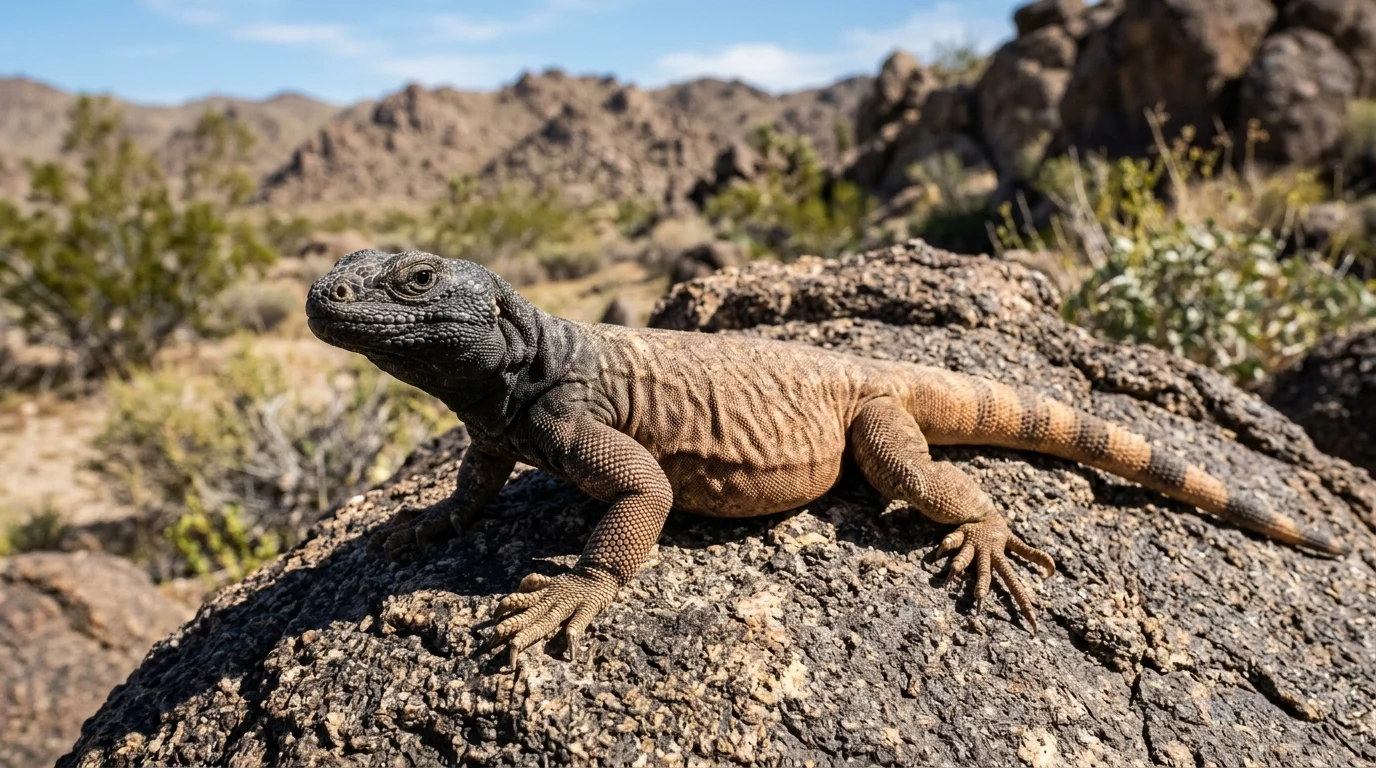
Chuckwalla Guide
Keep Track of What You See
Create a free Wild Things Guide membership to record this Chuckwalla in My Sightings and build your personal wildlife list.
Join to Add This SightingIntroduction
The common chuckwalla (Sauromalus ater) is a large, heavy-bodied lizard of the deserts of the southwestern United States and northwestern Mexico. It occurs primarily in rocky portions of the Mojave and Sonoran deserts, where it is often seen basking on sun-warmed boulders. This harmless, mostly plant-eating reptile is best known for retreating into rock crevices and inflating its body so that predators cannot easily pull it out.
Although some older sources use the name Sauromalus obesus, Sauromalus ater is the accepted scientific name for the widespread mainland species discussed here. Other chuckwalla species occur on islands in the Gulf of California.

Quick Identification
- Large desert lizard with a broad, flattened body and loose folds of skin along the neck and sides.
- Blunt head, small eyes, visible ear openings, and no crest or throat fan.
- Thick limbs with strong toes and claws adapted for climbing over rock.
- Heavy tail that is broad at the base and tapers toward a blunt point.
- Adult males often have a black or very dark head and forequarters with a tan, reddish, orange, yellowish, or dark gray body.
- Females and juveniles are usually gray, brown, or tan, commonly with dark crossbands, mottling, or scattered spots.
- Most often observed basking near cracks, ledges, and piles of fractured rock.
Appearance and Identification
The chuckwalla has a robust, somewhat flattened body that looks unusually heavy for a desert lizard. Its skin is covered with small, granular scales rather than the sharply keeled or spiny scales seen on many fence and spiny lizards. Loose skin forms conspicuous folds around the neck, shoulders, and sides of the torso. These folds allow the body to expand when the animal inflates its lungs inside a crevice.
The head is broad and blunt, but it is not greatly enlarged in proportion to the body. The eyes are relatively small, with round pupils, and a distinct external ear opening is visible behind each eye. The jaws are strong and adapted for cropping vegetation. Unlike an iguana, a chuckwalla lacks a prominent row of tall dorsal spines and does not have a large hanging dewlap.
The limbs are short but powerful. Long toes and curved claws provide traction on rough stone, allowing the lizard to move quickly across steep rock faces. Its thick tail is shorter and less whiplike than that of a desert iguana. Chuckwallas do not routinely shed the tail as a primary defense, and an intact adult normally has a heavy tail that gradually narrows toward the tip.
Sexual differences become clearer in mature animals. Adult males tend to be larger, with broader heads, more prominent femoral pores on the undersides of the thighs, and stronger color contrast. Females generally retain subdued gray-brown coloration and juvenile-like banding, although appearance varies considerably among individuals and populations.

Size
Most adult common chuckwallas measure approximately 12–18 inches (30–46 cm) in total length, including the tail. Exceptionally large males may approach about 20 inches (51 cm). Males are usually longer, heavier, and more robust than females. Body size varies with age, food availability, locality, and growing conditions, so do not use length alone for identification.
Color and Pattern
Color changes substantially with age, sex, locality, temperature, and lighting. Juveniles commonly have four or five dark bands across a gray or brown body and additional banding on the tail. The bands may break, fade, or become obscured as the lizard matures.
Many adult males develop a black head, neck, shoulders, and forelimbs. The middle and rear of the body may be tan, rusty red, orange, yellowish, dark gray, or nearly black. Some retain dark bars or mottling. Adult females are more often gray, olive-brown, or tan with irregular dark spots, bars, or crossbands. Individuals from different desert regions can look strikingly different, and not every male has a sharply divided black-and-orange pattern.
Temperature also affects visual impressions. A cool chuckwalla may appear darker while warming in the morning sun, whereas a warm, fully active animal can look lighter. Identification should therefore combine color with body shape, granular scales, loose skin folds, and rocky habitat.
Similar Species
Desert iguana: The desert iguana is slimmer and usually much paler, with a long, narrow tail and a fine brown reticulated pattern. It is often found on sandy flats and in creosote scrub. A chuckwalla is heavier, broader, more loosely skinned, and especially tied to boulders and crevices.
Spiny and fence lizards: These lizards have conspicuously rough, keeled scales and are much smaller. Chuckwallas have fine granular scales, thick limbs, loose folds of skin, and a massive torso.
Gila monster: A Gila monster has beadlike scales and a bold black pattern combined with pink, orange, or yellow. It also has a thick, rounded tail used for fat storage. Chuckwallas lack the beaded texture and high-contrast chain-like pattern. Because Gila monsters are venomous and legally protected in many areas, no unfamiliar lizard should be approached or handled for identification.
Collared lizards: Collared lizards are considerably slimmer and longer-legged, with two dark neck collars and a proportionally long tail. They may run upright on their hind legs, whereas chuckwallas typically remain close to rocks and escape into crevices.
Geographic Range
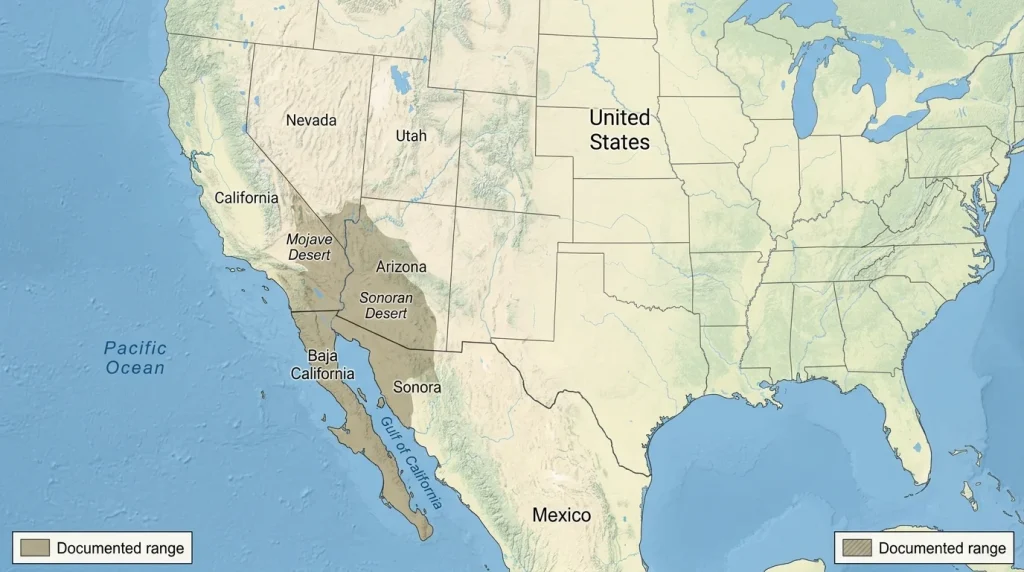
The common chuckwalla inhabits the desert Southwest of North America. Its U.S. range includes southeastern California, southern Nevada, southwestern Utah, and western Arizona. In Mexico, it extends into parts of Baja California, Sonora, and adjacent northwestern desert regions. Distribution is patchy where suitable rock formations are absent.
In the United States, the species is associated with the Mojave and Sonoran deserts, including areas around Death Valley, the lower Colorado River, and desert mountain ranges. The National ParkService’ss Joshua Tree National Park chuckwalla profile provides additional information about its life in rocky desert landscapes.
Habitat
Chuckwallas favor hot, dry terrain with abundant exposed rock. Typical settings include lava flows, talus slopes, canyon walls, rocky washes, desert hillsides, boulder fields, and fractured outcrops. Creosote bush scrub, bursage, desert wash vegetation, and scattered cacti may surround these rocky refuges.
Deep cracks and narrow spaces beneath boulders are essential habitat features. They protect from predators and extreme temperatures and may also serve as overnight or winter shelters. Chuckwallas occur from low desert basins into rocky mountain slopes, but local presence depends more on suitable crevices, sunlight, and nearby vegetation than on elevation alone.
Behavior and Activity
Chuckwallas are primarily diurnal. They often emerge after sunrise, bask on exposed stone, and then alternate between feeding, basking, shade, and shelter. Their flattened posture increases contact with warm rock. During extreme midday heat, they may remain in shade or deep inside a crevice.
Despite their bulky appearance, chuckwallas can move rapidly over boulders. They are capable climbers but are not generally associated with trees or water. Adult males may defend basking and feeding areas through head-bobbing, push-up displays, body postures, and occasional physical contests with other males.
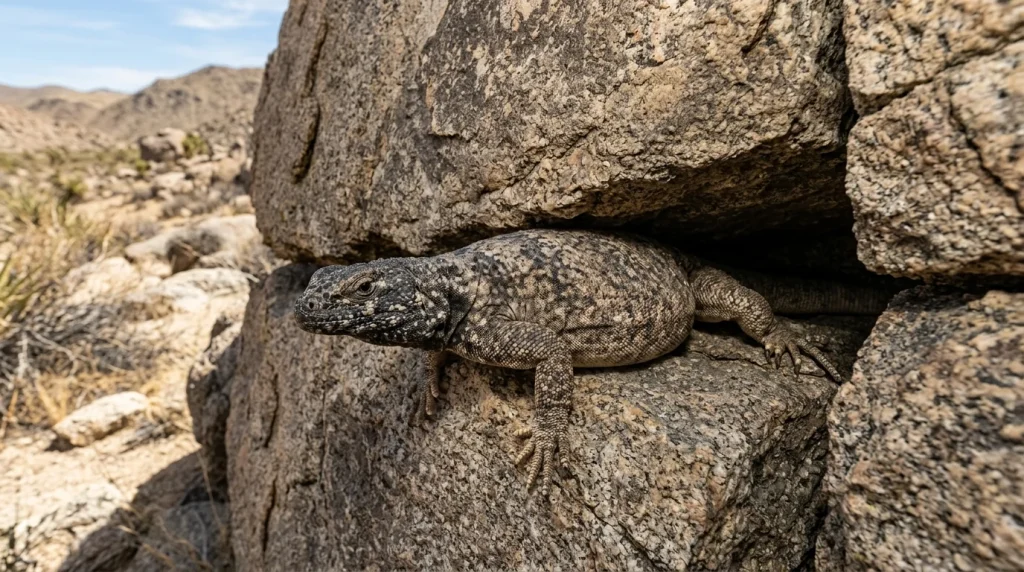
When threatened, a chuckwalla usually runs to a familiar crack. Once inside, it braces its legs and inflates its lungs, pressing the body against the surrounding rock. This makes removal difficult. If cornered or handled, it may gape, scratch, or bite, but it is neither venomous nor normally aggressive toward people.
Diet and Hunting
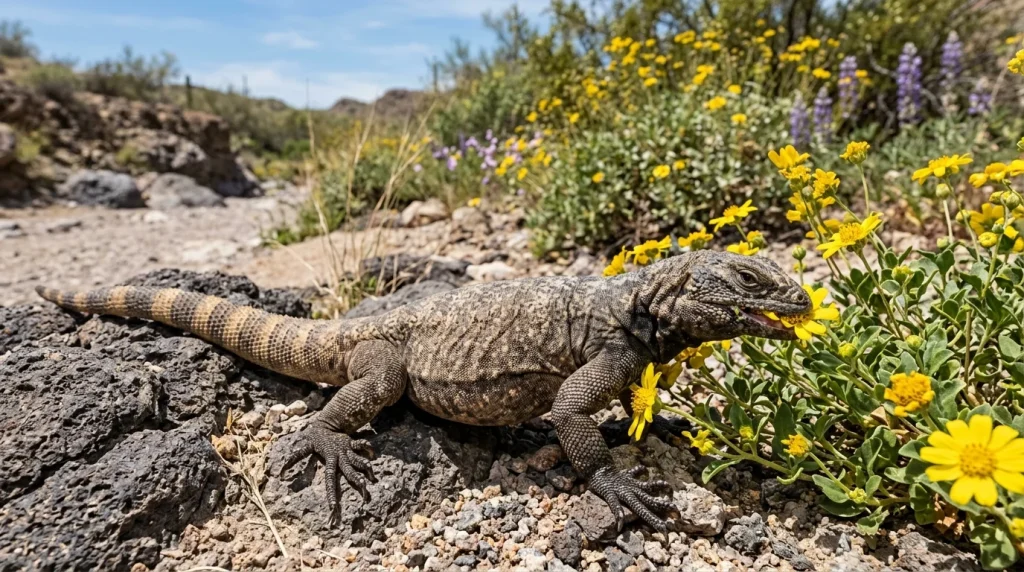
The chuckwalla is predominantly herbivorous and does not hunt like a predatory lizard. It feeds on leaves, flowers, buds, fruits, and tender shoots from desert plants. Seasonal wildflowers and the blossoms of shrubs and cacti can be important foods when available. Plant selection varies with locality and rainfall.
Juveniles may consume insects more regularly than adults, and adults occasionally take small invertebrates, but animal matter is a minor part of the usual diet. Much of the animal’s water comes from succulent vegetation and seasonally fresh plant growth.
Reproduction and Life Cycle
Courtship and mating generally occur in spring and early summer, after animals have resumed regular activity. Males use visual displays and may patrol areas containing several females. Reproductive timing and success depend on winter rainfall and spring plant growth; females may not breed every year when resources are poor.
The common chuckwalla is oviparous, meaning that it lays eggs. A female deposits a clutch in a protected underground nest or sheltered cavity, often in early to midsummer. Reported clutches are commonly around 5–16 eggs, although female size and environmental conditions cause variation. Incubation continues through the hot season, and hatchlings generally emerge in late summer or early autumn.
Young chuckwallas are strongly banded and remain vulnerable to predators. Growth and sexual maturity take several years. Reliable estimates of typical wild lifespan are limited, but chuckwallas are relatively long-lived lizards and may survive for 15 years or longer under favorable conditions; captive individuals can live beyond 20 years.
Seasonal Activity
In cooler parts of the range, chuckwallas spend winter inactive in deep rock shelters and emerge during spring as daytime temperatures rise. Spring is an important period for basking, feeding, territorial behavior, and mating. Activity may peak when winter rains produce abundant flowers and new leaves.
During summer, lizards often appear early in the morning and reduce exposed activity during the hottest hours. They may reappear later in the day as rock temperatures moderate. In the warmest low-desert areas, some activity may continue through much of the year, while populations at higher or more northerly sites have a longer winter dormancy. Chuckwallas do not make long seasonal migrations; they generally remain near established rocky refuges.
Predators and Threats
Natural predators include hawks and other raptors, coyotes, foxes, bobcats, roadrunners, and larger snakes. Eggs and hatchlings are particularly vulnerable. Rocky crevices, camouflage, rapid retreat, and body inflation are the chuckwalla’s principal defenses.
Human-related threats include habitat destruction or fragmentation, road mortality, illegal or poorly regulated collection, off-road vehicle use, and deliberate disturbance. Invasive grasses can increase the frequency of desert fires, damaging slow-recovering plant communities that provide food. Climate-driven changes in rainfall and extreme heat may also affect forage and reproduction, though effects likely vary by region.
Encounters With People
Hikers are most likely to see chuckwallas basking on boulders in the morning or moving between rocks and nearby vegetation. You often notice them beside canyon trails, lava flows, rocky washes, and desert picnic areas. A motionless animal can blend surprisingly well with dark or weathered stone.
Observe from a distance and leave the lizard an unobstructed path to shelter. Do not chase it into a crack, attempt to pull it out, feed it, or move rocks around its refuge. Chuckwallas are not venomous and do not pursue people. A bite is possible if one is captured or restrained, but you can avoid such incidents by leaving wild animals alone.
Conservation Status
The common chuckwalla is commonly assessed as Least Concern on the IUCN Red List because it occupies a broad range and remains locally common in suitable habitat. Nevertheless, development, habitat disturbance, unauthorized collection, and changing fire regimes can affect populations.
Legal protections and collection rules differ among U.S. states, federal lands, parks, and Mexican jurisdictions. Removing wildlife from national parks is prohibited, and permits or seasonal restrictions may apply elsewhere. Protecting intact boulder fields, native desert vegetation, and connected rocky terrain benefits the species.
Identification Summary
Identify the common chuckwalla by its large, flattened body, granular scales, loose skin folds, powerful limbs, blunt head, and thick tapering tail. Mature males are often dark over the head and forequarters, with a contrasting reddish, orange, tan, yellowish, or gray torso; females and juveniles are generally brown or gray with dark bands or mottling.
Range and habitat are strong supporting clues: look for this lizard in rocky parts of the Mojave and Sonoran deserts, particularly around lava, talus, canyon walls, and fractured boulders. Basking near a narrow crevice and retreating into it when disturbed are highly characteristic behaviors. Observe from a respectful distance rather than relying on close examination.
Frequently Asked Questions
Is a chuckwalla a snake?
No. A chuckwalla is a large iguanid lizard with four well-developed limbs, external ear openings, movable eyelids, and a heavy tail.
Are chuckwallas venomous or dangerous?
Chuckwallas are not venomous and are generally harmless. A restrained animal can bite or scratch defensively, so wild chuckwallas should never be handled.
Why does a chuckwalla inflate its body?
It inflates after entering a narrow rock crack. The expanded body presses against the stone, while the legs brace against the crevice, making it difficult for a predator to extract the lizard.
What do chuckwallas eat?
They eat mainly leaves, flowers, buds, fruits, and new plant growth. They may occasionally eat insects and other small invertebrates, especially young animals.
Where can chuckwallas be seen?
They occur in rocky desert areas of southeastern California, southern Nevada, southwestern Utah, western Arizona, and northwestern Mexico. Early morning basking sites near cracks and boulders offer the best viewing opportunities.
How can a male be distinguished from a female?
Adult males are typically larger, with broader heads and more conspicuous femoral pores. Many have dark heads and forequarters combined with a contrasting torso. Females usually retain subdued gray-brown banding, but color alone is not reliable in every population.
Can a chuckwalla lose its tail?
Its tail can be injured, but chuckwallas do not depend on easy tail release as strongly as many smaller lizards. The tail should never be grasped or used to restrain the animal.
When are chuckwallas active?
They are diurnal and are most conspicuous while basking or feeding during spring and warm mornings. Midday activity decreases in extreme summer heat, and northern populations spend winter inactive in sheltered rock crevices.


