

Acadian Flycatcher Guide
Keep Track of What You See
Create a free Wild Things Guide membership to record this Acadian Flycatcher in My Sightings and build your personal wildlife list.
Join to Add This SightingIntroduction
The Acadian Flycatcher (Empidonax virescens) is a small, olive-colored songbird associated with mature deciduous forests in eastern North America. It belongs to the challenging Empidonax group, whose members often look nearly identical in the field. Voice, habitat, structure, and range are therefore more useful than plumage alone.
This flycatcher usually occupies shady forest interiors, especially near streams, ravines, and wooded wetlands. Although it often remains beneath the canopy, an alert observer may notice its upright posture, broad-based bill, conspicuous eye ring, and quick flights after insects. Its abrupt, explosive song is usually the most dependable clue to its presence. The Cornell Lab of Ornithology species account provides additional recordings and identification material.
Quick Identification
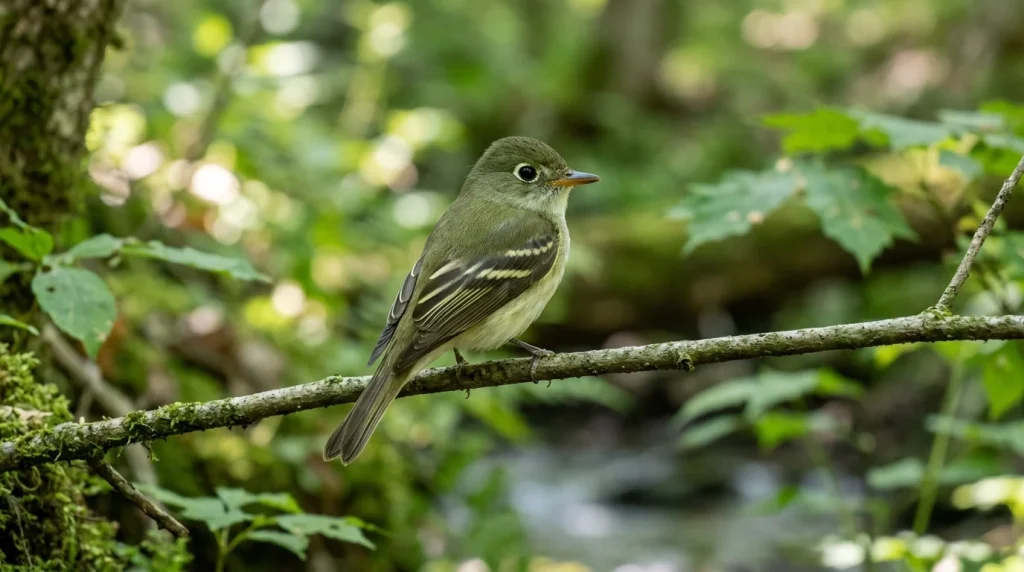
- Overall color: Olive-green upperparts with a pale throat and whitish underparts, often washed yellowish across the breast or belly.
- Face: Bold, complete whitish or yellowish-white eye ring that may appear slightly broader behind the eye.
- Wings: Two pale wing bars and dark wings with relatively long primary projection.
- Bill: Broad and flattened, with a dark upper mandible and usually a pale yellowish or pinkish-orange lower mandible.
- Shape: Large-headed, long-winged, and somewhat sleek for an Empidonax flycatcher.
- Voice: A sharp, explosive song commonly rendered as peet-sah or pit-see.
- Habitat: Mature, moist deciduous forest, often along shaded streams.
Appearance
Adult Acadian Flycatchers are olive to olive-green above, with the crown sometimes appearing slightly darker than the back. The throat is pale, while the breast and belly range from off-white to softly yellow-washed. Fresh plumage can look relatively bright, but worn birds may appear grayer and less strongly patterned.
The face has a prominent pale eye ring, although its shape varies with feather position, molt, lighting, and viewing angle. Two buffy-white or yellowish wing bars contrast with the darker wings. Long primary feathers create an extended, pointed-looking rear edge to the folded wing—a useful structural feature when the bird is seen well.
Males and females are essentially alike in plumage and cannot normally be separated by ordinary field observation. Juveniles resemble adults but may show warmer or buffier wing bars and fresher-looking feather edges. As with other small flycatchers, color can be misleading under a green forest canopy, so observers should not identify the species from apparent color alone.

Size and Wingspan
The Acadian Flycatcher is a small songbird with a relatively large head and long wings.
- Length: About 13–15 cm (5.1–5.9 in)
- Wingspan: About 22–23 cm (8.7–9.1 in)
- Weight: Commonly around 11–14 g (0.4–0.5 oz)
It may look larger and longer-winged than a Least Flycatcher, but direct size judgments are unreliable without a nearby comparison. Bill width, wing length, vocalizations, and habitat are usually more informative.
Range and Distribution
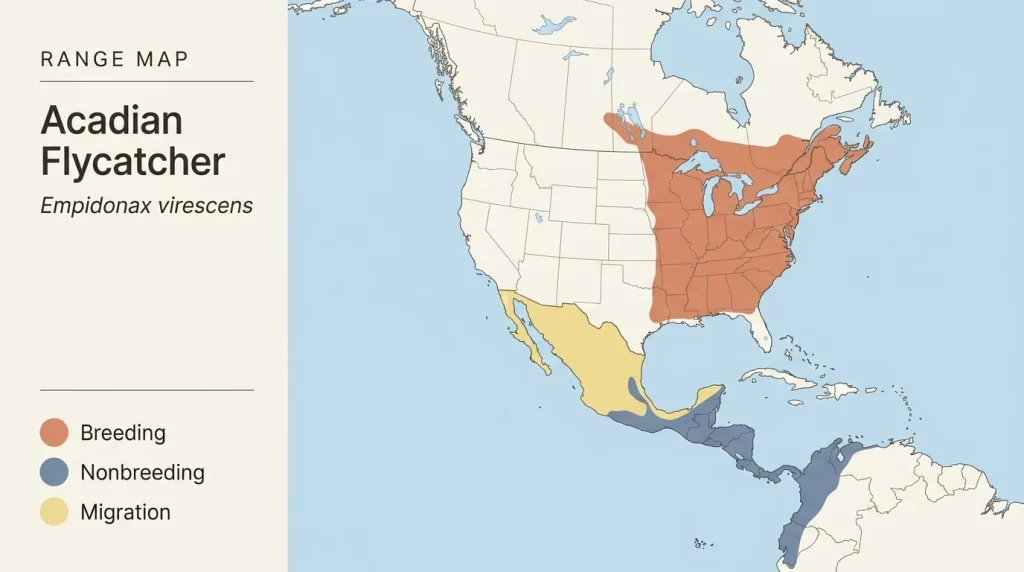
This species breeds primarily in the eastern United States. Its core range extends from parts of the Midwest and lower Great Lakes region east to the Atlantic states, then south to the Gulf Coast. It also reaches limited areas of southern Canada, where its distribution is local.
The Acadian Flycatcher is a long-distance migrant. Most individuals leave North American breeding areas in late summer and early fall, wintering from southern Mexico through Central America and into portions of northwestern South America. They return during spring, with arrival dates varying by latitude and weather.
Distribution within the breeding range is uneven. The species can be locally common in extensive, suitable forest yet absent from nearby young woodland, exposed ridges, or heavily fragmented landscapes.
Habitat
Acadian Flycatchers favor mature deciduous or mixed forest with a closed canopy, shaded understory, and relatively open space between the ground vegetation and upper foliage. Moisture is a frequent feature of occupied sites. Typical settings include:
- Wooded stream corridors and bottomland forest
- Shaded ravines and steep, forested slopes
- Swamp margins and wooded wetlands
- Mature beech-maple, oak-hickory, or mixed hardwood forest
- Large forest tracts with limited edge disturbance
Nests are often positioned over a stream, trail, or open gap beneath the canopy. The bird is generally considered sensitive to forest fragmentation, although local occupancy also depends on vegetation structure, moisture, predators, and regional conditions.

Behavior
Like other flycatchers, this species commonly hunts from a perch. It sits upright on a shaded horizontal branch, watches for moving prey, and makes a rapid outward flight to capture an insect. It may return to the same perch or land nearby, often flicking its wings or tail briefly after settling.
Foraging flights may be directed upward, sideways, or down toward leaves. Birds also hover momentarily beside foliage and pick prey from leaf surfaces. They usually remain below the upper canopy, though singing males may choose more exposed perches within the forest.
During the breeding season, males defend territories with songs, calls, flights, and chases. The species is not typically conspicuous on the ground and spends most of its time among branches and foliage.
Diet
The Acadian Flycatcher eats mostly insects and other small arthropods. Flies, moths, butterflies, beetles, wasps, bees, true bugs, ants, and spiders may all be taken. The exact mixture changes with season and local availability.
Most prey is captured in the air or gleaned from leaves during brief hovering movements. Small fruits or berries may occasionally supplement the diet, particularly during migration or when insect activity is reduced, but animal prey forms the main food source.

Vocalizations
Voice is the strongest field mark. The principal song is a loud, abrupt two-part phrase often written as peet-sah, pit-see, or pizza. It is sharper and more explosive than those spellings suggest and can carry surprisingly far through dense forest.
Other vocalizations include softer contact notes, thin whistles, and sharper calls used during agitation or interaction. Because members of the Empidonax group overlap in appearance, a clearly heard, typical song can be more diagnostic than a distant visual observation. Observers should nevertheless consider whether the sound came from the bird being watched, especially where several flycatchers are present.
Breeding and Nesting
Acadian Flycatchers form breeding territories after returning in spring. The female is principally responsible for constructing the nest, a shallow cup or hammock suspended in the fork of a slender horizontal branch. Fine plant fibers, bark, grasses, spider silk, and other flexible materials are woven together. Loose strands often hang beneath the finished structure, making it appear untidy or barely attached.
Nests are commonly placed several feet above the ground and are often over water, a path, or a relatively open woodland gap. A typical clutch contains two or three creamy-white eggs marked with brown or reddish-brown spotting, often concentrated toward the larger end. The female incubates, which generally lasts about two weeks. Both parents may help feed nestlings.
Brown-headed Cowbirds sometimes lay eggs in Acadian Flycatcher nests. Nest success also varies with storms, snakes, squirrels, corvids, mammals, and the degree of surrounding forest fragmentation.

Young and Development
Hatchlings are helpless and require brooding and frequent feeding. Adults deliver small insects, gradually increasing prey size as the nestlings grow. The young generally leave the nest after roughly two weeks, although timing varies with weather, food, and development.
Newly fledged birds have short tails and may remain close to the nest area while their flight improves. Parents continue feeding them after fledging. Buff-colored wing bars and fresh feather edges can make juveniles appear warmer than adults. Still, young Empidonax flycatchers remain difficult to identify safely without location, accompanying adults, or vocal evidence.
Where to See
Search large tracts of mature eastern forest from late spring through summer. Trails that follow shaded creeks, wooded ravines, or bottomland rivers are particularly productive. Walk slowly, pause often, and listen before trying to locate the singer.
Once you hear the song, scan horizontal branches in the middle and lower levels of the forest. Watch for a small bird making short aerial loops and returning to a perch. Early morning is usually best for singing activity, although Acadian Flycatchers may vocalize intermittently throughout the day.
Stay on established trails and avoid approaching occupied nests. The low, exposed-looking nest may be easy to disturb, and lingering nearby can attract predators.
Similar Species
- Yellow-bellied Flycatcher: Usually more strongly yellow below, with a yellower throat, more rounded eye ring, and shorter primary projection. It favors northern coniferous or boggy habitat during breeding.
- Least Flycatcher: Smaller and more compact, with a shorter, narrower-looking bill and bold eye ring. Its familiar che-bek song is distinctive.
- Willow Flycatcher: Often browner or grayer, with a weak or absent eye ring and less contrasting wing bars. It typically occupies shrubby, open wetlands and sings fitz-bew.
- Alder Flycatcher: Similar to Willow but associated mainly with northern wet thickets. Reliable separation is based largely on voice.
- Eastern Wood-Pewee: Larger, longer-bodied, and usually grayer, with a less obvious eye ring and a darker lower mandible. Its drawn-out, whistled song is unlike the Acadian’s explosive phrase.
Conservation
The Acadian Flycatcher is commonly classified as Least Concern on the IUCN Red List, but that category does not mean all populations are secure. Long-term monitoring has indicated declines in parts of its range. Loss and fragmentation of mature forest can reduce available habitat and may increase exposure to nest predators and brood parasitism.
Conservation priorities include protecting large forest blocks, maintaining wooded stream buffers, retaining mature canopy structure, and limiting unnecessary disturbance near breeding sites. Conditions on migration routes and wintering grounds also matter because the species depends on forest habitats across several countries.
Field Identification Tips
- Listen first. Learn the short, forceful song before visiting suitable habitat.
- Evaluate habitat. A singing empid in mature, shaded streamside forest is a stronger Acadian candidate than one in an open shrub marsh.
- Check structure. Look for a broad bill, relatively long wings, and substantial primary projection.
- Confirm the face and wings. Note the complete eye ring and two pale wing bars, but do not rely on either feature alone.
- Use multiple clues. Combine voice, range, date, habitat, proportions, and plumage.
- Accept uncertainty. A silent migrant seen briefly may be best recorded simply as an unidentified Empidonax flycatcher.
Frequently Asked Questions
Why is the Acadian Flycatcher difficult to identify?
It belongs to a group of small flycatchers with very similar olive upperparts, pale underparts, eye rings, and wing bars. Vocalizations and habitat usually provide the clearest separation.
Can males and females be distinguished in the field?
Not reliably by plumage. Males and females look alike to human observers under normal field conditions, although their roles and behavior around an active nest may differ.
Does it live in Acadia?
The common name is misleading. The species’ main breeding range lies farther south and west than the Canadian Maritimes historically known as Acadia, and it is not a characteristic breeder there.
Does the Acadian Flycatcher catch every insect in flight?
No. It frequently captures flying insects in short sallies, but it also hovers beside foliage and takes insects or spiders directly from leaves and twigs.
Is an eye ring enough for identification?
No. Several related flycatchers have prominent eye rings. A dependable identification should incorporate the voice, bill shape, wing structure, habitat, season, and geographic range.


