

Alder Flycatcher Guide
Keep Track of What You See
Create a free Wild Things Guide membership to record this Alder Flycatcher in My Sightings and build your personal wildlife list.
Join to Add This SightingIntroduction
The Alder Flycatcher (Empidonax alnorum) is a small, olive-gray songbird of wet thickets across northern North America. It belongs to a group of remarkably similar flycatchers in the genus Empidonax. Plumage alone is often insufficient for a confident identification, especially when separating Alder from Willow Flycatcher.
Voice, habitat, season, and geographic location are therefore central to field identification. During the breeding season, an Alder Flycatcher’s abrupt, burry song usually provides the best evidence. Outside that period, observers should be cautious and may need to record the bird simply as Alder/Willow Flycatcher, often called a “Traill’s Flycatcher.”
The Cornell Lab of Ornithology’s Alder Flycatcher account provides additional photographs, recordings, and distribution information.
Quick Identification
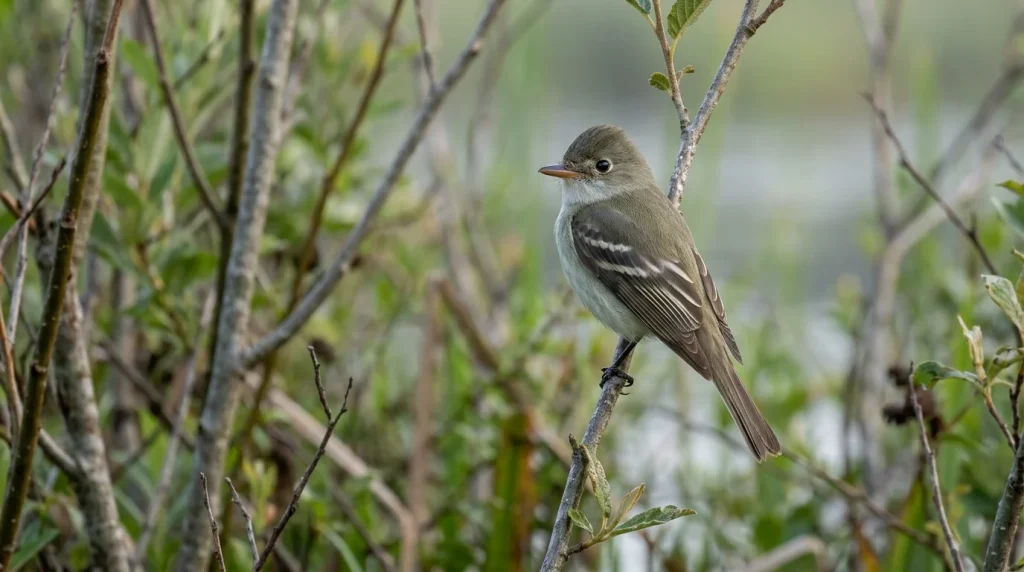
- Overall shape: Small, upright flycatcher with a fairly large head, short neck, and medium-length tail.
- Upperparts: Muted olive-gray to brownish olive, usually greener when fresh.
- Underparts: Whitish throat and belly with a pale gray to olive wash across the breast and sides.
- Wings: Two pale wing bars and light edging on the inner flight feathers.
- Face: Weak, narrow, or incomplete pale eye ring; no bold facial pattern.
- Bill: Broad and flat at the base, with a dark upper mandible and a largely pale lower mandible.
- Behavior: Watches from exposed perches, then flies out to capture insects.
- Best field mark: A rough, emphatic song commonly rendered as “fee-BEE-o,” “rree-BEER,” or the mnemonic “free beer.”
Appearance
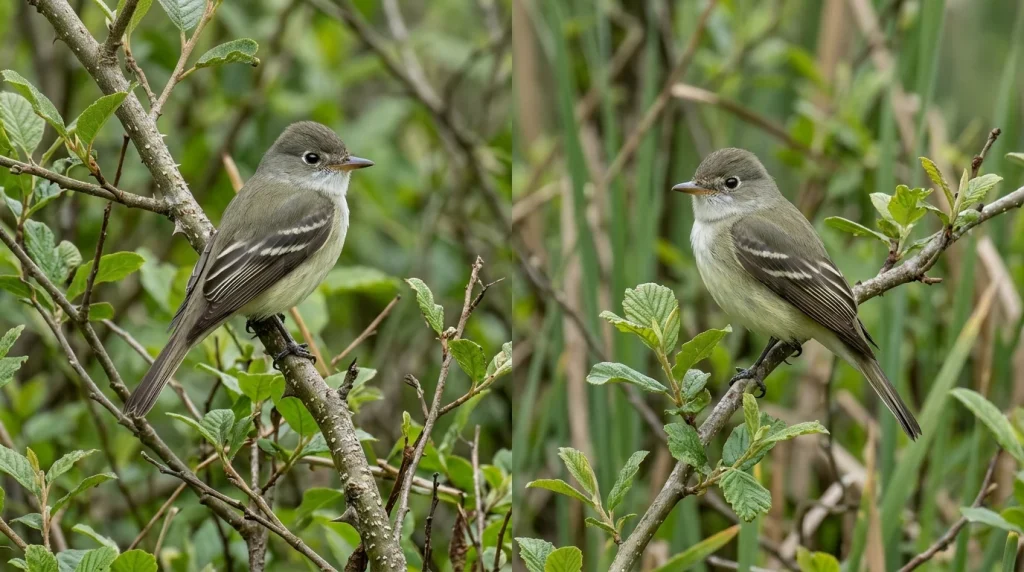
Alder Flycatchers have the restrained plumage typical of many Empidonax flycatchers. The crown and back are olive-gray, the wings are darker, and two pale buff or whitish wing bars cross each folded wing. Pale fringes on the tertials can create a subtly patterned wing panel.
The throat is whitish, while the breast is washed pale gray or olive. The center of the belly is generally whitish, sometimes with a faint yellowish cast in fresh plumage. The eye ring is usually narrow and subdued and may appear broken. This weakness can be useful when comparing the bird with Least or Yellow-bellied Flycatchers, although it varies with wear, age, light, and viewing angle.
The bill looks broad-based from above. The lower mandible is generally pale yellowish, orange, or pinkish, sometimes with a darker tip. The legs are dark. Males and females are alike in visible plumage and normally cannot be separated in the field. Juveniles tend to show warmer buff wing bars and fresher-looking feather edges.
Size and Wingspan
Adults are typically about 13–15 cm (5.1–5.9 in) long, with a wingspan of roughly 21–25 cm (8.3–9.8 in). They usually weigh around 12–14 g (0.4–0.5 oz). This makes the species a compact songbird, smaller than an Eastern Phoebe and close in size to other migratory Empidonax flycatchers.
Apparent size can be misleading in dense vegetation. Structure is more informative: note the modest primary projection, medium tail, rounded head, and relatively substantial bill. Even these traits overlap extensively with Willow Flycatcher.
Range and Distribution
The Alder Flycatcher breeds across much of Alaska and Canada, extending south into the northeastern and north-central United States. It also occurs locally along suitable wet, shrubby habitats in the Appalachian region and nearby uplands. Its breeding distribution is strongly associated with northern forests, bog margins, beaver wetlands, stream corridors, and regenerating clearings.
This species is a long-distance migrant. Birds leave northern breeding areas in late summer and travel through eastern and central North America, Mexico, Central America, and the Caribbean region. Wintering occurs primarily in northern and western South America, especially in humid lowlands and foothills east of the Andes. Migration routes and timing overlap broadly with those of Willow Flycatcher.

Habitat
Alder Flycatchers favor damp, brushy places rather than mature closed-canopy forest. Typical breeding habitats include:
- Willow and alder thickets beside streams, ponds, and marshes
- Bog and fen margins with scattered shrubs
- Beaver meadows and wet woodland openings
- Brushy edges of northern lakes
- Regenerating cuts or burns where moist soil supports dense shrubs
The habitat often contains shrubs two to several meters tall, interspersed with openings that provide room for aerial feeding. During migration and winter, Alder Flycatchers use a broader selection of brushy woodland edges, second growth, riparian vegetation, and humid scrub.

Behavior
An Alder Flycatcher typically sits upright on a twig near the edge of a shrub. From that lookout, it makes short aerial sallies to seize flying insects, often returning to the same perch or another one nearby. It also gleans prey from leaves and twigs and may hover briefly beside vegetation.
Compared with an Eastern Phoebe, it does not habitually pump or wag its tail. Breeding birds can be inconspicuous while feeding but become easier to locate when singing repeatedly from the top or outer edge of a shrub. Males defend territories with song and may chase neighboring flycatchers through the thicket.
Diet
The diet consists mainly of insects and other small arthropods. They may take flies, beetles, moths, butterflies, wasps, bees, true bugs, and spiders, depending on local and seasonal availability. Much of the prey is captured in flight, which explains the species’ preference for perches overlooking open pockets within dense vegetation.
Alder Flycatchers also pick prey from foliage and occasionally take small fruits or berries, particularly later in the season. Plant foods are supplementary rather than the main breeding-season diet.

Vocalizations
Song is the most dependable way to recognize an Alder Flycatcher. The usual advertising song is short, explosive, and burry, often transcribed as “fee-BEE-o” or “rree-BEER.” Many birders remember it as “free beer.” The final portion can sound clipped or upward-inflected, but human descriptions vary.
Calls include a dry or sharp “pip,” “pit,” or doubled note. Alder and Willow Flycatchers have more similar calls than songs, so an isolated call should be interpreted carefully. Both species may also give atypical or incomplete vocalizations during migration. Whenever possible, listen for repeated full songs and make an audio recording.
Breeding and Nesting
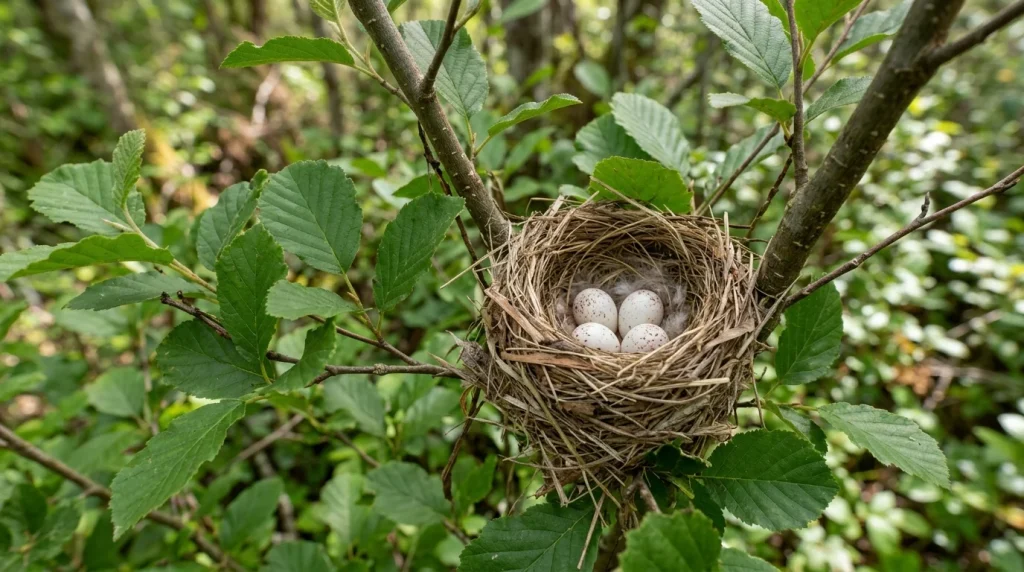
Breeding begins after birds return to northern territories in late spring. The female constructs a compact open cup, usually placed low in the fork of a deciduous shrub such as Alder, dogwood, or birch. Unlike many Willow Flycatcher nests, an Alder Flycatcher nest often appears tidier and less likely to have long streamers hanging below, but nest form alone is not diagnostic.
The cup is built from grasses, strips of bark, plant fibers, and other fine vegetation, with softer material lining the interior. A typical clutch contains three or four creamy white eggs marked with brown or dark spots, often concentrated toward the larger end. The female incubates the eggs for about two weeks. The male remains nearby, defends the territory, and may help supply food after hatching.
Young and Development
Hatchlings are helpless and depend completely on their parents for warmth and food. Both adults commonly deliver insects to the nestlings. The young develop rapidly and generally leave the nest after about two weeks, although timing varies with weather, food, and disturbance.
Recently fledged birds remain in thick cover and continue to receive food from adults. Juveniles can be recognized by their fresh plumage, buffier wing bars, and pale feather edges, but they remain difficult to distinguish from young Willow Flycatchers. Families gradually disperse before southbound migration.
Where to See
Search wet, brushy habitat within the breeding range from late May through July, when males are most vocal. Northern wildlife refuges, bog boardwalks, beaver wetlands, shrubby lake margins, and damp utility corridors can all be productive. In the Appalachian region, check cool mountain wetlands and streamside thickets.
Stop periodically and listen rather than walking continuously. A singing bird may remain hidden despite being close. Once a song reveals its position, scan dead twigs or projecting branches near the tops of shrubs. During migration, identification is harder because many birds are silent and may occur away from characteristic breeding habitat.
Similar Species
- Willow Flycatcher: The closest look-alike and often impossible to separate safely by appearance. Willow’s song is commonly rendered “fitz-bew,” while Alder’s is “fee-BEE-o.” Willow more often breeds in shrubby wetlands farther south or west, but ranges overlap.
- Least Flycatcher: Usually smaller and more compact, with a shorter, narrower-looking bill, a more obvious eye ring, and contrasting wing bars. Its song is a sharp “che-bek.”
- Yellow-bellied Flycatcher: Often has greener upperparts, a yellower throat and belly, a stronger eye ring, and a broad-based yellowish lower bill. Lighting can exaggerate or suppress these colors.
- Acadian Flycatcher: Generally larger and longer-winged, with a heavier bill, stronger primary projection, and a different sharp, explosive song. It is associated mainly with mature deciduous forest rather than open northern wetlands.
- Eastern Phoebe: Larger and darker-headed, usually lacking clear wing bars and a distinct eye ring. It frequently dips its tail and often nests on buildings, bridges, or rock ledges.
Conservation
The Alder Flycatcher is commonly classified as Least Concern by the International Union for Conservation of Nature because it has a broad range and a large overall population. Nevertheless, regional trends may differ, and some monitoring programs indicate declines in portions of its breeding range.
Wetland drainage, removal of streamside shrubs, altered water levels, and conversion of second-growth habitat can reduce nesting opportunities. Climate-driven changes to northern wetlands may also shift suitable habitat. Beaver activity, natural disturbance, and carefully managed early-successional vegetation can create the dense, moist shrub communities this species uses.
Field Identification Tips
- Start with voice. A repeated, complete breeding song is much stronger evidence than subtle differences in plumage.
- Confirm the setting. Wet Alder or Alderow scrub in the northern breeding range supports the identification, though habitat is never proof on its own.
- Study the bill and face. Look for a broad bill, mostly pale lower mandible, and weak eye ring.
- Check behavior. Watch for upright perching and short insect-catching flights without persistent tail dipping.
- Document difficult birds. Record vocalizations and note date, location, habitat, and behavior.
- Accept uncertainty. A silent bird resembling either Alder or Willow Flycatcher is often best reported as Alder/Willow Flycatcher rather than assigned to a species.
Frequently Asked Questions
How can I tell an Alder Flycatcher from a Willow Flycatcher?
Use the song whenever possible. Alder gives a rough “fee-BEE-o,” while Willow typically sings “fitz-bew.” Their plumage and measurements overlap so extensively that many silent individuals cannot be identified confidently in the field.
Do male and female Alder Flycatchers look different?
No reliable plumage difference is normally visible. Males and females look alike, although their breeding behavior may provide clues.
Why is it called an Alder Flycatcher?
The name reflects its frequent association with alder thickets, especially in wet northern habitats. It is not restricted to alders and also nests in willows and other deciduous shrubs.
Does the species catch all of its food in the air?
No. Aerial pursuit is conspicuous, but Alder Flycatchers also glean insects and spiders from foliage and may eat small fruits.
Can Alder Flycatchers be identified during migration?
Sometimes, particularly if a bird gives a diagnostic song, silent migrants are much more challenging, and cautious observers often use the combined designation Alder/Willow Flycatcher.


