

Baldcypress Guide
Keep Track of What You See
Create a free Wild Things Guide membership to record this Baldcypress in My Sightings and build your personal wildlife list.
Join to Add This SightingTree Name
Baldcypress (Taxodium distichum) is a large, deciduous conifer in the cypress family (Cupressaceae). Also called bald cypress, it is best known for its flared trunk, feathery foliage, and woody “knees” that often rise around trees growing in wet ground. Unlike most familiar conifers, it turns rusty orange in autumn and sheds its leafy branchlets.
A characteristic tree of southeastern swamps and river bottoms, bald cypress also grows well on many ordinary landscape sites. Finding one beside a street or far north of its native range does not rule out the identification.

Quick Identification
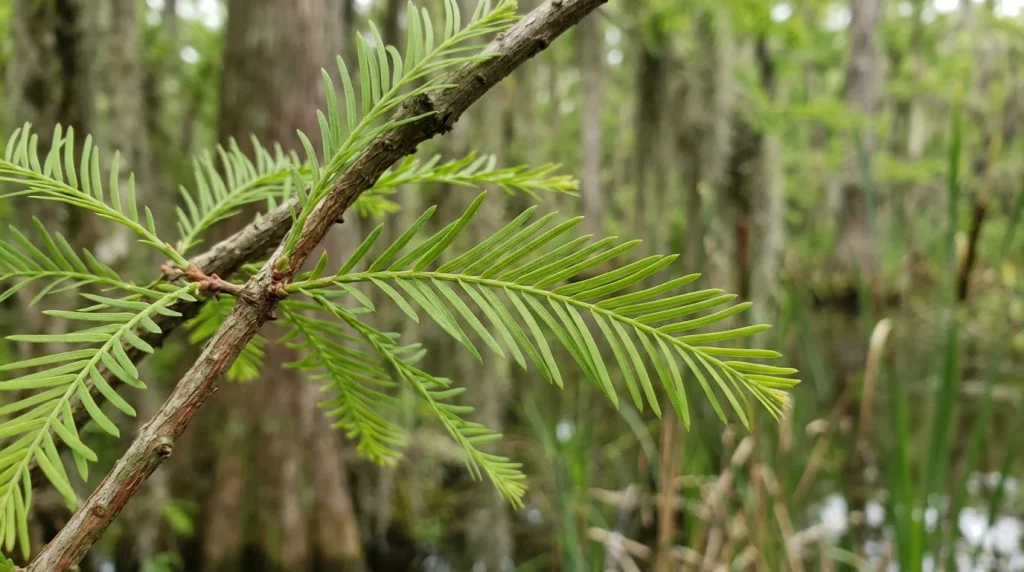
- Foliage: Soft, flat, narrow needles, usually about ⅓–¾ inch (8–20 mm) long, arranged alternately but appearing in two rows along slender branchlets.
- Shape: Young trees are pyramidal; older trees develop broad, irregular, sometimes flattened crowns.
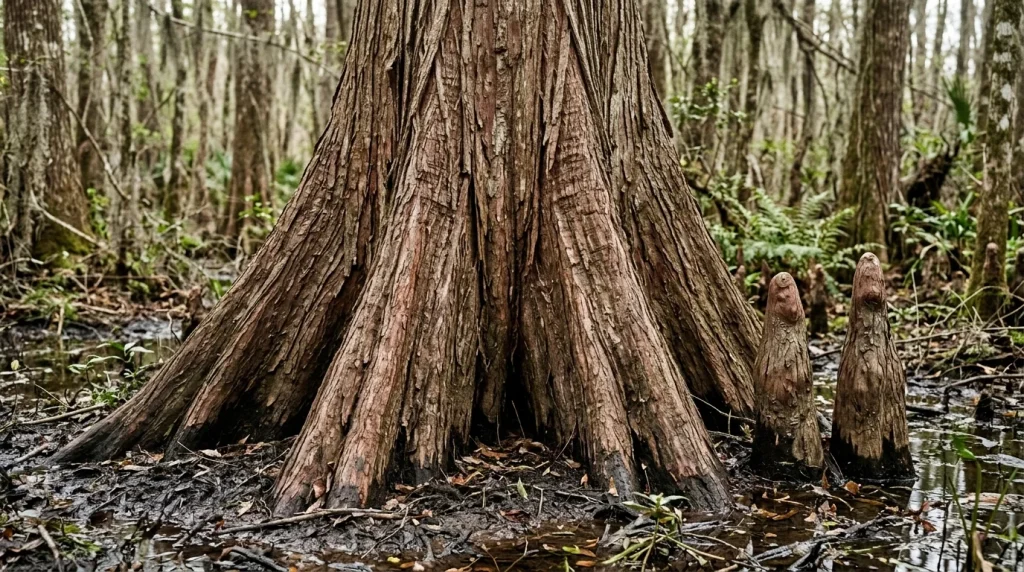
- Trunk: Reddish-brown to gray-brown, vertically fibrous, and often strongly enlarged at the base.
- Cones: Roughly spherical, woody seed cones about ¾–1¼ inches (2–3 cm) across.
- Seasonal clue: Coppery autumn foliage followed by a bare winter crown.
- Supporting clue: Conical or rounded root knees in wet settings, although many trees have none.
The strongest combination is feathery, alternate foliage plus rounded cones and a buttressed trunk. Knees alone are not a dependable identification.
Appearance
Mature baldcypress commonly reaches 50–100 feet (15–30 m), with a crown roughly 20–40 feet (6–12 m) wide. Old forest trees can grow considerably taller, while crowded trees may have much narrower crowns. Open-grown specimens usually retain a more complete outline, with spreading lower branches and ascending upper limbs.
The foliage looks delicate but is not composed of broad, divided leaves. Each narrow blade is an individual leaf attached to a slender shoot. On the familiar short, deciduous branchlets, the leaves spread to either side, making the whole spray resemble a feather. Leaves on vigorous, persistent shoots may be arranged more spirally.
Summer foliage is usually yellow-green to medium green. The trunk base can become dramatically swollen in frequently flooded ground, tapering rapidly above the buttresses. Trees on drier sites often have less exaggerated bases.
Bark, Twigs, and Buds
Bark is reddish-brown beneath a weathered gray-brown surface. It develops long, shallow furrows and narrow, fibrous ridges that may peel in strips. Very old trunks look deeply worked and irregular, but bark alone can resemble that of other cypress-family trees.
Baldcypress produces both persistent woody shoots and short leafy branchlets that are shed in autumn. The distinction matters: a carpet of fallen featherlike sprays is normal, not necessarily evidence of storm damage or disease. Persistent twigs carry small, inconspicuous buds arranged alternately.
In winter, inspect several intact woody twigs rather than relying on fallen sprays. Alternate buds and branching help separate bald cypress from dawn redwood, whose comparable structures are opposite.
Range and Habitat
The native range follows the Atlantic and Gulf coastal plains from Delaware south through Florida and west to eastern Texas. It also extends inland through the Mississippi drainage, reaching southern Illinois and southwestern Indiana. Within that broad outline, distribution follows suitable waterways and wetlands rather than forming a continuous forest.
Typical habitats include river floodplains, swamps, oxbows, lake margins, and sluggish stream channels. Once established, bald cypress tolerates prolonged freshwater flooding. It can also thrive in moist, well-drained soil, which helps explain its widespread use outside natural wetlands.
Seedlings face different conditions from mature trees. Seeds generally need exposed, moist substrate rather than standing water to germinate, and young seedlings must remain above prolonged flood levels to establish successfully. Natural water-level fluctuations therefore help renew stands.
For a useful botanical and landscape cross-check, the NC State Extension bald cypress profile includes identification features and growing conditions. Planted occurrences well beyond the Southeast should not be mistaken for evidence of native distribution.

Flowers, Fruit, Nuts, or Cones
Bald cypress does not produce true flowers, fruit, or nuts. It bears separate pollen cones and seed cones on the same tree. Small pollen cones form in conspicuous, drooping clusters and develop before pollen is released in late winter or spring, depending on location.
Young seed cones are green and rounded, usually held near shoot tips. They mature into brown, woody balls during their first growing season. Their thick scales fit together like irregular plates; mature cones eventually break apart, releasing angular seeds.
Look for attached green cones in summer or brown cones in late summer and autumn. Cone fragments and seeds may collect along the shoreline, but loose material can drift away from its parent tree. An attached cone is stronger evidence than one found on the ground.

Wildlife Connections
Baldcypress swamps provide nesting, roosting, shelter, and feeding places for many animals. Large crowns support colonial nesting waterbirds in some wetlands, while cavities in older trees may shelter wood ducks and other cavity users. The value comes from both the tree itself and the surrounding aquatic habitat.
Squirrels and some waterfowl eat seeds. Insects associated with foliage, bark, and decaying wood become food for birds and other predators. Fallen branchlets and wood enter wetland detrital food webs.
Buttresses, roots, knees, and submerged fallen branches add structural complexity around the water’s edge. Avoid assuming that every bald cypress hosts a rookery or produces abundant wildlife food every year; water depth, tree age, and surrounding habitat strongly influence use.
Seasonal Identification
Spring: Watch for fresh, soft green sprays and hanging pollen-cone clusters. New growth can look almost fernlike at a distance.
Summer: Inspect the alternate leaf attachments, flat needles, and developing spherical cones. This is usually the easiest season for confirming a leafy tree.
Autumn: Foliage shifts through yellowish, cinnamon, copper, and reddish-brown tones before the short branchlets fall. Timing and color vary with climate and growing conditions.
Winter: Use the flared base, fibrous bark, persistent branching pattern, and any remaining cone evidence. A leafless baldcypress is not dead simply because nearby pines and junipers remain green.

Human Uses and History
Baldcypress wood has long been used for boats, shingles, siding, posts, and other moisture-exposed applications. Old-tree heartwood was especially valued for its durability. Decay resistance varies with the wood’s age and character, so don’t apply the reputation of old-growth heartwood equally to all modern lumber.
Extensive logging removed many large, old stands. Surviving ancient trees preserve unusually long records of environmental conditions in their growth rings.
Today, bald cypress is also planted as a shade tree and for stormwater landscapes. On favorable sites, young trees may add roughly 1–2 feet (30–60 cm) of height annually, sometimes more; growth slows with age or stress. Allow room for the mature trunk and crown. Knees may develop in wet lawns, but their appearance is too unpredictable to promise either presence or absence.
Conservation and Threats
Baldcypress remains widespread, but old-growth stands and functioning swamp forests are much more limited than the species’ overall range suggests. Individual trees can live for many centuries, and exceptional specimens exceed 2,000 years. Such survivors are not representative of the age most landscape trees will reach.
Important threats include wetland drainage, logging, altered river flows, development, and saltwater intrusion. Coastal trees can tolerate flooding yet still suffer when freshwater wetlands become saline. Permanent deep water can also prevent successful regeneration even where mature trees persist.
Protecting a stand means maintaining suitable water patterns and opportunities for seedlings to establish, not merely retaining the largest trunks. When exploring swamps, avoid damaging knees and exposed roots, and use established access routes.
Similar Species
Dawn redwood (Metasequoia glyptostroboides): This introduced Asian conifer also sheds feathery foliage and may develop a flared trunk. Its leaves and small branchlets are opposite; baldcypress has alternate attachments. Check several nodes because flattened baldcypress sprays can look deceptively paired.
Pondcypress: Commonly treated as Taxodium ascendens or as a variety of T. distichum, this close relative typically has shorter, awl-shaped leaves pressed toward more upright branchlets. It is associated especially with Coastal Plain ponds and poorly drained depressions. Intermediate-looking foliage and differing taxonomic treatments make some trees difficult to name confidently.
Larches (Larix species): These are also deciduous conifers, but most needles occur in conspicuous clusters on short woody spurs, not in flattened featherlike sprays. Their cones have overlapping scales rather than the thick, fitted plates of baldcypress cones.
Eastern redcedar (Juniperus virginiana): Fibrous reddish bark can confuse a winter inspection, but redcedar normally retains scale-like or prickly foliage and bears berry-like cones.

Interesting Facts
- The “bald” name refers to seasonal foliage loss, an unusual but normal habit among conifers.
- Knees are woody projections arising from roots. Their functions remain debated; calling them proven breathing tubes overstates the evidence.
- A tree can survive long periods of flooding while still depending on lower-water intervals for successful reproduction.
- Baldcypress is Louisiana’s state tree, reflecting its close association with the state’s wetland landscapes.
Frequently Asked Questions
Does baldcypress need standing water?
No. It grows in many moist, well-drained soils as well as wetlands. Newly planted trees still need appropriate watering while roots establish.
Do all baldcypress trees make knees?
No. Knees are especially associated with wet conditions, but their abundance varies. Their absence does not rule out baldcypress.
Why are the needles turning brown?
Even coppery browning in autumn is normal. Browning during active growth, particularly if patchy or accompanied by dieback, warrants checking moisture, root disturbance, and other stress factors.
What is the quickest way to distinguish it from dawn redwood?
Inspect a leafy shoot closely. Baldcypress leaves attach alternately, even when they appear two-ranked; dawn redwood leaves attach in opposite pairs. Confirm with twig arrangement and cones when available.


