

Atlantic White-cedar Guide
Keep Track of What You See
Create a free Wild Things Guide membership to record this Atlantic White-cedar in My Sightings and build your personal wildlife list.
Join to Add This SightingTree Name
Atlantic white-cedar (Chamaecyparis thyoides) is a slender evergreen conifer of freshwater wetlands along the eastern and Gulf coastal regions of the United States. Also called southern white-cedar or swamp cedar, it belongs to the cypress family, Cupressaceae, rather than the true cedar genus, Cedrus.
Look for its combination of fine, scale-covered foliage, small round woody cones, and a straight trunk rising from wet, often peaty ground. Habitat is an important clue, but it should support—not replace—examination of the foliage and cones.

Quick Identification
- Form: A narrow, pointed evergreen, often growing with many similar straight-trunked trees.
- Foliage: Tiny overlapping scales in opposite pairs, forming fine, somewhat flattened branching sprays.
- Cones: Nearly spherical, about 1/4 inch across, with woody, shieldlike scales.
- Bark: Reddish brown to gray-brown, becoming fibrous and vertically furrowed.
- Setting: Acidic freshwater swamps, peatlands, and wet depressions, mainly within the coastal plain.
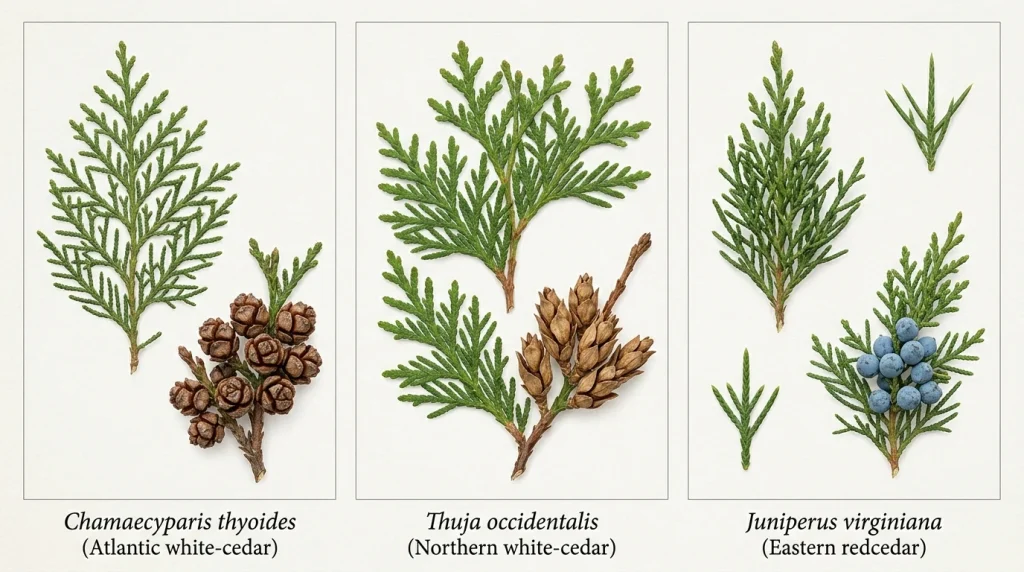
The most useful field combination is scale foliage plus small, round, woody cones. Northern white-cedar has elongated cones; eastern redcedar has fleshy, berry-like cones. Examine several attached cones when possible, since fallen material can come from neighboring trees.
Appearance
Mature Atlantic white-cedars commonly stand about 40–70 feet (12–21 m) tall, although favorable sites can produce taller trees. A typical crown may spread roughly 10–20 feet (3–6 m). Crowns in crowded swamps are often narrower, with bare lower trunks; open-grown trees retain more low branches and develop fuller outlines.
The foliage ranges from green to blue-green. Individual adult leaves are only about 1–3 mm long and lie against slender branchlets. Their opposite pairs alternate at right angles, covering the twig with overlapping scales. Seedlings can carry more pointed juvenile leaves.
Young trees on suitable sites may add around 1–2 feet (30–60 cm) in height annually, but growth varies substantially with light, water conditions, and competition. Suppressed or stressed trees grow much more slowly.

Bark, Twigs, and Buds
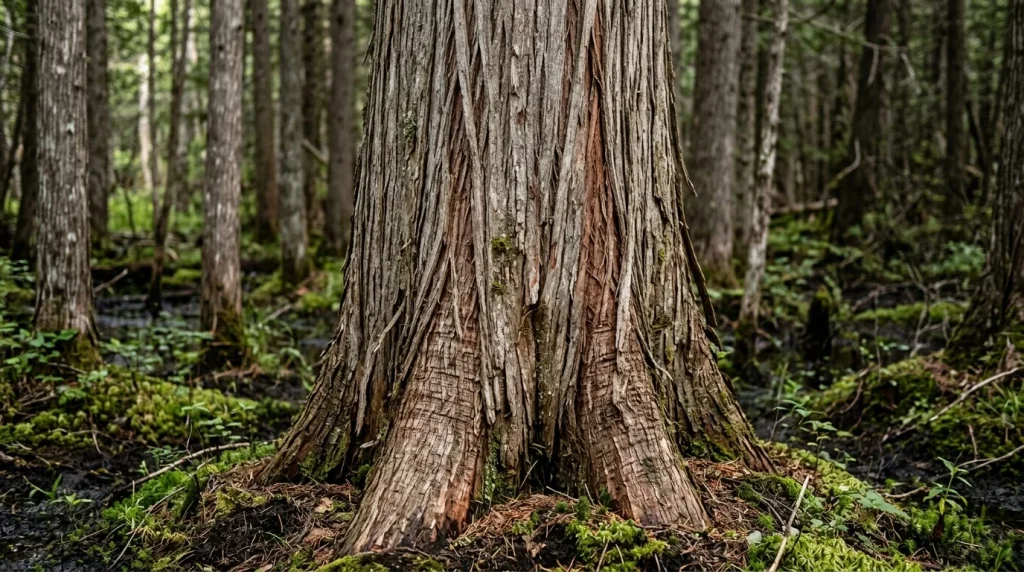
Young bark is relatively thin and reddish brown. With age, it becomes gray-brown, divided by shallow to deep vertical furrows and narrow, fibrous ridges. Loose strips may separate lengthwise, although bark alone rarely establishes the identification.
Older twigs are slender and brown; the finest living branchlets are mostly hidden beneath green scales. Under a hand lens, you may see a small resin gland on a leaf face. Crushed foliage has a resinous scent, but fragrance varies and is not a dependable species test.
There are no large, conspicuous winter buds like those of many broadleaf trees. Concentrate on the leafy branchlet tips, their arrangement, and any attached cones.
Range and Habitat
The native range is discontinuous, extending from southern Maine through the Atlantic coastal region to northern Florida, then west along the Gulf coastal plain to Mississippi. Its distribution consists of scattered suitable wetlands rather than an unbroken belt. It is not native throughout eastern North America, and a landscape specimen outside this region may have been planted.
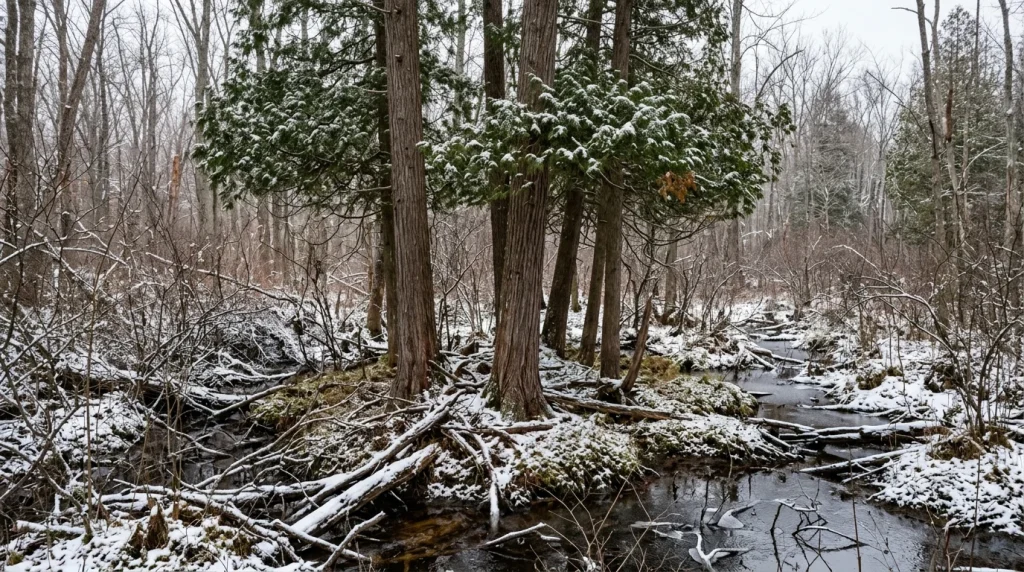
Characteristic habitats include acidic peat swamps, boggy depressions, streamhead wetlands, and other poorly drained freshwater sites. Stands can be nearly pure or mixed with red maple, blackgum, sweetbay magnolia, and other wetland trees, depending on location.
Despite “Atlantic” in the name, this is not a salt-marsh tree. It depends on freshwater conditions and can suffer when saltwater enters its habitat. Nor does wetland adaptation mean tolerance of unlimited flooding: prolonged deep inundation can kill established trees. The U.S. Forest Service’s Atlantic white-cedar account explains its restricted habitat and regeneration requirements.

Flowers, Fruit, Nuts, or Cones
Atlantic white-cedar produces cones, not true flowers, fruits, or nuts. Tiny pollen cones and seed cones occur on the same tree, with pollen generally released in spring; timing varies with latitude and weather.
Seed cones are nearly round, usually about 4–9 mm across. Young cones may appear greenish or bluish-purple before turning brown and woody. They typically have six to ten shieldlike scales, each with a small central projection.
Cones mature during their first growing season and open to release small, winged seeds. Empty cones may remain attached afterward. These little woody spheres are especially valuable for separating Atlantic white-cedar from other scale-leaved evergreens.

Wildlife Connections
Dense evergreen foliage offers shelter and potential nesting cover for birds. Birds and small mammals can eat the small seeds, while trunks, deadwood, and the moist forest floor support a broader community of insects and other animals.
A notable connection is Hessel’s hairstreak, a butterfly whose caterpillars feed on Atlantic white-cedar. The butterfly’s localized occurrence reflects its close association with cedar wetlands; a cedar stand does not necessarily mean the butterfly is present.
The habitat itself is a major part of the tree’s wildlife value. Shaded peat, wet hollows, and fallen logs create conditions different from nearby uplands. Deer browsing can damage young trees, making successful regeneration more difficult in some stands.
Seasonal Identification
Spring: Look for fresh branchlet growth and tiny reproductive cones. Pollen cones are much less conspicuous than the dangling catkins of many broadleaf trees.
Summer: Fine evergreen sprays and developing spherical cones provide the clearest close-range clues. Check foliage rather than relying on the distant crown shape.
Autumn: Seed cones turn brown and become woody. Older inner foliage may brown and fall as part of normal evergreen turnover, while the outer crown stays green.
Winter: The evergreen crown stands out among leafless swamp hardwoods. Some foliage may bronze in cold weather. Use bark, retained cones, and branching together, and avoid entering wetlands where snow hides water or ground is unstable.
Human Uses and History
Atlantic white-cedar wood is light, workable, and valued for its decay resistance. People have used it for shingles, siding, fence posts, boats, and other products exposed to moisture. Extensive cutting, often followed by drainage or wetland conversion, contributed to the loss of many historic stands.
Its common name also survives in regional place names and the term “cedar swamp.” In horticulture, the species and its cultivars are grown for fine foliage and narrow form, but cultivated selections can differ markedly from wild trees. The NC State Extension species profile provides useful information about landscape characteristics and growing conditions.
Conservation and Threats
Atlantic white-cedar varies in condition across its range. Major pressures include wetland drainage, development, altered water levels, saltwater intrusion, and inadequate regeneration after disturbance. Fragmentation can isolate remaining stands and the organisms associated with them.
Fire has a complicated role. Disturbance can expose seedbeds and reduce competition, but severe fire that consumes peat may destroy roots, seeds, and the wetland surface itself. Simply excluding all disturbance—or burning without attention to peat moisture—is not a universal solution.
Restoration usually requires more than planting trees: appropriate freshwater hydrology, sufficient light, suitable seedbeds, and protection from excessive browsing all matter. When visiting a cedar swamp, use established trails or boardwalks and avoid trampling seedlings or disturbing peat. Local wetland protections may restrict cutting, digging, and collecting.
Similar Species
- Northern white-cedar or arborvitae (Thuja occidentalis): Also has flattened scale-leaved sprays and fibrous bark. Its sprays are generally broader and more distinctly fan-shaped, and its cones are elongated with overlapping scales rather than round with shieldlike scales. Native stands often occupy mineral-rich wetlands or rocky sites, though habitats vary.
- Eastern redcedar (Juniperus virginiana): May have both scale-like and sharp, awl-shaped foliage. Female trees bear blue, waxy, berry-like cones rather than hard brown spheres. It is common in old fields, woodland edges, and many comparatively dry sites.
- Baldcypress (Taxodium distichum): Shares southern swamp habitat but has soft, linear leaves on feathery branchlets and loses its foliage in autumn. Its seed cones are much larger. Knees may be present, but their absence does not rule it out.
In gardens, other Chamaecyparis species can be convincing look-alikes. Location alone cannot identify a planted tree; you may need foliage details, mature cones, and a planting record.
Interesting Facts
- “White-cedar” is a common name, not evidence of membership in the true cedar genus.
- Dense cedar stands can create deeply shaded, sheltered conditions even during winter.
- Trees commonly live for a century or two, and some survive for several centuries where conditions remain suitable.
- Although established trees form dark stands, young Atlantic white-cedars generally need substantial light to grow successfully.
Frequently Asked Questions
Is Atlantic white-cedar evergreen?
Yes. It retains green foliage through winter, although it periodically sheds older inner foliage. Widespread browning of branch tips or the whole crown should not be assumed to be normal seasonal shedding.
Does it have berries?
No. Its seed cones become woody and brown. Blue, fleshy-looking”cedar berries” usually indicate a juniper, such as eastern redcedar.
Can I grow it in an ordinary yard?
Possibly, if the site provides suitable moisture, acidic soil, and adequate light; a hot, dry, compacted site is a poor match. Choose nursery-propagated stock and check the mature dimensions of the particular cultivar.
What is the quickest way to confirm the identification?
Look for an attached, round, woody cone on a branch with tiny, overlapping scale leaves. Combine that evidence with fibrous bark and freshwater wetland habitat. If cones are absent, photograph several foliage sprays and the whole tree rather than relying on one feature.


