
American Bullfrog Guide
Keep Track of What You See
Create a free Wild Things Guide membership to record this American Bullfrog in My Sightings and build your personal wildlife list.
Join to Add This SightingIntroduction
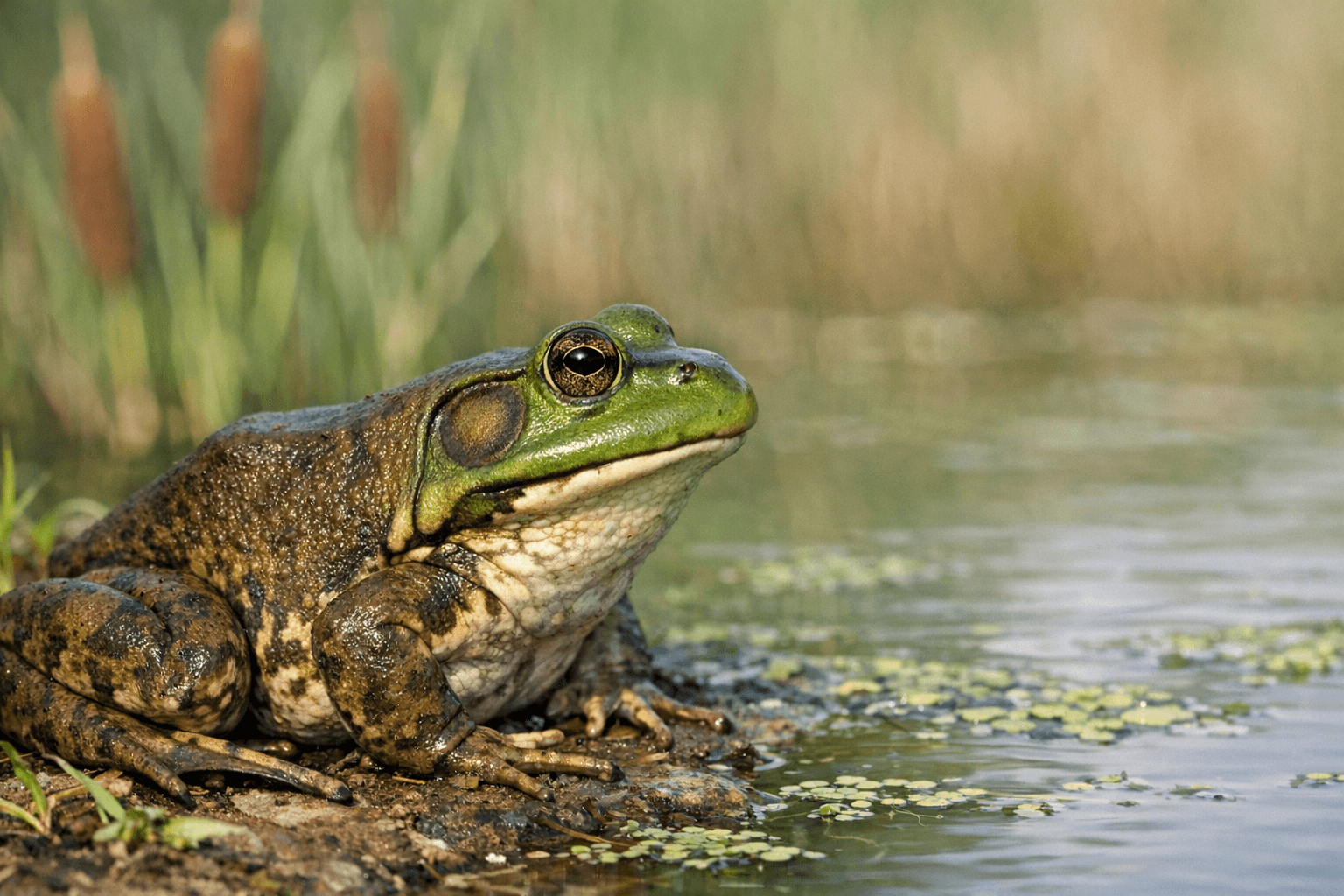
The American Bullfrog (Lithobates catesbeianus, also listed in some sources as Rana catesbeiana) is North America’s largest native frog. It is a powerful, heavy-bodied amphibian associated mainly with warm, permanent water. Its deep call, often rendered as “jug-o-rum,” is a familiar sound around summer ponds, lakes, marshes, and slow rivers.
Bullfrogs are native to much of eastern and central North America but have been introduced widely in the West and elsewhere. Because they eat a broad range of prey and can compete with or prey on native amphibians, introduced populations may harm ecosystems. Identification is therefore useful not only for nature study but also for regional monitoring and conservation.

Quick Identification
- Overall form: Very large, robust frog with a broad, flattened head and strong hind legs.
- Color: Usually olive, green, or greenish brown above; sometimes mottled with darker brown or gray.
- Key field mark: Dorsolateral skin folds do not continue down the back—instead, a fold curves around the rear of each tympanum.
- Tympanum: Large, round, and conspicuous behind the eye.
- Underside: Whitish to pale yellow, often with gray or brown mottling.
- Call: A deep, resonant series of low notes commonly described as “ug-o-rum.”
- Habitat: Permanent or long-lasting water with vegetated shorelines.
Appearance and Field Marks
An adult American Bullfrog has a broad head, a large mouth, prominent eyes, and smooth to moderately textured skin. The upper surface varies from bright olive green to dull greenish brown. The head is often greener than the body, especially in mature males, while the back may be plain or irregularly mottled.
The most dependable structural mark is the absence of long dorsolateral ridges. Green Frogs and several other similar species have raised folds running from behind the eyes along much of the back. On a bullfrog, the fold wraps around the tympanum and ends near the shoulder.
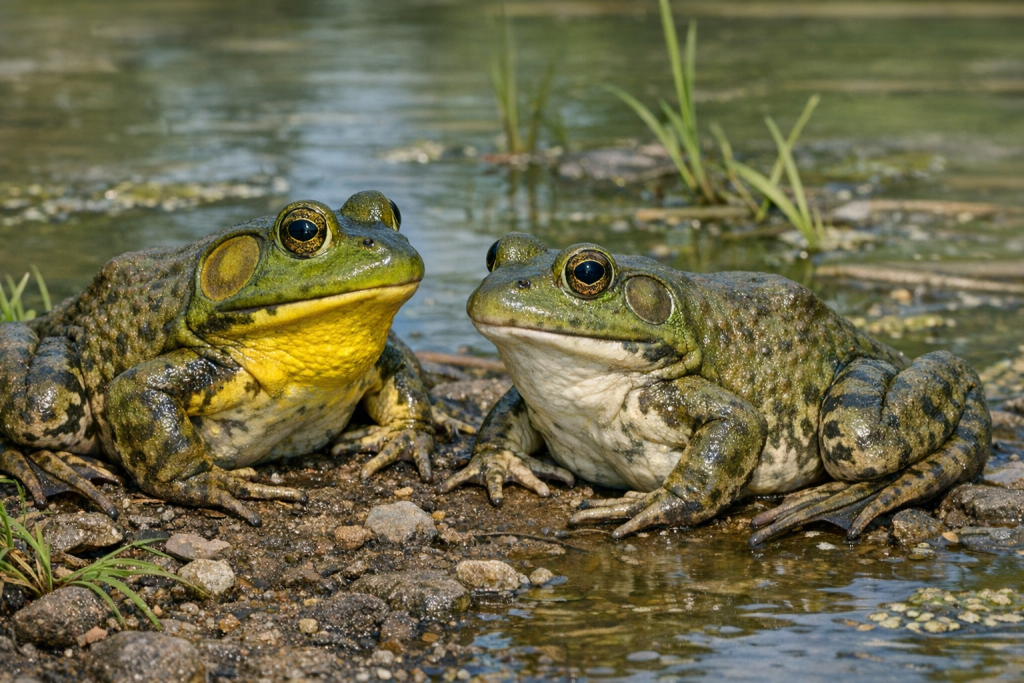
The tympanum, or external eardrum, is a flat circular disc immediately behind the eye. In mature males, it is often much larger than the eye; in females, it is usually about the same diameter as the eye. This distinction works best on breeding adults and should not be used alone for young frogs.
The belly is pale and may be marbled with gray. Adult males often develop a yellow throat during the breeding season, whereas females generally retain a cream or whitish throat. The hind feet are extensively webbed, fitting the species’ strongly aquatic habits.

Size and Measurements
Most adult American Bullfrogs measure about 9–15 cm (3.5–6 in) from snout tip to vent. Exceptionally large individuals may exceed 20 cm (8 in) in body length. Fully extended hind legs make a large frog appear considerably longer, but leg-inclusive measurements are not standard for identification.
Large adults can weigh several hundred grams and are noticeably heavier-bodied than most other North American frogs. Females tend to reach a greater maximum size than males, although size ranges overlap. Newly transformed juveniles are much smaller and may initially be mistaken for Green Frogs or other medium-sized ranids.
Range and Distribution
The native range covers broad portions of eastern and central North America, extending from parts of southern Canada through much of the eastern United States and south toward northeastern Mexico. In some regions, a long history of human-assisted movement complicates exact native boundaries.
Bullfrogs have been introduced into many areas of western North America, including parts of the Pacific Coast, Great Basin, Southwest, and western Canada. Populations also occur outside North America. Introductions result from deliberate releases, escapes from cultivation, discarded pets, and movement associated with fish stocking or aquatic plants.
The U.S. Geological Survey Nonindigenous Aquatic Species profile for the American Bullfrog provides distribution records and background on introduced populations in the United States.

Habitat
American Bullfrogs favor permanent or semi-permanent freshwater with warm shallows and abundant shoreline cover. Typical sites include ponds, small lakes, reservoirs, marshes, irrigation canals, flooded quarries, oxbows, and slow-moving sections of rivers and streams.
Adults commonly rest at the water’s edge among cattails, sedges, grasses, floating vegetation, exposed mud, or woody debris. Deep water offers an escape route from predators and may provide overwintering habitat. Because the tadpole stage can last beyond a single season, dependable water is usually more suitable than short-lived rain pools.
In introduced areas, artificial ponds and managed waterways can help bullfrogs spread through otherwise dry landscapes. They may travel overland during wet weather, but adults usually stay close to water.

Behavior
Bullfrogs are alert shoreline sitters. An individual may remain motionless with its head raised, then leap into deep water when approached. They often surface some distance away, with only their eyes and nostrils visible. At night, frogs may sit in shallow water or on open banks to feed.
Activity peaks in warm conditions, particularly from spring through early autumn. In colder regions, bullfrogs become inactive during winter and shelter underwater, often in bottom sediment or protected aquatic cover. They do not normally remain deeply buried where oxygen would be unavailable; they must continue to exchange dissolved oxygen through the skin.
Breeding males defend calling positions along the shoreline. Encounters may involve posturing, pushing, grappling, or short chases. Outside these interactions, bullfrogs are generally solitary.
Diet and Hunting
The American Bullfrog is an opportunistic, sit-and-wait predator. It watches for movement and captures prey with a rapid forward lunge and sticky tongue. Larger prey may be seized with the jaws and maneuvered into the mouth with help from the forefeet.
Common foods include insects, spiders, crayfish, worms, snails, small fish, and other frogs. Larger individuals may also take salamanders, small snakes, young turtles, mice, or unwary nestling birds when the opportunity arises. Cannibalism is well documented, with adults sometimes eating juvenile bullfrogs.
Diet varies with frog size, habitat, season, and locally available prey. The species does not specialize in a single food type. Tadpoles feed primarily by grazing or filtering algae, plant material, microbes, and organic detritus, although their diet can include small animal matter.

Vocalizations
The advertisement call is a low, carrying bellow often written as “jug-o-rum,” “br-wum,” or “rr-uum.” A male may produce one note or a short series, with pauses between calls. At close range, the sound is deep enough to seem almost mammalian.
Calling occurs mainly on warm evenings and nights in late spring and summer, with timing varying by latitude and weather conditions. Choruses may also be heard during the day. Other sounds include shorter territorial calls and a sharp release or distress sound when a frog is grabbed.
Juveniles and startled adults sometimes let out a brief squeak when jumping into the water. For field identification, the deep advertisement call is more useful than these variable alarm sounds.
Breeding and Nesting
Bullfrogs do not build nests like birds. Breeding takes place in water, usually in warm, shallow sections of permanent ponds, lakes, wetlands, or slow channels. Males establish calling territories, often near emergent vegetation or open patches of water.
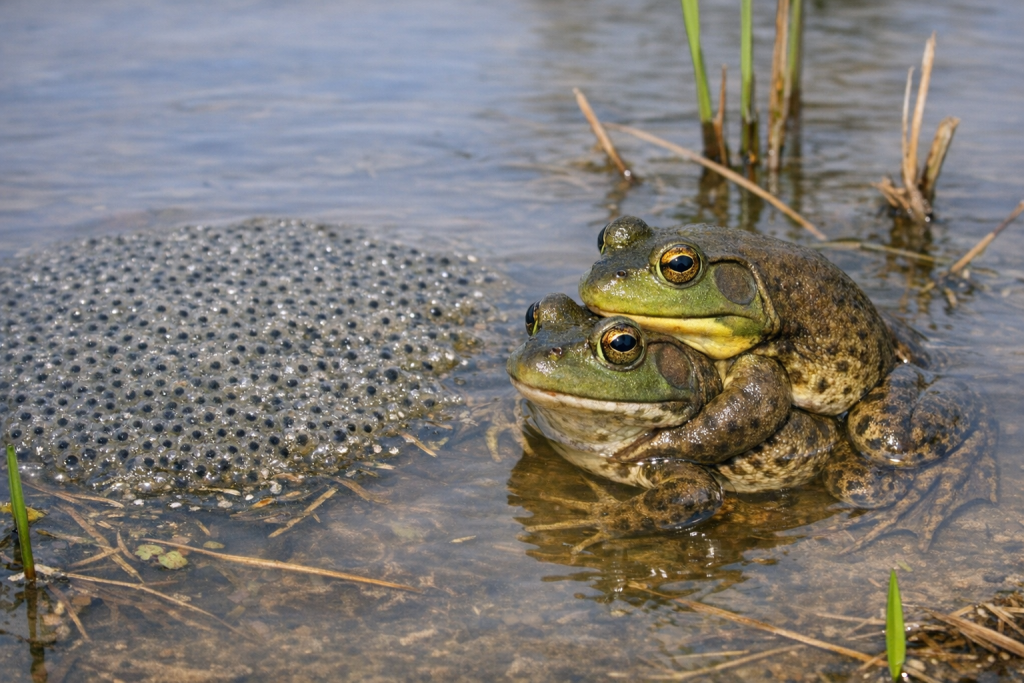
A receptive female approaches a male, and mating occurs through amplexus, with the male clasping her behind the forelimbs. Eggs are fertilized externally as they are released. The egg mass initially forms a broad, thin film floating at or just below the surface, rather than a compact ball. It may later sink or become entangled among vegetation.
Warm, sheltered water can speed early development, but exposed egg films are vulnerable to temperature extremes, drying, disturbance, and aquatic predators.
Reproduction
A large female can lay thousands of small eggs in a single breeding event, and especially large clutches may number tens of thousands. Actual output varies with age, body size, condition, and environmental circumstances. Under warm conditions, hatching may occur within several days, but it takes longer in cooler water.
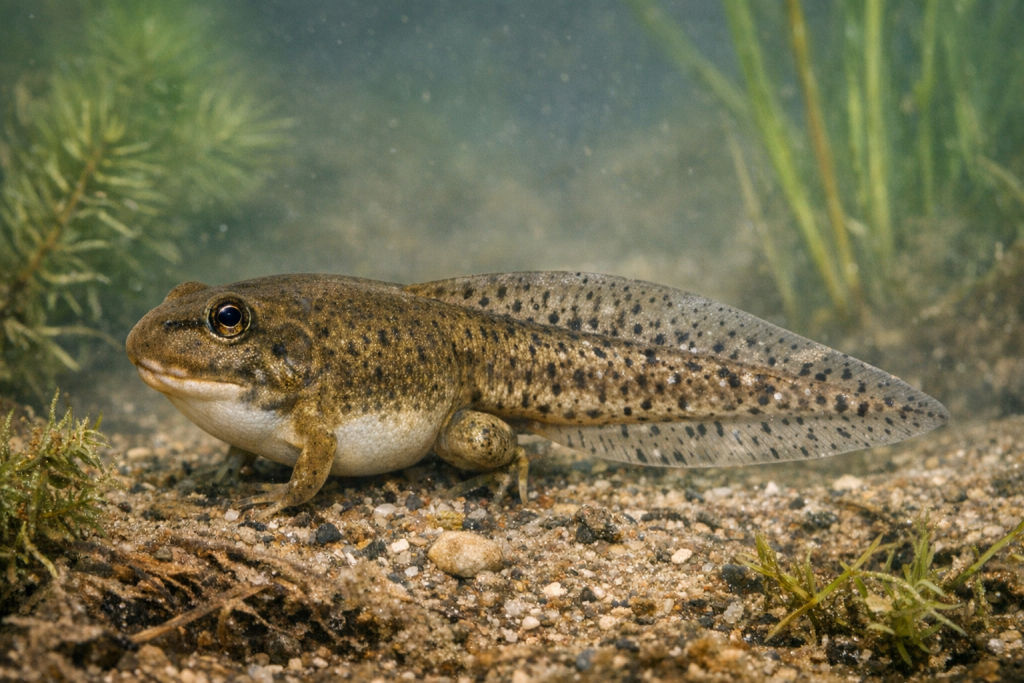
Bullfrog tadpoles are relatively large, with olive green to brown bodies and fine dark speckling. Their bellies may appear pale or yellowish, and their muscular tails have a translucent, spotted fin. Tadpoles are often conspicuous in shallow water but quickly retreat when disturbed.
Climate strongly influences larval development. In warm southern areas, some tadpoles may transform within a year; farther north, development commonly extends through two or more seasons. Recently transformed froglets remain near shore and retain a proportionally smaller, slimmer build than adults.
Similar Species
Green Frog: The Green Frog is the species most often confused with a bullfrog. It usually has obvious dorsolateral folds extending from behind the eyes down the back. A bullfrog has only the curved fold around each tympanum. Green Frogs are also generally smaller, although a juvenile bullfrog may overlap in size.
Southern Leopard Frog and other leopard frogs: Leopard frogs have distinct dark spots, pale dorsolateral ridges, and a more streamlined shape. Their tympana are not as proportionally large as those of adult male bullfrogs.
Pig Frog: In Florida and parts of the southeastern coastal plain, the aquatic Pig Frog can be challenging to identify. It lacks long dorsolateral folds like a bullfrog but usually shows bold dark patterning on the rear thighs, more extensive toe webbing, and a snoring or grunting call rather than a deep “jug-o-rum.”
River Frog: This large southeastern species often has pale spots on the lips and strongly mottled or netlike markings on the concealed surfaces of the thighs. It may also produce a strong odor when handled.
Conservation
The American Bullfrog remains widespread across much of its native range. Local populations can nevertheless be affected by wetland drainage, shoreline development, pollution, road mortality, disease, and intensive harvest.
Outside its native range, the conservation picture differs greatly. Bullfrogs may prey on native frogs and other small vertebrates, compete for food and breeding habitat, and potentially move amphibian pathogens. Management is difficult once the species occupies connected waterways.
Never release a captive bullfrog, tadpole, or egg mass into the wild. Collection, transport, possession, and control rules vary by state, province, or other jurisdiction. Report suspected nonnative populations through the appropriate wildlife agency rather than attempting unapproved relocation or control.
Field Identification Tips
- First inspect the back for long dorsolateral folds. Their absence strongly supports bullfrog, but you must still consider regional look-alikes.
- Check for the curved fold wrapping behind the tympanum.
- Compare the tympanum with the eye. A much larger tympanum suggests an adult male.
- Use throat color only as supporting evidence because lighting, season, age, and individual variation can alter its appearance.
- Listen before approaching. The low advertisement call may reveal frogs hidden among shoreline vegetation.
- When documenting an uncertain identification, photograph the side of the head, back, thighs, and feet.
- Avoid handling whenever possible. Wet hands, clean equipment, and strict disinfection between wetlands reduce the risk of skin damage or disease transmission.
Interesting Facts
- The species name catesbeianus honors English naturalist Mark Catesby.
- The eyes and nostrils sit high on the head, letting a bullfrog watch and breathe while most of its body stays underwater.
- Bullfrog tadpoles may overwinter beneath ice and resume growth when water warms.
- The circular tympanum is both a hearing structure and one of the most useful visible clues for estimating an adult’s sex.
- Bullfrogs can consume surprisingly large prey, but most feeding events involve abundant invertebrates and other manageable items.
- The same traits that make the species successful—large size, broad diet, high reproductive output, and use of human-made waters—can make introduced populations difficult to manage.


