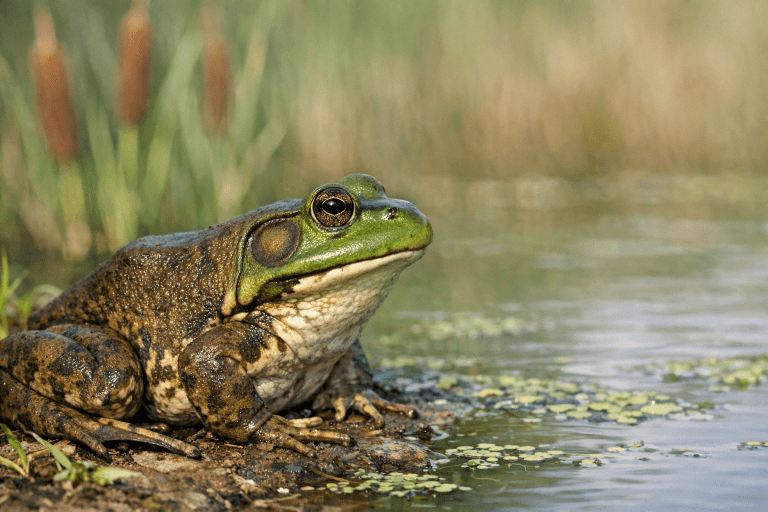
Northern Leopard Frog Guide
Keep Track of What You See
Create a free Wild Things Guide membership to record this Northern Leopard Frog in My Sightings and build your personal wildlife list.
Join to Add This SightingIntroduction
The northern leopard frog (Lithobates pipiens, also called Rana pipiens in some references) is a familiar spotted frog of northern and central North America. Its bold dark blotches, pale-edged dorsolateral folds, and powerful hind legs make it distinctive, but several related leopard frogs can look remarkably similar.
This adaptable amphibian uses shallow wetlands to breed, moist grasslands to feed in summer, and deeper water for winter shelter. Individuals may travel well beyond the shoreline, particularly in damp weather. Identification is therefore based on a combination of pattern, body proportions, geographic range, habitat, and—during the breeding season—voice.

Quick Identification
- Overall appearance: Medium to large, slim-waisted frog with long hind legs.
- Color: Usually green, olive, tan, or brown.
- Spots: Rounded or oval dark spots, generally bordered by a narrow pale outline.
- Dorsolateral folds: Two pale, raised ridges extending along the back without a strong break near the hind legs.
- Underside: Creamy white, usually without heavy markings.
- Call: A low, drawn-out snore, often followed by short chuckling or clucking notes.
- Typical setting: Marsh edges, wet meadows, pond margins, slow streams, and damp grasslands.
Appearance and Field Marks
Northern leopard frogs have a streamlined body, a somewhat pointed snout, prominent eyes, and long, muscular hind limbs. The back may be bright grass green, dull olive, gray-brown, or tan. Color alone is unreliable because it varies among individuals and can change somewhat with temperature, moisture, and surroundings.
The principal field mark is a series of irregular rounded or oval dark spots across the back and sides. Most spots have a thin cream, yellowish, or pale green border, producing the leopard-like pattern behind the common name. Some frogs are heavily marked, while others have relatively few spots.
A pair of light-colored dorsolateral folds runs from behind the eyes toward the groin. These folds are generally continuous and remain fairly straight. The upper lip is often pale. The belly is smooth and white to cream, while the inner surfaces of the hind legs may show muted yellow or greenish tones. The toes lack the enlarged adhesive pads found on tree frogs.

Size and Measurements
Adults are commonly about 5–9 cm (2–3.5 in) in snout-to-vent length, although unusually large individuals may approach 11 cm (4.3 in). Females usually average larger and more robust than males. Newly transformed froglets are much smaller, often measuring only a few centimeters.
The hind legs are long relative to the body and enable quick, far-reaching jumps. Exact size is not sufficient for identification because age, sex, nutrition, and regional conditions all affect growth, and several related leopard frogs overlap in size.
Range and Distribution
The northern leopard frog occupies a broad but uneven range across much of southern Canada and the northern and central United States. Its distribution extends from parts of the Northeast and Great Lakes region west through the northern Great Plains and portions of the Rocky Mountain region. Populations also occur farther north in western Canada and southward in suitable interior habitats.

Habitat
Distribution is not continuous. Arid landscapes, mountain barriers, wetland loss, and local population declines create substantial gaps. The species has disappeared from some former sites, especially in parts of western North America, while introduced populations may occur outside the generally recognized native range. A local or regional amphibian atlas should be consulted when a sighting lies near the expected range boundary.
Northern leopard frogs use a connected set of habitats rather than one permanent home. Breeding usually occurs in shallow, fish-free or lightly vegetated water, including marshes, seasonal pools, flooded fields, pond margins, and quiet lake bays. Emergent sedges, grasses, and rushes provide cover and support for egg masses.
After breeding, adults and juveniles often disperse into wet meadows, prairie pothole margins, moist pasture, open woodland edges, and grassy areas near water. They are more terrestrial than many large North American frogs and may be encountered considerable distances from a pond during cool, wet conditions.
Winter habitat must remain wet and sufficiently oxygenated. Frogs commonly shelter on or within the bottom substrate of deeper ponds, lakes, or slow streams that do not freeze solid. Maintaining movement corridors among breeding, feeding, and overwintering sites is important for local populations.

Behavior
Northern leopard frogs are alert and difficult to approach in open habitat. When disturbed, they usually make one or more long zigzagging leaps toward water, then dive and hide among submerged vegetation or bottom debris. A frog may remain motionless after landing, relying on its broken pattern for camouflage.
Activity is strongly influenced by weather. Frogs may forage by day when conditions are cool and damp but become more active around dusk or at night during warm weather. Rain can trigger overland movement, especially among recently transformed juveniles. In northern areas, much of the year is spent inactive beneath water.
Diet and Hunting
Adults are opportunistic predators of insects, spiders, slugs, snails, worms, and other small invertebrates. Large frogs may occasionally capture small vertebrates, including tiny frogs, but such prey should not be considered the main diet.
Hunting typically combines stillness with sudden movement. A frog waits among short vegetation or at a wetland edge, turns toward nearby prey, and lunges with a rapid extension of its sticky tongue. It may also make short hops while actively searching. Tadpoles feed differently, grazing on algae, microorganisms, plant material, and organic matter in the water.

Vocalizations
The advertisement call is most often described as a low, guttural snore lasting several seconds. It may be followed by shorter chuckles, grunts, or clucking notes. A calling chorus can sound like multiple fingers being rubbed across an inflated balloon, though descriptions vary among listeners.
Males call mainly during the spring breeding period, often from shallow water while floating among vegetation. Calling may occur during the day and at night, particularly in warm, calm conditions. The voice helps separate this species from visually similar frogs, but individual calls may be obscured in mixed-species choruses.
Breeding and Nesting
Breeding begins after the thaw and as water warms, with timing varying greatly by latitude and elevation. Males gather in shallow wetlands and call to attract females. During amplexus, a male clasps a female behind the forelimbs while she releases eggs and he fertilizes them externally.
Like other frogs, northern leopard frogs do not build a nest. The female deposits a soft, globular mass containing hundreds to several thousand eggs, usually attached to submerged stems or resting among shallow vegetation. Several females may place masses close together. Fresh masses are compact but swell as the surrounding jelly absorbs water.
Shallow sites warm quickly and can promote development, but they are vulnerable to drying, freezing, trampling, pollution, and aquatic predators. Reproductive success can therefore vary considerably from year to year.
Reproduction
Embryos develop within clear jelly capsules and hatch into dark, aquatic tadpoles. Hatching time depends mainly on water temperature and may range from several days to a few weeks. Tadpoles have a rounded body and a muscular tail with a translucent fin. As they grow, they often become olive or brownish with fine gold or dark flecking.
Metamorphosis commonly occurs during the same summer, often after roughly two to three months, but development can be faster or slower depending on temperature, food, crowding, and water permanence. The hind legs appear first, followed by the forelegs; the tail is then absorbed. Newly transformed froglets leave the water and disperse through surrounding vegetation. Sexual maturity generally requires additional growth over one or more seasons.

Similar Species
Pickerel frog: Pickerel frogs usually have squarish dark spots arranged in two fairly orderly rows between the dorsolateral folds. The concealed surfaces of the thighs and groin are often conspicuously yellow or orange. Northern leopard frog: Generally has rounder, less regularly arranged spots and lacks such vivid hidden-leg color.
Southern leopard frog: This species often has a distinct pale spot in the center of the tympanum and a more pointed snout. Its range overlaps the northern leopard frog in parts of the central and eastern United States, so calls and multiple field marks should be considered.
Plains leopard frog: The dorsolateral folds commonly angle inward or are interrupted near the rear of the body, and a pale spot may be present on the tympanum. Northern leopard frog folds are usually straighter and more continuous.
Green frog: Green frogs have dorsolateral ridges but generally lack the leopard frog’s orderly pale-bordered blotches. They also tend to remain close to permanent water and give a short, banjo-like call.
Conservation
The northern leopard frog remains widespread, but its status varies sharply by region. Some populations appear stable, while others have undergone major declines or local disappearance. Wetland drainage, shoreline alteration, road mortality, introduced predatory fish, contaminants, disease, drought, and the loss of movement corridors may act alone or in combination.
Conservation is most effective when it protects the complete seasonal habitat network: shallow breeding wetlands, summer feeding areas, secure overwintering water, and safe routes between them. Avoid handling frogs unnecessarily, and never move frogs, tadpoles, eggs, water, or aquatic plants between wetlands; such movement can spread pathogens and invasive organisms.
Field Identification Tips
- Look for dark rounded spots with narrow pale borders rather than relying on green coloration.
- Trace the pale dorsolateral folds toward the hind legs; in this species they are usually continuous and fairly straight.
- Check the tympanum for a central pale spot, which may suggest another leopard frog species.
- If safely visible without handling, note whether the hidden thigh and groin are bright yellow or orange, a feature favoring pickerel frog.
- Listen for the low snore and chuckling notes during spring.
- Record habitat, date, location, and multiple photographs. A dorsal view and a side view showing the tympanum are particularly useful.
- Near range boundaries, treat a photograph-only identification as provisional unless pattern, call, and location agree.
Interesting Facts
- The northern leopard frog was historically used extensively in biology education and medical research.
- Individuals may travel between separate breeding, feeding, and overwintering habitats rather than remaining at one pond year-round.
- Its skin pattern varies greatly; two frogs from the same wetland can differ in background color and number of spots.
- Adults survive northern winters underwater but still rely on dissolved oxygen, so they cannot simply remain in oxygen-poor mud beneath a completely sealed pond.
- Young frogs can disperse in large numbers after metamorphosis, especially following rain.
- The combination of connected wetlands and moist uplands is often more important than the condition of any single pond.