Green Frog Guide
Keep Track of What You See
Create a free Wild Things Guide membership to record this Green Frog in My Sightings and build your personal wildlife list.
Join to Add This SightingIntroduction
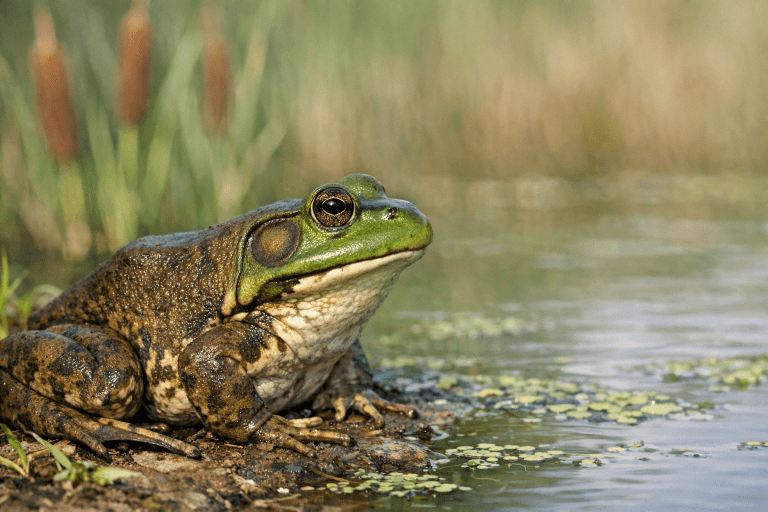
The green frog (Lithobates clamitans) is a familiar waterside frog of eastern North America. Despite its name, it is not always green. Individuals may be olive, brown, bronze, gray-green, or strongly mottled, with the brightest green often limited to the head and upper lip.
Green frogs are commonly encountered at pond margins, in marshy coves, and beside slow streams. They often sit partly submerged in shallow water and leap with a splash when approached. Their short, resonant call—often compared with the pluck of a loose banjo string—is one of the characteristic summer sounds of wooded wetlands.
The species is sometimes called the bronze frog, especially when describing brown or bronze-colored populations. Older sources may place it in the genus Rana, and scientific naming conventions still vary among authorities.

Quick Identification
- Overall form: A medium to large, sturdy true frog with long hind legs and a broad head.
- Color: Variable green, olive, brown, bronze, or grayish, often with dark spots or irregular mottling.
- Key mark: Raised dorsolateral folds begin behind the eyes and continue along the back.
- Eardrum: A large, round tympanum is clearly visible behind each eye.
- Face: The snout and upper lip are often brighter green than the body.
- Call: A short, low-pitched note resembling a plucked banjo string: “gung.”
- Habitat: Usually found at the edge of permanent or semipermanent freshwater.
Appearance and Field Marks
The green frog has a robust body, smooth to slightly granular skin, a blunt snout, and powerful hind legs. Color is highly variable. Some adults have vivid green heads and brown bodies, while others are almost entirely bronze or olive. Dark spots may be sharply defined, faint, or absent.
The most useful field marks are the paired dorsolateral folds. These raised ridges start behind the eyes and extend much of the way down the back. This feature separates green frogs from American bullfrogs, whose prominent skin folds curve around the tympanum rather than continuing along the back.
The belly is generally white or cream, sometimes with gray or dusky mottling. Dark crossbars are usually visible on the hind legs. The toes are extensively webbed, although the webbing does not normally reach the tip of the longest toe. The round tympanum is conspicuous and may have a bronze or dark center.
Adult males commonly develop a yellow throat during the breeding season. Their tympanum is usually noticeably larger than the eye. Females generally have a pale or mottled throat, and the tympanum is approximately equal to the eye in diameter. These traits are most reliable in mature animals viewed clearly from the side and below.

Size and Measurements
Most adult green frogs measure about 5.5–10 cm (2.2–3.9 in) from the tip of the snout to the vent. Exceptionally large individuals may approach 11 cm (about 4.3 in). Females tend to reach larger body sizes than males, although the ranges overlap substantially.
Hind legs add considerable length when extended, so a frog may appear much larger in motion than its body measurement suggests. Newly transformed froglets are far smaller and may retain a short tail stub for several days as metamorphosis is completed.
Range and Distribution
Green frogs are native across much of eastern North America. Their range extends from parts of southeastern and south-central Canada through the eastern United States, reaching westward into portions of the central states and southward to the Gulf Coast. Distribution becomes patchier near the western and southern limits, and the species is absent from some parts of peninsular Florida and the arid West.
Introduced populations occur outside the core native range, including parts of western North America. Local records should therefore be checked rather than inferred from a broad continental map. The University of Michigan’s Animal Diversity Web green frog account provides additional background on the species’ distribution and biology.

Habitat
Green frogs are strongly associated with freshwater edges. Typical habitats include ponds, small lakes, marshes, swamps, beaver impoundments, drainage ditches, springs, and slow sections of streams. They favor sites with shallow water, emergent plants, fallen branches, muddy banks, or other cover.
Adults often occupy small shoreline territories where they can sit at the water’s edge and escape quickly. Forest canopies are not required, but shaded ponds and wooded streams provide favorable cool, humid conditions. Green frogs also use human-made habitats such as farm ponds, stormwater basins, and old quarries when water quality and shoreline cover are suitable.
Permanent or long-lasting water is important because larvae frequently remain aquatic through winter. Fishless pools can support green frogs, but the species also persists in many waters containing fish, especially where dense vegetation gives tadpoles refuge.

Behavior
Green frogs are active mainly from spring into autumn, with timing determined by latitude and weather. They may forage during the day, particularly along shaded shorelines, but calling and feeding activity often increase after dusk or following rain.
When disturbed, a frog usually jumps into the water and hides beneath vegetation, debris, or an undercut bank. It may resurface nearby with only its eyes and nostrils exposed. Individuals often return to favored shoreline stations after danger has passed.
Breeding males defend small calling territories. Encounters may involve calls, posturing, chasing, or brief wrestling. In cold regions, green frogs become inactive during winter and shelter underwater in places where sufficient oxygen remains available.
Diet and Hunting
Adult green frogs are opportunistic predators. Their diet includes insects, spiders, snails, slugs, worms, small crustaceans, and other invertebrates. Large individuals may also capture small fish, tadpoles, salamanders, or smaller frogs, including young of their own species.
A green frog commonly waits motionless near the shoreline and lunges when prey comes within reach. The sticky tongue helps secure small prey, while larger items may be grasped with the jaws and pushed into the mouth with the forefeet.
Tadpoles feed differently from adults. They graze on algae, diatoms, microbes, and decomposing organic matter, scraping surfaces or filtering fine material from the water. Their feeding can help move nutrients through shallow-water ecosystems.

Vocalizations
The advertisement call is a deep, abrupt “gung” or “boink,” similar to a loose banjo string being plucked. A male may give one note or a short, uneven series, with later notes sometimes lower or quieter. Calls carry well across calm water but can be overlooked among louder bullfrogs and treefrogs.
Males call mainly during warm weather from late spring through summer, though exact dates vary widely with latitude and local conditions. They usually call from the shoreline, floating vegetation, or shallow water. Green frogs also produce territorial and release calls during close encounters.
Breeding and Nesting
Green frogs do not construct nests in the manner of birds. Mating takes place in shallow water, where the male clasps the female behind the forelegs in axillary amplexus. Breeding generally occurs from late spring into summer and may continue for an extended period in warm regions.
Eggs are deposited as a loose surface mass or film, often among emergent plants. A fresh mass may spread over a broad area and can contain hundreds to several thousand eggs. The dark upper surfaces of the embryos contrast with the paler undersides, and a jelly envelope surrounds each egg.
Egg masses should not be handled. Several frog species use similar breeding sites, and appearance changes as the jelly swells, collects sediment, or begins to break apart.

Reproduction
Eggs generally hatch within several days to roughly two weeks, depending strongly on water temperature and other conditions. The newly hatched larvae cling to vegetation before becoming free-swimming tadpoles.
Green frog tadpoles are usually olive, brownish, or gray-green above, with a lighter underside and fine dark speckling. They have muscular tails and may grow relatively large before transformation. In much of the range, larvae overwinter and metamorphose during the following summer. Development may proceed more quickly under some warm, productive conditions.
Young frogs leave the water after absorbing the tail, but they normally remain near damp margins. Sexual maturity is reached after further growth over one or more seasons; development rates vary with climate, food, and local habitat quality.

Similar Species
American bullfrog: Usually grows larger and lacks dorsolateral folds running down the back. Its skin fold curves around the tympanum. Bullfrogs also give deeper, drawn-out calls often rendered as “jug-o-rum.”
Mink frog: Overlaps the green frog in northern areas. It often has irregular dark spotting, a musky odor when handled, and dorsolateral folds that may be weak or incomplete. Its call resembles metallic tapping or rapid knocking.
Pickerel frog: Has two fairly orderly rows of squarish dark spots, prominent dorsolateral folds, and bright yellow or orange on the concealed inner thighs.
Leopard frogs: Typically have more distinct rounded spots with pale borders, a narrower appearance, and stronger terrestrial habits. Their dorsolateral folds are usually pale and sharply defined.
Young green frogs: Small juveniles can resemble several spotted pond frogs. Check for a green upper lip, a large tympanum, irregular body pattern, and dorsolateral folds extending behind the eyes.
Conservation
The green frog remains widespread and common across much of its native range. Its willingness to use modified ponds and other artificial waters gives it some resilience, but local populations can still decline when wetlands are drained, shorelines are hardened, or vegetated margins are removed.
Other potential pressures include road mortality, chemical contamination, disease, invasive predators, and altered water levels. Because tadpoles often need long-lasting water, premature drying can eliminate a season’s reproductive effort. Conversely, deepening every temporary wetland may introduce fish and change the broader amphibian community.
Useful conservation measures include protecting connected wetland networks, retaining natural shoreline vegetation, minimizing pesticide and fertilizer runoff, and avoiding unnecessary disturbance of egg masses and tadpoles. Frogs should not be moved between water bodies because movement can spread pathogens or introduce animals beyond their natural range.
Field Identification Tips
- Look at the back: Confirm that raised folds run from behind the eyes along the body. This is the fastest distinction from a bullfrog.
- Check the tympanum: A male usually has an eardrum larger than his eye; in a female, it is closer to eye size.
- Do not rely on color: A brown or bronze individual may still be a green frog.
- Listen for a single plucked note: The short “banjo string” call is more abrupt than a bullfrog’s resonant phrase.
- Consider the setting: Green frogs usually remain close to freshwater, often sitting directly on the bank or in the shallows.
- Use several traits: Pattern, folds, call, size, and habitat together provide a stronger identification than any single feature.
Observe from a short distance or use binoculars and a camera with zoom. Avoid catching frogs unless a permitted survey requires handling, and disinfect field equipment before visiting another wetland.
Interesting Facts
- The common name can be misleading: some green frogs are predominantly bronze or brown.
- The banjo-like call is produced by males using inflatable vocal sacs at the sides of the throat.
- A male’s large tympanum and yellow throat can often be recognized without capturing him.
- Tadpoles commonly survive under ice and complete metamorphosis the next year.
- Green frogs may share a pond with bullfrogs but can be separated by the long ridges running down the back.
- The species functions as both predator and prey, consuming many small animals while supporting snakes, birds, fish, turtles, and mammals.