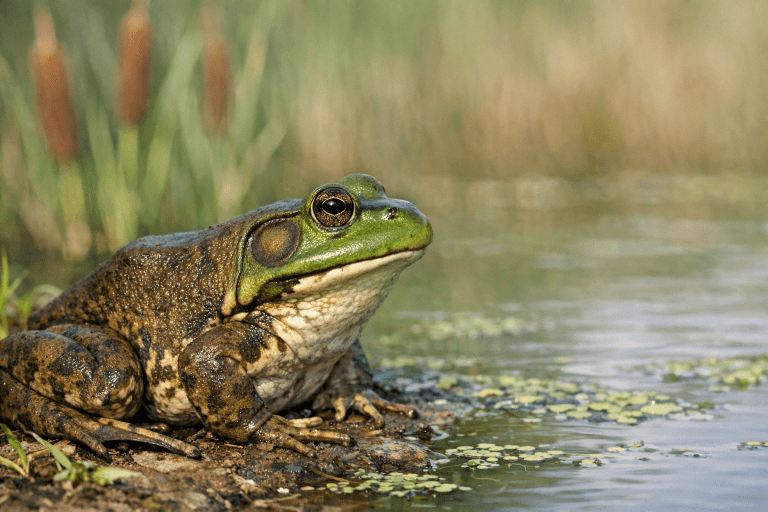
Wood Frog Guide
Keep Track of What You See
Create a free Wild Things Guide membership to record this Wood Frog in My Sightings and build your personal wildlife list.
Join to Add This SightingIntroduction
The wood frog (Lithobates sylvaticus, also widely listed as Rana sylvatica) is a small, terrestrial frog of northern North America. It is best known for the dark mask behind each eye, its ducklike breeding call, and its ability to survive partial freezing during winter dormancy.
Unlike strongly aquatic frogs, wood frogs spend much of the year on the forest floor. They may wander well away from permanent water, returning to shallow ponds and temporary woodland pools for a brief breeding season. Their variable brown, tan, reddish, or gray coloration blends remarkably well with dead leaves.

Quick Identification
- Key mark: A dark brown or blackish mask extending from the snout through the eye to behind the tympanum.
- Body: Compact, with relatively smooth skin and distinct dorsolateral folds along the back.
- Color: Tan, brown, reddish brown, coppery, gray, or occasionally pinkish.
- Underside: Pale, often with gray or brown mottling on the throat and chest.
- Legs: Dark crossbars are usually visible on the hind legs.
- Call: A short, nasal clucking or quacking sound, often delivered in a noisy chorus.
- Typical setting: Leaf litter in moist woods or the edges of temporary pools in early spring.
Appearance and Field Marks
The facial mask is the wood frog’s most useful field mark. It begins near the snout, surrounds the eye, and continues backward across the tympanum—the round external eardrum behind the eye. A pale line often borders the upper lip beneath the mask, increasing the contrast.
The back is usually plain or only lightly marked, although some individuals have scattered dark flecks or a faint central stripe. Raised dorsolateral folds run from behind the eyes toward the rear of the body. A darker marking may occur between the eyes, sometimes resembling an irregular triangle.
Wood frogs have a pointed to moderately rounded snout, a relatively narrow waist, and long hind legs suited to strong jumps. Their toes lack the large adhesive pads found on tree frogs. Webbing is present on the hind feet but is less extensive than in many highly aquatic frogs.
Color can change with temperature, moisture, lighting, and the individual frog. Consequently, overall color is less dependable than the mask, body shape, and habitat. Breeding males may appear darker than usual, while recently emerged frogs can look almost black when cold and wet.

Size and Measurements
Most adult wood frogs measure about 1.5–3.25 inches (3.8–8.3 cm) from the tip of the snout to the vent. Individuals near the lower half of that range are more commonly encountered. Females generally grow larger and heavier than males.
Sex is difficult to determine outside the breeding season. Mature males are typically smaller, may have enlarged dark nuptial pads near the inner thumbs, and develop relatively robust forelimbs used to hold females during amplexus. Measurements can overlap, so size alone does not reliably establish sex.
Range and Distribution
The wood frog occupies one of the broadest and most northerly ranges of any North American amphibian. It occurs from Alaska across much of Canada to Labrador and the Maritime Provinces. In the contiguous United States, it is widespread in the Northeast, Great Lakes region, and parts of the northern Midwest, extending southward at higher elevations through the Appalachian Mountains.
Western and southern populations may be scattered where suitable cool, wooded habitat is limited. Elevation, local climate, wetland availability, and forest continuity all influence its distribution. A detailed species account is available through the University of Michigan’s Animal Diversity Web.

Habitat
Wood frogs inhabit deciduous, mixed, boreal, and subalpine forests. Moist leaf litter, downed wood, shaded ground, and seasonal wetlands are important habitat features. Adults can also occur in forested swamps, bog margins, damp meadows, shrubby clearings, and wooded suburban landscapes.
Breeding habitat usually consists of shallow, still water. Vernal pools, flooded depressions, roadside woodland pools, beaver ponds, and quiet marsh edges may all be used. Fish-free temporary pools are particularly valuable because they contain fewer predators capable of consuming eggs and tadpoles.
The species depends on both wetlands and surrounding uplands. A frog seen hundreds of yards from water may still rely on a nearby seasonal pool to reproduce. Maintaining movement routes between forest refuges and breeding pools is therefore important.

Behavior
Outside the breeding season, wood frogs are mostly terrestrial and secretive. They shelter beneath leaves, logs, moss, roots, and other ground cover. Activity is greatest under cool, damp conditions, especially after rain. During dry weather they remain concealed to reduce water loss.
When disturbed, a wood frog often makes one or several long jumps and then becomes motionless in leaf litter. Its outline and color can make it difficult to relocate. Although capable swimmers, adults generally do not remain in open water for long after breeding.
In autumn, wood frogs seek shallow protected sites beneath leaves or organic debris. They overwinter on land rather than burying deeply below the frost line. Physiological adaptations allow them to tolerate ice forming in portions of the body while protective compounds help limit cellular damage.
Diet and Hunting
Adult wood frogs eat small invertebrates, including beetles, flies, ants, spiders, moth larvae, slugs, and other appropriately sized prey. The diet varies with season, habitat, and local availability.
They are primarily sit-and-wait hunters. A frog remains still until prey moves within range, then lunges and captures it with a rapid movement of the tongue and jaws. Hunting usually takes place on the ground among leaves and low vegetation.
Tadpoles feed differently from adults. They graze on algae, microorganisms, decomposing plant material, and organic films on submerged surfaces. They may also consume suspended particles or other available organic matter.

Vocalizations
The male’s advertisement call is a short, low cluck or quack, often compared with the sound of a duck. A single frog can sound subdued, but a dense chorus produces a rolling series of chuckles that carries across a woodland pool.
Calling begins very early in spring, sometimes while snow or ice remains nearby. Males may call during the day as well as at night, particularly in mild, wet weather. The calling period at an individual pool is often brief, so silence later in spring does not mean the species is absent.
Breeding and Nesting
Wood frogs are explosive breeders: many adults arrive at a pool, mate, and depart within a relatively short period. Timing varies greatly with latitude and elevation. Southern populations may begin in late winter, while northern frogs may not breed until late spring or early summer.
Wood frogs do not construct a nest in the manner of birds. During amplexus, the male clasps the female behind the forelimbs while eggs are released and fertilized externally. The female deposits a rounded gelatinous egg mass, usually attached to submerged twigs or vegetation near the surface.
Several females often place their egg masses together, creating a communal cluster. These clusters can benefit from warm, sunlit shallows, although exposed pools may also cool rapidly or dry before larvae complete development.
Reproduction
A female may lay several hundred to more than a thousand eggs, with clutch size influenced by her age and body size. Individual eggs are dark above and paler below, enclosed within clear jelly. Fresh masses are compact but swell as the jelly absorbs water.
Hatching may occur within a few weeks, depending strongly on water temperature. The dark tadpoles develop in the pool through spring or summer. Metamorphosis can take roughly two to several months, with colder climates and food conditions often slowing development.
Newly transformed froglets are tiny and leave the water after the tail has been absorbed. Juvenile survival is affected by pool drying, predation, weather, and access to moist forest cover. Adults provide no parental care after eggs are deposited.

Similar Species
Northern leopard frog: Usually greener or browner with bold rounded dark spots bordered by pale rings. Leopard frogs have light dorsolateral folds but lack the wood frog’s solid dark facial mask. They are also more closely associated with open wetlands and grassy areas.
Pickerel frog: Has paired rows of squarish brown spots and yellow or orange coloration on the concealed surfaces of the hind legs. Its facial markings do not form the same broad, continuous mask.
Spring peeper: Much smaller, with adhesive toe pads and usually a dark X-shaped mark on the back. Its call is a clear, high whistle rather than a cluck.
Chorus frogs: Small and often striped, with toe pads that are modest but more evident than those of a wood frog. Their calls and dorsal patterns differ, although quick glimpses near early spring pools can cause confusion.
Spotted frogs: In parts of western North America, spotted frogs may overlap with wood frogs. They tend to be more aquatic, have distinct dark spotting, and lack the sharply defined dark mask.
Conservation
The wood frog remains widespread, but local populations can decline when breeding pools are drained, polluted, stocked with fish, or isolated from surrounding forest. Road traffic may kill large numbers during seasonal migrations. Removal of leaf litter, coarse woody debris, and shaded upland cover can also reduce habitat quality.
Conservation is most effective when it protects the entire seasonal habitat network rather than the pool alone. Useful measures include retaining fish-free vernal pools, maintaining broad areas of adjacent forest, providing safe movement corridors, and limiting chemical runoff. Climate-related changes in snow cover, drought, and pool duration may create additional regional pressures.
Field Identification Tips
- Look first for the dark mask, then confirm the presence of dorsolateral folds and the absence of large toe pads.
- Search slowly along damp leaf litter rather than concentrating only on the water’s edge.
- In early spring, listen during mild rain or thaw conditions for a chorus resembling distant ducks.
- Examine egg masses without removing them. Wood frog masses are rounded, jelly-like, and frequently grouped in communal clusters.
- Do not rely on back color; individuals can range from pale tan to deep reddish brown or gray.
- Avoid handling when possible. If handling is necessary for an authorized survey, use clean, wet, chemical-free hands or follow the project’s hygiene protocol.
Interesting Facts
Wood frogs occur farther north than any other North American frog and are found in regions with long, severe winters. Their freeze tolerance involves controlled physiological changes: ice forms outside many cells, while glucose, urea, and related responses help protect tissues. The frog’s heart and breathing can temporarily stop during freezing and resume as it thaws.
The species also illustrates why small, temporary wetlands matter. A shallow pool that is dry by late summer may still support an entire spring generation of amphibians. Because wood frogs connect aquatic breeding sites with surrounding terrestrial food webs, their presence can be a useful sign of a functioning forest-wetland landscape.