

Wild Bergamot Guide
- Scientific Name
- Monarda fistulosa
- Family
- Lamiaceae
- Order
- Lamiales
- Length
- Typically 2–4 ft (60–120 cm) tall; occasionally to about 5 ft (1.5 m)
- Conservation Status
- Globally secure (NatureServe G5); not federally listed in the United States
- Habitat
- Prairies, meadows, savannas, open woods, dry slopes, roadsides, and other sunny, well-drained sites
- Range Summary
- Native across much of southern Canada and the continental United States, extending into parts of northern Mexico; most widespread in the Great Plains, Midwest, and eastern interior
Keep Track of What You See
Create a free Wild Things Guide membership to record this Wild Bergamot in My Sightings and build your personal wildlife list.
Join to Add This SightingIntroduction
Wild bergamot (Monarda fistulosa) is an aromatic North American wildflower of prairies, open woods, roadsides, and other sunny habitats. A member of the mint family, it combines square stems and opposite leaves with rounded heads of lavender, pink, or occasionally nearly white tubular flowers. The shaggy-looking flower heads are especially conspicuous in summer, when they attract bees, butterflies, moths, and hummingbirds.
The plant is also called bee balm or horsemint, although those names may be applied to other Monarda species. Crushing a leaf releases a strong fragrance often compared with oregano, thyme, or mint. That aroma is a useful field mark, but identification should also consider the flower structure, leaf arrangement, and habitat.
Quick Identification Summary
- Flowers: Dense, rounded terminal heads about 1–3 inches (2.5–7.5 cm) wide, composed of many narrow, two-lipped tubular flowers.
- Color: Usually pale lavender to rosy purple; white or deep pink forms occur.
- Leaves: Opposite, toothed, aromatic, and generally lance-shaped to ovate.
- Stem: Upright, branching, square in cross-section, and often softly hairy.
- Height: Commonly 2–4 feet (60–120 cm), occasionally approaching 5 feet (1.5 m).
- Habitat: Prairies, meadows, savannas, woodland openings, roadsides, and dry open slopes.
- Bloom: Usually June through September, depending on latitude and local conditions.
How to Identify the Plant
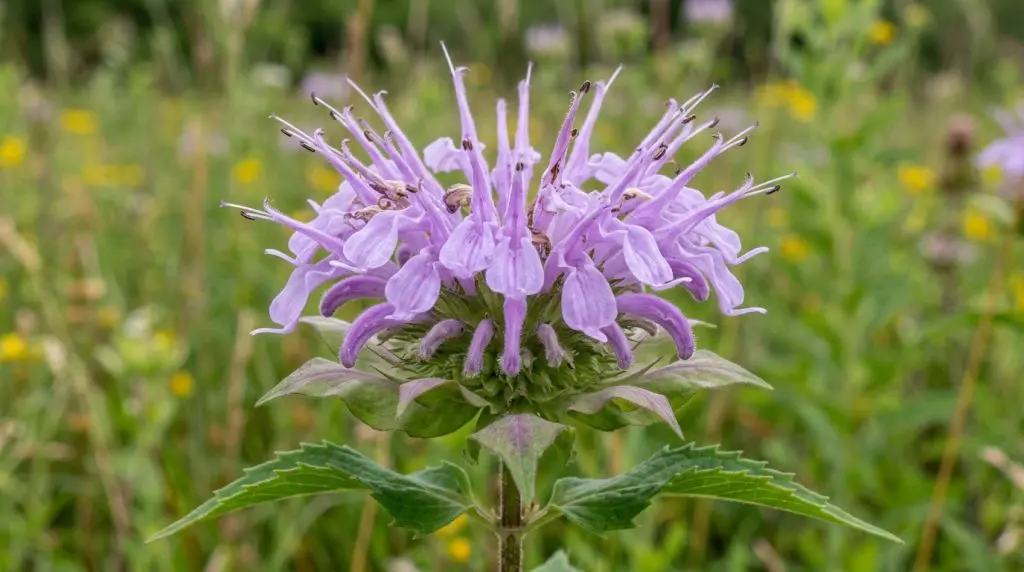
Begin with the flower head. What looks like one large flower is actually a compact cluster of numerous tubular flowers. Each flower has a hooded upper lip and a three-lobed lower lip. Slender stamens and the style may project from the floral tube, giving the head an irregular, tufted appearance. Flowers generally open over several days rather than all at once.
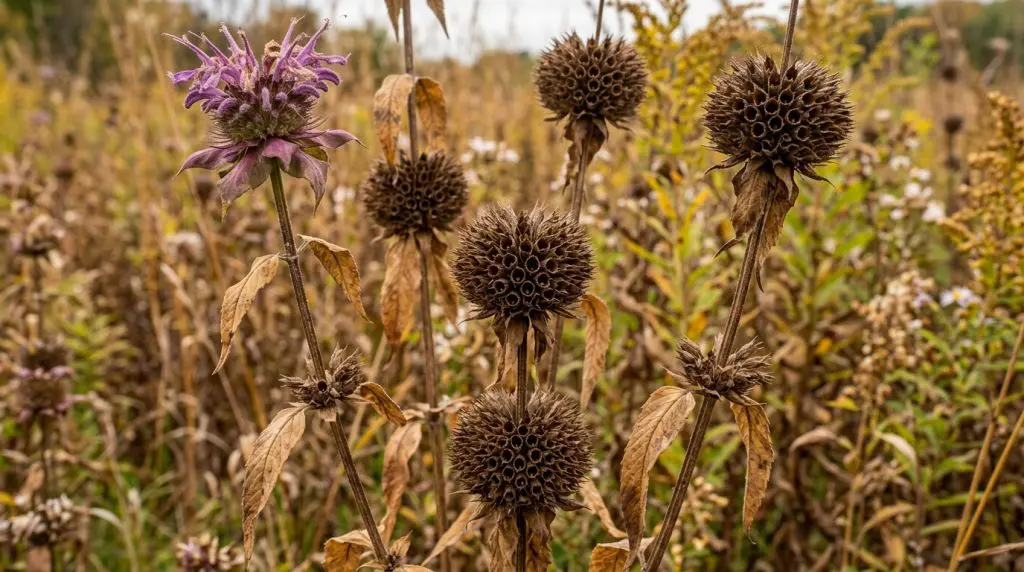
Beneath each head is a whorl of leafy bracts. These are usually green or tinged with purple, rather than the conspicuously cream, pink, or purple bracts found on some related horsemints. The persistent calyx tubes eventually form a firm, rounded brown seed head.
The leaves occur in opposite pairs along the stem. They are typically 2–4 inches (5–10 cm) long, with toothed margins, pointed tips, and short leaf stalks. Leaf shape varies from relatively narrow and lance-like to broader and ovate. Fine hairs may occur on the leaves and stems. The square stem and aromatic foliage confirm its placement in the mint family, although those traits alone do not distinguish it from every related species.
Size and Growth Habit
Wild bergamot is an upright herbaceous perennial, usually 2–4 feet tall. It dies back to the ground after the growing season and emerges again from perennial roots and short rhizomes. Several stems commonly rise together, producing an open clump that gradually expands where conditions are suitable.
Plants growing in exposed, dry soil may remain short and somewhat sparse. In deeper soil with adequate moisture, they can become taller, more branched, and densely leafy. The stems are usually sturdy but may lean after heavy rain or when grown in overly rich soil. Flower heads are borne at stem tips and sometimes at the ends of upper branches.
Blooming Season
Across much of its range, wild bergamot flowers from early or midsummer into early fall. June through September is a practical general window, but flowering may begin later in northern regions or at higher elevations. Individual plants often bloom for several weeks because the many flowers in each head open progressively.
Removing spent heads can extend flowering in a garden, although leaving at least some heads allows seeds to mature and provides late-season structure. Drought may shorten the bloom period, while good moisture during spring and early summer can support a fuller display.
Habitat
Wild bergamot favors places with abundant sun and open vegetation. Typical settings include tallgrass and mixed-grass prairie, old fields, meadow edges, oak or pine savannas, limestone glades, woodland openings, dry banks, railroad corridors, and roadsides. It is especially characteristic of moderately dry sites, though it also grows in mesic soils that drain well.
The species tolerates clay, loam, gravelly ground, and shallow rocky soil. It generally performs poorly in prolonged standing water or deep shade. Some roadside occurrences represent surviving native vegetation, while others may result from seed mixtures, garden escapes, or deliberate restoration plantings.

Geographic Range
Wild bergamot is native across a broad portion of North America, from southern Canada through much of the continental United States and into parts of northern Mexico. It is particularly widespread in the Great Plains, Midwest, and eastern interior. Distribution becomes more scattered toward some coastal regions and the far West, and local occurrence depends on habitat and the treatment of geographic varieties.
County- and state-level records can be explored through the USDA PLANTS profile for wild bergamot. Planted populations outside the documented native range should not automatically be interpreted as naturally occurring.

Similar Species and Look-Alikes
Scarlet bee balm (Monarda didyma) normally has bright red flowers, broader leaves, and a stronger association with moist stream banks and rich woodland edges. Cultivated forms, however, occur in many colors and can complicate identification near gardens.
Spotted beebalm (Monarda punctata) has tiered flower clusters with pale yellow tubular flowers marked by purple spots. Showy cream, pink, or purplish bracts often provide most of its visible color. Its stacked, elongated flowering structure differs from the rounded lavender heads of wild bergamot.
Bradbury’s beebalm (Monarda bradburiana) is generally shorter and blooms earlier, often in spring or early summer. Its pale flowers may carry darker purple markings, and its natural range is centered in the south-central United States.
White bergamot (Monarda clinopodia) usually bears whitish or cream flowers and is associated more often with eastern woodlands. Wild bergamot can occasionally produce very pale flowers, so use color in combination with leaf, bract, and habitat characters.
Mountain mints (Pycnanthemum species) also have aromatic opposite leaves and small clustered flowers. Their individual flowers are much smaller, and pale, silvery, or whitened upper leaves often surround the clusters.
Wildlife Connections
The long floral tubes contain nectar used by bumble bees, other native bees, butterflies, skippers, sphinx moths, and hummingbirds. Different visitors reach the nectar in different ways: long-tongued insects enter through the floral opening, while some short-tongued bees may make small holes near the base of the tube.
Wild bergamot is also a larval host for several specialized moths, including species whose caterpillars feed on Monarda foliage or flower heads. Its aromatic oils may discourage some mammalian browsers, but deer and rabbits can still eat young growth, particularly where other forage is limited.
Ecological Importance
Because it flowers during the height of summer, wild bergamot helps bridge the nectar period between spring wildflowers and late-blooming asters and goldenrods. A colony can offer many flowers within a small area, making it valuable in pollinator plantings and prairie restorations.
Its roots and rhizomes help maintain perennial cover on open soil, while the stems add structure among grasses and other wildflowers. It is not a substitute for a diverse native community, but it works well as one component of plantings designed to provide overlapping bloom times and varied flower shapes.
Native, Introduced, or Invasive?
Wild bergamot is native to much of North America. It may also occur as an introduced plant beyond parts of its natural range because it is widely grown and included in seed mixes. Native status should therefore be evaluated regionally rather than assumed from a single roadside or garden-adjacent population.
It is not generally classified as an invasive species in North America. Nevertheless, it can spread assertively by rhizomes and seed in favorable garden soil. That behavior is usually manageable and should not be confused with the ecological impacts associated with highly invasive nonnative plants.
Traditional and Historical Uses
Various Indigenous peoples have used wild bergamot and related Monarda species as aromatic teas, seasonings, washes, and components of traditional remedies. Uses and preparation methods differed among communities and should not be reduced to a single generalized practice. The plant’s fragrance comes partly from compounds also found in thyme and oregano.
Later settlers and herbalists adopted some culinary and household uses. Historical medicinal use does not establish modern clinical effectiveness, and surviving traditional knowledge should be approached with respect for its cultural sources.
Is It Edible or Toxic?
The leaves and flowers are commonly described as edible in modest culinary quantities. Fresh or dried leaves can flavor tea and savory dishes, while individual flowers may be used as an aromatic garnish. The flavor is strong, so a small amount is usually sufficient.
Correct identification is essential, particularly where plants have been sprayed along roadsides or mixed with unrelated species. Concentrated essential oil is far more potent than a tea or seasoning and should not be treated as an equivalent food product. Anyone pregnant, managing a medical condition, taking medication, or considering medicinal use should seek qualified guidance. Skin irritation or allergic reactions are possible in sensitive individuals.
Growing It in a Native Garden
Plant wild bergamot in full sun for the strongest stems and heaviest flowering. It tolerates light shade, but plants may become taller and produce fewer blooms. Average to dry, well-drained soil is usually preferable to heavily fertilized ground. Once established, it has good drought tolerance, though occasional watering during extended dry periods can improve flowering.
Space plants about 18–24 inches (45–60 cm) apart, allowing room for clumps to expand. Division in spring or fall is an easy way to control spread and renew older colonies. Seeds often benefit from a period of cool, moist stratification, and seedlings may vary somewhat in flower color and stature.
Powdery mildew can coat the leaves during humid weather, especially where plants are crowded, or air circulation is poor. Provide adequate spacing, avoid excessive nitrogen fertilizer, and water near the soil rather than repeatedly wetting the foliage. Mildew is often cosmetic and does not necessarily kill an established plant. Cutting some stems back in late spring can produce shorter, more branched growth, although flowering may be delayed.

Conservation
Wild bergamot is globally secure and is not federally listed as threatened or endangered in the United States. Its broad range and ability to occupy disturbed open ground contribute to that status. Local populations can still be lost when prairie remnants, savannas, and open woodland edges are converted, heavily sprayed, or overtaken by woody vegetation.
Gardeners can support regional conservation by purchasing plants or seeds from reputable native-plant nurseries that identify their source region. Do not dig up wild populations without permission. In remnant habitats, appropriate mowing, prescribed fire, grazing, or selective brush control may be necessary to retain the open conditions the species needs.
Interesting Fact
A wild bergamot “flower” is a community of flowers. Each rounded head contains many separate tubular blossoms packed around a central receptacle. As they open in sequence, the head changes shape and continues presenting fresh pollen and nectar to visitors over an extended period.
Frequently Asked Questions
Is wild bergamot the same as the bergamot used in Earl Grey tea?
No. Earl Grey is traditionally flavored with oil from bergamot orange (Citrus bergamia), a citrus tree. Wild bergamot is a North American member of the mint family. The shared name reflects an aromatic resemblance rather than a close botanical relationship.
Does wild bergamot attract hummingbirds?
Yes. Hummingbirds may visit its tubular flowers, although bees and butterflies are often more frequent visitors. Red-flowered Monarda species and cultivars may be especially conspicuous to hummingbirds.
Will it spread in a flowerbed?
It can form a widening clump through short rhizomes and may self-seed into open soil. Divide clumps, remove unwanted seedlings, or deadhead some flowers if space is limited.
Is wild bergamot deer-resistant?
Its aromatic foliage makes it less appealing than many garden plants, but it is not deer-proof. Browsing varies with deer pressure and the availability of other food.
Should the stems be left standing in winter?
Leaving stems until spring provides seed heads, winter structure, and potential shelter for stem-nesting insects. If tidiness is important, cut stems back in spring after consistently mild weather rather than immediately after flowering.


