Whooping Crane Guide
Keep Track of What You See
Create a free Wild Things Guide membership to record this Whooping Crane in My Sightings and build your personal wildlife list.
Join to Add This SightingIntroduction
The Whooping Crane (Grus americana) is North America’s tallest native bird and one of its rarest cranes. Adults stand out with white bodies, long black legs, and a red crown. In flight, broad black wingtips become a key clue.
Finding one takes planning, patience, and care: birds use scattered wetlands, and some sightings involve small, closely monitored populations.

Quick Identification
- Overall shape: Very tall, with a long neck, long legs, and a straight, pointed bill.
- Adult color: Mostly white, with a red crown and dark facial markings.
- Flight pattern: White wings with large black outer flight feathers.
- Flight posture: Neck stretched forward and legs trailing well beyond the tail.
- Young birds: White mixed with rusty cinnamon, especially on the head, neck, and upper body.
- Voice: Loud, carrying trumpet calls.
Appearance
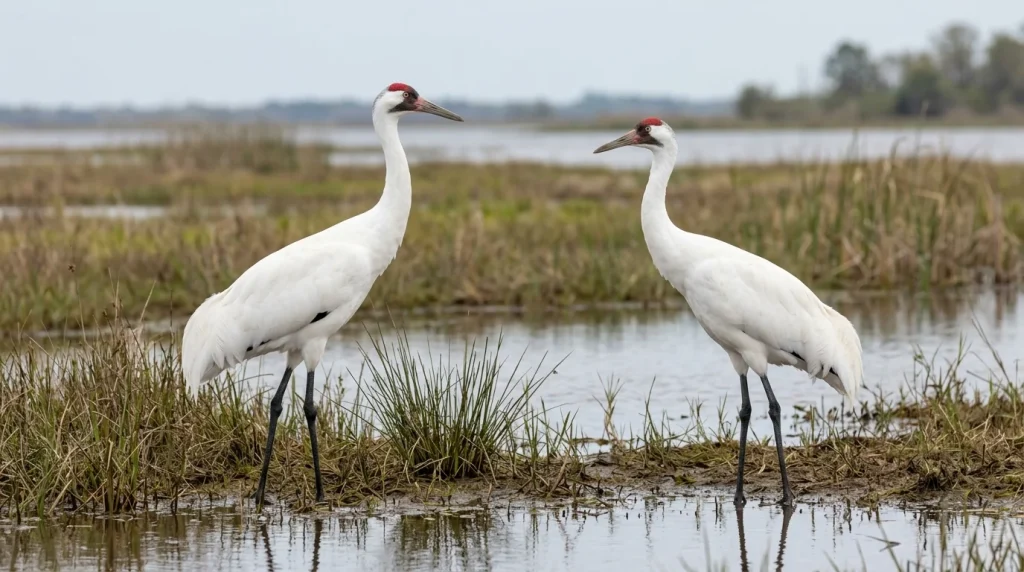
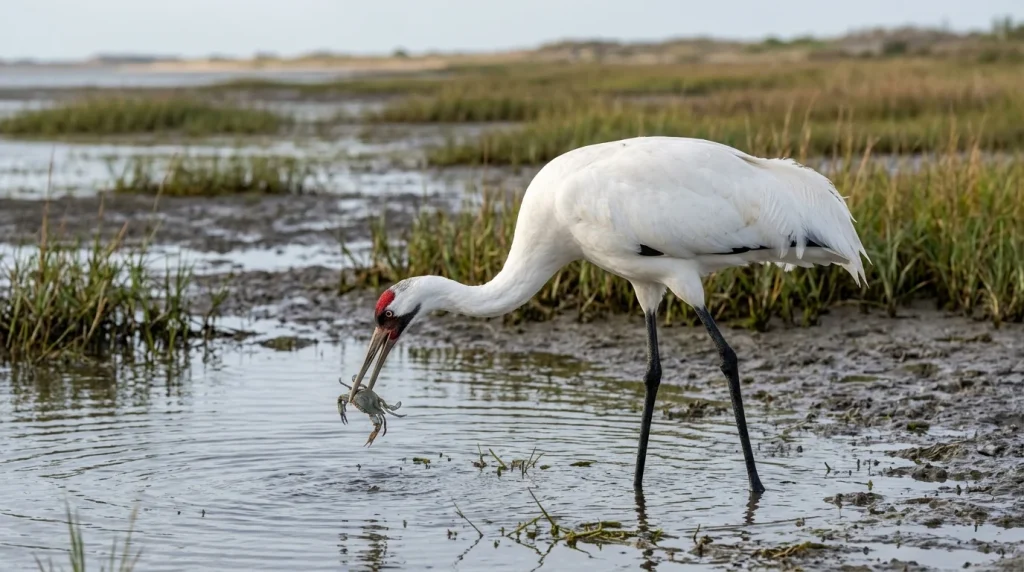
An adult Whooping Crane looks nearly all white when standing. The folded wings often hide the black primary feathers, so a resting bird may not show the feature that makes it easiest to recognize in flight. Look for a red patch of bare skin on the crown, dark markings around the face, and a long grayish bill.
Males and females have the same basic plumage. Males average larger, but size overlap and viewing distance make sex difficult to judge in the field. Do not identify sex from crown color or feather pattern.
Juveniles carry cinnamon or rusty patches among their white feathers. These markings fade as the bird matures. Mud and staining can also affect appearance, so use body shape and wing pattern along with color.
Size and Wingspan
- Adult length: About 130–160 cm (51–63 inches).
- Standing height: Up to about 1.5 m (5 feet).
- Wingspan: About 200–230 cm (6.6–7.5 feet).
Measurements vary by individual and method. Compared with most Sandhill Cranes, a Whooping Crane looks taller and heavier and has a longer bill. Distance can fool the eye, however, so size alone isn’t enough for reliable identification.
Range and Distribution
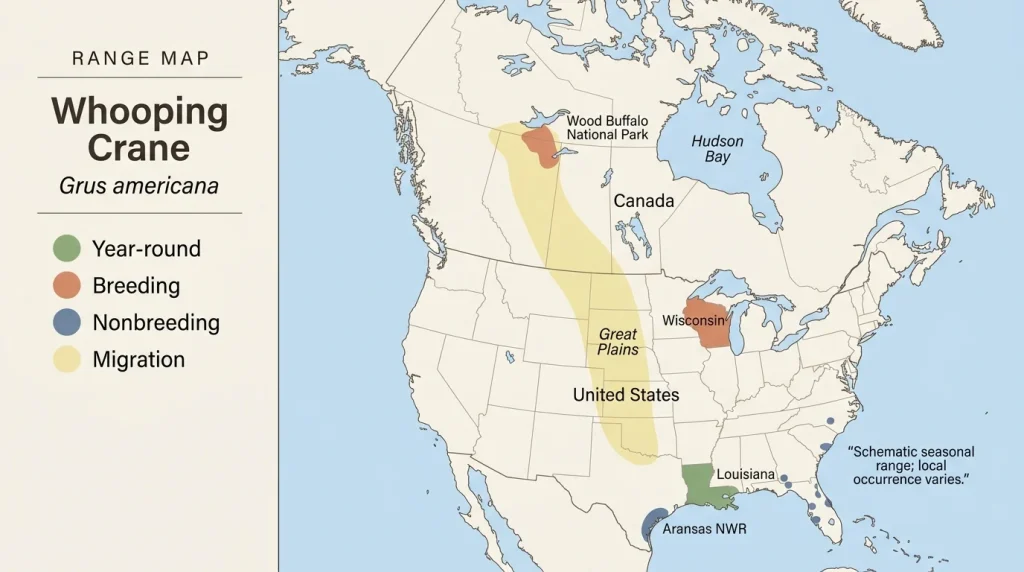
The main self-sustaining wild population breeds in and around Wood Buffalo National Park in northern Alberta and the southern Northwest Territories. These birds migrate through the central Great Plains and winter mainly along the Texas coast near Aransas National Wildlife Refuge.
The migration route passes through parts of the Canadian Prairies and the central United States. Stopovers may occur in Saskatchewan, North Dakota, South Dakota, Nebraska, Kansas, Oklahoma, and Texas, though routes and timing vary.
Reintroduced populations also occur in eastern North America. These include birds breeding mainly in Wisconsin and wintering at scattered sites farther south, plus a nonmigratory population in Louisiana. Their locations and numbers change as recovery work continues. A crane well outside the main western route may belong to one of these populations.
Habitat
Whooping Cranes need open places with shallow water and good visibility. Their habitat changes with the season:
- Breeding: Remote northern wetland mosaics with shallow ponds, marshes, and low vegetation.
- Migration: Prairie wetlands, shallow lakes, river channels, wet meadows, and nearby farm fields.
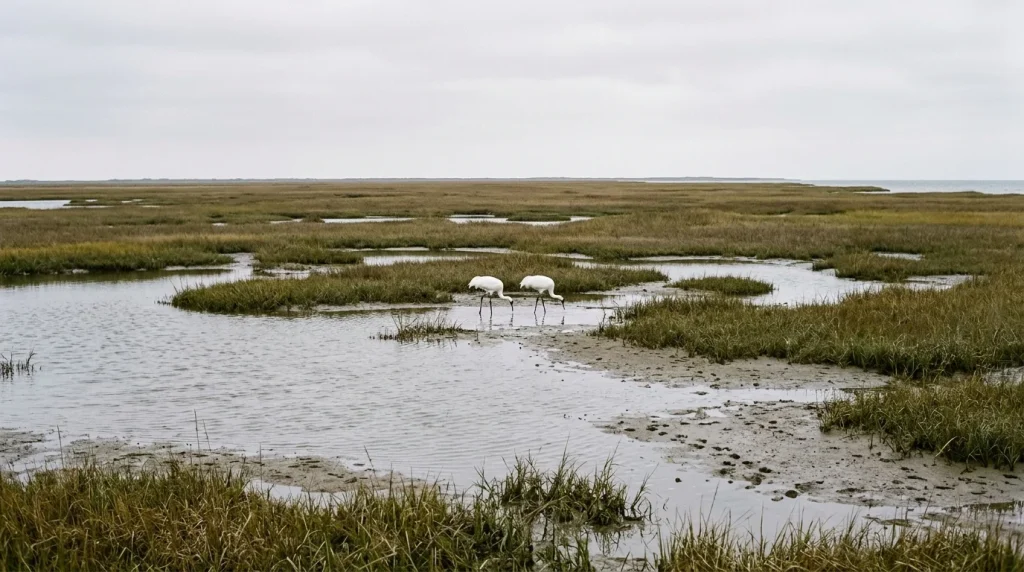
- Winter on the Texas coast: Salt marshes, tidal flats, shallow bays, and nearby uplands.
- Reintroduced populations: Freshwater marshes, managed wetlands, and some agricultural landscapes.
Shallow water offers both feeding sites and safer nighttime roosts. A wetland may look suitable but remain unused if water depth, food supply, or disturbance is wrong.
Behavior
Watch for slow, deliberate walking interrupted by quick pecks or probes. Whooping Cranes often travel as pairs or family groups, although larger gatherings occur at some stopovers and winter sites. They may feed near Sandhill Cranes without forming their own large flock.
Pairs perform dances that include bows, jumps, running steps, and wing spreading. Dancing helps maintain social bonds and is not limited to the nesting season.
In flight, cranes use steady wingbeats and may soar on rising warm air. Unlike herons and egrets, they normally keep their necks extended. Birds that stop feeding, raise their heads repeatedly, or move away may be reacting to your presence. Back away rather than waiting for them to settle.
Diet
Whooping Cranes are omnivores. They eat animal and plant foods depending on season and location, picking from the surface or probing shallow water and soft ground.
- Animal foods: Crabs, crayfish, insects, snails, clams, small fish, and other small animals.
- Plant foods: Berries, seeds, roots, tubers, and waste grain.
Blue crabs are important winter food along the Texas coast, where cranes also eat wolfberries and other foods. During migration, grain fields can provide feeding opportunities, but nearby wetland roosts remain important. Never offer food to attract a crane.
Vocalizations
The species gets its name from loud, resonant calls that can carry a long distance. Adults give trumpet-like notes used in contact, alarm, and pair communication. In a coordinated pair call, the birds stand upright and exchange patterned calls
Young birds make higher, thinner calls. Sandhill Cranes also give loud, rolling calls, so voice should support a visual identification rather than replace it. Avoid playback around cranes, especially near nests or family groups.
Breeding and Nesting
Whooping Cranes form long-term pair bonds and defend nesting territories. They usually begin breeding only after several years, often around four or five, though timing varies.
The nest is a broad mound of wetland plants built in shallow water. Both adults help with nesting duties. A typical clutch contains two eggs, usually buff to olive-brown with darker markings. Incubation lasts about a month, commonly around 29–31 days.
Although two chicks may hatch, often only one survives. Food supply, weather, predators, and competition between chicks can affect the outcome. Nesting birds are sensitive to disturbance; never approach a nest for a closer look or photograph.

Young and Development
Newly hatched chicks have cinnamon-colored down and can walk soon after hatching. They leave the nest area with their parents, who guide them to food and protect them. Early on, adults feed them directly; chicks gradually become better at finding their own food.
Young cranes generally begin flying at about three months old. In the mild, migratory populations, they travel south with their parents and learn migration routes and stopover sites. Families often stay together through winter, with young birds separating the following spring.
Where to See
The Texas coast near Aransas National Wildlife Refuge is the best place to see the main wild population in winter. Many birds occupy marshes that are hard to see from the road. Established overlooks and responsible wildlife boat tours can offer views without approaching birds on foot. Winter is generally the most dependable season.
Great Plains wetlands offer migration chances, but visits are brief and unpredictable. Check recent refuge reports rather than assuming cranes will appear at a familiar stopover.
Wisconsin and Louisiana provide opportunities to see reintroduced birds. Follow local viewing guidance and respect closures. Wood Buffalo’s breeding wetlands are remote and generally unsuitable for casual crane searching. At every site, use binoculars or a scope and remain on permitted routes.
Similar Species
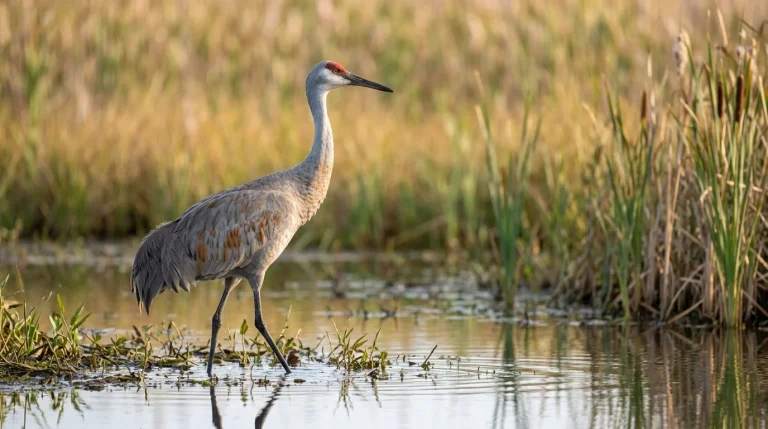
- Sandhill Crane: Usually gray, sometimes stained rusty brown, with a red crown. It shares the long-necked flight posture but lacks the adult Whooping Crane’s white body and sharply contrasting black wingtips.
- Great Egret: White with black legs, but much smaller and slimmer. It normally flies with its neck folded and has entirely white wings.
- American White Pelican: White with black flight feathers, but has a huge pouched bill, a bulky body, and short legs. It holds its neck back in flight.
- Snow Goose: Also white with black wingtips, but much smaller, with a short neck and legs that don’t trail far beyond the tail.
- Trumpeter Swan: Large and white with an extended neck in flight, but lacks black wingtips and long trailing legs.
Conservation
The IUCN lists the Whooping Crane as globally Endangered, and the U.S. Endangered Species Act lists it as threatened. Legal rules for some reintroduced populations differ under special management provisions. The species fell to a tiny remnant population in the twentieth century and has recovered through long-term protection, habitat work, captive breeding, and reintroduction.
Major concerns include wetland loss, power-line collisions, illegal shooting, disturbance, and changes in water supply. Drought and coastal habitat change can affect winter feeding areas. A small population with concentrated seasonal ranges remains vulnerable to severe events.
The U.S. Fish and Wildlife Service provides species and recovery information. Birders can help by respecting closures, keeping dogs under control, and reporting sightings to local wildlife agencies without publicizing sensitive nest locations.
Field Identification Tips
- Start with shape: Look for a towering bird with a long, straight bill and very long legs.
- Check flight posture: The neck stays outstretched, and the legs trail far behind.
- Look for black primaries: These may be hidden while the bird stands.
- Consider age: A rusty-and-white crane beside white adults may be their juvenile.
- Use several clues: Combine plumage, shape, companions, location, and season.
For a doubtful sighting, take a distant photograph and note the location, date, and any leg bands. The Cornell Lab of Ornithology’s Whooping Crane guide offers useful comparison images.
Frequently Asked Questions
Is a Whooping Crane a songbird?
No. It is a crane in the family Gruidae, not a songbird.
Are males and females different colors?
No. Both adults have the same basic white, black, and red pattern. Males average larger.
Do all Whooping Cranes migrate?
No. The main wild population migrates between Canada and Texas, while the reintroduced Louisiana population is nonmigratory.
What should I do if I find one?
Keep your distance, avoid blocking its movements, and follow local reporting guidance. Never chase, feed, or flush it to see the wings.