

White Trillium Guide
Keep Track of What You See
Create a free Wild Things Guide membership to record this White Trillium in My Sightings and build your personal wildlife list.
Join to Add This SightingWhite Trillium Guide
A complete field profile of Trillium grandiflorum, an iconic spring woodland wildflower with three broad leaves and a showy white bloom.
A mature white trillium holds one three-petaled flower above a whorl of three broad green bracts.
Quick Identification Summary
White trillium most often refers to Trillium grandiflorum, also known as large-flowered trillium or great white trillium. It is a long-lived perennial of eastern North American forests and one of the easiest spring wildflowers to recognize once its complete structure is visible.
- Flower: One large bloom with three broad white petals, usually facing outward or upward.
- Foliage: Three plain green, broadly ovate to diamond-shaped structures arranged in a whorl.
- Height: Commonly 8 to 18 inches on flowering plants.
- Season: Primarily April and May across much of its range.
- Habitat: Rich, cool, moist but well-drained deciduous or mixed woodland.
Key identification takeaway
Do not identify a trillium by white petals alone. Confirm the flower’s position, petal proportions, plain or mottled bracts, reproductive structures, habitat, and regional range.
How to Identify White Trillium
Begin with the plant’s conspicuous three-part symmetry. A mature specimen has three broad green structures in a single whorl near the top of an upright stem. They perform the work of leaves, although botanists generally call them bracts. Above them is one flower on a short stalk, or pedicel.
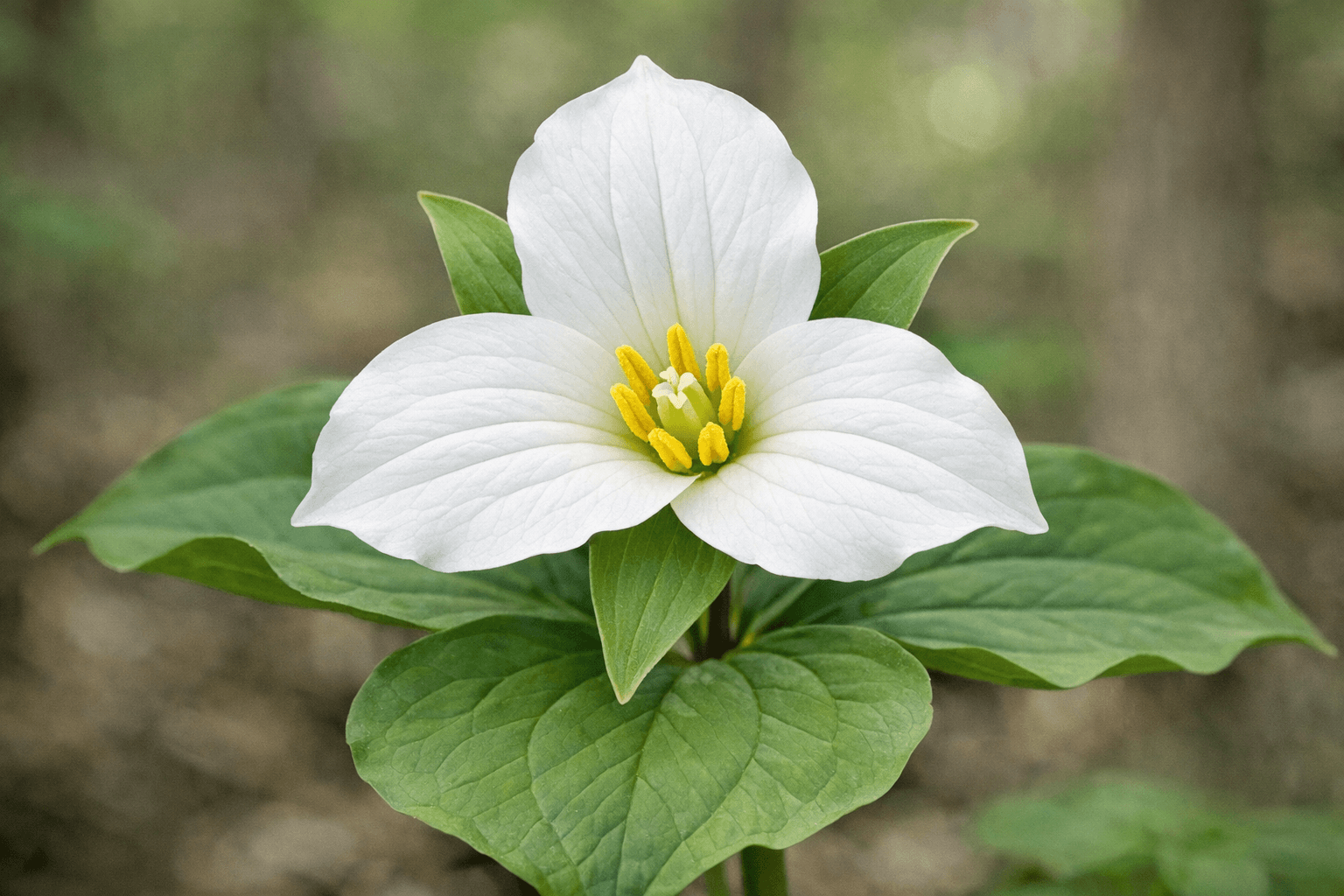
Diagnostic details include three broad petals, three narrower green sepals, six stamens, and unspotted green bracts.
The flower has three white petals backed by three narrower green sepals. Six stamens surround a central, three-parted reproductive structure. On robust plants, the bloom may approach 2 to 4 inches across. Petals are typically longer and broader than the sepals and may have gently rippled margins.
Fresh flowers are usually bright white, but aging or pollinated blooms often develop pale pink or rose tones. That color shift is normal and does not necessarily indicate a different species. Large-flowered trillium also normally has plain green bracts, unlike sessile species whose foliage may be strongly mottled.
The most reliable field identification comes from a combination of structure and place—not from one attractive feature viewed in isolation.
Size and Growth Habit
A flowering white trillium generally stands 8 to 18 inches tall, although age, soil fertility, moisture, browsing, and local climate all influence size. Its aboveground shoot is upright and unbranched. The whorl of three bracts sits near the top, supporting a solitary stalked flower.

The simple growth form becomes distinctive when the entire plant can be viewed from the forest floor to the flower.
Below ground, the plant persists through a thick rhizome. Undisturbed rhizomes can live for many years and expand gradually, while seeds establish new individuals nearby. What looks like a sudden sweep of flowers may therefore represent decades of slow growth.
Young trilliums do not immediately resemble flowering adults. Seedlings may produce only one small bract, and juvenile plants can remain nonflowering through multiple seasons. They eventually develop the familiar three-bract form, but may still need several more years before producing a bloom.
Blooming Season
White trillium generally blooms from mid-spring into early summer. In much of its range, peak flowering falls in April or May, before deciduous trees have fully leafed out. Northern populations and plants at higher elevations tend to bloom later than those in warmer lowlands.
Individual flowers can remain attractive for one to several weeks, depending on weather and pollination. During this brief period, the plant takes advantage of abundant sunlight reaching the forest floor. It then produces fruit and stores energy before becoming less conspicuous later in the season.
Habitat
Large-flowered white trillium favors rich deciduous and mixed forests where soil stays cool, contains plentiful organic matter, and drains well. Typical sites include wooded slopes, ravines, stream valleys, and elevated floodplain terraces. A deep layer of decomposing leaves helps retain moisture while supporting the fungi and soil organisms of a healthy forest floor.

Natural colonies occur in stable woodland soils beneath a seasonally changing canopy.
Associated canopy trees vary by region but may include beech, basswood, tulip tree, hemlock, and sugar maple. Learning to recognize the leaves, bark, and fruit of sugar maple can provide useful habitat context while exploring rich eastern forests.
Large colonies often indicate long-established woodland conditions. Trilliums disperse slowly, and repeated logging, grading, off-trail traffic, invasive plants, or soil compaction can interrupt the stable conditions they need.
Geographic Range
Trillium grandiflorum is native to eastern North America. Its broad distribution extends from parts of southern Canada through the Great Lakes, Northeast, Appalachians, and sections of the eastern and central United States.
Distribution is not uniform. Soil chemistry, moisture, forest history, deer abundance, development, and past collecting have all shaped local populations. A species that carpets one county’s woodlands may be scarce, protected, or absent nearby. Regional floras, herbarium records, and state or provincial conservation databases are therefore more useful than a generalized range map when evaluating a local population.
Garden records outside the core range also require care. A cultivated or naturalized plant is not automatically evidence that a historically native population occurred at that location.
Similar Species and Look-Alikes
Look first at flower position and petal markings
- Drooping trillium (T. flexipes): May have white petals, but its flower is often held at or below the bract whorl. Reproductive details and range also differ.
- Nodding trillium (T. cernuum): Bears a flower hanging beneath the bracts, where it may be hidden from an observer looking down.
- Painted trillium (T. undulatum): Has narrower white petals with a conspicuous reddish or purplish chevron near the center.
- Red trillium (T. erectum): Occasionally occurs in a pale or white form. Posture, petal proportions, ovary color, scent, and local range help distinguish it.
- Sessile trilliums: Hold the bloom directly against the bracts rather than on an obvious pedicel and often have mottled foliage.
Photograph the plant from above and from the side, including the underside of the flower if possible without touching it. Those views preserve more diagnostic evidence than a close-up of the petals alone.
Wildlife Connections
White trillium is not a major nectar plant, but small bees, flies, and beetles may visit its flowers and transfer pollen. These modest early-season interactions matter because woodland insects emerge when relatively few flowers are available. Readers interested in distinguishing common spring visitors can compare them with the common eastern bumble bee identification guide.

A berry-like capsule contains seeds equipped for an unusual partnership with forest ants.
Ants as seed dispersers
After pollination, trillium develops a berry-like fruit. Each seed bears a fatty appendage called an elaiosome. Ants carry seeds to their nests, eat the elaiosomes, and discard the intact seeds in protected, nutrient-rich locations. This dispersal relationship is known as myrmecochory.
The effect of deer browsing
White-tailed deer readily browse trillium flowers and foliage. Repeated browsing reduces plant height, flowering, energy storage, and seed production; over time, it can transform or eliminate a colony. Browsing pressure from large herbivores is a recurring ecological theme, also explored in the site’s practical mule deer field guide.
Trillium patches also provide seasonal cover and plant diversity in habitats used by beetles, amphibians, small mammals, and woodland birds such as the barred owl.
Ecological Importance
White trillium belongs to the spring woodland flora that uses sunlight before the canopy closes. Although it retains foliage beyond flowering, its most visible growth and reproduction align with this bright seasonal window.
- Flowers and pollen provide timely resources for early woodland insects.
- Ant-assisted seed movement links the plant to forest-floor invertebrates.
- Long-lived colonies reflect continuity of canopy, soil, and moisture conditions.
- Trillium conservation also protects fungi, salamanders, birds, native trees, and neighboring wildflowers.
A trillium colony is not proof that a forest is pristine, but abundant mature plants can be one clue in a broader assessment of habitat continuity and disturbance.
Native, Introduced, or Invasive?
Trillium grandiflorum is native to eastern North America and is an integral member of many woodland communities within its natural range. It is not considered invasive: it establishes and spreads slowly rather than forming aggressive stands that displace other native vegetation.
A garden specimen planted outside the species’ historic range may be locally nonnative even though the species is native to the continent. This distinction matters when planning restoration projects, where plants should align with regional ecology rather than merely carry a broad “North American native” label.
Traditional and Historical Uses
Various Indigenous peoples historically used trillium species in distinct, regionally specific medicinal traditions. The old common name “birthroot” reflects documented associations between some trilliums and reproductive or childbirth-related practices. European American herbal traditions later adopted reported uses, sometimes treating different species as interchangeable.
These records should be approached as cultural and historical information, not modern medical advice. Sources differ regarding the species, plant part, preparation, and purpose involved, and generalized retellings can erase important cultural context. Living plants should never be harvested from wild colonies to recreate historical remedies.
Is White Trillium Edible or Toxic?
White trillium should not be treated as a foraging plant. Although historical references sometimes mention the use of young tissues or underground parts, reliable guidance on species, preparation, dose, and individual susceptibility is limited. Ingestion may cause gastrointestinal discomfort.
Safety guidance
The safest choice is to admire white trillium without eating it or using it as a home remedy. If a child, adult, or pet swallows an uncertain amount, contact an appropriate poison control service, medical professional, or veterinarian.
Foraging also creates a conservation problem. Removing bracts deprives the rhizome of energy-producing tissue, digging destroys the plant, and harvesting flowers prevents seed formation. Collection may also violate park rules or protected-plant laws.
Growing White Trillium in a Native Garden
The best garden setting imitates a stable deciduous forest floor rather than a conventional flower bed. White trillium rewards patience, but it does not tolerate frequent disturbance.
- Choose woodland light. Select a shaded or partially shaded spot beneath deciduous trees, with spring sunlight and protection from intense summer heat.
- Prepare suitable soil. Provide humus-rich, moisture-retentive but freely draining soil. Avoid sites that remain waterlogged or bake dry.
- Buy propagated plants. Use an ethical native-plant nursery that explicitly identifies its trilliums as nursery-propagated. Never dig plants from forests, roadsides, or public land.
- Plant carefully. Install dormant rhizomes at the depth recommended by the supplier. Minimize root disturbance and mark the location so it is not accidentally cultivated.
- Maintain natural mulch. Let clean fallen leaves remain as insulation and slowly decompose. Avoid piling dense mulch directly over emerging shoots.
- Water during drought. Keep the site evenly moist during establishment and prolonged dry periods, without creating saturated soil.
Good tree selection can help create the right long-term setting. Native canopy species, as described in the white oak identification and ecology guide, can anchor a layered woodland garden where regionally appropriate.
Expect slow results. Plants raised from seed may take seven years or considerably longer to bloom. Established rhizomes can flower sooner, but even these may pause as they adjust to a new site.
Conservation
The species is secure in some regions but locally vulnerable in others. Habitat loss, fragmentation, invasive plants, soil disturbance, illegal collection, and excessive deer browsing can all reduce populations. Conservation rank and legal protection vary by jurisdiction, so current state, provincial, and local sources are essential.
Picking only a flower may not kill the rhizome immediately, but it prevents that bloom from producing seeds. Removing the green bracts is more damaging because they manufacture and store energy for future growth. Repeated injury can weaken or eventually kill a plant.
- Remain on established trails near dense colonies.
- Leave flowers, fruits, seeds, and rhizomes where they grow.
- Photograph without bending or repositioning plants.
- Control invasive vegetation carefully, avoiding soil disruption.
- Purchase only verifiably nursery-propagated stock.
- Use appropriate protection where deer browsing is severe.
Interesting Fact
Trillium’s name reflects its repeated pattern of three: three bracts, three sepals, three petals, and reproductive structures arranged in multiples of three. Its life cycle, however, is more complicated than its geometry suggests.
Seeds may require multiple seasonal temperature cycles before germinating. Seedlings then spend years building enough underground reserves to flower. A colony filled with mature blooms is therefore a record of persistence—often the result of decades of gradual rhizome growth and ant-assisted dispersal.
Frequently Asked Questions
Does white trillium turn pink?
Yes. Flowers of Trillium grandiflorum commonly develop pale pink or rose tones as they age or after pollination. Color change alone does not prove the species identity.
Can white trillium grow in full sun?
It generally performs best in woodland shade or dappled light. Hot, exposed, rapidly drying sites can scorch foliage and reduce vigor, although gentle spring sun before canopy leaf-out is beneficial.
Is it illegal to pick white trillium?
Rules differ by jurisdiction and land ownership. Collection is prohibited in many parks and protected areas, and taking any plant without the landowner’s permission may be unlawful. Picking remains ecologically harmful even where it is not explicitly prohibited.
Will a picked trillium die?
Removing only the flower differs from removing the green bracts or uprooting the rhizome. Still, flower removal prevents reproduction, while damage to the bracts reduces energy storage. Repeated picking can weaken or kill plants.
How quickly does white trillium spread?
Very slowly. Expansion occurs through rhizome growth and seed dispersal, and seedlings require years to mature. Garden progress is best measured over years rather than weeks or months.
Sources and Further Reading
For local identification and conservation decisions, consult several complementary source types rather than relying on one photograph or generalized range description:
- Regional floras, university herbaria, and botanical garden references for diagnostic features.
- Federal, state, and provincial databases for current distribution, conservation rank, and legal protections.
- Peer-reviewed research on deer browsing, pollination, myrmecochory, fragmentation, and trillium population demography.
- Native-plant societies and established botanical institutions for cultivation recommendations.
- Carefully documented ethnobotanical works that identify the culture, geographic region, species, and historical context involved.
Conclusion: Recognize and Respect White Trillium
White trillium is recognized by one large, three-petaled flower held above three broad green bracts, but accurate identification also requires attention to posture, markings, habitat, and range. Its slow life cycle, ant-dispersed seeds, sensitivity to deer, and dependence on stable forest soil make it much more than an attractive spring bloom.
Gardeners can support the species by choosing ethically propagated plants and recreating the cool, leaf-rich conditions of a deciduous woodland. In the wild, the best practice is simpler: stay on the trail, take photographs, and leave every part of the plant intact.
Protect White Trillium Where It Grows
Observe and photograph wild colonies without picking them, support ethical native-plant nurseries, and help preserve the healthy forests that trilliums and woodland wildlife share.


