Rocky Mountain Juniper Guide
Keep Track of What You See
Create a free Wild Things Guide membership to record this Rocky Mountain Juniper in My Sightings and build your personal wildlife list.
Join to Add This SightingTree Name
Rocky Mountain juniper (Juniperus scopulorum) is an evergreen conifer in the cypress family (Cupressaceae). Native to western North America, it is a familiar tree of rocky slopes, foothills, canyon rims, and open woodlands. People sometimes call it cedar or red cedar, but it is a juniper, not a true cedar of the genus Cedrus.
Its small, overlapping leaves, fibrous bark, and blue, berry-like cones make it easy to identify as a juniper. Identifying the species takes a little more care: foliage color varies, several western junipers overlap geographically, and cultivated varieties can look quite different from wild trees.

Quick Identification
- Size: Commonly 20–40 feet (6–12 m) tall, with a crown about 10–20 feet (3–6 m) wide; exposed trees may remain much smaller.
- Form: Often upright and conical when young, becoming irregular, rounded, or picturesque with age.
- Foliage: Mostly tiny, opposite, overlapping scales on slender branchlets; green, gray-green, or blue-green.
- Bark: Reddish brown to gray-brown, peeling in narrow, fibrous strips.
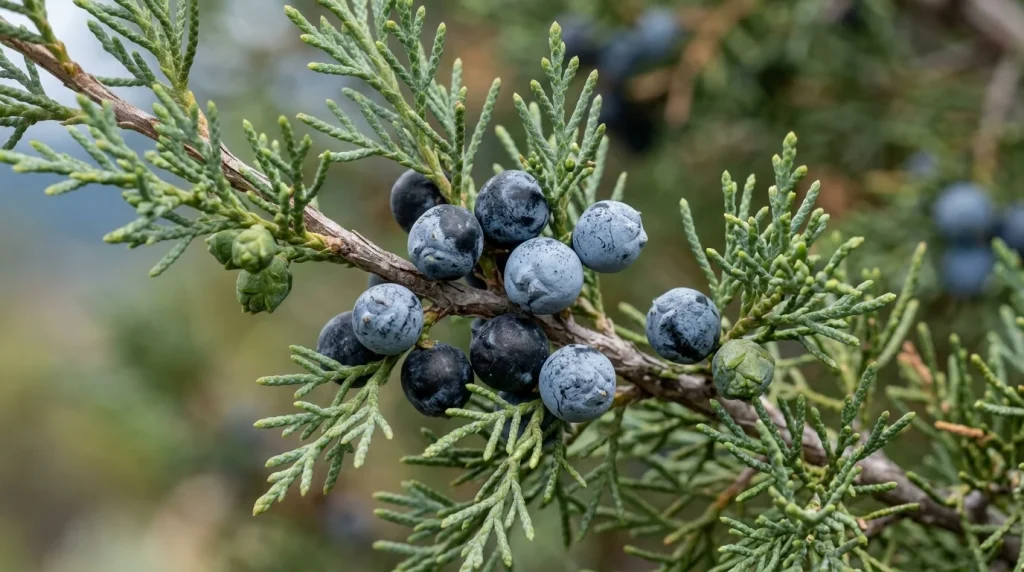
- Cones: Small, rounded, blue to blue-black seed cones with a pale waxy coating, generally 4–9 mm across.
- Best field approach: Combine mature scale foliage, small waxy cones, tree form, and location. Blue foliage alone is not diagnostic.
Appearance
A young Rocky Mountain juniper often has a pointed crown with ascending branches. Older trees may develop spreading limbs, multiple trunks, dead tops, or an uneven silhouette. Wind, shallow soil, browsing, and broken branches can produce dramatically twisted forms. On favorable sites, the species can exceed its usual height.
Most adult leaves are approximately 1–2 mm long and lie close against the twigs in opposite pairs. Successive pairs face different directions, creating a tightly clothed branchlet. Unlike many arborvitae, its foliage does not form broad, strongly flattened fans.
Seedlings and vigorous new shoots may carry longer, sharp, awl-shaped juvenile leaves. Finding both foliage types on one plant is therefore not unusual. Foliage can be aromatic when gently rubbed, but many junipers share this scent, so it is not a reliable species test.
Growth is usually slow to moderate. Young, established trees on reasonably favorable sites may add roughly 6–12 inches (15–30 cm) in height annually; dry, exposed trees can grow far less. Narrow blue ornamental selections should not be treated as a model for every wild tree.

Bark, Twigs, and Buds
Young bark is relatively thin and reddish brown. With age, it becomes gray-brown, shallowly furrowed, and stringy, separating into long strips. Old trunks can appear fluted or twisted, with reddish inner surfaces visible where outer fibers loosen. Avoid pulling bark away to examine it.
The youngest twigs are slender and largely hidden beneath their scale leaves. Older exposed twigs become brown. Dormant shoot tips are inconspicuous rather than carrying the large, obvious winter buds seen on many broadleaf trees.
Bark helps confirm a juniper, but it rarely settles the species. Many junipers have similarly shredding bark, and trunk texture changes considerably with age and weather exposure.

Range and Habitat
Rocky Mountain juniper occurs across much of interior western North America, from southern British Columbia and southwestern Alberta south through the Rocky Mountain region and adjoining country to the southwestern United States and northern Mexico. Its distribution also reaches portions of the Great Basin and western Great Plains. Occurrence is patchy rather than continuous across this large area.
Look for it on rocky hillsides, limestone or sandstone outcrops, canyon slopes, ridges, and open woodland margins. It also grows along some draws and stream corridors where soils remainwell-drainedd. Associates vary geographically and include ponderosa pine, Douglas-fir, pinyon pines, other junipers, grasses, and sagebrush.
The tree tolerates cold, drought, and relatively poor soils, but prolonged saturation is unfavorable. It generally does best with abundant light. The U.S. Forest Service Fire Effects Information System account of Rocky Mountain juniper provides detailed background on its distribution, habitats, and response to fire.

Flowers, Fruit, Nuts, or Cones
This conifer does not produce flowers or true berries. Instead, it bears small pollen cones and fleshy seed cones whose fused scales create a berry-like appearance. Trees are usually either pollen-producing or seed-producing, although exceptions occur.
Pollen cones are small and yellowish to tan when releasing wind-carried pollen, typically in spring. Developing seed cones begin green and mature to blue or blue-black beneath a whitish waxy bloom. That coating can make ripe cones look pale blue from a distance.
Seed cones usually mature during their second growing season and commonly contain one to three seeds, often two. Developing and mature cones may occur together. Size, maturation time, and seed number help distinguish neighboring junipers, but none should be used alone. Observe attached cones whenever possible; fallen cones may have come from another nearby tree.
Wildlife Connections
The fleshy cones feed birds and mammals, especially when other foods are scarce. Waxwings, Townsend’s solitaires, robins, and other thrushes eat juniper cones and can disperse the seeds away from the parent tree. Local use varies with cone crops, bird movements, and the surrounding vegetation.
Dense evergreen branches offer shelter, roosting cover, and nesting sites. Deer and other browsing animals may use the foliage, particularly during difficult seasons, though not all herbivores prefer it equally.
An old juniper also supplies crevices, shaded ground, and accumulated litter in an otherwise exposed setting. Retaining a variety of tree ages and nearby native shrubs generally provides more habitat diversity than keeping only uniform ornamental trees.
Seasonal Identification
Spring: Look for fresh shoot growth and small pollen cones. Pollen release can make pollen-producing branches appear dusted yellow. Young seed cones are easy to overlook.
Summer: Examine leaf arrangement and branchlet shape in good light. Check several branches because vigorous shoots may have juvenile foliage. Note the habitat and any nearby juniper species.
Autumn: Mature blue cones are often conspicuous on seed-producing trees, although crop size varies. Rocky Mountain juniper has no broadleaf-style fall color display.
Winter: Evergreen foliage, shredding bark, and retained cones remain useful. Some trees take on bronze or purplish tones in cold weather. However, extensive browning or dieback should not automatically be dismissed as normal winter color.

Human Uses and History
The aromatic, relatively decay-resistant heartwood has been used for fence posts, small wood products, and rustic construction. Irregular trunks often limit the supply of large, straight lumber. Its durability and distinctive grain make sound salvaged wood useful for small craft projects.
Indigenous peoples within its range have used Rocky Mountain juniper for practical, medicinal, and ceremonial purposes. Those traditions differ among nations and communities; they should not be reduced to a single universal use or treated as instructions for home remedies.
Today, the species and its cultivars are planted in windbreaks, screens, and dry-climate landscapes. Give it sun, drainage, and enough room for its eventual crown. Water during establishment, then adjust irrigation to climate and soil. Don’t assume wild or ornamental juniper cones are interchangeable culinary ingredients.
Conservation and Threats
Rocky Mountain juniper is widespread and is not generally regarded as globally threatened. Individual populations and old trees can nevertheless be affected by development, severe drought, fire, and locally important insects or diseases.
Its relatively thin bark and lack of dependable resprouting make it vulnerable to fire. Conversely, reduced fire frequency can allow junipers to expand into some formerly more open grasslands. Whether a stand should be protected, thinned, or otherwise managed depends on local ecological history and conservation goals.
In landscapes, poorly drained soil, excessive irrigation, and crowding can contribute to decline. Junipers also host certain rust fungi that alternate with members of the rose family. Identify the actual problem before treating: orange fungal growth, twig death, and drought injury require different responses.
Similar Species
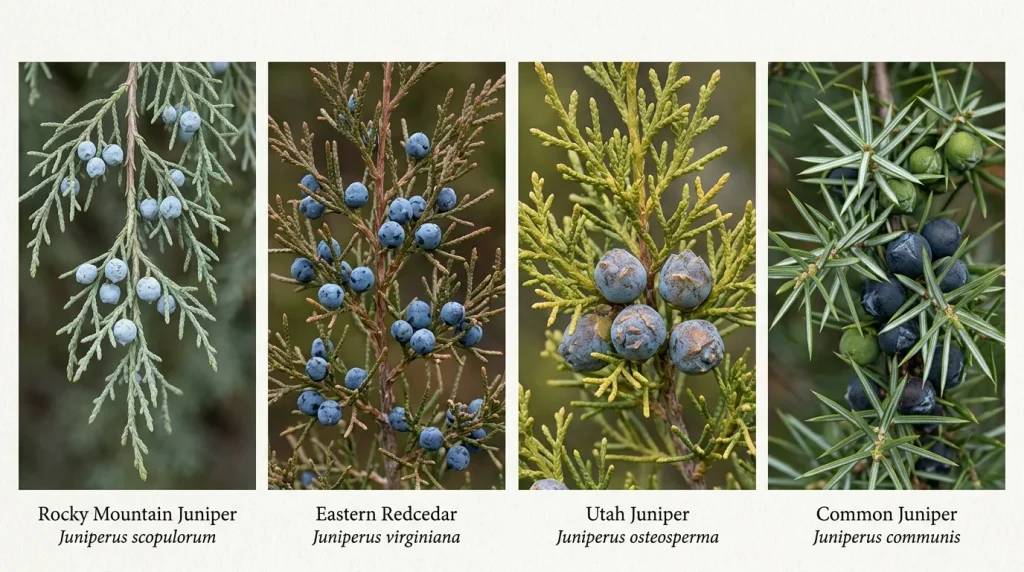
- Eastern redcedar (Juniperus virginiana): Very similar scale foliage and small blue cones. Its principal range lies farther east, and its cones generally mature in one growing season. The species can hybridize where they meet, making some Great Plains trees difficult to assign confidently.
- Utah juniper (Juniperus osteosperma): Often stockier, with coarser branchlets, yellow-green foliage, and generally larger cones that commonly contain one seed. Form and color overlap, so inspect multiple characters.
- Common juniper (Juniperus communis): Retains stiff, needle-like leaves in whorls of three, each with a conspicuous pale band above. It does not switch predominantly to the tightly overlapping adult scales typical of Rocky Mountain juniper.
For difficult trees, photograph the entire crown, bark, adult foliage, and cones, and record the location. A regional flora or herbarium can help resolve uncertain identifications.
Interesting Facts
- The name scopulorum refers to rocks or cliffs, fitting its frequent rocky habitats.
- The apparent berry is actually a cone with fleshy, fused scales.
- Established trees can live for several centuries; exceptional individuals have been reported to exceed a thousand years.
- A small, weather-beaten tree may be much older than its height suggests.
Frequently Asked Questions
Is Rocky Mountain juniper a cedar?
Only in the common-name sense. Botanically, it is a Juniperus in the cypress family, not a true cedar.
Why does my tree have no blue cones?
It may be a pollen-producing tree, immature, or between substantial cone crops. Developing cones are also small and green.
Can I identify it by blue foliage?
No. Foliage color varies naturally and among cultivars. Use leaves, cones, bark, range, and comparisons together.
Is it suitable for a dry yard?
Often, if the climate is appropriate and the site is sunny and well-drained. Newly planted trees still need establishment watering, and mature size varies by cultivar and growing conditions.