
Purple Coneflower Guide
- Scientific Name
- Echinacea purpurea
- Family
- Asteraceae
- Order
- Asterales
- Length
- Typically 2–4 ft (0.6–1.2 m) tall; occasionally to about 5 ft (1.5 m)
- Conservation Status
- Globally secure (commonly ranked G5); local populations may face habitat loss
- Habitat
- Mesic to moderately dry prairies, savannas, glades, open woods, woodland edges, and sunny disturbed sites
- Range Summary
- Native primarily to the central and southeastern United States; widely cultivated and locally naturalized elsewhere in the United States and southern Canada
Keep Track of What You See
Create a free Wild Things Guide membership to record this Purple Coneflower in My Sightings and build your personal wildlife list.
Join to Add This SightingIntroduction
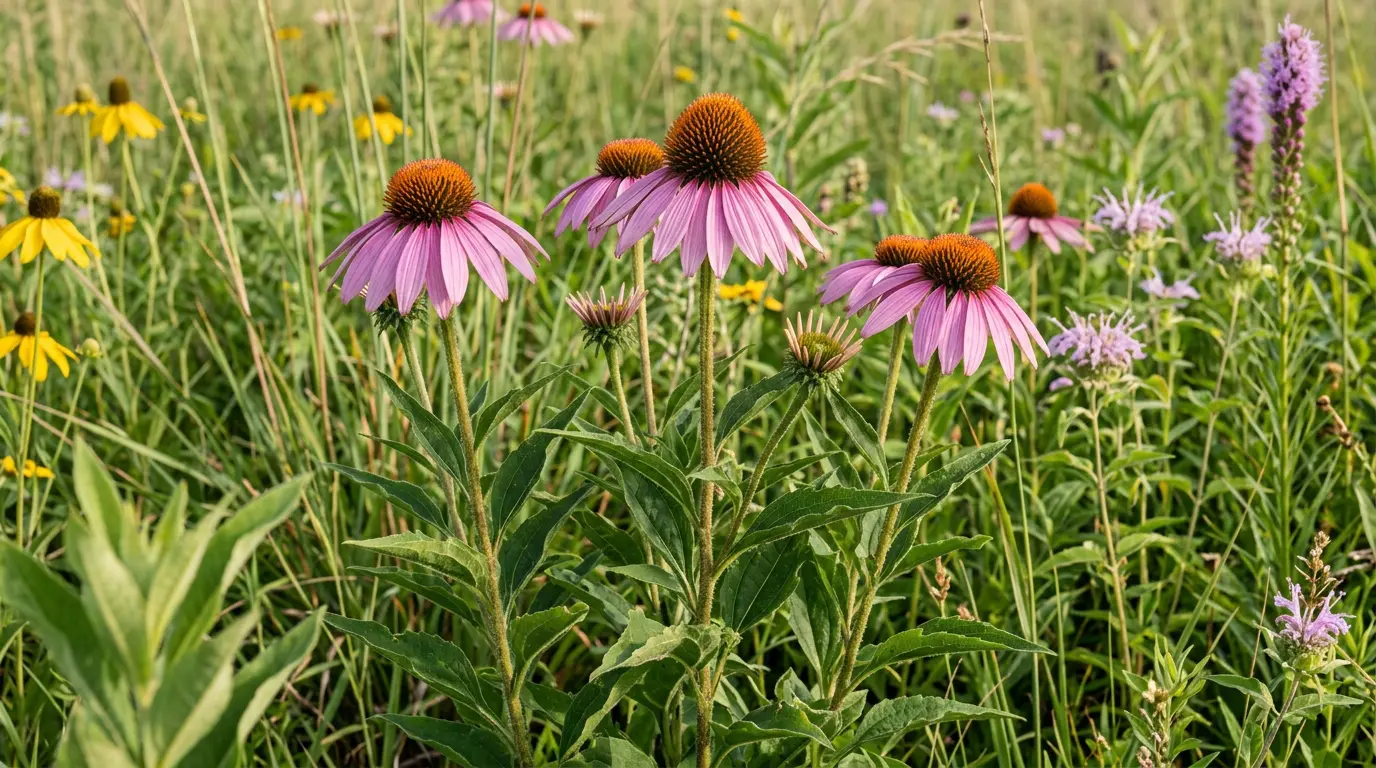
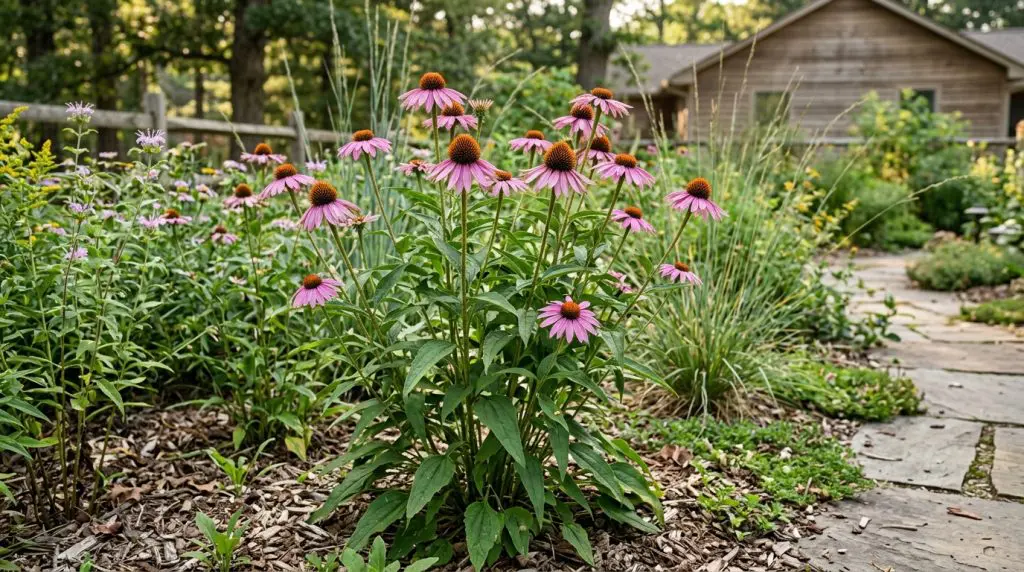
Purple coneflower (Echinacea purpurea) is a sturdy, long-blooming perennial wildflower of prairies, savannas, woodland openings, and other sunny habitats in central and eastern North America. Its large flower heads combine pink-purple ray florets with a prominent orange-brown central cone, creating one of the most recognizable silhouettes in the sunflower family.
Because purple coneflower is widely planted in gardens, roadside projects, and pollinator landscapes, not every wild-looking occurrence represents a naturally established native population. Identification should consider the whole plant—especially its broad, toothed leaves and relatively robust stems—rather than flower color alone.
Quick Identification Summary
- Flowers: Large heads with pink, rose-purple, or occasionally pale ray florets surrounding a raised, prickly orange-brown cone.
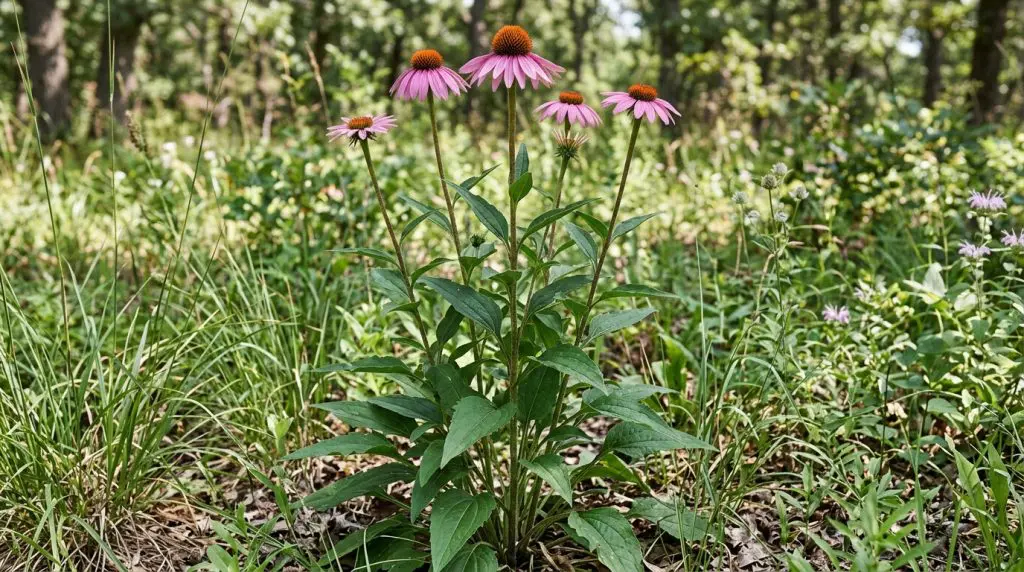
- Leaves: Mostly alternate, broadly ovate to lance-shaped, coarsely toothed, rough-textured, and often long-stalked below.
- Stems: Upright, stout, usually hairy, and unbranched or sparingly branched.
- Height: Commonly 2–4 feet (0.6–1.2 meters), occasionally taller in favorable conditions.
- Bloom period: Usually early summer through late summer, with timing varying by latitude and weather.
- Habitat: Sunny prairies, savannas, glades, open woods, woodland edges, and disturbed open ground.
How to Identify the Plant
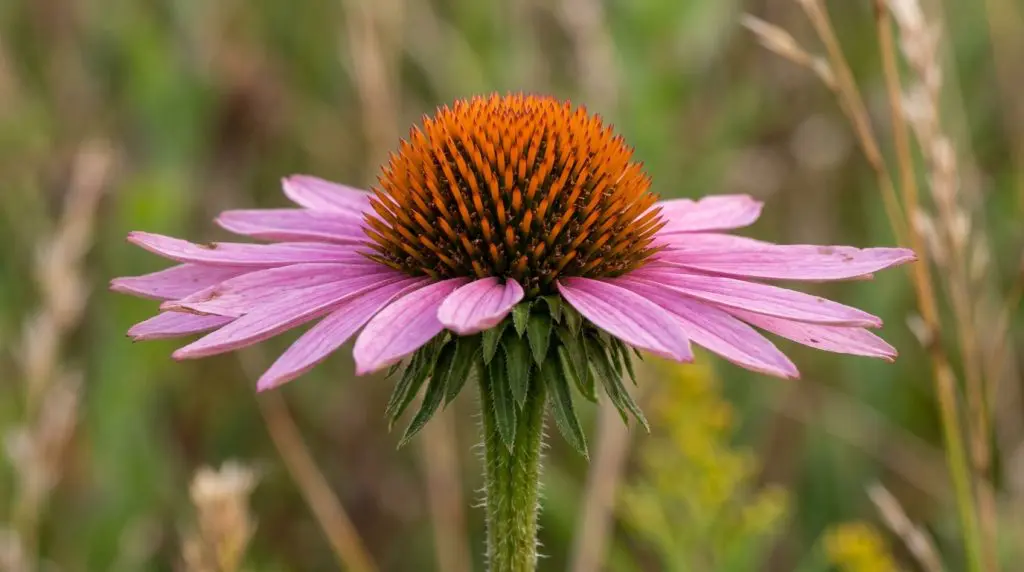
What appears to be a single flower is a composite head made of many small florets. The central disk is dome-shaped to distinctly conical and contains numerous tightly packed disk florets. Stiff, pointed chaff scales among those florets give the mature cone its bristly or prickly feel. The genus name Echinacea is derived from a Greek word associated with a hedgehog, referring to this spiny center.
A ring of usually pink-purple ray florets surrounds the disk. The rays are approximately 1.5–3 inches (4–8 centimeters) long and may spread outward, curve slightly downward, or become more reflexed with age. Wild plants vary naturally in color and posture, so strongly drooping petals are not required for identification.
The leaves provide an important distinction from narrow-leaved coneflowers. Lower leaves are broadly ovate, often with rounded or somewhat heart-shaped bases, pointed tips, and long petioles. Upper leaves become smaller, narrower, and more nearly stalkless. Leaf margins are commonly coarsely toothed, while the surfaces feel rough because of short, stiff hairs. Several prominent veins may arise near the leaf base.
Beneath each flower head are overlapping green bracts. The flowering stalk is firm and hairy, and a healthy mature plant may carry several heads if its upper stem branches.
Size and Growth Habit
Purple coneflower grows as an herbaceous perennial from a persistent root crown with fibrous roots. New shoots emerge in spring, forming a basal cluster before the flowering stems elongate. Plants generally reach 2–4 feet tall and about 1.5–2 feet (45–60 centimeters) wide. Rich soil, ample moisture, shade, or competition can alter these proportions.
The stems remain upright under ordinary conditions, although plants grown in overly fertile soil or insufficient sun may lean. Individual crowns can expand into clumps over time, but the species does not normally spread by aggressive underground runners. Seedlings may appear nearby where seed heads are left standing, and open soil is available.
Blooming Season
Flowering commonly begins from late May to July and continues into August; scattered flowers may persist into September. Southern populations generally start earlier than those at northern latitudes. Drought, rainfall, elevation, mowing, and plant age all affect timing.
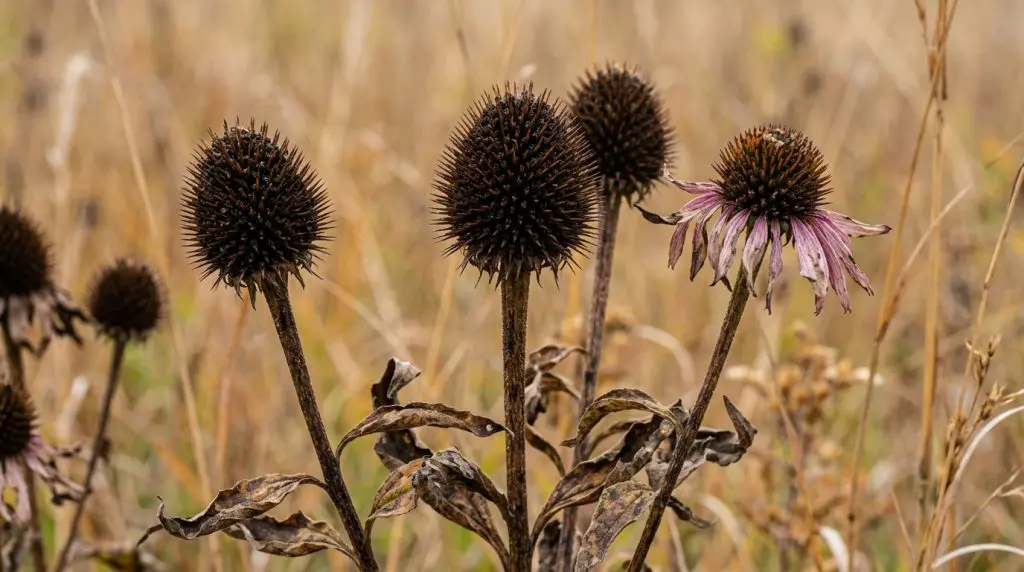
Each head changes as it matures. The disk begins relatively flat, rises into a more pronounced cone, and darkens after pollination. The rays eventually fade, shrivel, and fall, leaving a stiff brown seed head that can remain upright through autumn and winter.
Habitat
Natural habitat includes mesic to moderately dry prairies, open rocky woods, savannas, limestone glades, woodland margins, and sunny openings. Purple coneflower generally performs best where it receives substantial direct sunlight but may tolerate light, open shade.
It occurs in loam, clay-loam, and rocky or shallow soils, provided drainage is adequate. Established plants tolerate periodic dryness, although they are not restricted to extremely dry sites. Road banks, old fields, rail corridors, and restoration plantings may also support the species, but such occurrences can originate from introduced seed.
Geographic Range
Purple coneflower is native primarily to the central and southeastern United States, extending through parts of the Mississippi, Ohio, and Tennessee river regions and adjacent areas. Published range treatments differ somewhat because the plant has long been cultivated and has escaped beyond its original distribution.
It is now grown and locally naturalized across much of the United States and into parts of southern Canada. A plant found outside the central-eastern native range may be persistent from cultivation, descended from restoration seed, or locally naturalized. The USDA PLANTS profile for purple coneflower provides county- and state-level distribution information, although mapped presence does not always distinguish original populations from later introductions.

Similar Species and Look-Alikes
Pale purple coneflower (Echinacea pallida) usually has very narrow, strongly drooping pale rays and narrower leaves, many of which cluster near the base. Its overall appearance is often more slender than that of purple coneflower.
Narrow-leaved purple coneflower (Echinacea angustifolia) is generally shorter and has narrow, mostly entire leaves. Its flower heads can resemble smaller forms of purple coneflower, so check leaf width, petiole length, and overall habit.
Tennessee coneflower (Echinacea tennesseensis) tends to hold its pink rays outward or slightly upward rather than strongly downward. It has a naturally restricted range in central Tennessee and should not be identified from petal posture alone.
Black-eyed Susans (Rudbeckia species) also have dark raised centers, but their rays are ordinarily yellow or orange-yellow. Some garden-bred coneflowers have yellow rays, making leaves and cone structure useful secondary features.
Ornamental Echinacea cultivars and hybrids may have double centers, unusual colors, shortened rays, or altered plant proportions. These traits are not typical of wild E. purpurea.
Wildlife Connections
The flower heads attract a broad assortment of native bees, bumble bees, butterflies, skippers, beetles, and other insects seeking pollen or nectar. Different visitors contact different portions of the disk, and an active head may host several species at once.
After flowering, the dry heads hold small, hard fruits commonly called seeds. American goldfinches and other seed-eating birds may cling to the stalks and remove them during late summer, autumn, or winter. Standing stems also create perches and add structure to dormant-season habitat.
Ecological Importance
Purple coneflower supplies floral resources during the warm part of the growing season, when many nesting insects require repeated access to pollen and nectar. In a diverse prairie or garden planting, its long flowering period can help bridge shorter bloom windows of neighboring species.
Its perennial crown protects soil, while the aboveground stems contribute cover and structural variety. It is most ecologically useful as one component of a locally appropriate plant community rather than as a large single-species planting. Combining it with native grasses, legumes, asters, goldenrods, and spring flowers supports a wider range of organisms and seasons.
Native, Introduced, or Invasive?
Purple coneflower is native to parts of the central and eastern United States. It is introduced through cultivation in many areas outside that core range and sometimes persists or naturalizes. It is not generally regarded as a major invasive species in North America, but garden plants can self-seed into nearby open ground.
For habitat restoration, seed origin matters. Cultivars, hybrids, and seed collected far from a project may differ from local populations in flowering time, form, or genetics. Regionally sourced, straight-species material is usually preferable where conservation is the objective.
Traditional and Historical Uses
Several Indigenous peoples of the Great Plains and surrounding regions used Echinacea species in traditional practices. Historical accounts describe preparations made from roots or other plant parts for a variety of purposes. However, common names and early records do not always identify the exact species, and you should not assume that every account refers specifically to E. purpurea.
Commercial interest in Echinacea later developed around herbal preparations. Modern products may contain E. purpurea, other coneflower species, or mixtures, and their composition and evidence base vary. Traditional use is culturally specific and should not be treated as proof of medical effectiveness.
Is It Edible or Toxic?
Purple coneflower is not ordinarily classified as a highly poisonous plant, but it should not be treated as a casual edible wildflower. Plant material can cause stomach upset, allergic reactions, or skin irritation in some people, particularly those sensitive to members of the aster family.
Echinacea supplements may interact with medications or be unsuitable for some medical conditions. Pregnant or nursing people, children, individuals with allergies, and anyone taking prescription medicine should seek qualified medical advice before using it. Never harvest from protected land, restoration sites, or uncertain populations, and do not use a wild plant medicinally unless its identity is secure.
Growing It in a Native Garden
Plant purple coneflower in full sun or light afternoon shade and in well-drained soil. Average garden loam is suitable; heavy fertilization is unnecessary and can produce tall, weak growth. Water new plants regularly during establishment, then allow the upper soil to dry somewhat between waterings. Established crowns tolerate moderate drought but flower better when prolonged drought is relieved.
Space plants roughly 18–24 inches (45–60 centimeters) apart. Remove spent heads if unwanted seedlings are a concern, or leave them standing for birds and winter interest. Cutting only part of the planting provides a tidier appearance while retaining wildlife value.
Seeds often germinate more evenly after a period of cool, moist conditions, although requirements vary with seed source and storage. Division is possible in spring or fall, but mature crowns do not need frequent division. Avoid double-flowered cultivars when the goal is accessible pollen and nectar. The Lady Bird Johnson Wildflower Center plant profile offers additional cultivation and habitat information.
Conservation
Purple coneflower is commonly considered globally secure and is widespread in cultivation. That broad status does not mean every natural population is safe. Prairie conversion, development, woody encroachment, inappropriate mowing, herbicide drift, and unauthorized digging can damage local occurrences.
Never remove wild crowns. Purchase nursery-propagated plants from reputable native-plant growers and ask whether the stock is straight species and regionally sourced. Protecting intact prairie, savanna, and open-woodland communities conserves far more than a single conspicuous flower.
Interesting Fact
The “cone” is a tightly organized community of small flowers rather than one central structure. Disk florets generally mature in sequence, creating visible rings of changing color and texture as flowering progresses from the outer part of the disk toward its center.
Frequently Asked Questions
Does purple coneflower return every year?
Yes. It is a herbaceous perennial: the stems die back after the growing season, while the living crown remains below or near ground level and produces new shoots in spring.
Does it need full sun?
Full sun usually produces the strongest stems and most abundant flowering. It can tolerate light shade, but plants in substantial shade may lean, flower less, or become less competitive.
Should seed heads be removed?
Removal is optional. Deadheading can reduce self-seeding and may encourage additional flowers, while leaving mature heads provides food for birds and winter structure. A mixed approach works well.
Is purple coneflower deer-resistant?
It is sometimes described as deer-resistant, but no coneflower is deer-proof. Browsing varies with location, deer pressure, season, and the availability of other food. Rabbits may also eat young shoots.
Can it spread aggressively?
It may self-seed in favorable open soil, but it generally does not form rapidly spreading underground colonies. Removing seed heads before fruits mature is usually enough to limit volunteers.
How can I distinguish a wild plant from a garden escape?
Appearance alone may not reveal its origin. Location, land-use history, nearby gardens, restoration records, associated native vegetation, and regional distribution are all relevant. Unusual colors or doubled flower heads strongly suggest cultivated ancestry, but ordinary-looking plants may also be escapes.


