
Ouachita Map Turtle Guide
Keep Track of What You See
Create a free Wild Things Guide membership to record this Ouachita Map Turtle in My Sightings and build your personal wildlife list.
Join to Add This SightingIntroduction
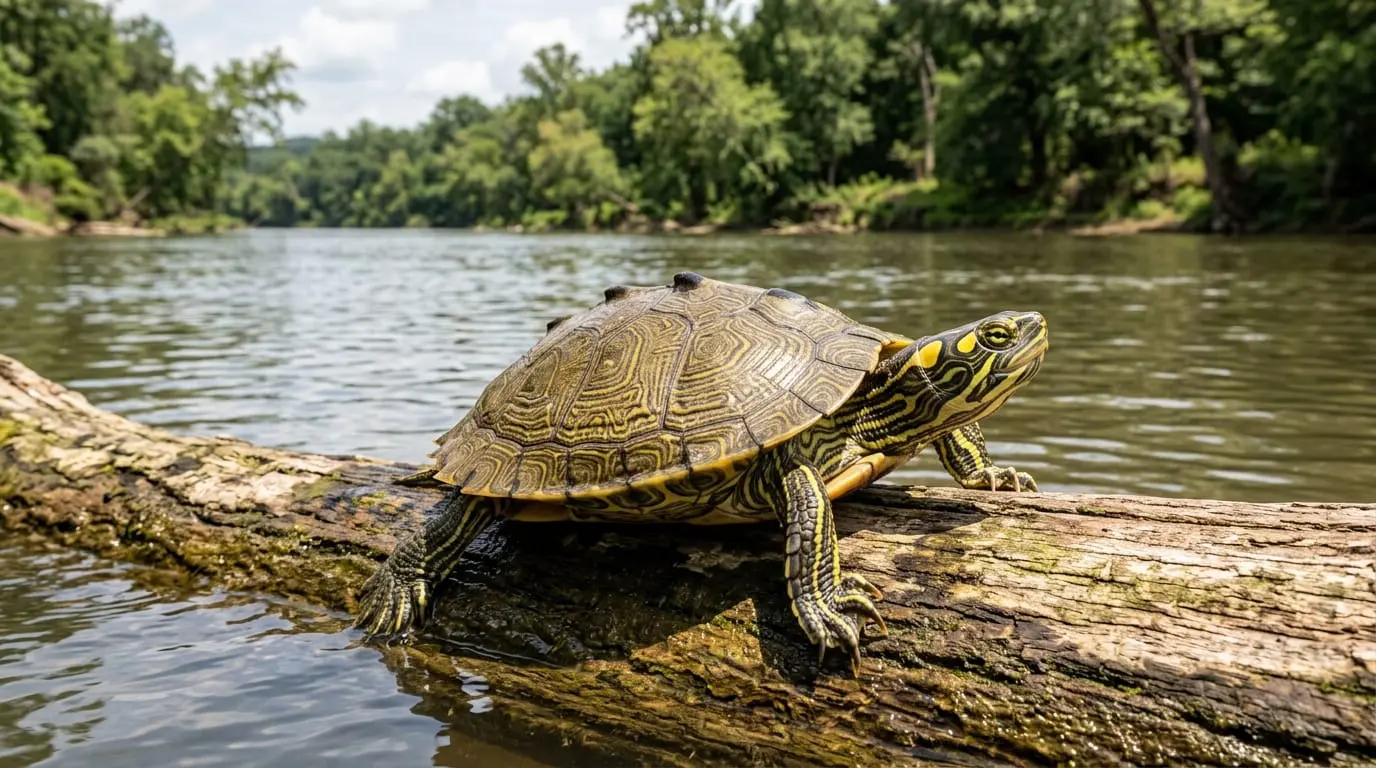
The Ouachita map turtle (Graptemys ouachitensis) is a freshwater turtle of the Mississippi River basin and neighboring Gulf Coast drainages. Like other map turtles, it has fine, maplike lines on the shell, a keeled carapace, and a strong preference for basking over open water. It is most often encountered along sizable rivers, where several individuals may share exposed logs.
Field identification requires a close look at the markings around the eye and jaw. Shell patterns can fade with age, particularly in large females, and the species often occurs beside other map turtles. Whenever possible, examine several features rather than relying on shell color alone.
Quick Identification
- Olive, brown, or gray-brown upper shell marked with thin yellow lines and loops.
- Low-to-moderate central keel, usually with dark-tipped knobs most obvious in juveniles and males.
- Large yellow or orange-yellow blotch behind each eye, generally separated from the neck stripes.
- Additional pale spots below the eye and near the rear of the jaw are often visible.
- Yellow plastron, sometimes retaining dark seam markings or faint patterning.
- Strong size difference between the sexes: adult females are much larger and broader-headed than males.
Appearance
The carapace is moderately domed and typically olive to brown, with a network of narrow yellow or yellow-green lines resembling roads on a map. These markings follow the edges and contours of the scutes. Each marginal scute may contain a curved pale mark, while dark blotches or smudges can occur along the rear edge of the shell.
A vertebral keel runs down the center. Its knobs are pronounced in hatchlings and young turtles but become lower with age, especially in large females. The rear margin is slightly serrated. The plastron is pale yellow to cream. Juveniles may show dark lines along the seams, while older animals often become nearly unmarked below.
The skin is dark olive, brown, or nearly black with numerous narrow yellow stripes. The most useful head marking is the relatively large postorbital blotch immediately behind the eye. Its exact shape varies, but it is often oval, rectangular, or somewhat L-shaped. Small but conspicuous pale spots below the eye and on the lower jaw help support an identification.

Size and Physical Characteristics
Adult males usually measure about 3.5–5.5 inches (9–14 cm) in straight carapace length. Adult females commonly reach about 5–10 inches (13–25 cm), with occasional individuals approaching the upper end of that range. Measurements vary among populations, and unusually large females should not be identified by size alone.
Males have a narrow head, a long thickened tail, and the vent positioned beyond the rear edge of the shell. They use their elongated front claws during courtship. Females have shorter tails, shorter front claws, broader shells, and increasingly wide heads as they mature. The expanded female jaw surfaces are suited to crushing hard-shelled prey.
Similar Species
The false map turtle (Graptemys pseudogeographica) can occur in the same rivers. It generally has a smaller or narrower mark behind the eye and lacks the same combination of prominent postorbital, subocular, and jaw spots. Because markings vary, photographs showing both sides of the head are especially useful.
The Mississippi map turtle, traditionally treated as Graptemys pseudogeographica kohnii, usually has a bold yellow crescent that curves around the rear of the eye. That crescent may extend beneath the eye rather than appearing as a large, more isolated blotch behind it.
Northern map turtles (Graptemys geographica) have a comparatively low keel as adults and typically show a small yellow spot behind the eye rather than the Ouachita map turtle’s larger head markings. Ringed and pearl map turtles have different shell patterns and much more restricted Gulf drainage distributions.
Habitat
Ouachita map turtles primarily inhabit medium to large rivers with a steady or moderate current. Favored reaches usually provide deep pools, open channels, abundant basking structures, and nearby sandbars or other well-drained nesting sites. Fallen trees, root masses, and snags offer both basking platforms and underwater shelter.
They also enter oxbows, backwaters, reservoirs, and large tributaries, particularly where these waters remain connected to suitable river habitat. They are less characteristic of isolated ponds, shallow seasonal wetlands, and heavily vegetated marshes.

Geographic Range
The species is native mainly to the central United States within the Mississippi River system. Its range extends from portions of the upper Mississippi basin southward through the Missouri, Arkansas, Ouachita, Red, and lower Mississippi drainage regions to Louisiana and neighboring Gulf Coast watersheds.
Records occur across parts of the Midwest and south-central United States, but distribution is tied to river systems rather than state boundaries. Taxonomic treatment of some southwestern populations has changed, so consult local field guides near the Sabine and adjacent drainages.

Behavior
Basking is the most visible behavior. Turtles climb onto logs, branches, stumps, and occasionally rocks, often selecting structures surrounded by deep water. Several map turtles may stack or line up along the same snag. Basking helps regulate body temperature and may assist with shell and skin maintenance.
Ouachita map turtles are alert and usually drop into the water when approached. After diving, they may remain submerged, hide beneath woody debris, or resurface at a distance. They are strong swimmers and spend most of their lives in or immediately beside water. Nesting females are the main exception.
Diet and Feeding
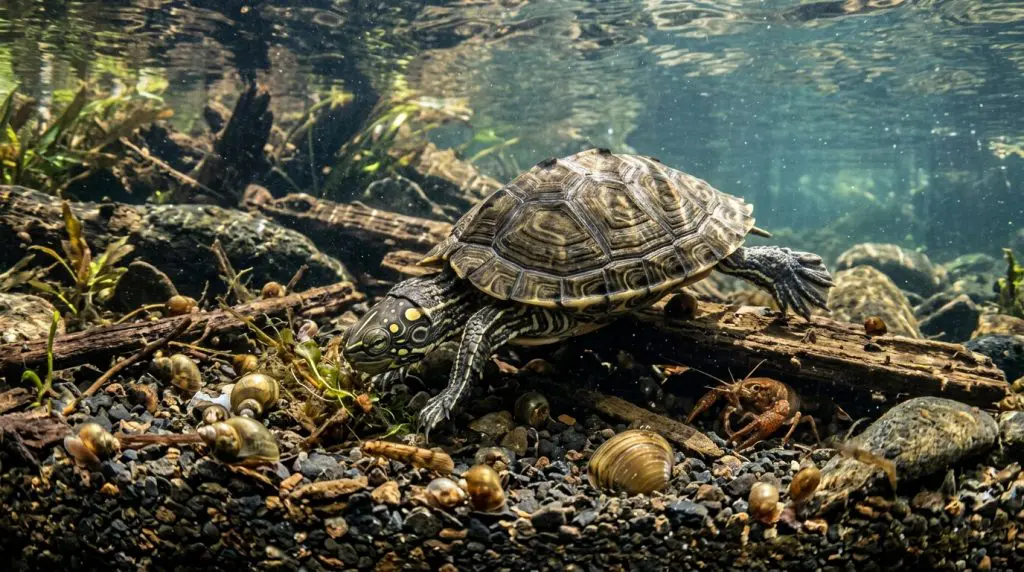
The diet includes aquatic insects and their larvae, snails, small clams, crayfish, worms, fish remains, and other available animal matter. They may also consume some plant material. Young turtles and adult males tend to take relatively small, softer prey that can be gathered from the bottom, vegetation, or submerged wood.
Large females have broader heads and stronger crushing surfaces. They can handle more snails and bivalves than males, although prey use depends on what is locally abundant. Map turtles may forage by searching the river bottom, probing crevices, or taking drifting and attached invertebrates.
Activity and Seasonal Patterns
Activity is greatest from spring through early fall. Basking may be frequent on mild spring days and during sunny periods between feeding bouts. In the hottest weather, turtles can shift activity toward morning and late afternoon or remain in deeper water during midday.
In colder parts of the range, they overwinter underwater in deep pools, protected channel areas, or other sites with stable conditions and adequate oxygen. Southern populations may remain intermittently active during warm winter weather. River temperature and flow influence the timing of emergence and dormancy.
Reproduction and Life Cycle
Courtship occurs mainly in spring, although some mating may take place in fall. A male approaches a female and vibrates his elongated front claws near her face. Females store sperm, so mating and egg laying need not occur close together.
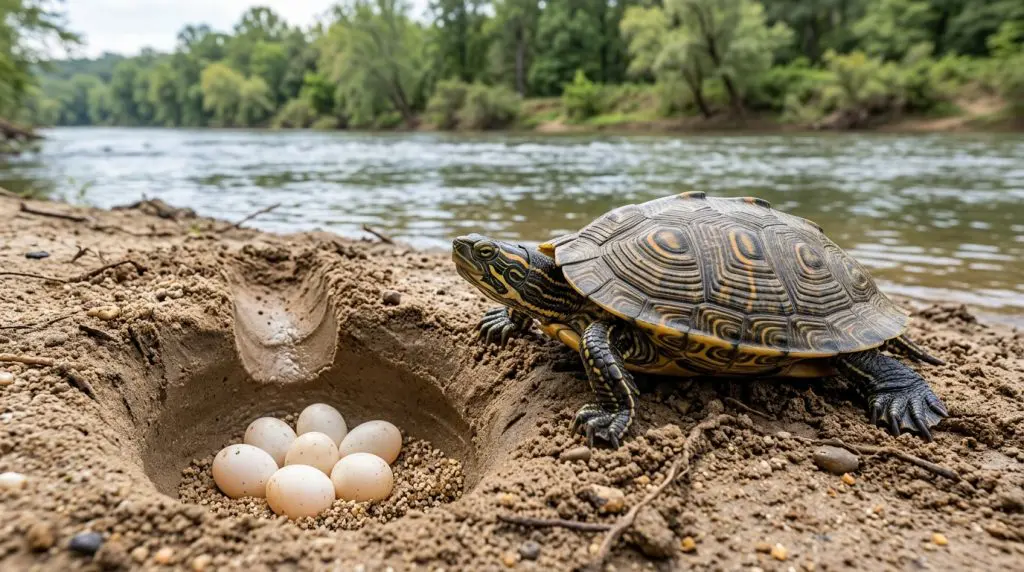
Nesting generally takes place from late spring through midsummer. The female leaves the river and selects an open, sunny patch of sand or loose soil, often on a bar, bank, or nearby upland. She digs a flask-shaped chamber with her hind feet, lays a clutch of several flexible-shelled eggs, and carefully covers the nest. More than one clutch may be produced in favorable years.
Incubation commonly lasts much of the summer but varies with temperature and moisture. As in many emydid turtles, incubation temperature influences offspring sex. Individuals mature slowly, particularly females, and surviving adults may live for several decades.
Young and Juveniles
Hatchlings are roughly coin-sized, with vivid shell lines, a strongly serrated rear margin, and a conspicuous row of central knobs. Their head markings are usually sharper than those of old adults. These proportions can make a young Ouachita map turtle appear more ornate and spiny than its parents.
Juveniles use protected shallows, submerged branches, and low-current margins where small aquatic invertebrates are plentiful. Some hatchlings emerge in late summer or fall; others may remain in the nest through winter and surface the following spring. Flooding, drought, and local soil conditions affect emergence.
Predators and Defense
Eggs and hatchlings face heavy predation from raccoons, skunks, foxes, coyotes, crows, herons, large fish, and other opportunistic hunters. Flooding can expose or drown nests, while falling water may leave newly emerged young far from cover.
Adults rely mainly on vigilance, rapid diving, camouflage, and a strong shell. A turtle caught on land may withdraw, gape, scratch, release musk, or bite. Large females have powerful jaws and should not be handled by the head, tail, or limbs.
Tracks, Signs, and Other Evidence
Direct sightings on basking logs provide the best evidence. From shore, look for a moderately keeled turtle with yellow-striped skin and a head that appears relatively small in males but broad in mature females.
Nesting females leave alternating claw marks and a shallow drag line where the plastron or tail contacts sand. A completed nest is difficult to recognize because the female smooths its surface. Raided nests may contain leathery white eggshell fragments. You usually cannot assign these signs to a particular turtle species without direct observation.
Where and How to Find It
Search broad rivers from a bridge, bluff, boat, or quiet shoreline. Scan sunlit logs with binoculars before approaching, as map turtles often dive while an observer is still far away. Morning and mild afternoon periods are productive, especially after cool or cloudy weather.
For identification photographs, capture the side of the head, top of the shell, plastron, and tail without disturbing the animal. A telephoto lens is preferable to capture without close pursuit. Avoid walking on nesting bars during the nesting season, and never pull turtles from basking sites with hooks or fishing line.
Conservation Status and Threats
The Ouachita map turtle is commonly assessed as Least Concern globally, reflecting its broad distribution and presence in several major river systems. That status does not mean every population is secure. Local abundance can decline where river habitat is substantially altered.
Important threats include water pollution, sedimentation, channelization, dams, shoreline development, removal of basking snags, boat strikes, fishing-hook injuries, and illegal collection. Nesting females are vulnerable to road traffic where they cross developed land. Maintaining clean water, natural flow patterns, woody structure, and undisturbed sandbars benefits the species.
Relationship with Humans
Ouachita map turtles are generally shy and pose little risk when left alone. Like other reptiles, they may carry Salmonella, so unnecessary handling is discouraged, and hands should be washed after accidental contact. Do not move wild turtles unless they face an immediate hazard.
If a turtle is crossing a road, an adult may be moved only when it is safe to do so and only in the direction it was already traveling. Do not relocate it to a different river. Wildlife collection and possession rules vary by state, and some jurisdictions protect native map turtles from commercial harvest.
Interesting Facts
- The common name refers to the Ouachita River system, while the shell’s fine lines give map turtles their group name.
- Males and females can occupy different feeding niches because mature females develop much larger heads and stronger jaws.
- Young turtles have taller keels and sharper shell knobs than most adults.
- A basking group may contain several map turtle species, so careful inspection of head markings is essential.
- Submerged portions of fallen trees are as important as the exposed basking surfaces because they provide escape cover and feeding sites.
Frequently Asked Questions
Is the Ouachita map turtle dangerous?
No. It normally escapes into the water rather than confront people. A restrained turtle can scratch or bite, however, and a large female’s bite may be painful.
How can I distinguish it from a false map turtle?
Look for a relatively large yellow blotch behind the eye together with pale spots below the eye and near the jaw. Confirm the identification with shell pattern, range, and multiple photographs because individual markings vary.
Why are some Ouachita map turtles much larger than others?
The species has strong sexual size dimorphism. Adult females are substantially larger and have broader heads than males. Juveniles of both sexes are small and often have more prominent shell knobs.
Do Ouachita map turtles live in ponds?
They may enter connected backwaters and reservoirs, but they are primarily river turtles. Large flowing waters with basking logs, deep refuge areas, and nearby nesting sand are more typical habitat.
Can I keep a wild one as a pet?
Wild collection may be restricted or prohibited, and removing adults can harm local populations. These active river turtles also require specialized space, water quality, lighting, and diet. Observing them in the wild is the better option.


