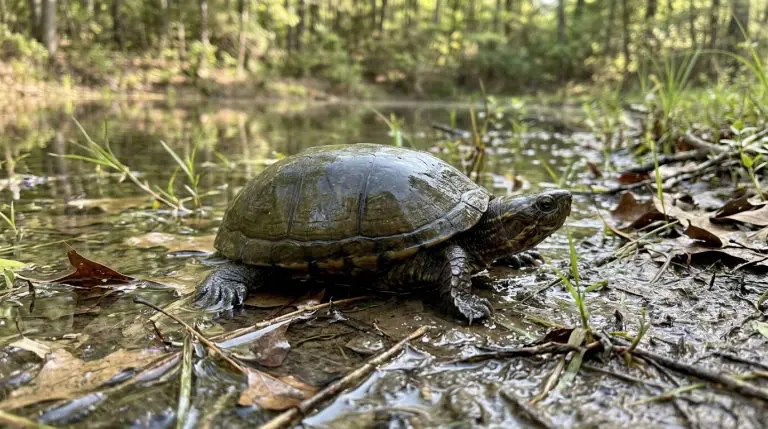
Common Map Turtle Guide
Keep Track of What You See
Create a free Wild Things Guide membership to record this Common Map Turtle in My Sightings and build your personal wildlife list.
Join to Add This SightingIntroduction
The common map turtle (Graptemys geographica), also called the northern map turtle, is a freshwater turtle of lakes and river systems in eastern and central North America. Its name comes from the network of fine lines on the shell, which resembles contour lines on a map. These markings are often clearest on young turtles and may become muted by age, algae, or staining.
Common map turtles are strongly aquatic and quick to retreat from basking sites. Identification is easiest when the shell pattern, head markings, body size, and habitat can all be considered together.
Quick Identification
- Olive, brown, or grayish carapace crossed by thin yellow to orange lines.
- Low central keel, usually more prominent and knobbed in juveniles.
- Yellow or cream stripes on the head, neck, legs, and tail.
- Small yellow spot or triangular mark behind each eye.
- Slightly serrated rear edge of the shell, especially in younger turtles.
- Strong size difference between the sexes: adult females are much larger and broader-headed than males.
- Usually associated with rivers, large streams, lakes, and reservoirs offering exposed basking sites.
Appearance
The upper shell is oval and moderately flattened, with a low ridge running down its center. Its background varies from olive green to brown or gray-brown. Narrow yellow, orange, or tan lines curve across the scutes and generally follow their contours. On worn older shells, the maplike pattern may be faint or partly hidden by algae.
The skin is dark olive to nearly black and marked with numerous narrow yellow stripes. A pale spot or short triangular blotch behind the eye is an important field mark, although its shape varies. The eye has a bright iris and a dark horizontal bar. The plastron is yellowish or cream. Juveniles often have dark lines along the plastral seams and a central figure that fades with maturity.

Size and Physical Characteristics
Adult males usually have a carapace about 3.5–6.5 inches (9–16 cm) long. Females commonly measure about 7–10.5 inches (18–27 cm), making them substantially larger and heavier. Exact size varies by population and individual.
Females develop broad heads and powerful jaws suited to crushing snails and other hard-shelled prey. Males retain narrower heads and have longer, thicker tails, with the vent extending beyond the rear margin of the shell. Females have shorter tails and a more robust body. Both sexes have webbed feet and strong claws for swimming and climbing onto basking structures.
Similar Species
The common map turtle overlaps with several other Graptemys species. False map turtles usually show a narrow, curved mark behind the eye rather than a small isolated spot, although individual patterns can be ambiguous. Ouachita map turtles often have a larger rectangular or oval patch behind the eye and conspicuous light spots below the eye and on the lower jaw.
Mississippi map turtles possess a bold crescent behind the eye that commonly curves downward. Geographic range helps separate these species, but introduced turtles and zones of overlap complicate identification. Painted turtles differ in having a smoother, unkeeled shell and red or orange markings along the shell margins and limbs. When viewing from a distance, photographs of the side of the head and the top of the shell are particularly useful.
Habitat
Common map turtles inhabit medium to large rivers, lakes, reservoirs, and occasionally sizable streams or connected backwaters. They favor permanent water with basking logs, rocks, root masses, or low branches. Suitable habitat often includes open sunny areas, moderate to slow currents, and enough depth for escape and overwintering.
Females require accessible, well-drained nesting ground near water. Sandbars, sandy banks, gravelly openings, fields, and disturbed soil may all be used. Clean water and healthy populations of aquatic invertebrates are especially important for feeding.

Geographic Range
The species occurs through much of the Great Lakes and St. Lawrence drainage and across portions of the northeastern and central United States. Its range includes southern parts of Ontario and Quebec and extends west toward Minnesota and adjoining areas. To the south, populations follow the Mississippi, Ohio, and related river systems into parts of the central and southeastern United States. Distribution is uneven because the turtles are tied closely to suitable waterways.

Behavior
Common map turtles are alert, agile swimmers. They frequently bask in groups but plunge into the water when approached. Large females may remain on logs slightly longer than smaller individuals, yet even apparently relaxed turtles can disappear rapidly.
Basking helps regulate body temperature and may assist with shell maintenance. Individuals sometimes stack or crowd together when good sites are limited. Once underwater, they may hide beneath submerged wood, rest on the bottom, or swim into deeper water.
Diet and Feeding
The diet consists mainly of aquatic invertebrates, with prey selection differing by age and sex. Broad-headed adult females commonly crush freshwater snails and mussels. They may also consume crayfish, insects, carrion, or other available animal matter.
Males and juveniles eat smaller prey, including aquatic insect larvae, small snails, amphipods, and other soft-bodied invertebrates. Feeding usually occurs underwater. Fish may be taken opportunistically, but active pursuit of healthy fish is not generally the turtle’s primary feeding strategy.

Activity and Seasonal Patterns
This is primarily a daytime species, with basking and feeding concentrated during suitable temperatures. Surface activity increases in spring after the turtles emerge from winter dormancy and continues through summer into early fall. Basking may occur even on cool days when sunlight is available.
In colder regions, common map turtles overwinter underwater in deep river pools, lake bottoms, or other protected sites with adequate oxygen. Several turtles may use the same general wintering area. Seasonal timing varies with latitude, weather, water temperature, and local hydrology.
Reproduction and Life Cycle
Courtship and mating occur mainly in spring and may also take place in fall. Females can store sperm, so mating and egg laying need not occur close together. Nesting generally begins in late spring and continues into midsummer.
A female leaves the water and excavates a flask-shaped nest with her hind feet. Clutches often contain roughly 6–20 flexible-shelled eggs, although clutch size varies with female size and location. A female may produce more than one clutch in a season. Incubation usually lasts several weeks to a few months, depending largely on nest temperature and moisture. As in many turtles, incubation temperature influences the sex of the hatchlings.

Young and Juveniles
Hatchlings have a strongly patterned shell, a sharper keel, and more obvious knobs than adults. Their rear shell margin may also appear distinctly serrated. Young turtles remain in shallow, protected water where small prey and submerged cover are available.
Hatchlings from late nests may remain underground through winter and emerge the following spring, though local conditions affect this behavior. Juvenile survival is low because nests, hatchlings, and small turtles face numerous predators. Those reaching adulthood may live for several decades.
Predators and Defense
Raccoons, skunks, foxes, coyotes, and other mammals dig up nests and eat eggs. Hatchlings may be taken by birds, large fish, snakes, frogs, and mammals. Adult turtles face fewer natural predators, although large females are vulnerable while nesting on land.
The principal defense is rapid escape into water. If handled, a common map turtle may withdraw, scratch, release musk, or bite. Large females have powerful jaws capable of causing injury. Wild turtles should be observed without capture whenever possible.
Tracks, Signs, and Other Evidence
A nesting female may leave a broad drag mark crossed by alternating foot impressions on sand or soft soil. A completed nest is usually concealed, appearing as a patch of disturbed or compacted ground rather than an obvious hole. Raccoon-dug nests may contain leathery eggshell fragments.
Basking turtles, smooth slides on muddy banks, shed scutes, and empty mollusk shells can indicate turtle activity, but these signs are rarely diagnostic by themselves. A spotting scope or telephoto photograph is more reliable than tracks for confirming the species.
Where and How to Find It
Search sunny shorelines of large rivers and lakes from midmorning through afternoon in spring and summer. Scan exposed logs, rocks, root wads, and angled tree trunks before approaching the water. Common map turtles often bask well away from shore and may resemble knots of wood.
Use binoculars and remain still. Look for a low, patterned shell, striped neck, and small pale mark behind the eye. Early spring can be productive because vegetation is sparse and turtles bask readily. Avoid walking onto nesting banks, moving basking logs, or repeatedly flushing turtles into the water.
Conservation Status and Threats
The common map turtle is widely cited as Least Concern globally, but status and legal protection vary by state and province. Some regional populations are uncommon, declining, or isolated. The University of Michigan’s Animal Diversity Web account for the common map turtle provides additional natural-history context.
Threats include shoreline development, water pollution, sedimentation, channel modification, loss of basking structures, road mortality of nesting females, boat strikes, fishing-hook injuries, illegal collection, and unusually high nest predation. Dams can alter currents and nesting habitat while separating populations. Protecting connected waterways, natural shorelines, basking structures, and nesting areas benefits the species.
Relationship with Humans
Common map turtles are harmless when left undisturbed and contribute to freshwater food webs as both predators and prey. They should not be removed from the wild. Captive care is demanding because these turtles require excellent water quality, substantial swimming space, appropriate heat and ultraviolet lighting, and a specialized diet.
Anglers occasionally hook map turtles. A deeply embedded hook should not be pulled out forcefully; local wildlife rehabilitators or conservation officers can advise on safe handling. Drivers near rivers should watch for nesting females crossing roads during late spring and summer.
Interesting Facts
- The species name geographica refers to the shell’s maplike network of lines.
- Its other common name, northern map turtle, helps distinguish it from map turtles centered farther south.
- Adult females can be several times heavier than adult males.
- Female jaw width increases as the turtle matures, allowing larger mollusks to be crushed.
- Old individuals may lose much of the shell pattern that makes young turtles easy to recognize.
- A good basking log may be shared with painted turtles, sliders, and other map turtles.
Frequently Asked Questions
Is a common map turtle the same as a northern map turtle?
Yes. Both names refer to Graptemys geographica.
How can I tell a male from a female?
Adult females are much larger and usually have broad heads. Males remain smaller and have longer, thicker tails, with the vent positioned farther beyond the shell.
Do common map turtles bite?
They may bite when restrained, particularly large females. They do not normally approach or threaten people in the wild.
Why did the turtle’s shell pattern disappear?
The pattern often fades with age and may be obscured by algae, mineral staining, abrasion, or retained surface material. Head markings and shell shape may remain useful.
Can I move one off a road?
If it is safe and legal to help, move the turtle only across the road in the direction it was already traveling. Do not relocate it to another waterway, and never lift it by the tail.