

Common Mud Turtle Guide
Keep Track of What You See
Create a free Wild Things Guide membership to record this Common Mud Turtle in My Sightings and build your personal wildlife list.
Join to Add This SightingIntroduction
The common mud turtle (Kinosternon subrubrum), also called the eastern mud turtle, is a small, secretive freshwater turtle native to the eastern and south-central United States. It occupies quiet wetlands but spends more time on land than many other aquatic turtles. Individuals may walk between ponds, shelter beneath leaf litter, or remain buried during hot, cold, or dry weather.
Because its shell is usually plain and dark, this turtle is easily overlooked or confused with a young snapping turtle, musk turtle, or another mud turtle. Its compact oval shell, relatively large hinged plastron, and modest adult size provide the most useful identification clues. Additional natural-history information is available from the University of Michigan’s Animal Diversity Web.
Quick Identification
- Small turtle with an adult upper-shell length generally around 3–5 inches (7.5–12.5 cm).
- Carapace smooth, oval, moderately domed, and usually plain brown, olive-brown, or nearly black.
- Plastron comparatively large, with two movable hinges and 11 scutes.
- Head brown to gray with variable yellowish mottling or broken light markings.
- Tail short in females and longer, thicker, and tipped with a horny spine in males.
- Usually found in shallow, slow-moving water with a soft or muddy bottom.
Appearance
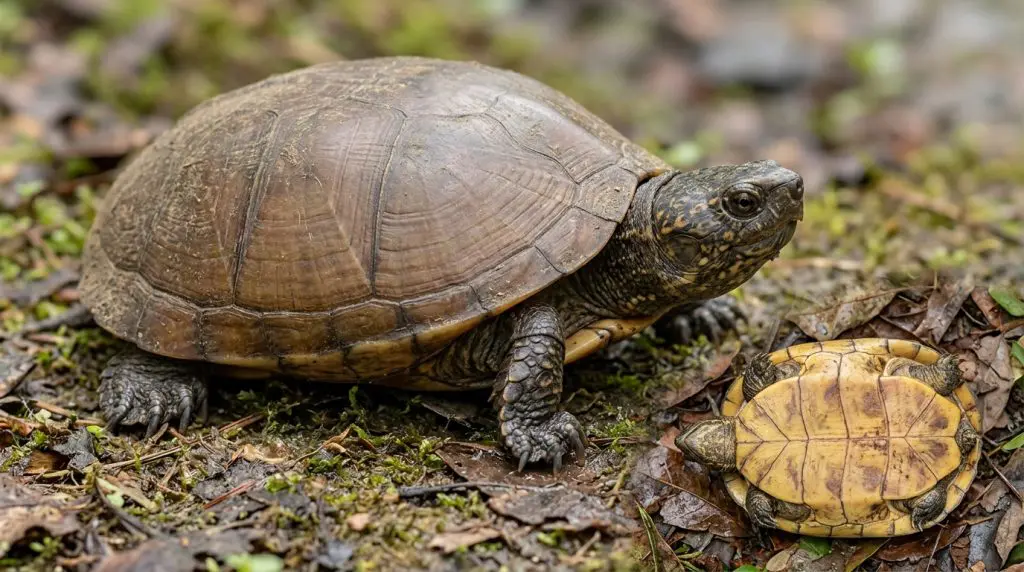
The upper shell, or carapace, is smooth-edged and broadly oval when viewed from above. It is usually unpatterned, although growth rings, algae, staining, or faint darker seams may be visible. Color ranges from yellowish brown and olive to dark brown or black. Older turtles often appear especially plain because shell wear obscures subtle markings.
The lower shell, or plastron, varies from yellow and tan to brown. Dark seams or irregular dark patches may develop with age. Its front and rear lobes are hinged, allowing the turtle to draw in its limbs and partly close the shell. The closure is less complete than that of a box turtle.
The head is proportionately broad but lacks the strongly hooked jaws and rough, ridged shell of a snapping turtle. Yellowish or cream mottling may occur along the jaw, throat, and sides of the head. One or more small barbels can be present beneath the chin, although these are not always obvious in field views.
Size and Physical Characteristics
Most adults have a straight carapace length of approximately 3–5 inches (7.5–12.5 cm). Exceptional individuals may fall slightly outside that range, but this remains one of North America’s smaller freshwater turtles. Hatchlings are roughly 1 inch (2.5 cm) long.
The shell is more domed than that of many sliders and painted turtles but lacks their colorful striping. Adults normally have no strong median keel. The feet are webbed for swimming, yet the sturdy limbs and claws also support frequent movement over land.
Sex is easiest to determine in mature animals. Males generally have a longer, thicker tail with the vent positioned farther beyond the shell margin. A small horny tip is often visible at the end. Males may also have a slightly concave plastron and roughened patches on the inner hind legs. Females have shorter tails and a flatter plastron.
Similar Species
Common musk turtle: The common musk turtle usually has a smaller, cross-shaped plastron with extensive exposed skin around it. It often shows two pale stripes on the head, a more peaked shell, and conspicuous chin barbels. The common mud turtle’s plastron is larger and has two functional hinges.
Striped mud turtle: The striped mud turtle frequently displays three pale longitudinal stripes on the carapace and clearer light stripes on the head. Some individuals are faintly marked, so consider plastral details and geographic location.
Yellow mud turtle: This western relative often has a lower, broader shell and more extensive yellow or cream coloring on the chin and throat. Range can help separate the species, although contact areas require careful examination.
Juvenile snapping turtle: A young snapping turtle has a long, saw-edged tail, a much smaller plastron, and a rough carapace with pronounced keels. It also has a proportionately larger head.
Habitat
Common mud turtles favor shallow, quiet water with soft bottoms and abundant cover. Typical sites include swamps, marshes, woodland ponds, cypress wetlands, oxbows, sloughs, drainage ditches, and the sheltered margins of slow streams. They may also use temporary ponds or seasonally flooded depressions.
Nearby terrestrial habitat is important. Turtles burrow into damp soil, mud, leaf litter, or decaying vegetation to avoid drought, summer heat, or winter cold. Wetlands surrounded by intact forest, grassland, or other permeable ground offer better opportunities for these seasonal movements than isolated ponds bordered by pavement.

Geographic Range
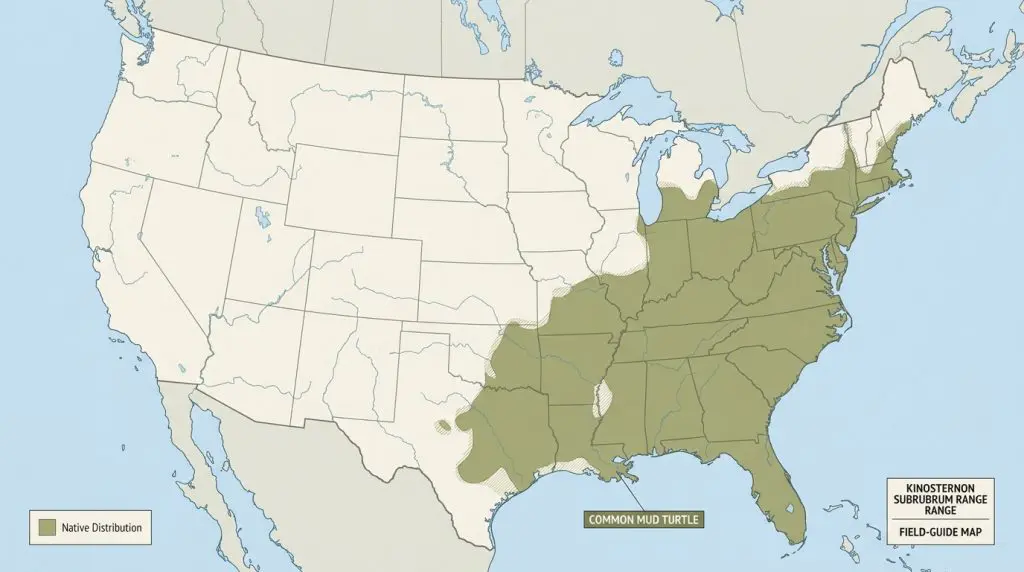
The species occurs across much of the eastern and south-central United States. Its distribution extends broadly from parts of the southern Great Lakes region and southern New England south through the Atlantic and Gulf coastal states to Florida, and west into portions of the Mississippi Valley and Texas. Distribution is patchy near the northern and western limits, and local taxonomy or subspecies treatments may differ among authorities.
Within this broad range, the turtle can be locally common in suitable lowland wetlands yet absent from apparently similar waters nearby. It is not native to most of Canada or the western United States.
Behavior
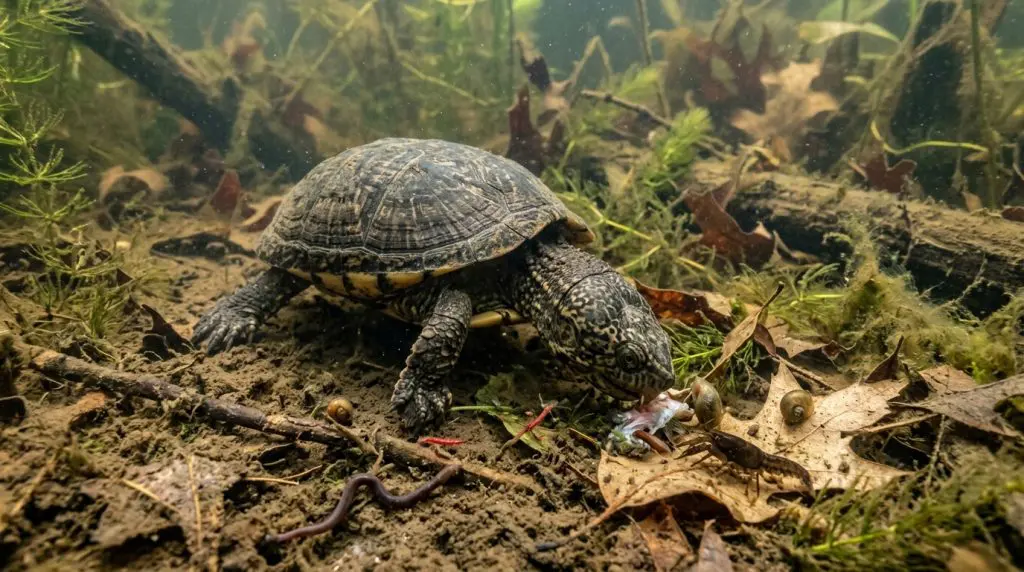
This is a secretive bottom-walking turtle rather than a conspicuous basker. It searches through mud, submerged leaves, and aquatic vegetation, often remaining beneath cover. Although capable of swimming, it commonly walks along the bottom of shallow water.
Common mud turtles sometimes bask at the water’s edge or on low debris, but they do so less openly than painted turtles and sliders. They also travel overland, especially after rain, during nesting, or when a wetland is drying. An animal encountered far from water is not necessarily lost.
When restrained, a mud turtle may withdraw, gape, bite, scratch, or release a strong-smelling musk. Observe wild turtles without handling whenever possible.
Diet and Feeding
The common mud turtle is an opportunistic omnivore with a diet weighted toward animal prey. It consumes aquatic insects and their larvae, worms, snails, small clams, crustaceans, tadpoles, small fish, amphibian eggs, carrion, and other food encountered along the bottom. Aquatic plants, seeds, algae, and fallen fruits may also be eaten.
Feeding usually takes place in water, where the turtle probes soft sediment and leaf litter. Its willingness to consume carrion gives it a minor scavenging role in wetland food webs.
Activity and Seasonal Patterns
Activity varies with latitude, rainfall, temperature, and wetland depth. In much of the range, turtles become active during spring and remain so into autumn. Southern populations may be active during mild periods in almost any month.
During winter, individuals generally shelter underwater or bury themselves in mud, soil, or vegetation. In hot or drought-prone regions, they may also become dormant on land during summer. These terrestrial retreats can last weeks or months. Surface activity and road crossings often increase after warm rain.
Reproduction and Life Cycle
Courtship and mating may occur in spring and again during late summer or autumn, with timing varying geographically. Females typically nest from late spring through midsummer. A female leaves the water and excavates a shallow chamber in soil, sand, or decomposing vegetation, sometimes beneath leaf litter or woody cover.
Clutches are small, commonly containing about 1–6 hard-shelled white eggs. More than one clutch may be produced in a season where conditions permit. Incubation is strongly affected by temperature and moisture and can take several months. Development may pause, and some young remain in the nest through winter before emerging.
Growth is slow, and maturity requires several years. Reliable wildlife lifespan figures are limited, but adults appear capable of surviving for several decades when they avoid vehicles, predators, and wetland destruction.

Young and Juveniles
Hatchlings have a shell around 1 inch (2.5 cm) long and often look rougher than adults. The carapace may show a weak keel, more distinct growth texture, or a sharper rear margin. These juvenile features become less noticeable as the shell grows and wears smooth.
Young turtles remain near dense vegetation, submerged leaves, shallow margins, and other protective cover. Their small size makes them vulnerable to fish, frogs, snakes, wading birds, and mammals. They are rarely noticed unless they are crossing wet ground or are exposed during wetland sampling.
Predators and Defense
Raccoons, skunks, foxes, opossums, coyotes, snakes, large fish, wading birds, and other predators may eat eggs, hatchlings, or adults. Nests are especially vulnerable to mammals that locate recently disturbed soil by scent.
The turtle’s first defenses are concealment and its hard shell. Its hinged plastron helps protect the head and limbs, though it cannot seal as tightly as a box turtle. If those defenses fail, it may bite or emit foul-smelling musk. The bite can be painful but is not venomous.
Tracks, Signs, and Other Evidence
Mud-turtle signs are subtle. On soft mud, tracks may show small clawed footprints on either side of a narrow tail or plastron drag. A nesting female can leave a short trail leading from water to disturbed soil, but rain and loose vegetation quickly erase it.
Small oval eggshell fragments may occur around a depredated nest. Shell fragments alone are rarely identifiable to species. Visual observation of a live turtle, photographed from above and below without prolonged restraint, is generally more useful than tracks for confirming identification.
Where and How to Find It
Search the shallow margins of quiet wetlands with muddy bottoms, submerged leaves, emergent plants, and nearby woodland. Early morning and overcast periods may be productive, although this species often remains concealed. Watching patiently from shore is less disruptive than turning logs or disturbing bottom sediment.
Warm rainy nights and the day following heavy rain offer the best chance of seeing individuals moving overland. Check low-traffic roads near wetlands from a safe position. Never stop where visibility is poor, and do not move a turtle unless it is in immediate danger. If assistance is necessary, move it only to the side toward which it was already traveling.
Conservation Status and Threats
The common mud turtle is generally regarded as secure across its broad range and is commonly cited as Least Concern globally. Local populations can nevertheless decline when shallow wetlands are drained, filled, polluted, or separated from surrounding uplands.
Road mortality is a significant concern because adults move between wetlands and nesting areas. Other threats include drought intensified by climate change, shoreline hardening, wetland isolation, illegal collection, fishhooks, and mortality from mowing or construction in terrestrial refuges. Protecting both wetlands and the adjoining land is more effective than protecting water alone.
Relationship with Humans
Common mud turtles are harmless when left alone and provide ecological value as predators and scavengers. They are not appropriate animals to remove from the wild. Collection laws vary by state, and wild turtles may carry Salmonella even when they appear healthy.
Never pick up a turtle found crossing a road by the tail, as it can injure the spine. If conditions are safe, lift it with two hands around the sides or rear of the shell and place it just beyond the road in its original direction of travel. Wash hands afterward.
Interesting Facts
- Despite its aquatic appearance, the common mud turtle may spend long dormant periods buried on land.
- Its two-hinged plastron distinguishes it from musk turtles, whose reduced plastron leaves more skin exposed.
- The species often walks along the bottom instead of swimming through open water.
- Embryonic development can pause, allowing emergence to occur when seasonal conditions are more favorable.
- A plain shell can provide effective camouflage among muddy bottoms and water-darkened leaves.
Frequently Asked Questions
Is a common mud turtle the same as a musk turtle?
No. They belong to the same family, but mud turtles have a larger, double-hinged plastron. Musk turtles generally have a reduced plastron, more exposed skin, and more obvious head striping or barbels.
Do common mud turtles bite?
They can bite when frightened or handled, but they do not pursue people. Observe them without handling and give road-crossing turtles room to continue in their chosen direction.
Can common mud turtles close their shells?
The hinged front and rear plastral lobes can partly close around the limbs and head. The seal is not as complete as that of a typical box turtle.
Why is a mud turtle walking away from water?
It may be nesting, moving between wetlands, or seeking a terrestrial refuge for winter, heat, or drought. Overland movement is a normal part of the species’ life cycle.
Can I keep one I find?
Wild turtles should remain in the wild, and collection may be restricted or prohibited. If an animal appears injured, contact a licensed wildlife rehabilitator or the appropriate state wildlife agency rather than attempting long-term care.


