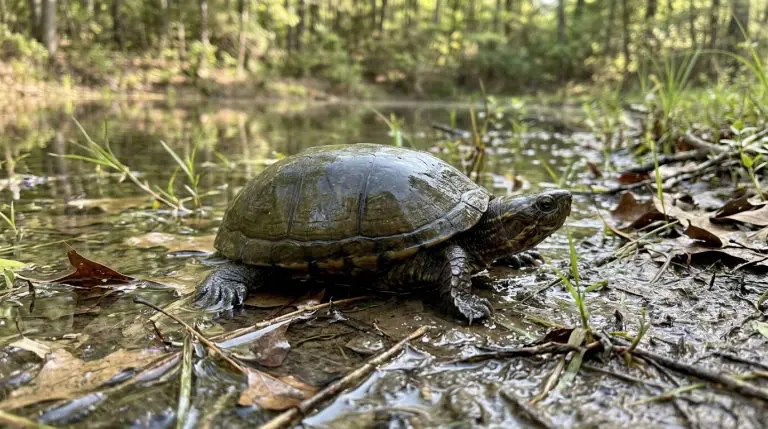
Blanding’s Turtle Guide
Keep Track of What You See
Create a free Wild Things Guide membership to record this Blanding’s Turtle in My Sightings and build your personal wildlife list.
Join to Add This SightingIntroduction
Blanding’s Turtle (Emydoidea blandingii) is a long-lived freshwater turtle best recognized by its bright yellow throat and chin. It inhabits wetlands across parts of the Great Lakes region, upper Midwest, northeastern United States, and southern Canada. Although strongly associated with water, it frequently travels overland among wetlands, nesting grounds, and seasonal refuges.
This Turtle is wary but sometimes raises its head above the water with an expression that appears almost smiling. Field identification should be made from a respectful distance. In many areas,s Blanding’s Turtles are legally protected, and unnecessary handling can interrupt feeding, courtship, nesting, or migration.
Quick Identification
- Bright yellow chin and throat, contrasting sharply with the dark head.
- High, smoothly domed black or dark brown upper shell, usually marked with small yellow or tan flecks.
- Yellow plastron with irregular dark blotches; the front portion is hinged.
- Relatively long neck and a head that may be held high while swimming.
- Adults generally have a straight carapace length of about 7–10 inches (18–25 cm).
- Most often encountered in shallow wetlands or crossing land between wetlands.
Appearance
The upper shell, or carapace, is oval, smooth, and noticeably domed. Its ground color ranges from nearly black to dark olive-brown. Numerous small yellow, cream, or tan spots and streaks often decorate each scute, although the density of these markings varies. Older turtles may have worn or subdued shell patterns.
The diagnostic yellow coloration covers the chin and much of the throat. The top and sides of the head are darker, sometimes with pale speckling. The neck is long, while the limbs are dark and strongly webbed for swimming. The lower shell, or plastron, is yellow to cream with dark blotches that differ among individuals.
A hinge crosses the plastron, allowing some upward movement of the front lobe. Unlike a box turtle, however, a Blanding’s Turtle generally cannot seal its shell completely.

Size and Physical Characteristics
Most adults measure approximately 7–10 inches (18–25 cm) in straight carapace length, with occasional individuals approaching 11 inches (28 cm). Females tend to become larger and broader than males. Mature males commonly have a slightly concave plastron, a thicker tail, and a vent positioned farther beyond the shell margin. Females usually have a flatter plastron and a shorter, narrower tail.
The shell is less flattened than that of a painted turtle and less sculptured than that of many wood turtles. Its long neck helps the Turtle breathe at the surface while much of the body remains concealed in vegetation. Exact size and sexual characteristics can overlap, so sex should not be assigned from a distant or partial view.
Similar Species
Spotted Turtle: Spotted Turtles also have yellow markings on a black shell, but they are much smaller, generally no more than about 5 inches (13 cm), and their spots are larger, rounder, and more clearly defined. They lack the broad yellow throat of a Blanding’s Turtle.
Eastern and Midland Painted Turtles: Painted turtles have a lower, flatter shell and red or orange striping along the head, legs, or shell margins. Their throats are striped rather than solid yellow.
Wood Turtle: Wood turtles have a rough, strongly sculptured carapace and orange, reddish, or yellow skin on the neck and legs. Blanding’s Turtles have smoother, more domed shells.
Eastern Box Turtle: Box turtles have a fully closing plastron, stouter terrestrial feet, and more variable orange or yellow patterning. A Blanding’s Turtle is more aquatic, has webbed feet, and shows a distinctly yellow chin and throat.
Habitat
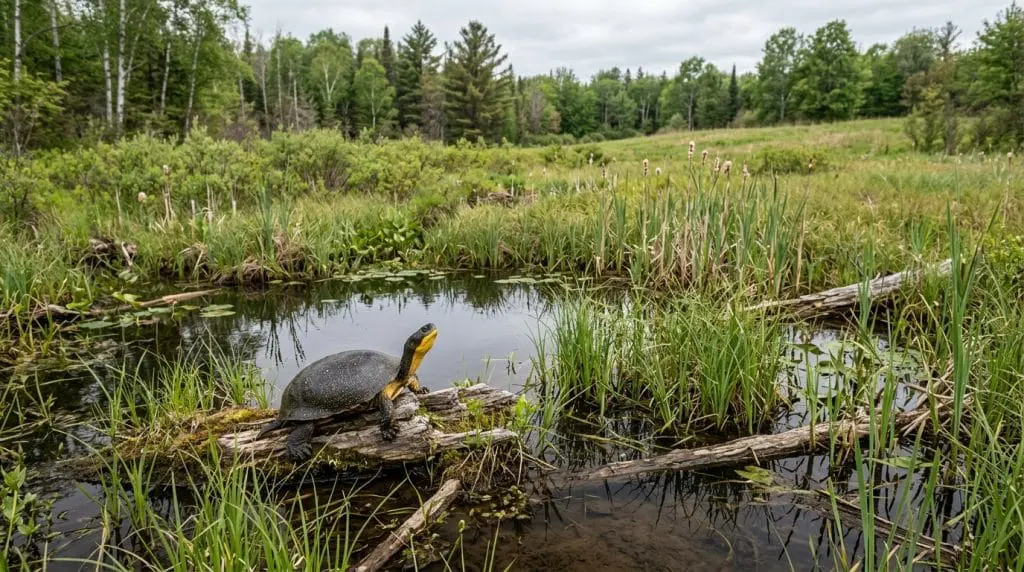
Blanding’s Turtles favor shallow, slow-moving wetlands with abundant aquatic vegetation, soft bottoms, basking sites, and nearby open water. Marshes, sedge meadows, shrub swamps, fens, shallow ponds, wet prairies, and quiet stream backwaters may all be used. Different wetlands can serve different purposes: one may provide spring feeding habitat, another summer refuge, and another a suitable overwintering site.
Surrounding uplands are also essential. Females need sunny, well-drained soil for nesting, while turtles of both sexes may cross forests, fields, roads, lawns, and other uplands when moving among wetlands.
Geographic Range
The species is centered on the Great Lakes and upper Midwest. Its distribution extends from Nebraska, Minnesota, Iowa, Wisconsin, and Illinois east through Michigan and portions of Indiana, Ohio, Pennsylvania, and New York. In Canada, it occurs mainly in southern Ontario, with more localized populations in Quebec and Nova Scotia. Disjunct populations survive in parts of New England.
The range is not continuous. Many populations are isolated within scattered wetland complexes, and the Turtle may be absent from otherwise suitable-looking habitat.

Behavior
Blanding’s Turtles spend much of their time in shallow water, moving slowly through submerged plants or resting beneath cover. They bask on logs, muskrat lodges, hummocks, and grassy banks, but may drop into the water quickly when approached.
Individuals can use several wetlands during a year and may make substantial overland movements. Adult females are especially conspicuous during nesting season, when they may travel away from water in daylight or near dusk. Despite their deliberate pace on land, these turtles navigate familiar wetland landscapes effectively.
Diet and Feeding
Blanding’s Turtles are opportunistic omnivores. Common prey includes crayfish, aquatic insects, snails, worms, tadpoles, frogs, small fish, and other small aquatic animals. Carrion may also be eaten. Plant material, including seeds and aquatic vegetation, forms part of the diet, although its importance can vary with age, season, and local food availability.
Feeding usually occurs in water. The Turtle may search through vegetation and bottom debris or approach slow-moving prey with its long neck extended.
Activity and Seasonal Patterns
Activity begins after spring thaw, with timing governed by latitude, water temperature, and weather. Turtles feed, bask, mate, and move among wetlands through spring and summer. They may be active during the day, around dawn and dusk, or during warm, rainy periods. Overland movements often increase after rainfall.
In northern parts of the range, Blanding’s Turtles become inactive during autumn and overwinter underwater. Hibernation sites commonly have soft sediment, vegetation, and enough water to avoid freezing solid. Individuals may gather in favorable wintering areas. They emerge again in spring, sometimes while water temperatures remain cool.
Reproduction and Life Cycle
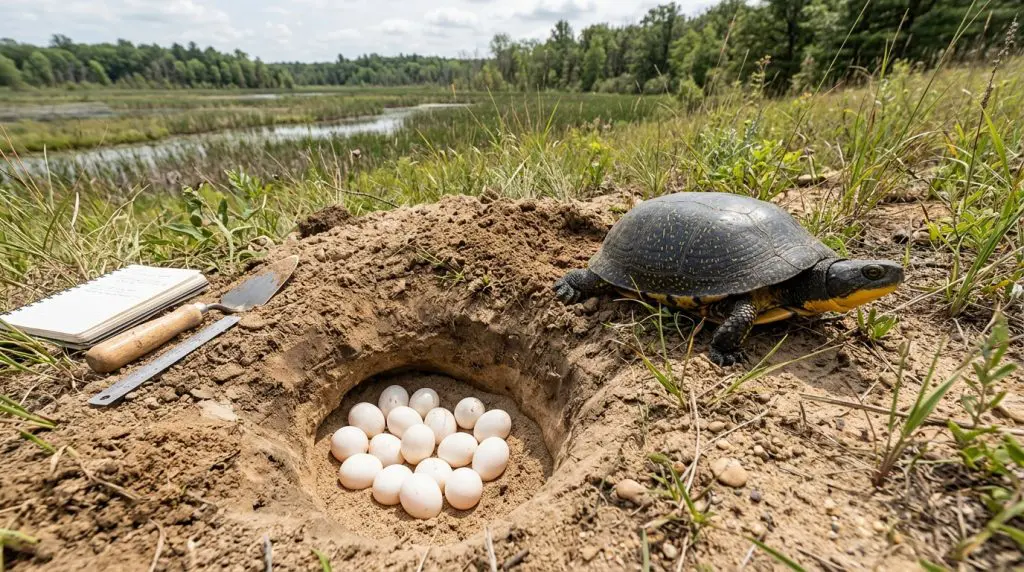
Courtship and mating occur primarily in spring, although autumn mating has also been reported. Females generally nest from late May through early July, depending on local climate. A female may travel considerable distances to reach an open, sunny site with sand, gravel, loam, or other workable soil.
Using her hind feet, she excavates a flask-shaped nest chamber and usually deposits roughly 6–17 flexible-shelled eggs, though clutch size varies. She covers and disguises the nest before leaving; there is no parental care. Incubation commonly lasts about two to three months and is strongly affected by temperature and moisture.
Blanding’s Turtles mature slowly, often not breeding until their mid-teens or later. Adults can reproduce over many decades, making the survival of mature turtles especially important to population stability.
Young and Juveniles
Hatchlings have rounded shells roughly 1–1.5 inches (2.5–4 cm) long. Their carapaces are usually dark and may show faint pale flecks, while the yellow throat is present but can be less vivid than in an adult. The shell often has a more pronounced central keel and a less smoothly domed profile.
Young turtles use shallow, densely vegetated water where plants, leaf litter, and soft substrate provide cover. They are difficult to detect and vulnerable to fish, wading birds, mammals, and drying wetlands. Growth is gradual, and many years pass before juveniles join the breeding population.

Predators and Defense
Raccoons, skunks, foxes, coyotes, and other mammals frequently dig up nests. Large fish, birds, snakes, and mammals may take hatchlings and small juveniles. Healthy adults have fewer natural predators, but shell injuries can occur during attempted predation.
When threatened in water, a Blanding’s Turtle usually dives or hides among vegetation. On land, it withdraws its head and limbs and may partly raise the hinged front plastron. It may release musk or struggle if picked up, but it is not considered aggressive. Its shell does not close as tightly as a box turtle’s shell.
Tracks, Signs, and Other Evidence
Tracks are easiest to find in mud, wet sand, or newly disturbed nesting soil. A walking trail may show alternating clawed footprints with a central drag mark from the tail or plastron. Track size and drag marks overlap with those of other medium-sized turtles, so they rarely confirm species on their own.
Nest excavation leaves a patch of disturbed soil, but females carefully tamp and conceal completed nests. Predator-dug nests may contain leathery shell fragments. Do not collect or disturb shells, eggs, nests, or live turtles; photographs and location notes are more useful for responsible reporting.
Where and How to Find It
Search shallow marsh edges, sedge wetlands, shrub swamps, and quiet ponds on mild spring mornings. Scan basking logs, muskrat lodges, grassy hummocks, and openings in emergent vegetation with binoculars. The yellow throat is often easier to see than the shell pattern when a turtle raises its head above water.
Warm rainy days in late spring and early summer can produce overland sightings, especially near wetland complexes. Drive slowly where turtle-crossing signs are posted. If a turtle is crossing a road and assistance is safe and legal, move it only in the direction it was already traveling; never relocate it to a different wetland. Avoid publicly revealing precise nesting or population locations.
Conservation Status and Threats
Blanding’s Turtle is categorized as Endangered on the IUCN Red List, and it receives varying levels of protection from states, provinces, and national governments. The U.S. Fish and Wildlife Service species profile for Blanding’s Turtle provides current federal information for the United States.
Major threats include wetland loss, drainage, shoreline alteration, road mortality, nest predation, illegal collection, invasive vegetation, and fragmentation of the uplands connecting seasonal habitats. Climate change may alter wetland permanence and incubation conditions. Because the species matures late and adult survival is naturally high, the repeated loss of even a few breeding adults can have long-term effects.
Relationship with Humans
Blanding’s Turtles sometimes appear in agricultural fields, residential yards, gravel pits, and road shoulders because open ground can resemble natural nesting habitat. This proximity creates risks from vehicles, mowing, pets, construction, and collection.
Landowners can help by retaining shallow wetlands, protecting vegetated buffers, limiting pesticide use, and maintaining safe connections among wetlands. Sightings can be submitted to state or provincial wildlife agencies. Only permitted wildlife professionals should attempt captive care or relocation.
Interesting Facts
- The species is the only living member of the genus Emydoidea.
- Its yellow throat can remain visible when the rest of the Turtle is concealed in dark water.
- Individuals may use a network of wetlands rather than remaining in one pond throughout life.
- Blanding’s Turtles can live for many decades, with some documented individuals exceeding 70 years.
- The hinged plastron provides partial protection but cannot usually close the shell completely.
- Long life does not guarantee population security because maturity is delayed and adults reproduce relatively slowly.
Frequently Asked Questions
Is a Blanding’s Turtle dangerous?
No. It may struggle, scratch, or release musk when handled, but it is not aggressive toward people. Observe without touching whenever possible.
What is the easiest way to identify one?
Look for the combination of a bright yellow chin and throat, a high dark shell with fine pale flecks, and a yellow plastron marked by dark blotches.
Can Blanding’s Turtles close their shells?
They can partly raise the hinged front portion of the plastron, but they generally cannot seal the shell as completely as a box turtle.
Why are they often seen on roads?
Roads frequently divide wetlands from nesting areas or other seasonal habitats. Females are especially likely to cross roads during the late-spring and early-summer nesting period.
How long do Blanding’s Turtles live?
They commonly survive for several decades under favorable conditions. Wild individuals older than 70 years have been documented, although many turtles die earlier from vehicles, predators, habitat disruption, or other causes.