Northern White-cedar Guide
Keep Track of What You See
Create a free Wild Things Guide membership to record this Northern White-cedar in My Sightings and build your personal wildlife list.
Join to Add This SightingTree Name
Northern white-cedar (Thuja occidentalis) is an evergreen conifer of the cypress family, Cupressaceae. Also called eastern white-cedar or American arborvitae, it grows naturally across much of northeastern North America. Despite its name, it is not a true cedar of the genus Cedrus.
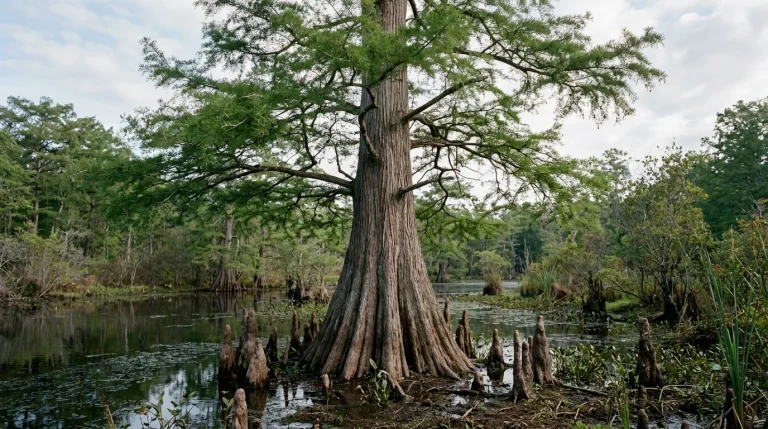
In the field, look for flattened fans of scale-like foliage, small woody cones, and fibrous bark. Wild trees may be narrow and upright in swamps, broad and irregular along shorelines, or remarkably twisted on exposed limestone cliffs. Nursery cultivars can look quite different from typical wild trees.

Quick Identification
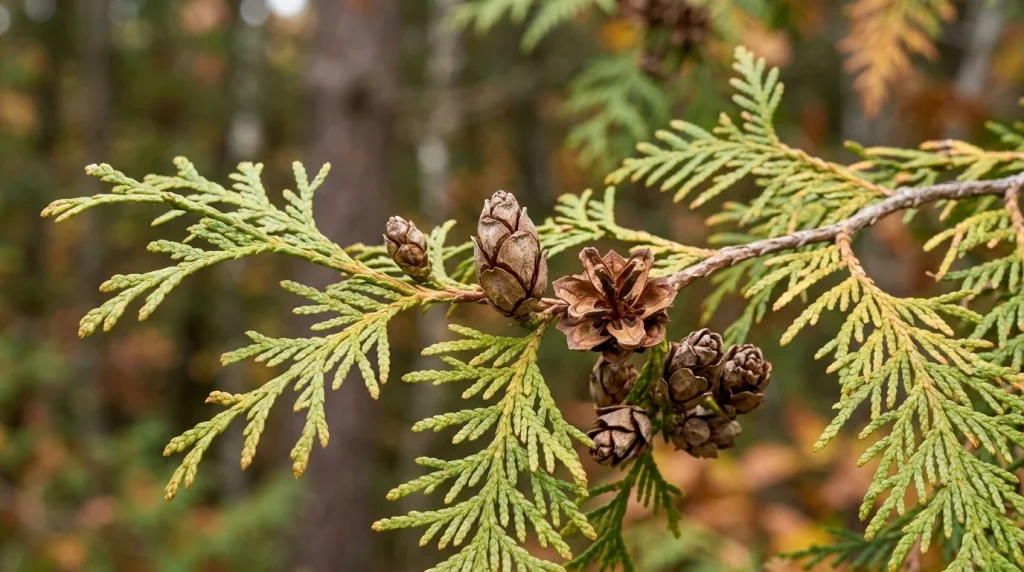
- Foliage: Tiny, overlapping scales cover slender branchlets arranged in flattened, fanlike sprays.
- Cones: Small, elongated, and woody, about ⅓–½ inch (8–13 mm) long, with a few pairs of thin scales.
- Bark: Gray to reddish-brown, fibrous, and peeling in narrow lengthwise strips.
- Shape: Usually a narrow, tapering evergreen, often with a strongly flared base or several upright stems.
- Setting: Especially characteristic of cool wetlands, Great Lakes shorelines, and calcium-rich rocky ground.
The best combination is flat foliage fans plus small, elongated woody cones. Habitat supports an identification but should not replace checking the plant itself.
Appearance
Mature wild trees commonly stand about 30–50 feet (9–15 m) tall, with crowns roughly 10–20 feet (3–6 m) wide. Favorable forest sites can produce substantially taller trees. Cliff-grown individuals may remain low and contorted for centuries, while landscape cultivars range from compact globes to slender columns.
The crown is usually conical when young. Older trees may develop irregular tops, drooping lower branches, or several leaders. Dense foliage can extend nearly to the ground where light and browsing pressure allow.
The leaves are scales rather than the obvious needles of pines or spruces. Most are only about 1–4 mm long and occur in opposite pairs, closely pressed against the twig. Face leaves and side leaves differ slightly in shape, producing the characteristic flattened spray. Upper surfaces are green; undersides are generally paler, without the conspicuous white pattern often seen on western redcedar.
Gently rubbed foliage has a resinous, distinctive scent. Treat scent as supporting evidence, not a stand-alone test, and avoid damaging plants where collection is prohibited.

Bark, Twigs, and Buds
Young bark is relatively thin and reddish-brown. With age, it becomes gray-brown, stringy, and shallowly furrowed, separating into long, narrow strips. Old trunks may show twisting grain, buttressed bases, cavities, and areas of exposed wood.
The youngest branchlets are green and almost hidden by their overlapping leaves. Older twigs become brown and woody. Their arrangement matters: foliage-bearing branchlets lie mostly in flattened planes rather than forming the more rounded sprays of some other cypress-family trees.
Buds are small and inconspicuous among the scale leaves. Unlike a maple or oak, northern white-cedar does not offer large, obvious winter buds as a convenient identification feature. In winter, concentrate on foliage arrangement, retained cones, and bark.

Range and Habitat
The native range centers on southeastern Canada, the Great Lakes region, and the northeastern United States. It extends from southeastern Manitoba east toward Atlantic Canada, with southern outliers in the Appalachian region. Plantings occur far beyond the native range, so a hedge or cemetery tree does not necessarily indicate a local wild population.
Northern white-cedar is strongly associated with cool, moist conditions and soils influenced by limestone or other calcium-rich materials. Look in cedar swamps, groundwater-fed wetlands, stream margins, lakeshores, and rocky escarpments. It also grows on surprisingly dry cliffs, where roots exploit cracks and competition may be limited.
It tolerates considerable shade, although growth and reproduction depend on site conditions. Growth is generally slow to moderate; young trees on favorable sites may add roughly 6–12 inches (15–30 cm) in height annually, while stressed trees grow much less. The U.S. Forest Service’s northern white-cedar silvics account provides a detailed discussion of its habitat and regeneration.

Flowers, Fruit, Nuts, or Cones
This conifer does not produce botanical flowers, berries, or nuts. Male pollen cones and female seed cones occur on the same tree, usually on separate branchlet tips. The pollen cones are tiny, and wind carries their pollen in spring.
Seed cones begin green and ripen to brown during the same growing season. Mature cones are elongated or egg-shaped, about ⅓–½ inch (8–13 mm) long, usually with four or five pairs of overlapping scales. When dry, they open to release small winged seeds.
Opened cones may remain attached after seed release and are useful identification clues beyond autumn. Their thin, spreading scales contrast with the fleshy, berry-like cones of junipers and the rounder woody cones of Atlantic white-cedar.
Wildlife Connections
Northern white-cedar provides important winter cover in parts of its range. Dense stands shelter white-tailed deer from wind and deep snow, and the foliage is valuable winter browse. Heavy browsing can remove reachable branches and prevent seedlings from growing beyond deer height.
Small birds use the foliage for shelter and nesting, while birds and small mammals consume seeds. Old trees, broken trunks, and cavities add habitat features that clipped landscape hedges generally lack.
Cedar wetlands also contribute shade, woody structure, and protected conditions around streams and seepages. Their ecological value includes the surrounding wetland community, not simply the food produced by an individual tree.
Seasonal Identification
- Spring: Look for tiny pollen cones and fresh, lighter-green growth at branchlet tips.
- Summer: Examine complete foliage fans and developing green seed cones. Flat sprays are especially easy to see against an open background.
- Autumn: Brown cones become conspicuous. Some older interior foliage turns brown and falls, often as small leafy branchlet sections.
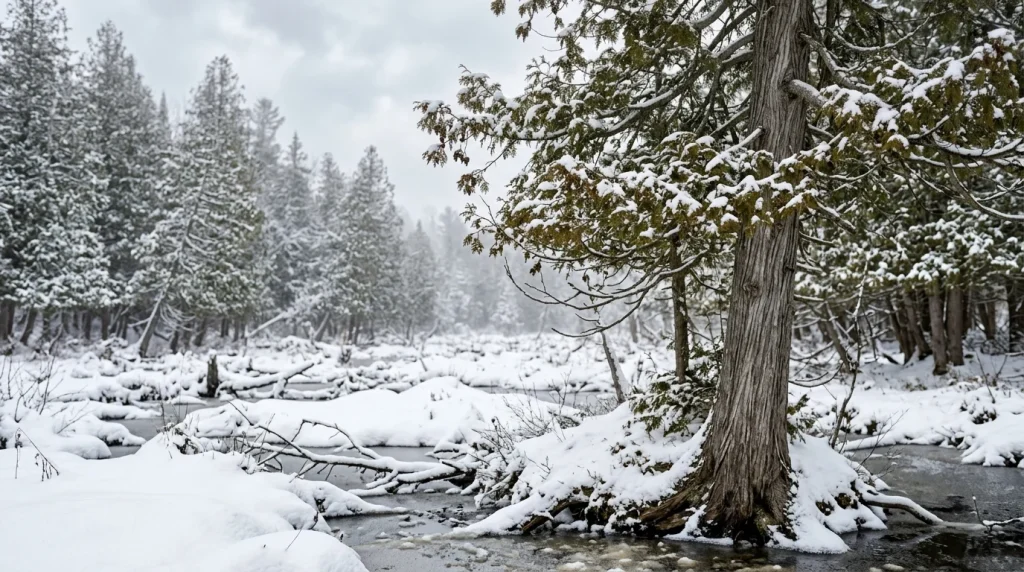
- Winter: Evergreen fans, fibrous bark, and retained cones remain useful. Exposed foliage may become bronze or yellow-green, depending on weather and cultivar.
Seasonal interior shedding is not automatically a disease symptom. Extensive tip death, large dead patches, or sudden whole-tree browning deserves closer investigation.
Human Uses and History
The lightweight wood resists decay relatively well and has long been used for posts, shingles, siding, small boats, and other outdoor applications. Its durability varies with the wood and exposure; “decay-resistant” does not mean permanent.
Indigenous peoples across its range have used northern white-cedar for practical, medicinal, and ceremonial purposes, with traditions differing among nations. European accounts also associate it with early remedies for scurvy. These histories should not be treated as instructions for home medicine: foliage and concentrated oils contain biologically active compounds and should not be ingested casually.
As an American arborvitae, the species is widely planted for screens and hedges. Cultivars differ greatly in size, shape, foliage color, and growth. Check the cultivar before assuming that a compact nursery plant will remain small.
Conservation and Threats
Northern white-cedar remains widespread, but particular stands can face serious regeneration problems. Sustained deer browsing may leave mature trees standing above a nearly empty understory, with few young cedars to replace them.
Wetland drainage, altered groundwater, shoreline development, and forest fragmentation can degrade habitat. Drought and changing moisture conditions may stress trees, especially near vulnerable range margins. Fire can kill trees readily because their bark is thin and roots are often shallow.
Ancient cliff populations deserve particular care. Climbing, trampling, and root disturbance can damage trees whose small size conceals great age. In landscapes, allow room for mature growth, protect young trees from browsing where necessary, and avoid cutting deeply into bare old wood, which often fails to produce replacement foliage.
Similar Species
- Western redcedar (Thuja plicata): Another flat-sprayed conifer, native to western North America and planted elsewhere. Its foliage undersides commonly show clearer whitish markings, and branchlet tips often droop. Cones are similar, so consider geography and several characters together.
- Atlantic white-cedar (Chamaecyparis thyoides): Primarily a coastal-plain wetland tree of the eastern United States. Its cones are small and rounded, with shieldlike scales rather than elongated, thin, overlapping scales.
- Eastern redcedar (Juniperus virginiana): Often has more three-dimensional foliage, sometimes mixed with prickly juvenile leaves. Seed-bearing trees produce blue, berry-like cones instead of northern white-cedar’s dry woody cones.
- Other cultivated arborvitae: Garden selections and related species can complicate identification. In formal plantings, check cones and foliage carefully rather than relying on an upright “hedge tree” shape.

Interesting Facts
- Some cliff-growing northern white-cedars have documented ages exceeding 1,000 years. Small stature does not necessarily mean youth.
- Low branches can root where they contact suitable moist ground, producing new stems through layering.
- The name “arborvitae” means “tree of life.”
- A pronounced browse line can record repeated deer feeding, not deliberate pruning.
Frequently Asked Questions
How long does northern white-cedar live?
It commonly lives for a few centuries where conditions allow; roughly 150–400 years is a useful general range, not a fixed limit. Exceptional cliff trees live much longer.
Is northern white-cedar the same as arborvitae?
Often. American or eastern arborvitae usually means Thuja occidentalis, but nurseries also sell other species and hybrids under the broader arborvitae name.
Does it lose its leaves?
It stays evergreen but gradually sheds older foliage, often noticeably in autumn. It does not retain every leafy branchlet indefinitely.
Can it grow outside a swamp?
Yes. It also grows on rocky shores and cliffs, and in suitable garden soils. Consistent moisture generally helps establishment, but habitat needs vary with site and growing conditions.
What is the quickest way to separate it from eastern redcedar?
Check foliage and cones together: northern white-cedar has flat fans and small brown woody cones; eastern redcedar has less flattened foliage and, on seed-bearing trees, blue berry-like cones.