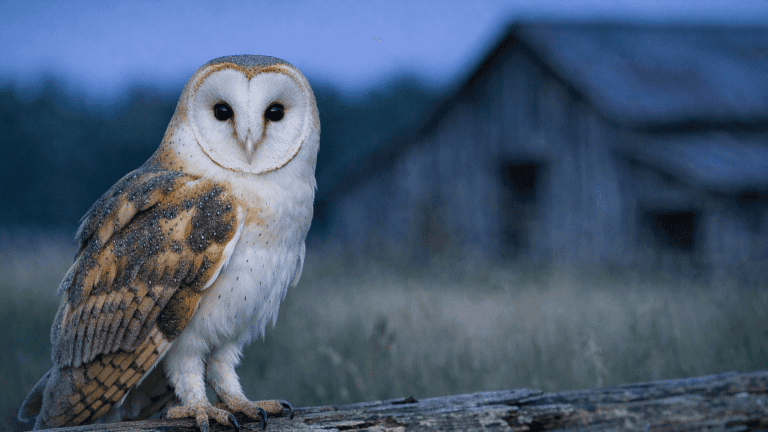
Northern Saw-whet Owl Guide
- Scientific Name
- Aegolius acadicus
- Family
- Strigidae
- Order
- Strigiformes
- Length
- 18–21 cm (7.1–8.3 in)
- Wingspan
- 42–48 cm (16.5–18.9 in)
- Weight
- 65–151 g (2.3–5.3 oz)
- Conservation Status
- Least Concern
- Habitat
- Coniferous, mixed, and deciduous woodland with dense roost cover, cavity-bearing trees, and nearby openings or edges for hunting.
Keep Track of What You See
Create a free Wild Things Guide membership to record this Northern Saw-whet Owl in My Sightings and build your personal wildlife list.
Join to Add This SightingIntroduction
The Northern Saw-whet Owl (Aegolius acadicus) is one of North America’s smallest and most easily overlooked owls. Barely larger than a robin, it spends daylight hours concealed in dense foliage and becomes active after dusk. Its oversized head, bright yellow eyes, streaked underparts, and compact shape give it a distinctive appearance when seen well.
Finding one is rarely a matter of scanning open fields. Successful identification usually depends on recognizing suitable habitat, learning its calls, and checking sheltered roosts without disturbing the bird. Although often described as uncommon, Northern Saw-whet Owls can be locally numerous during migration. Their secretive behavior means they are detected less often than their actual presence might suggest.
Quick Identification
- Size: A tiny, compact owl about 7–8.5 inches long.
- Face: Pale facial disk with a whitish V between the eyes.
- Eyes: Large and bright yellow.
- Upperparts: Warm brown with bold white spotting.
- Underparts: White to buff with broad reddish-brown streaks.
- Behavior: Nocturnal; roosts quietly in dense conifers or tangled cover by day.
- Voice: A steady series of high, whistled notes, often rendered as toot-toot-toot.
Appearance and Field Marks
An adult Northern Saw-whet Owl has a disproportionately large, rounded head and no ear tufts. The pale facial disk is edged and patterned with brown, while white feathers above and between the eyes often form a conspicuous Y- or V-shaped mark. The bill is dark, short, and partly hidden by facial feathers.
The crown, back, and wings are brown, usually with crisp white spots. The breast and belly are pale, with broad vertical streaks in warm reddish-brown. The short tail is crossed by narrow pale bars. In a resting bird, the long wing feathers may extend close to the tail tip.
Males and females have essentially the same plumage. Females average larger and heavier, but size overlap makes sex difficult to determine in the field. Apparent color also changes with lighting: a bird under warm artificial light may look more reddish than one observed in neutral daylight.

Size and Measurements
Adults are typically 18–21 centimeters (7.1–8.3 inches) long, with a wingspan of approximately 42–48 centimeters (16.5–18.9 inches). Reported adult weights span roughly 65–151 grams (2.3–5.3 ounces), with females generally heavier than males.
For a useful field comparison, a Northern Saw-whet Owl is much smaller than an Eastern or Western Screech-Owl and only modestly longer-bodied than an American Robin. Its broad head and fluffed plumage can make a perched bird seem larger than it is. Direct size judgments at night are especially unreliable, so combine size with facial pattern, eye color, and voice.
Range and Distribution
The species occurs across much of North America. Its breeding distribution extends from southern Alaska through large portions of Canada and into the northern, western, and northeastern United States. Additional breeding populations occupy mountain forests farther south, including parts of the Appalachians, the western United States, and Mexico.
Some populations are resident, especially where suitable forest persists year-round. Others migrate south or move to lower elevations in autumn. Wintering birds may occur across much of the continental United States, sometimes well beyond areas where they breed. Numbers vary substantially between years, and larger southward movements are often associated with changes in prey availability and breeding success. The Cornell Lab of Ornithology’s Northern Saw-whet Owl account provides additional range and identification information.

Habitat
Northern Saw-whet Owls use coniferous, mixed, and deciduous woodland, particularly where dense vegetation provides secure daytime cover. Breeding habitat commonly includes mature or older trees with woodpecker cavities, alongside younger forest, brushy edges, wetlands, or openings that support small mammals.
During migration and winter, birds may roost in cedar groves, spruce plantations, pine thickets, tangled streamside growth, and dense ornamental evergreens. Habitat structure can matter more than tree species: a concealed perch protected from wind, predators, and mobbing songbirds is especially valuable.

Behavior
This owl is primarily nocturnal. It usually leaves its roost around dusk, hunts through the night, and settles into dense cover before daylight. A roosting bird may sit close to a trunk on a low branch, relying on stillness and concealment rather than immediate flight.
When alert, it may stretch upward, narrow its feathers, or rotate and bob its head while judging distance. The species can appear remarkably tame, but failure to fly does not mean that close approach is harmless. Repeated disturbance may force an owl to abandon protective cover or expend energy needed for winter survival.
Flight is quiet and generally direct, with rapid wingbeats interrupted by short glides. Migrants may cross open landscapes at night, even though they spend most daylight hours in wooded cover.

Diet and Hunting
Small mammals dominate the diet. Deer mice, voles, shrews, and other mouse-sized prey are commonly taken, depending on local availability. Small birds, bats, and insects may supplement the diet, but their importance varies by place and season.
A hunting owl typically watches from a low perch, listens for movement, and drops or glides toward prey. Sensitive hearing helps it locate animals in darkness and beneath light vegetation or snow. Like other owls, it swallows manageable prey whole and later regurgitates compact pellets containing fur, feathers, teeth, and bones.
A large prey item may be carried to a perch and eaten in portions. Food can also be cached for later use, particularly near a nest or during cold weather.
Vocalizations
The best-known breeding call is a long sequence of clear, evenly spaced whistles: toot-toot-toot-toot. It is usually given by the male and may continue for minutes. The sound can carry through forest despite seeming soft at close range.
Other sounds include rising or descending whines, squeaks, barks, and sharper notes exchanged near a nest. The call historically associated with the common name has been compared to the sound of sharpening, or “whetting,” a saw, although descriptions of the name’s origin vary.
Do not rely on audio playback to force a response. Repeated playback can interrupt feeding, territorial behavior, or nest attendance. Listening quietly after sunset is a more responsible approach.
Breeding and Nesting
Northern Saw-whet Owls are cavity nesters but do not excavate their own nest holes. They use abandoned woodpecker cavities, natural hollows, and appropriately sized nest boxes. Nest sites are usually in woodland with nearby hunting habitat.
The female commonly lays about four to seven white eggs, though clutch size varies with food conditions and geography. She performs most incubation and initially broods the young, while the male supplies much of the food. As nestlings grow, the female may begin hunting as well.
Breeding timing varies across the range, but egg laying usually occurs in spring. In years and regions with abundant prey, nesting may begin relatively early. The nest cavity often contains prey remains, pellets, and accumulated debris rather than a carefully constructed nest lining.

Young and Development
Young hatch covered in pale down and depend completely on adults for warmth and food. As juvenile feathers develop, they acquire a striking plumage unlike that of adults: dark chocolate-brown upperparts and head contrast with warm tawny or cinnamon underparts. Pale marks between and above the eyes can be especially noticeable.
Nestlings leave the cavity before they are fully independent, generally at around four to five weeks of age. Recently fledged birds may climb branches and make short flights while adults continue to deliver food. Their begging calls can reveal a family group after dark, but observers should remain well away from the nest area.

Where to See
The easiest opportunities often occur during autumn migration, especially around Great Lakes shorelines, coastal headlands, mountain ridges, and established owl-banding stations. Many stations conduct nocturnal research under permit and occasionally offer public education programs.
For daytime searches, examine dense conifers from a respectful distance. Clues beneath a favored roost may include small pellets, whitewash, or concentrations of songbirds giving alarm calls. Avoid trampling vegetation or circling the owl for a better view. Never remove branches to expose a roosting bird, and do not publish precise locations when crowding could result.
Similar Species
Eastern and Western Screech-Owls are larger, heavier-looking, and have obvious ear tufts when relaxed, though the tufts can be flattened. Their plumage is more intricately bark-patterned, and their vocalizations are trills or bouncing series rather than evenly repeated single whistles.
Boreal Owl resembles a larger, squarer-headed version of a saw-whet. It has a more strongly defined pale facial disk, dark facial border, and white spotting on the crown. Boreal Owls also favor northern and high-elevation forests and are generally much larger.
Northern Pygmy-Owl is small but has a longer tail, a less strongly defined facial disk, and dark false “eye” patches on the back of the head. It is more likely to hunt during daylight and often attracts intense mobbing by small birds.
Young saw-whets can initially cause confusion because they lack the adult’s streaked underparts. Their compact shape, yellow eyes, dark juvenile hood, and pale brow pattern help establish the identification.
Conservation
The Northern Saw-whet Owl is commonly classified as Least Concern globally. Its broad range and sizable population reduce the likelihood of immediate range-wide extinction, but local trends are difficult to measure because the species is nocturnal, secretive, and unevenly detected by standard bird surveys.
Potential pressures include loss of cavity-bearing trees, removal of dense roost cover, vehicle collisions, and exposure to rodenticides through contaminated prey. Retaining snags where safe, protecting mixed-age forest, and limiting unnecessary rodent poison use can benefit this owl and other cavity-dependent wildlife. Properly designed nest boxes may provide nesting sites where natural cavities are scarce, but boxes require careful placement and maintenance.
Field Identification Tips
- Start with shape: Look for a tiny owl with a large round head, short tail, and no ear tufts.
- Check the face: Yellow eyes and a pale V between them are strong clues.
- Study the breast: Adults show broad reddish-brown vertical streaks rather than fine horizontal barring.
- Use voice carefully: A prolonged series of evenly spaced whistles is more useful than a single distant note.
- Consider habitat and season: Dense woodland or conifer cover is typical, but migrants may appear in small urban groves.
- Do not identify by tameness: A motionless roosting owl may be relying on camouflage and may still be stressed by observers.
Interesting Facts
- Females average noticeably heavier than males even though their plumage looks alike.
- The ear openings are asymmetrical, an arrangement that assists with locating sounds in three dimensions.
- Migration studies using regulated mist-netting have shown that far more saw-whets move through some regions than daytime sightings suggest.
- Individuals may use tiny wooded patches during migration, including shelterbelts and urban conifer plantings.
- The owl’s small size does not prevent it from taking prey approaching its own mass, although smaller rodents are more typical.
Frequently Asked Questions
Are Northern Saw-whet Owls rare?
They are widespread but difficult to detect. They may be genuinely scarce in some places, while in others their apparent rarity mainly reflects nocturnal habits and concealed daytime roosts.
Do Northern Saw-whet Owls migrate?
Many do, particularly birds from northern populations, but migration patterns vary. Some remain near breeding areas, while others move southward or downslope. The number of migrants can fluctuate greatly from year to year.
Why is it called a saw-whet owl?
The name is generally linked to an old comparison between one of its calls and the sound of a saw being sharpened, or whetted. The owl’s familiar repeated whistle is only one part of its varied vocal repertoire.
Can I attract one with a nest box?
A suitable box may be used where saw-whets breed and adequate forest and prey are present. A box cannot compensate for poor habitat, and it should be installed, monitored, and cleaned using established owl-box guidance.
What should I do if I find a roost?
Observe briefly from a distance, keep noise low, control pets, and avoid repeated visits. If the owl becomes alert, elongates its body, repeatedly changes position, or flies, increase your distance and leave the area.