Boreal Owl Guide
- Scientific Name
- Aegolius funereus
- Family
- Strigidae
- Order
- Strigiformes
- Length
- 9–10.5 in (23–27 cm)
- Wingspan
- 20–24 in (51–61 cm)
- Weight
- 3.3–7.6 oz (93–215 g)
- Conservation Status
- Least Concern (IUCN)
- Habitat
- Mature boreal and montane conifer or mixed forest with dense roosting cover, hunting openings, and cavity-bearing trees or snags.
Keep Track of What You See
Create a free Wild Things Guide membership to record this Boreal Owl in My Sightings and build your personal wildlife list.
Join to Add This SightingIntroduction
The Boreal Owl (Aegolius funereus) is a small, large-headed owl of northern forests and high-elevation conifer country. It is widespread across the boreal regions of North America, Europe, and Asia, although its nocturnal habits and preference for dense forest make it difficult to observe. In North America, it occurs from Alaska across much of Canada, with smaller and more fragmented populations extending south through the Rocky Mountains, the northern Great Lakes region, and parts of the Northeast.
Most encounters begin with sound rather than sight. On calm late-winter and spring nights, a calling male may give a rapid series of hollow whistles from deep within a spruce or fir forest. Daytime sightings are uncommon and often involve a roosting owl concealed close to a tree trunk.
Quick Identification
- Small owl with a proportionately large, rounded head and no ear tufts
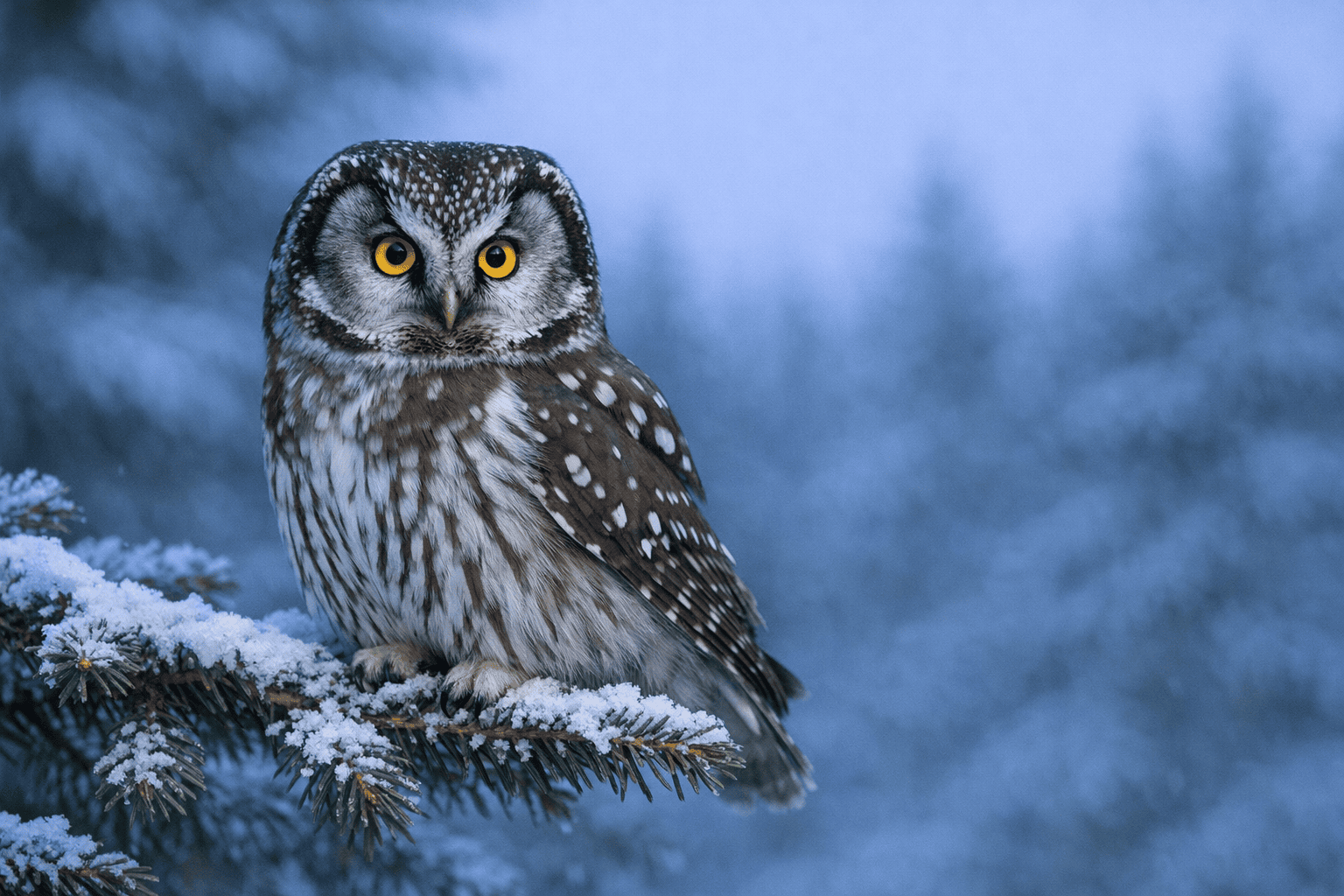
- Bright yellow eyes and a pale facial disc outlined by a dark border
- Brown upperparts marked with numerous white spots
- Whitish underparts with broad brown streaking
- Short tail, compact body, and broad, rounded wings
- Most often found in mature boreal or mountain conifer forest
- Male’s territorial song is a rhythmic series of low, hollow whistles
Appearance and Field Marks
It has a compact body, short tail, and oversized head. The rounded crown lacks ear tufts. Its yellow eyes stand out against a pale grayish-white facial disc, usually bordered by a dark brown or blackish rim. Small white marks above and between the eyes can create a surprised or stern expression.
The crown, back, and upperwing coverts are rich brown to gray-brown with bold white spots. The flight feathers and tail are barred with paler markings. Below, the owl is whitish with broad brown streaks that are usually heaviest on the chest and flanks. Its legs and toes are densely feathered, an adaptation suited to cold climates.
Males and females have similar plumage. Females are substantially larger and heavier on average, but size is difficult to judge without a direct comparison. Plumage tone also varies, so a reddish or grayish cast should not be used alone to determine age or sex.

Size and Measurements
Boreal Owls are about 9–10.5 inches (23–27 centimeters) long, with a wingspan of roughly 20–24 inches (51–61 centimeters). Adults generally weigh about 3.3–7.6 ounces (93–215 grams). Females occupy the upper part of that range, while males are usually smaller and lighter.
The species is similar in length to a Northern Saw-whet Owl but often looks more robust and large-headed. It remains much smaller than a Northern Hawk Owl or Barred Owl. Apparent size can be misleading when a bird fluffs its feathers in cold weather.
Range and Distribution
In North America, the Boreal Owl breeds across forested Alaska and much of Canada, reaching east to Labrador and Newfoundland. Its distribution continues south in suitable habitat through portions of the Cascades and Rocky Mountains. Smaller populations occur around the northern Great Lakes, the Adirondacks, northern New England, and other isolated areas of cool forest.
The species is generally resident but not completely sedentary. Individuals may move in response to vole numbers, severe weather, or local food shortages. During some winters, Boreal Owls appear south of their usual range. These movements are irregular and do not occur uniformly across the continent.

Habitat
Boreal Owls favor mature boreal and montane forests dominated by spruce, fir, pine, aspen, birch, or mixtures of coniferous and deciduous trees. Suitable habitat combines shaded roosting cover, openings or forest edges for hunting, and large trees or snags containing nesting cavities.
At southern latitudes, they are strongly associated with cool, high-elevation forests. They may hunt near bogs, meadows, recent burns, regenerating cuts, or other places where small mammals are accessible. Although some forest disturbance can create feeding habitat, the loss of cavity-bearing trees may reduce nesting opportunities.

Behavior
This owl is primarily nocturnal. It usually spends daylight hours roosting quietly in dense foliage or against a trunk, where its spotted brown plumage provides effective camouflage. A roosting bird may elongate its body, narrow its eyes, and remain motionless when approached.
At night, Boreal Owls hunt from perches and fly between openings with quick, direct wingbeats. Their broad wings also permit slow, controlled flight. Outside the breeding season, they are generally solitary. Individuals may tolerate low temperatures, but deep or crusted snow can make prey more difficult to reach.

Diet and Hunting
Small mammals form most of the diet. Voles are especially important, but Boreal Owls also take mice, shrews, lemmings, and occasionally small squirrels or bats. Birds, insects, and other small prey may supplement the diet, particularly when rodents are scarce.
A hunting owl commonly waits on a low or middle-level perch, listens for movement, and drops onto prey. Its asymmetrically placed ear openings help it locate sounds in darkness and beneath loose snow or vegetation. Prey abundance can strongly influence breeding activity, clutch size, and local population movements.
Vocalizations
The male’s primary advertising song is a sequence of low, hollow, evenly spaced whistles, often rendered as hoo-hoo-hoo-hoo-hoo. A series may accelerate slightly or continue for several seconds before a pause. The sound can carry through a still forest but may be surprisingly hard to locate.
Boreal Owls also produce short calls, squeals, and defensive sounds. Calling is most frequent from late winter into spring, though timing varies with latitude, elevation, weather, and breeding conditions. Playback should be used sparingly, particularly near known nesting areas.
Breeding and Nesting
Boreal Owls are cavity nesters and do not excavate their own nest holes. They most often use old woodpecker cavities, especially holes made by larger species, as well as natural hollows and appropriately sized nest boxes. No elaborate nest is built; eggs are laid on debris already present in the cavity.
A typical clutch contains about three to seven white eggs, although clutch size varies with food supply and geography. The female performs most or all incubation, while the male brings food. Incubation lasts roughly four weeks. During years of abundant prey, breeding density and reproductive output may increase noticeably.

Young and Development
Newly hatched chicks are covered in pale down and depend completely on the adults. The female broods and feeds small pieces of prey to the young, using food supplied mainly by the male during the early nestling period. As the chicks grow, their down is replaced by soft juvenile plumage.
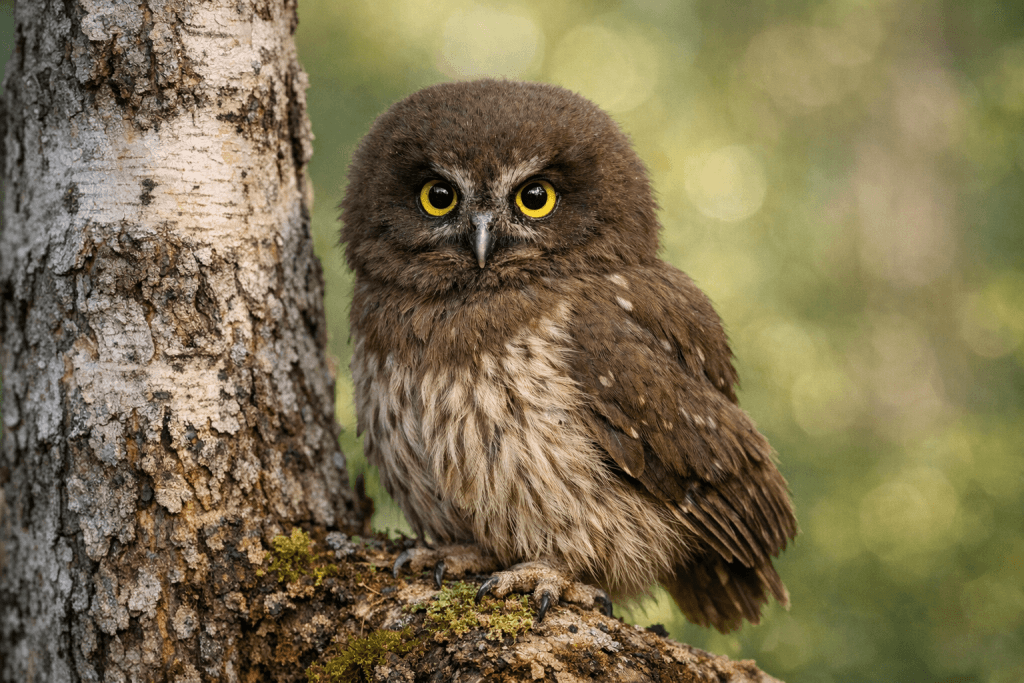
Young typically leave the cavity when they are about a month old, before becoming fully independent. Fledglings may climb on nearby trunks and branches and continue to receive food from their parents. Juveniles have a plainer chocolate-brown head and upper body than adults, with fewer obvious white crown spots, but retain bright yellow eyes.
Where to See
Search in extensive spruce-fir forest, mature mixed boreal woodland, or high-elevation conifer stands containing old aspens and snags. Quiet roads, ski trails, and forest openings can provide listening access without requiring travel through dense vegetation. In the southern part of the range, focus on cool mountain forests rather than surrounding lowlands.
The best detection method is patient listening on calm nights from late winter through spring. Begin after dusk or before dawn, stop at safe public access points, and allow several minutes at each location. Daytime searches are less productive and can disturb roosting birds. Never crowd a roost, cavity, or recently fledged young.
Similar Species
Northern Saw-whet Owl: This is the most likely source of confusion. It is similarly small and yellow-eyed, but usually shows a warmer, more orange-brown facial pattern with stronger white streaking around the face. The adult Boreal Owl has a more clearly defined pale facial disc, bold white spotting above, and broader brown streaks below. The saw-whet’s repeated advertising call is a high, mechanical toot, unlike the Boreal Owl’s lower, hollow whistles.
Northern Pygmy-Owl: This owl has a smaller-looking head, a longer tail, and no strongly defined facial disc. It also has dark false eye spots on the back of the head and is more likely to be active during daylight.
Barred Owl: A Barred Owl is dramatically larger, with dark eyes, a broad rounded head, and different barring and streaking. Size and eye color usually separate it immediately.
Conservation
The Boreal Owl is commonly classified as Least Concern globally because of its extensive circumpolar range. Even so, its secretive behavior makes population trends difficult to measure, and conditions differ among regions. Southern, isolated populations may be more vulnerable than those within continuous northern forest.
Potential pressures include the removal of large-cavity trees and snags, broad-scale forest conversion, collisions, and climate-related changes affecting cool conifer habitat and prey communities. Retaining mature forest patches, natural cavities, and a varied landscape of forest ages can support both nesting and hunting needs. Properly designed nest boxes may provide supplemental cavities where natural sites are limited.
Field Identification Tips
- Use voice first: a low series of hollow whistles is often the strongest clue.
- Confirm yellow eyes, a dark-edged pale facial disc, and a crown covered with white spots.
- Look for broad brown streaks on whitish underparts rather than fine reddish streaking.
- Consider habitat and elevation; southern birds are usually associated with cool mountain forest.
- Do not estimate sex from plumage. Females are larger, but overlap and viewing conditions complicate size judgments.
- Keep a generous distance from roosts and nest cavities, and avoid repeated playback.
Interesting Facts
- The Boreal Owl is called Tengmalm’s Owl in much of Europe.
- Its scientific name, Aegolius funereus, reflects a long history of names associated with nocturnal or mournful-sounding owls.
- Feathered legs and toes help insulate the bird in cold northern and mountain environments.
- Breeding numbers can fluctuate with cycles in vole abundance.
- Females may be nearly twice as heavy as small males, although the difference is not always obvious in the field.
- The species’ uneven southern distribution largely follows islands of cool coniferous habitat.
Frequently Asked Questions
Are Boreal Owls rare?
They are widespread in northern forests but are rarely seen because they are nocturnal, quiet outside the breeding period, and well concealed by day. They may be genuinely uncommon or localized near the southern edge of their range.
Do Boreal Owls migrate?
They are not regular long-distance migrants. Some individuals remain near breeding areas, while others move irregularly when prey declines, or winter conditions become unfavorable.
How can I distinguish one from a Northern Saw-whet Owl?
Look for the Boreal Owl’s dark-bordered pale facial disc, heavily white-spotted crown, and broad brown underpart streaks. Voice is especially useful: Boreal gives low hollow whistles, whereas Northern Saw-whet gives repeated high, bell-like toots.
Do Boreal Owls use nest boxes?
Yes. They may accept boxes with dimensions and entrance sizes suited to the species, especially where natural cavities are scarce. Boxes should be placed and monitored to minimize disturbance and discourage predators.
When is the best time to hear one?
Late winter and spring are generally best, particularly on calm nights. Calling schedules vary across the owl’s broad range and may be influenced by local weather and prey conditions.