Barred Owl Guide
- Scientific Name
- Strix varia
- Family
- Strigidae
- Order
- Strigiformes
- Length
- 17–20 in (43–50 cm)
- Wingspan
- 39–43 in (99–110 cm)
- Weight
- 16.5–37 oz (470–1,050 g)
- Conservation Status
- Least Concern (IUCN); widespread and generally secure overall
- Habitat
- Mature hardwood, mixed, and coniferous forests, especially wooded wetlands, bottomlands, riparian corridors, and areas with large cavity-bearing trees
Keep Track of What You See
Create a free Wild Things Guide membership to record this Barred Owl in My Sightings and build your personal wildlife list.
Join to Add This SightingIntroduction
The Barred Owl (Strix varia) is a large, round-headed woodland owl of North America. It is best known for its dark eyes, strongly barred-and-streaked plumage, and resonant call commonly rendered as “Who cooks for you? Who cooks for you-all?” Once associated mainly with eastern forests, the species has expanded across parts of western Canada and into the Pacific Northwest.
Barred Owls often remain concealed in shaded forest during the day, but patient observers may find one perched close to a trunk. They are most active from dusk through the night, although daytime hunting and calling are not unusual, especially during the breeding season.
Quick Identification
- Large, bulky owl with a broad, rounded head and no ear tufts
- Dark brown eyes set in a pale gray-brown facial disc
- Brown-and-white horizontal barring across the upper breast
- Long vertical brown streaks on the lower breast and belly
- Broad, rounded wings and a moderately long barred tail
- Deep series of hoots, often ending in a forceful descending phrase
In much of eastern North America, the combination of dark eyes, a round head, and mixed horizontal and vertical markings is distinctive. Size can be difficult to judge on a solitary perched bird, so emphasize facial shape, eye color, and plumage pattern.
Appearance and Field Marks
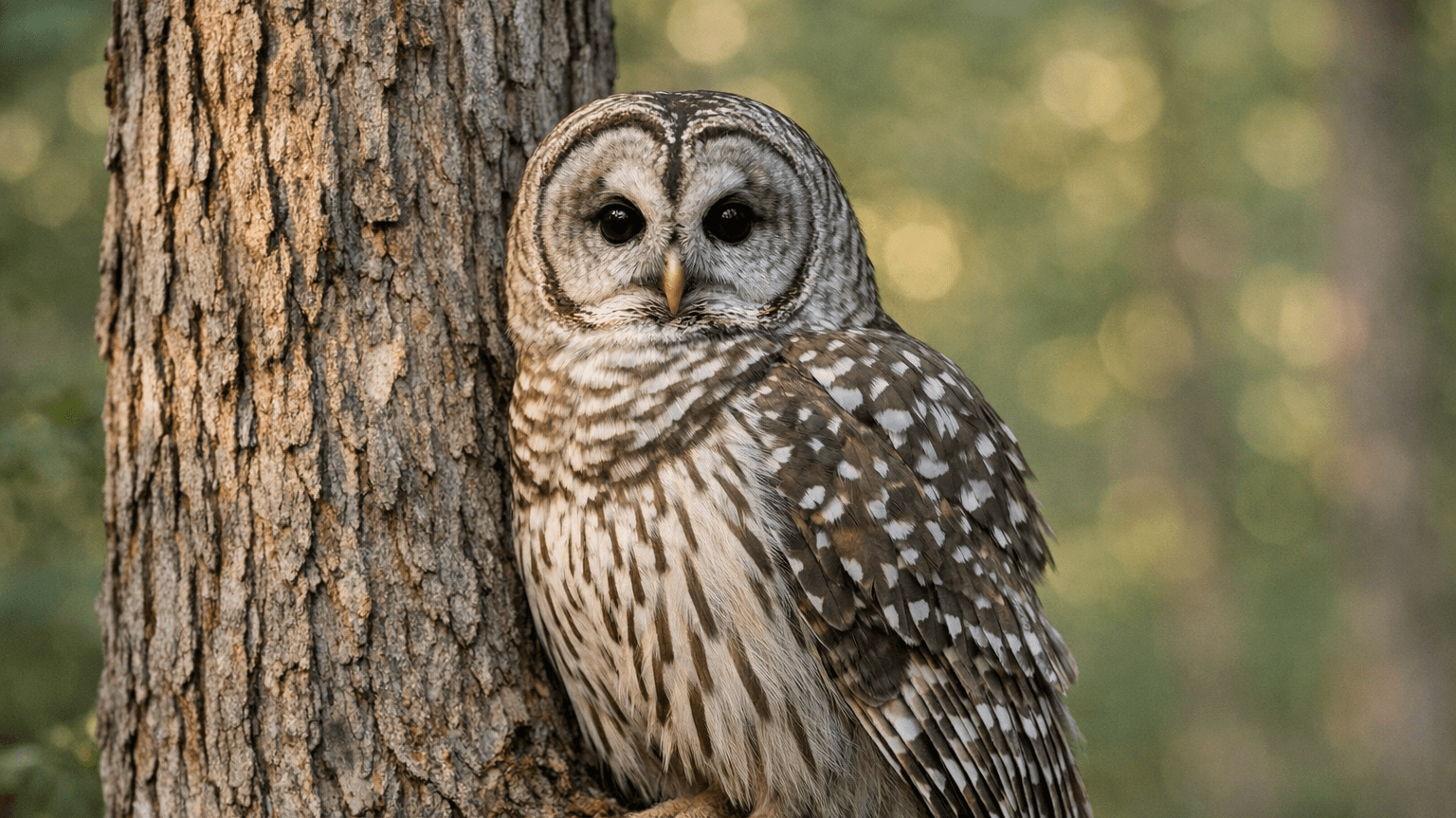
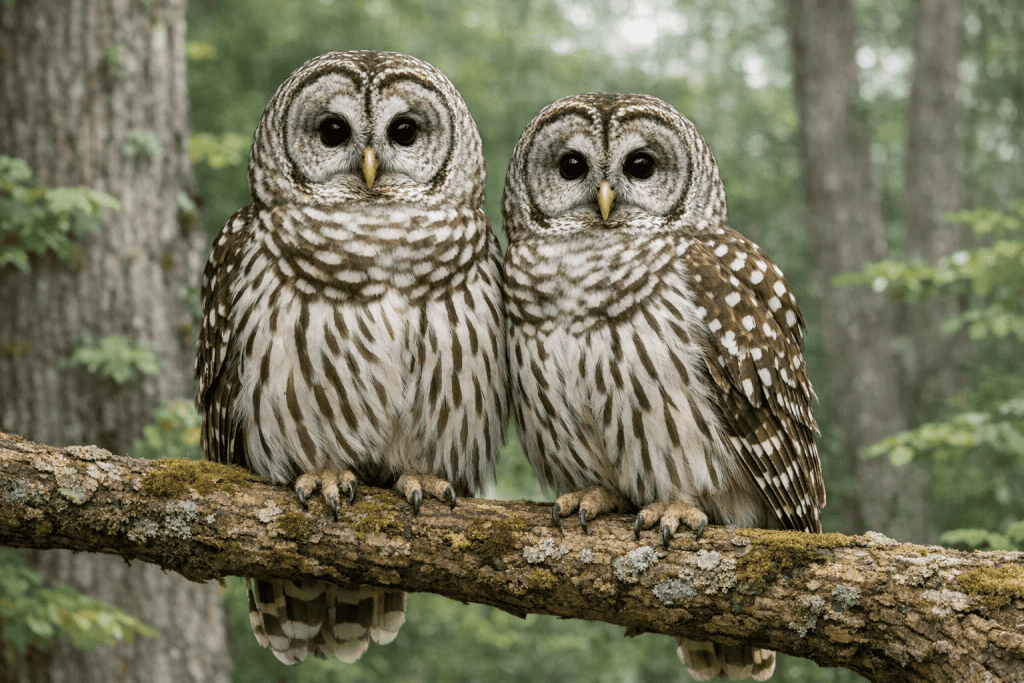
Adult Barred Owls are mottled gray-brown above, with pale spotting and bars that help them blend into furrowed bark. The facial disc is rounded and relatively pale, bordered by darker feathering. The eyes appear very dark brown or almost black. A small yellow bill may be partly hidden by facial feathers.
The upper breast shows clear horizontal brown bars on a pale background. Below this barred area, the markings change to long vertical streaks. This transition is one of the most useful field marks. The tail and broad flight feathers are crossed by alternating light and dark bands.
Males and females have essentially the same plumage. Females average larger and heavier, but the difference is usually apparent only when a pair is together. Plumage varies somewhat with wear, lighting, and geography; birds can appear cool gray in shade or warmer brown in direct light.
Size and Measurements
Barred Owls are large owls, though notably smaller and less massive than Great Horned Owls.
- Length: about 17–20 inches (43–50 centimeters)
- Wingspan: about 39–43 inches (99–110 centimeters)
- Weight: approximately 16.5–37 ounces (470–1,050 grams)
Females tend to occupy the upper portion of the weight range. A perched bird can look compact, but in flight its broad wings and long-looking tail become conspicuous.
Range and Distribution
The Barred Owl is widespread across eastern and central North America. Its core range extends from southern and central Canada through the eastern United States to Florida and the Gulf Coast. It occurs westward into parts of the Great Plains where suitable wooded corridors are available.
During the last century, Barred Owls spread westward through Canadian forests and became established from southeastern Alaska and British Columbia, south through Washington and Oregon, into northern California. Most adults are year-round residents. Young birds disperse from their natal areas and may appear outside familiar local territories.

Habitat
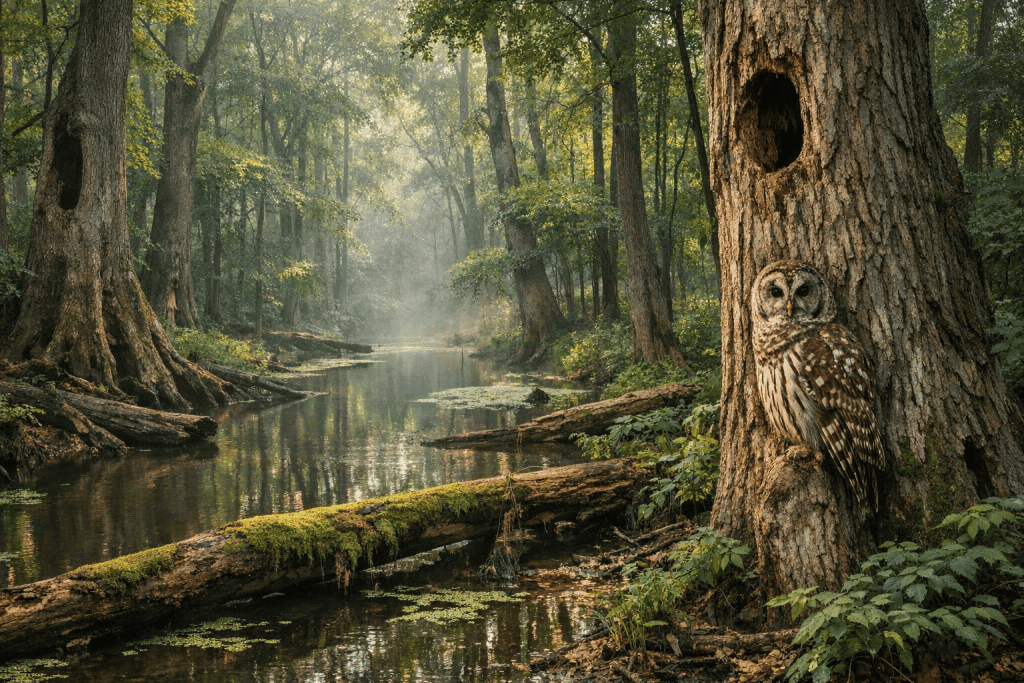
Barred Owls favor forests with large trees, substantial canopy cover, and cavities suitable for nesting or roosting. Common settings include bottomland hardwood forests, wooded swamps, riparian corridors, mature mixed forests, and coniferous forests. Water is frequently nearby, although it is not required at every occupied site.
The species also uses forest edges, wooded parks, and established suburban neighborhoods when mature trees and connected habitat remain. A mixture of dense daytime cover and more open hunting areas can be especially favorable.
Behavior
During daylight, a Barred Owl typically roosts on a shaded branch, often near the trunk or within dense foliage. Its cryptic plumage and upright posture make it easy to overlook. If disturbed, it may elongate its body, watch silently, or fly deeper into cover.
Activity is usually greatest around dusk, at night, and near dawn. Barred Owls defend territories with calls and occasional chases. Mated pairs may call back and forth in duets that include hoots, cackles, barks, and excited caterwauling. They are capable fliers but often move through the forest with slow, direct wingbeats and short glides.
Diet and Hunting
Barred Owls are opportunistic predators with a broader diet than many woodland owls. Small mammals—including mice, voles, rats, squirrels, and young rabbits—are important prey. They also take birds, frogs, salamanders, snakes, lizards, large insects, crayfish, and occasionally fish.
A hunting owl commonly waits on a low or middle-level perch, using hearing and vision to locate movement before dropping onto prey. It may also fly between perches or investigate shallow water and wet ground. Indigestible fur, feathers, bones, and exoskeletons are compressed into pellets and later regurgitated near roosts.

Vocalizations
The familiar territorial call consists of eight or nine accented hoots, popularly translated as “Who cooks for you? Who cooks for you-all?” The final notes often descend and sound emphatic. Individual rhythm and pitch vary, and a distant call may be heard more easily than the owl can be seen.
Barred Owls also produce shorter hoots, rising calls, barks, screams, and cackling exchanges. Calling can occur throughout the year but is often especially noticeable from late winter into the breeding period.
Breeding and Nesting
Courtship commonly begins in winter or early spring, with timing varying by latitude. A pair may use the same territory for multiple years. The usual nest site is a natural tree cavity or a hollow created by a broken limb. Abandoned stick nests of hawks, crows, or squirrels are also used, as are appropriately designed large nest boxes.
A typical clutch contains two or three dull white eggs, although larger or smaller clutches occur. The female performs most or all incubation, which lasts roughly four to five weeks, while the male supplies much of her food. Both parents participate in feeding and defending the young after hatching.

Young and Development
Newly hatched owlets are covered in white down and depend completely on their parents. As they grow, the down becomes buffier and developing flight feathers create a shaggy appearance. Young Barred Owls commonly leave the nest cavity at about four to five weeks of age, before they can fly well.
These “branchers” climb and hop among nearby limbs using their feet, bills, and wings. A youngster found perched low near a nest is not necessarily abandoned. Parents usually continue to deliver food as their ability to fly improves, and family groups may remain associated for several months.
Similar Species
Spotted Owl: The closest identification challenge in western North America. Spotted Owls have pale spots rather than strong horizontal bars across the breast, and their underparts are more evenly patterned. They also tend to have a warmer brown appearance. The two species overlap extensively in parts of the Pacific Northwest.
Great Horned Owl: Larger and more powerful, with prominent ear tufts, yellow eyes, and a differently patterned face. Ear tufts may be flattened, so eye color and overall structure remain useful.
Great Gray Owl: Much taller-looking, with a very large circular facial disc, yellow eyes, and a dark bow-tie mark below the bill. Despite its imposing size, it may not weigh much more than a large Barred Owl.
Boreal Owl: Considerably smaller, with a proportionally large head, yellow eyes, and white-spotted upperparts. It is usually associated with northern or high-elevation coniferous forest.
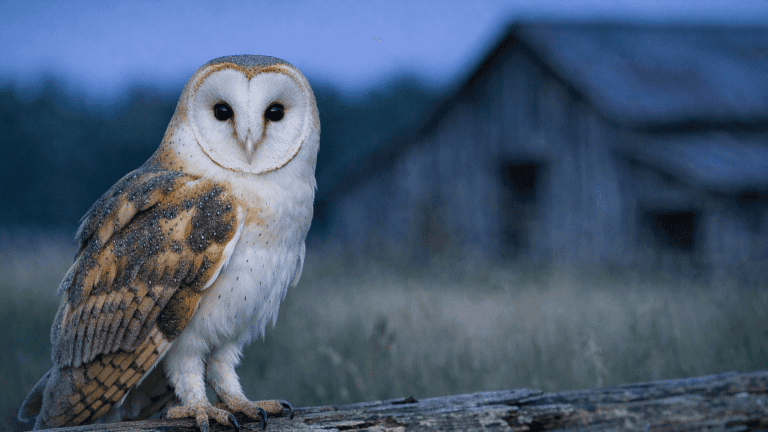
Barn Owl: Recognizable by its white, heart-shaped face, long legs, pale underparts, and buoyant flight over open country.
Conservation
The Barred Owl is classified as Least Concern by the International Union for Conservation of Nature and remains widespread overall. Mature forest loss, vehicle collisions, secondary poisoning from rodenticides, and entanglement or other human-made hazards can affect local birds. Preserving large trees, wooded wetlands, and connected forest corridors benefits the species.
Its western expansion presents a separate conservation concern. In the Pacific Northwest, Barred Owls compete with the smaller Northern Spotted Owl for territories and prey and can displace them from suitable habitat. Wildlife agencies use research, monitoring, and localized population management in efforts to reduce this pressure. This regional conflict does not indicate that Barred Owls are declining across their broader range.
Field Identification Tips
Search mature woodland near water at dawn or dusk, scanning the horizontal branches near large trunks. Listen for alarm calls from crows, jays, chickadees, or squirrels, which may reveal a roosting owl. Pellets and white droppings beneath a favored tree provide clues but are not sufficient for identification on their own.
When an owl is visible, check for a round, tuftless head; dark eyes; barred upper breast; and vertically streaked belly. In the West, document the complete breast pattern before distinguishing a Barred Owl from a Spotted Owl. Avoid repeated playback near nests or agitated birds, and observe from a distance that does not change their behavior.
Interesting Facts
- The common name refers to the strong crossbars on the upper breast, wings, and tail.
- Barred Owls can wade into shallow water and capture aquatic prey such as frogs, crayfish, or fish.
- Their western range expansion was probably aided by the expansion of tree cover across portions of the northern Great Plains and boreal regions.
- Young owls can climb sloping trunks and branches before becoming capable fliers.
- A Barred Owl may remain motionless for long periods, relying on camouflage rather than immediately fleeing an observer.