

Northern Map Turtle Guide
Keep Track of What You See
Create a free Wild Things Guide membership to record this Northern Map Turtle in My Sightings and build your personal wildlife list.
Join to Add This SightingIntroduction
The Northern Map Turtle (Graptemys geographica), also called the Common Map Turtle, is a freshwater turtle of rivers, lakes, and connected waterways in eastern and central North America. Its name comes from the fine yellow lines crossing the shell like roads or contour lines on a map.
This species is an enthusiastic basker but an alert one. Several turtles may gather on a log, only to plunge into the water when a person, boat, or potential predator approaches. Identification is easiest when you can assess the head markings, shell pattern, and the strongly different sizes of adult males and females.
Quick Identification
- Olive, brown, or grayish carapace covered with thin yellow or yellow-green lines.
- Large oval or triangular yellow spot behind each eye.
- Numerous narrow yellow stripes on the head, neck, and limbs.
- Low keel along the middle of the shell, most noticeable in juveniles and males.
- Slightly serrated rear edge of the carapace, especially in young turtles.
- Yellow to cream plastron, sometimes with darker markings along the scute seams.
- Adult females are much larger and broader-headed than adult males.
Appearance
The upper shell is moderately flattened and usually olive green, brown, or gray-brown. Thin, curved yellow lines form irregular loops and networks across each scute. These maplike markings are often vivid in juveniles but may fade, darken, or become obscured by algae in older turtles.
A low midline keel runs down the carapace. Its raised knobs and the shell’s toothed rear margin are most distinct in hatchlings and juveniles, becoming smoother with age. The underside is generally pale yellow or cream. Young individuals often show dark lines or blotches following the plastral seams; mature animals may have a nearly unmarked plastron.
The skin is dark olive to nearly black with many narrow yellow stripes. A prominent light spot behind the eye is a useful field mark. This spot is usually oval or triangular and is broader than the fine neck stripes.

Size and Physical Characteristics
Northern Map Turtles display pronounced sexual size dimorphism. Adult males commonly have carapaces about 3.5–6.5 inches (9–16 cm) long, while adult females are approximately 7–10.5 inches (18–27 cm). Exceptionally large females may fall near the upper end of that range.
Females also develop broad heads and powerful jaws adapted for crushing snails and other hard-shelled prey. Males retain narrower heads and have longer, thicker tails, with the vent positioned farther beyond the edge of the shell. Their front claws are not as dramatically elongated as in some other basking turtles.
A turtle’s apparent size can be difficult to judge at a distance. Nearby leaves, branches, or exposed portions of a basking log provide better scale than open water.
Similar Species
Other map turtles in the genus Graptemys can be difficult to separate, particularly where ranges overlap. False Map, Ouachita Map, and Mississippi Map Turtles differ in the shape and arrangement of markings around the eye, jaw, and neck. Northern Map Turtles typically show a relatively large yellow spot behind the eye without the bold eye-enclosing crescent associated with some other forms. Because markings vary and may fade, photographs of both sides of the head and the carapace are more useful than a single distant view.
Painted Turtles have smoother shells, usually lack the intricate maplike network, and commonly show red or orange markings along the shell margins and limbs. Red-eared Sliders possess a broad red patch behind the eye. Diamondback Terrapins have concentric sculpturing on the scutes and normally occupy brackish coastal habitats rather than inland freshwater rivers and lakes.
Habitat
Northern Map Turtles inhabit rivers, large streams, lakes, reservoirs, and backwaters. They are often associated with relatively clean water, abundant aquatic prey, and numerous basking sites. Fallen trees, exposed roots, rocks, muskrat lodges, and low islands may all serve as basking platforms.
River populations often favor pools, slow runs, and protected margins near stronger current. Lake populations use sheltered bays and shorelines but may also enter deeper water. Suitable nesting habitat generally consists of sunny, well-drained sand, fine gravel, or loose soil within traveling distance of water.

Geographic Range
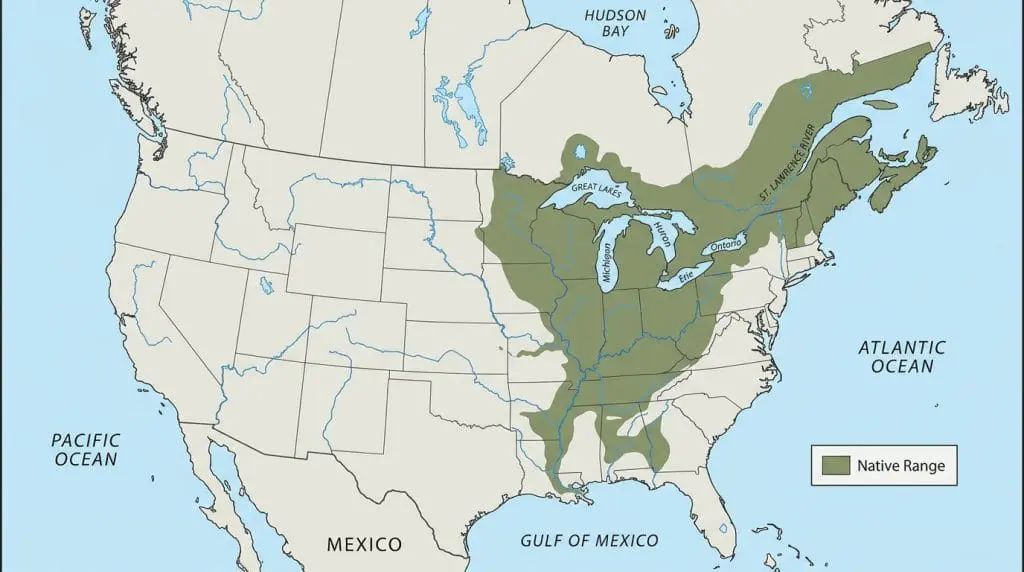
The species occurs across parts of the Great Lakes and St. Lawrence systems and through portions of the Mississippi, Ohio, and related eastern and central drainage basins. Its distribution includes southern Canada and a broad area of the northeastern and central United States, extending southward through several major river systems.
Distribution is uneven rather than continuous. Dams, unsuitable channels, pollution, and natural watershed boundaries can separate populations. The University of Michigan Animal Diversity Web account for the Northern Map Turtle provides additional species and range information.
Behavior
Basking is one of the species’ most visible behaviors. Individuals climb onto logs or rocks to warm themselves and dry their shells. They may rest alone or in mixed groups with painted turtles, sliders, or other map turtles. Northern Map Turtles are wary and commonly enter the water at the first sign of danger.
They are strong swimmers and usually escape underwater rather than traveling over land. Females make the most conspicuous terrestrial movements during nesting. Disturbed turtles may bite, scratch, withdraw into the shell, or release musk, but their first defense is normally flight.
Diet and Feeding
Northern Map Turtles are opportunistic aquatic predators, and their diet differs by sex and size. Large females use their broad jaws to crush freshwater snails, clams, and mussels. They also eat crayfish and aquatic insect larvae. Smaller males and juveniles take more insects, small snails, crustaceans, worms, carrion, and occasional fish or fish eggs.
Most feeding occurs underwater. A turtle may search along the bottom, inspect submerged wood and vegetation, or seize prey from rocks and sediment. Because females can consume invasive as well as native mollusks, the available prey community may influence local diet.

Activity and Seasonal Patterns
This is a mainly diurnal species. Basking and feeding are most apparent on sunny or partly sunny days from spring through early fall. Turtles may bask even during cool weather when sunlight raises the temperature of an exposed log above that of the surrounding water.
In northern parts of the range, activity declines in autumn. Individuals overwinter underwater in deep pools, lake bottoms, or other sites protected from freezing and severe currents. Emergence timing varies with latitude, water temperature, ice cover, and local weather. Southern populations may have longer activity seasons.
Reproduction and Life Cycle
Courtship and mating occur mainly in spring, although fall mating has also been reported. Nesting generally takes place from late spring through midsummer. A female leaves the water, often on warm mornings or evenings, and selects an open area with soil she can excavate.
Using her hind feet, she digs a flask-shaped chamber and deposits a clutch commonly numbering about 6–20 eggs. Large females may lay more than one clutch in a season. The female covers and tamped the nest before returning to the water.
Incubation commonly lasts several weeks and varies with temperature and moisture. Incubation temperature, as in many turtles, influences sex. Some late-season hatchlings remain underground through winter and emerge the following spring. Maturity takes several years, particularly in females, which must reach a substantially larger body size.

Young and Juveniles
Hatchlings are only about 1–1.5 inches (2.5–3.8 cm) in shell length. They have a sharply defined keel, a strongly serrated rear shell margin, and bright maplike markings. Their heads are proportionally small compared with those of mature females.
Young turtles feed heavily on aquatic insects, tiny mollusks, and other small invertebrates. They often remain in shallow, protected water with submerged vegetation, woody cover, and low basking sites. Their small size leaves them vulnerable to fish, wading birds, snakes, and mammals.
Predators and Defense
Eggs and hatchlings face the greatest predation pressure. Raccoons, skunks, foxes, coyotes, and other mammals dig up nests, while birds, snakes, large fish, and bullfrogs may take young turtles. Adults have fewer natural predators, although large mammals, alligators in limited areas, and birds of prey may occasionally attack them.
The main defenses are vigilance, rapid diving, swimming ability, and the protective shell. A captured adult, especially a large female, can deliver a strong bite. Wild turtles should therefore be observed without handling.
Tracks, Signs, and Other Evidence
A nesting female may leave alternating footprints and a broad drag mark across sand or soft soil. The finished nest is usually inconspicuous, appearing as a disturbed or dampened patch rather than an open hole. Such signs cannot reliably identify the species because several freshwater turtles produce similar trails and nests.
More useful evidence includes repeated occupancy of prominent basking logs, shed shell scutes near shore, or empty mollusk shells at feeding areas. Even these clues are not diagnostic. Clear photographs of the living turtle provide the most dependable record.
Where and How to Find It
Search from a bridge, public shoreline, canoe, or riverside trail where long views of exposed logs are available. Calm mornings and sunny periods after cool weather can be productive. Scan every log with binoculars before approaching; map turtles often dive while an observer is still far away.
Look for a moderately flattened shell and a small yellow spot behind the eye. In mixed basking groups, compare head shape and shell pattern rather than relying only on size. Keep boats slow near basking structures, remain well back from nesting females, and never probe or uncover a suspected nest.
Conservation Status and Threats
The Northern Map Turtle is commonly listed as Least Concern on the IUCN Red List because of its broad distribution. That global category does not mean every population is secure. Provincial and state rankings vary, and isolated populations may be small or declining.
Major concerns include shoreline development, removal of basking logs, water pollution, sedimentation, wetland alteration, boat strikes, fishing-hook injuries, road mortality of nesting females, nest predation, and illegal collection. Dams can alter currents, water temperatures, prey communities, and movement routes. Protecting mature females is especially important because they take years to reproduce and contribute many more eggs than small, young adults.
Relationship with Humans
Northern Map Turtles are harmless when left alone and can be valuable indicators of functioning freshwater habitats. Do not remove them from the wild. Captive care requires specialized water quality, lighting, diet, and space, and possession may be restricted by state or provincial law.
If a turtle is crossing a road, help only when you can do so safely and legally. Move it in the direction it was already traveling, without relocating it to a different waterway. Never lift a turtle by the tail; support the shell from the rear, keeping your hands away from the head.
Interesting Facts
- The scientific name geographica refers to the shell’s maplike pattern.
- Females may be several times heavier than adult males.
- The broad female head reflects a diet rich in hard-shelled mollusks.
- Several map turtles may stack or crowd together on a favored basking log.
- Shell markings often become less distinct as the turtle ages.
- Hatchlings may spend their first winter inside the underground nest.
Frequently Asked Questions
Is the Northern Map Turtle the same as the Common Map Turtle?
Yes. Both names are widely used for Graptemys geographica. “Northern Map Turtle” is especially common in Canada and in regional conservation material.
How can I distinguish a male from a female?
Adult females are much larger and have broad heads. Adult males are smaller, have narrower heads, and have longer, thicker tails. Juveniles cannot always be sexed confidently in the field.
Do Northern Map Turtles bite?
They may bite when restrained, and large females have strong jaws. Free-ranging turtles usually dive or swim away rather than confront people.
Why are they difficult to approach?
Map turtles depend on early detection and rapid escape. They often bask with their heads raised and enter the water when they notice movement, vibration, or a changing silhouette.
How long do Northern Map Turtles live?
Precise wild longevity is not well documented, but they are long-lived turtles and can probably survive for several decades. Treat estimates cautiously because long-term records are limited.
Can I keep one I find?
Leave wild turtles where you find them. Collection may be illegal, removes breeding animals from local populations, and often leads to poor outcomes in captivity.


