

Mountain Lettuce Guide
- Scientific Name
- Lactuca pulchella
- Family
- Asteraceae
- Order
- Asterales
- Length
- Typically 30–100 cm (1–3.3 ft) tall, occasionally taller
- Conservation Status
- Generally secure across its broad range; not federally listed in the United States or Canada, though local status varies
- Habitat
- Prairies, foothill and montane meadows, open woods, shrubland edges, stream terraces, sandy banks, roadsides, and other sunny open ground
- Range Summary
- Broad but uneven distribution from Alaska across western and central Canada, south through the western United States, Rocky Mountains, Great Plains, and parts of the northern Midwest and Southwest
Keep Track of What You See
Create a free Wild Things Guide membership to record this Mountain Lettuce in My Sightings and build your personal wildlife list.
Join to Add This SightingIntroduction
Mountain lettuce (Lactuca pulchella) is a native perennial wildflower of open landscapes across much of northern and western North America. Also called blue lettuce or beautiful lettuce, it belongs to the same genus as cultivated lettuce. Still, it has a distinctly wild appearance: upright stems, narrow leaves, milky sap, and loose clusters of pale blue to lavender flower heads.
Despite its common name, mountain lettuce is not restricted to mountains. It also grows in prairies, meadows, open woodland, river terraces, roadsides, and other sunny or lightly disturbed places. Its flower color is unusual among North American wild lettuces, many of which bloom yellow.
Taxonomic treatment varies. Some authorities place this plant within the widespread Eurasian and North American species Lactuca tatarica, using the name Lactuca tatarica var. pulchella or subsp. pulchella. This guide follows the commonly used North American name Lactuca pulchella. The USDA PLANTS profile for mountain lettuce provides additional distribution and nomenclatural information.
Quick Identification Summary
- Growth form: Erect, colony-forming perennial with underground rhizomes.
- Height: Commonly about 30–100 cm (1–3.3 feet), occasionally taller.
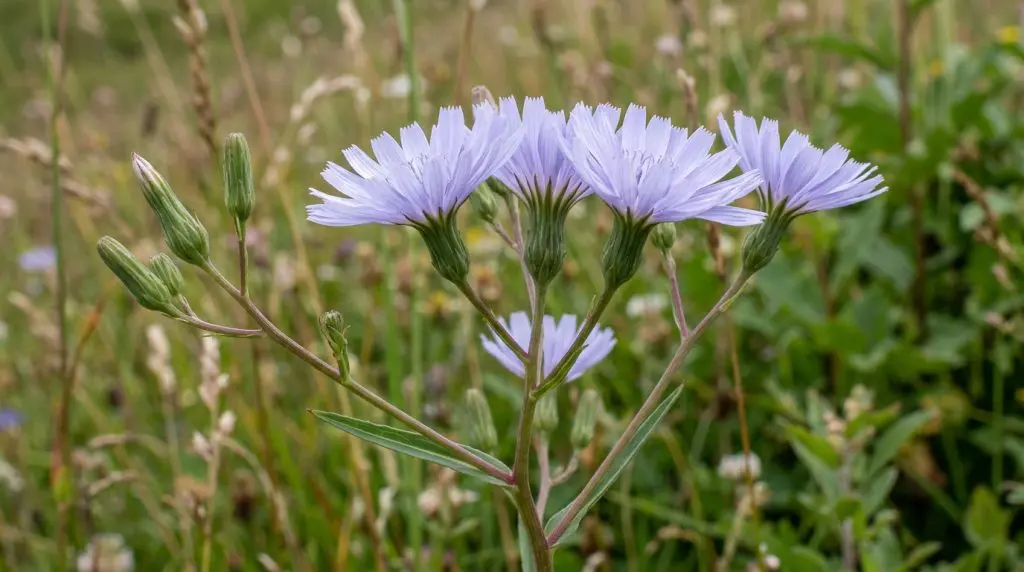
- Flowers: Pale blue, lavender, or bluish purple flower heads composed entirely of strap-shaped ray florets.
- Leaves: Alternate, narrow to lance-shaped; margins may be entire, toothed, or deeply lobed.
- Stems: Upright, often somewhat waxy or gray-green, containing white milky latex.
- Fruit: Flattened, dry, one-seeded fruits with slender beaks and white, parachute-like bristles.
- Habitat: Sunny prairies, foothill meadows, open woods, slopes, banks, and roadsides.
- Best field marks: Blue-lavender heads, alternate narrow leaves, milky sap, and a perennial rhizomatous habit.
How to Identify the Plant
Begin with the flower heads. As in other members of the aster family, what appears to be one flower is a compact head of many small florets. Mountain lettuce lacks a central disk. Every floret is strap-shaped, producing a head that resembles a small, loose dandelion in pale blue or lavender rather than yellow. Heads are generally around 2–4 cm (0.8–1.6 inches) across when fully open, although size varies with growing conditions.
The heads are held in an open, branching cluster near the upper part of the plant. They commonly open in bright daylight and may partly close during cloudy weather or later in the day. Narrow green involucral bracts form a cylindrical to narrowly bell-shaped base beneath each head.
Leaves are alternate rather than opposite. Lower leaves may be lance-shaped, shallowly toothed, or divided into backward-pointing lobes. Upper leaves are usually smaller, narrower, and less deeply cut. Leaf shape varies enough that it should not be used alone for identification.
A broken leaf or stem usually releases white latex. Check this feature sparingly because cutting the plant is unnecessary when other characters are visible. The combination of milky sap, blue ray florets, alternate leaves, and numerous small flower heads strongly suggests mountain lettuce.
Size and Growth Habit
Mountain lettuce usually stands 30–100 cm tall, with vigorous plants sometimes exceeding that range. One or several upright stems arise from a perennial underground system of creeping rhizomes. These rhizomes allow the plant to survive winter and produce small colonies.
Plants growing among grasses often remain slender and lightly branched below the flowering cluster. In open, productive soil, they may be more robust and branched. Stems are generally smooth or nearly so and can have a pale, slightly waxy surface. Unlike a basal rosette-forming dandelion, mountain lettuce carries leaves along an obvious leafy stem.
Blooming Season
Flowering generally occurs from early summer into early autumn, most often from June through September. Northern or high-elevation populations may bloom mainly in July and August, while plants farther south can begin earlier. Elevation, spring temperature, soil moisture, grazing, and mowing can all shift the timing.
Individual heads are short-lived, but a branched plant can continue opening new heads over an extended period. Mature seed heads may be present while younger buds are still developing.
Habitat
Look for mountain lettuce in sunny to partly open settings. Typical habitats include native prairie, foothill grassland, montane meadow, open aspen or conifer woodland, shrubland edges, stream terraces, lake margins, sandy banks, and stabilized dunes. It also colonizes roadsides, railway margins, fence lines, and other disturbed ground where native vegetation remains nearby.
The species tolerates a range of soils, including sandy, gravelly, loamy, and occasionally somewhat saline substrates. It generally performs best where taller vegetation does not create dense shade. Its occurrence along roads does not automatically mean that it is introduced; disturbance can reproduce the open conditions present in natural grasslands and floodplains.

Geographic Range
Mountain lettuce has a broad but uneven North American distribution. It is most characteristic of Alaska, western and central Canada, the western United States, the Rocky Mountains, the Great Plains, and parts of the northern Midwest. Its range extends south into portions of the Southwest, with scattered or localized records toward its eastern and southern limits.
Interpret distribution maps as county, province, or regional records rather than proof that the plant occurs throughout every shaded area. Suitable habitat may be patchy, especially where prairie and open meadow systems have been converted or heavily altered.

Similar Species and Look-Alikes
Chicory (Cichorium intybus) also has blue flower heads and milky sap. Chicory typically has larger, brighter blue heads attached closely to stiff, angular, widely branching stems. Its upper stems may appear nearly leafless. Mountain lettuce usually has smaller heads in a looser terminal cluster and a softer, less rigid growth form.
Tall blue lettuce (Lactuca biennis) is often much taller and has broader, conspicuously lobed leaves. Its numerous small heads are commonly dull purplish, cream, or yellowish rather than clear blue-lavender. It favors moist woodland edges and rich thickets more often than open, dry prairie.
Prairie lettuce (Lactuca ludoviciana) can share grassland habitats with mountain lettuce. It is commonly taller, has broader and more deeply lobed leaves, and normally produces yellow flower heads.
Rattlesnakeroots (Nabalus species) also contain milky sap, but their heads are usually nodding and narrowly cylindrical, with cream, greenish, or pinkish florets. They are often found in woodlands or along shaded edges.
Because leaf shape changes from the base to the top of a mountain lettuce plant, compare several features: flower color, head orientation, leaf arrangement, sap, stature, and habitat.
Wildlife Connections
The open flower heads offer pollen and nectar to a variety of insects, including native bees, small butterflies, moths, hover flies, and other flower-visiting flies. The exact visitor community differs by region and flowering season.
After flowering, the dry fruits may be taken by small seed-eating animals, although many are carried away by wind. Mammals can browse the foliage, but its bitter latex may discourage prolonged feeding. Dense patches also add low vertical structure and cover within mixed prairie or meadow vegetation.
Ecological Importance
Mountain lettuce contributes summer and late-season floral resources in open ecosystems. Because it spreads by both seed and rhizomes, established plants can persist after moderate disturbance and help occupy small openings where exposed soil might otherwise remain bare.
Its roots and rhizomes contribute to belowground plant structure in grasslands and slopes. The species is not usually dominant, but it adds botanical diversity to communities containing native grasses, asters, goldenrods, legumes, and other meadow wildflowers.
Native, Introduced, or Invasive?
Mountain lettuce is native across its established North American range. It is not generally classified as invasive. Its ability to spread through rhizomes can produce noticeable colonies, but that behavior is part of its natural growth strategy.
The related Lactuca tatarica complex also occurs in Eurasia, which partly explains differences among botanical treatments. Gardeners should obtain locally appropriate, accurately identified native stock rather than importing material under a similar name.

Traditional and Historical Uses
Ethnobotanical accounts report that some Indigenous communities used wild lettuces as foods or for medicinal purposes. Uses, preparation methods, and the species involved differed among nations and regions. Historical records may also use older or broader botanical names, so it is unsafe to assume that every account refers specifically to Lactuca pulchella.
Such knowledge belongs to living cultural traditions and should not be reduced to a generalized recipe. Anyone researching a particular use should consult Indigenous-led sources and carefully documented regional ethnobotanical records.
Is It Edible or Toxic?
Young leaves of mountain lettuce have been reported as edible, usually when tender and before they become strongly bitter. The plant is not generally regarded as a highly poisonous wildflower, but mature tissues contain bitter milky latex, and individual reactions are possible.
Do not eat a plant based only on a blue flower or common name. Chicory, other wild lettuces, and unrelated milky-sapped plants can be confused with it. Avoid plants exposed to herbicides, roadside contaminants, livestock waste, or polluted water. Do not use wild plants medicinally without qualified guidance, and collecting may be prohibited on public or protected land.
Growing It in a Native Garden
Mountain lettuce is best suited to prairie, meadow, and naturalistic gardens within its native region. Give it full sun or light partial shade and ordinary, well-drained soil. Established plants tolerate seasonal dryness, although seedlings benefit from steady moisture while developing roots.
Sow responsibly sourced seed outdoors in autumn so it experiences natural winter conditions. Press the seed lightly against the soil rather than burying it deeply. Germination may be irregular, and patience is appropriate for regionally sourced native seed.
Allow enough space for rhizomatous spread. A meadow edge or contained native bed is usually more suitable than a formal border. Avoid rich fertilizer, which can produce weak, overly tall growth. Leave some seed heads standing for natural dispersal and wildlife use, but remove them before maturity if unwanted seedlings are a concern.

Conservation
Mountain lettuce is generally considered secure across its broad range and is not federally listed as threatened or endangered in the United States or Canada. Status can nevertheless differ at the state, provincial, or local level, especially near the edge of its distribution.
The main conservation concern is less the species as a whole than the continued loss and fragmentation of native prairie, meadow, and open woodland. Herbicide use, grassland conversion, poorly timed mowing, and suppression of natural disturbance can reduce local populations. Photograph plants where they grow, avoid digging wild specimens, and use nursery-propagated regional material in gardens.
Interesting Fact
The blue “petals” are not petals at all. Each is the exposed strap-shaped portion of a separate floret. A single mountain lettuce head is therefore a compact community of small flowers, all enclosed at the base by shared green bracts.
Frequently Asked Questions
Why is it called mountain lettuce?
The name reflects both its occurrence in upland and montane habitats and its relationship to cultivated lettuce. It also grows well beyond mountains, including prairies, roadsides, and river terraces.
Does mountain lettuce always have blue flowers?
Flower color ranges from pale sky blue to lavender or bluish purple. Lighting and flower age can alter its appearance. Very pale heads may look nearly whitish, so other identification features remain important.
How can I distinguish it from chicory?
Chicory generally has larger, brighter blue heads positioned along stiff, angular branches. Mountain lettuce has smaller heads in a loose upper cluster, narrower leafy stems, and often forms patches from rhizomes.
Is mountain lettuce related to garden lettuce?
Yes. Both belong to the genus Lactuca and produce milky latex and wind-dispersed fruits. Mountain lettuce is a perennial wild species, not a wild form of common salad lettuce.
Will it spread in a garden?
It can spread through underground rhizomes and seed. In a suitable site, it may form a colony, so place it where gradual expansion is acceptable.
Can I collect mountain lettuce from the wild?
Regulations depend on land ownership and location. Collection is often prohibited in parks and protected natural areas. For cultivation, use legally collected seed or plants propagated by a reputable native-plant nursery.


