Flammulated Owl Guide
- Scientific Name
- Psiloscops flammeolus
- Family
- Strigidae
- Order
- Strigiformes
- Length
- 15–17 cm (6–7 in)
- Wingspan
- 36–41 cm (14–16 in)
- Weight
- 45–63 g (1.6–2.2 oz)
- Conservation Status
- Least Concern
- Habitat
- Mature, open conifer and mixed-conifer forests with large trees, clear flight space, abundant insects, and existing nesting cavities.
Keep Track of What You See
Create a free Wild Things Guide membership to record this Flammulated Owl in My Sightings and build your personal wildlife list.
Join to Add This SightingIntroduction
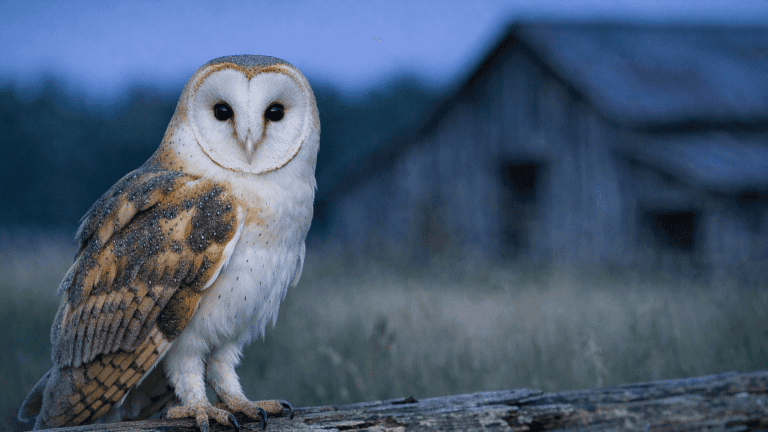
The Flammulated Owl (Psiloscops flammeolus) is a tiny, secretive forest owl of western North America. Barely larger than a sparrow but broad-winged and large-headed, it spends daylight hours hidden against bark and becomes active after dusk. Many observers detect it first by voice: a soft, low hoot that can sound surprisingly distant or belong to a much larger bird.
This owl is associated mainly with mature, open conifer and mixed-conifer forests. It nests in tree cavities and feeds primarily on insects, especially moths, beetles, crickets, and other nocturnal arthropods. Unlike most North American owls, many Flammulated Owls migrate, leaving northern breeding areas for wintering grounds in Mexico and Central America.
Quick Identification
- Overall shape: Very small, compact owl with a rounded head and short tail.
- Eyes: Dark brown, not yellow.
- Plumage: Intricately mottled gray, brown, buff, and rusty red.
- Face: Pale facial disks bordered by darker markings; the eyebrows may look whitish.
- Ear tufts: Short and often flattened, making the head appear rounded.
- Voice: A low, soft, single or double hoot repeated at intervals.
- Habitat: Open pine, fir, Douglas-fir, and mixed-conifer woodland with mature trees and nesting cavities.
The combination of minute size, dark eyes, barklike plumage, and a low hooting call is highly useful. Visual identification is often difficult because the owl usually remains high in shadowed foliage.
Appearance and Field Marks
Flammulated Owls are heavily patterned, with irregular streaks, spots, and bars that provide excellent camouflage against conifer bark. Gray birds may appear silvery brown, while rufous individuals show stronger rusty or cinnamon tones. Intermediate plumages also occur. The species name refers to flame-colored markings, but not every individual looks distinctly reddish.
The facial disks are pale gray or buff and edged with dark brown. A darker area around each eye emphasizes the pale brows and bill. The eyes are dark brown, an especially helpful distinction from the bright yellow eyes of Northern Saw-whet, Western Screech, and Northern Pygmy-Owls. Small ear tufts may be visible when the bird is alert, but they are frequently held flat.
The underparts are pale with dark shaft streaks, crossbars, and rusty accents. The back and folded wings have complex pale and dark markings rather than bold, orderly spotting. Males and females look alike in the field. Females average somewhat larger, but this is rarely useful unless a pair is observed together.

Size and Measurements
Adults are typically about 15–17 centimeters (6–7 inches) long, with a wingspan around 36–41 centimeters (14–16 inches). Weight generally ranges from 45–63 grams (1.6–2.2 ounces), although measurements vary by sex, season, and condition. Females tend to be heavier than males.
A Flammulated Owl is similar in length to a large sparrow and smaller than a Northern Saw-whet Owl. Its broad wings and loose-looking plumage can make it seem larger in flight. Exact size is difficult to judge at night, so observers should combine apparent size with eye color, call, habitat, and plumage.
Range and Distribution
The breeding range extends through the mountainous West, from southern British Columbia and parts of the northwestern United States, south through the Rocky Mountains, the Great Basin ranges, the Sierra Nevada, and other western highlands, into Mexico. Distribution is patchy because suitable open forest, cavities, and insect prey are not continuous.
Most northern breeders migrate south in autumn. Winter records are concentrated in Mexico and extend into parts of Central America, though the species is difficult to survey outside the breeding season. Migration routes and winter distribution remain less conspicuous than the breeding range because these owls are quiet and easily overlooked. The Cornell Lab of Ornithology’s Flammulated Owl account provides a useful range map and seasonal overview.

Habitat
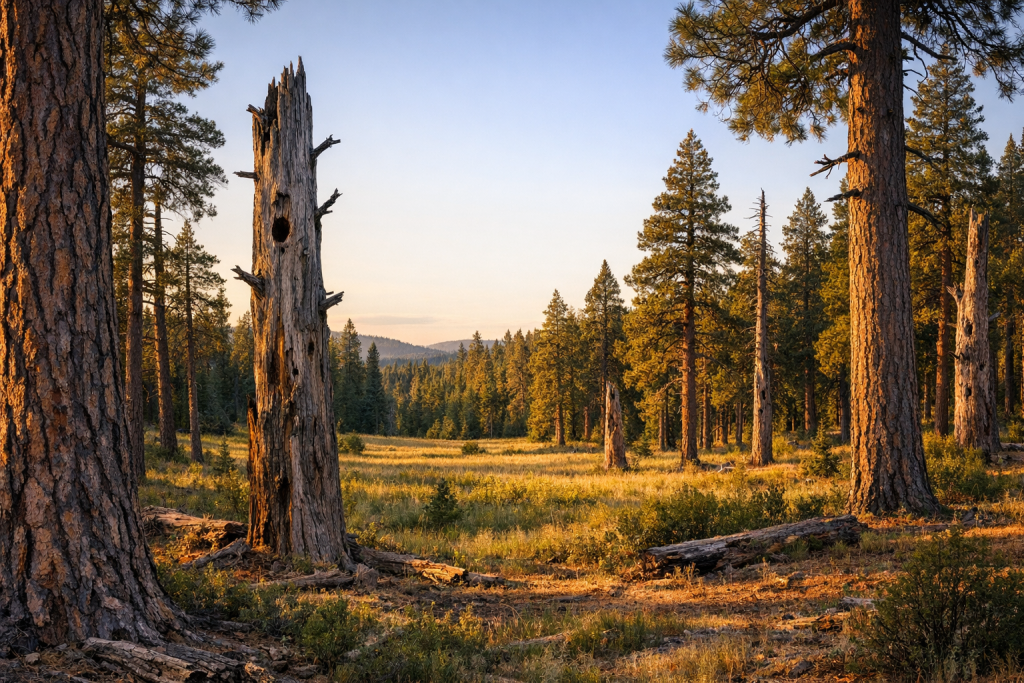
Flammulated Owls favor mature or old, relatively open coniferous forest, often where large trees are mixed with clear flight space and patches of understory. Common associations include ponderosa pine, Douglas-fir, Jeffrey pine, aspen-conifer woodland, and mixed stands of pine and fir. In parts of Mexico, they also use montane pine and pine-oak forest.
Good habitat usually combines large trees for cover, abundant nocturnal insects, and existing cavities for nesting. The owls do not excavate their own nest holes. Stands containing old woodpecker cavities, decayed limbs, snags, or suitable nest boxes may therefore be important. They may tolerate some forest openings, but extensive removal of mature cavity-bearing trees can reduce nesting opportunities.
Behavior
This species is almost entirely nocturnal. By day, an owl roosts close to a trunk or among dense branches, relying on stillness and cryptic plumage. If discovered, it may stretch upright and narrow its eyes to resemble a broken branch. At night it moves through the canopy and along forest openings with quick, maneuverable flight.
Breeding males call repeatedly to advertise territories and communicate with mates. Pairs are socially monogamous during a nesting season, although details of long-term pair bonds vary and are difficult to observe. The owl is generally inconspicuous away from nesting areas and may pass through migration sites without being detected.

Diet and Hunting
Flammulated Owls are unusually insectivorous for North American owls. Their prey includes moths, beetles, crickets, grasshoppers, katydids, spiders, and other arthropods. Small vertebrates may occasionally be taken, but they form a minor part of the diet in most studies.
The owl hunts from a perch, watching or listening before making a short flight to seize prey from foliage, branches, trunks, or the ground. It may also capture insects in the air. Large insects can be carried to a perch and broken into manageable pieces. Seasonal insect abundance helps explain the species’ migration and its arrival in northern forests during spring.
Vocalizations
The male’s typical territorial call is a low, muffled boop or hoot, sometimes followed by a weaker second note. Calls may be spaced several seconds apart and continue for long periods. Their low pitch is striking for such a small owl and can make the singer seem farther away or larger than it is.
Females and young give higher, thinner notes, including soft whistles and begging calls. Exact phrasing varies by context. Listen from a respectful distance and avoid prolonged playback, particularly near an active nest; repeated stimulation can interrupt normal territorial, feeding, or incubation behavior.
Breeding and Nesting
Breeding generally occurs from spring into summer, with timing influenced by latitude, elevation, and weather. Courtship involves calling and food delivery by the male. The pair selects a natural tree cavity or, more often, a hole previously excavated by a woodpecker. Nest boxes are used in some areas when their dimensions and placement are suitable.
The female commonly lays about two to four white eggs directly on cavity debris, without building a conventional stick nest. She performs most or all incubation while the male supplies food. Incubation lasts roughly three weeks, though published estimates vary. After hatching, the male continues bringing prey, and the female broods and feeds the small nestlings until they can regulate their temperature more effectively.

Young and Development
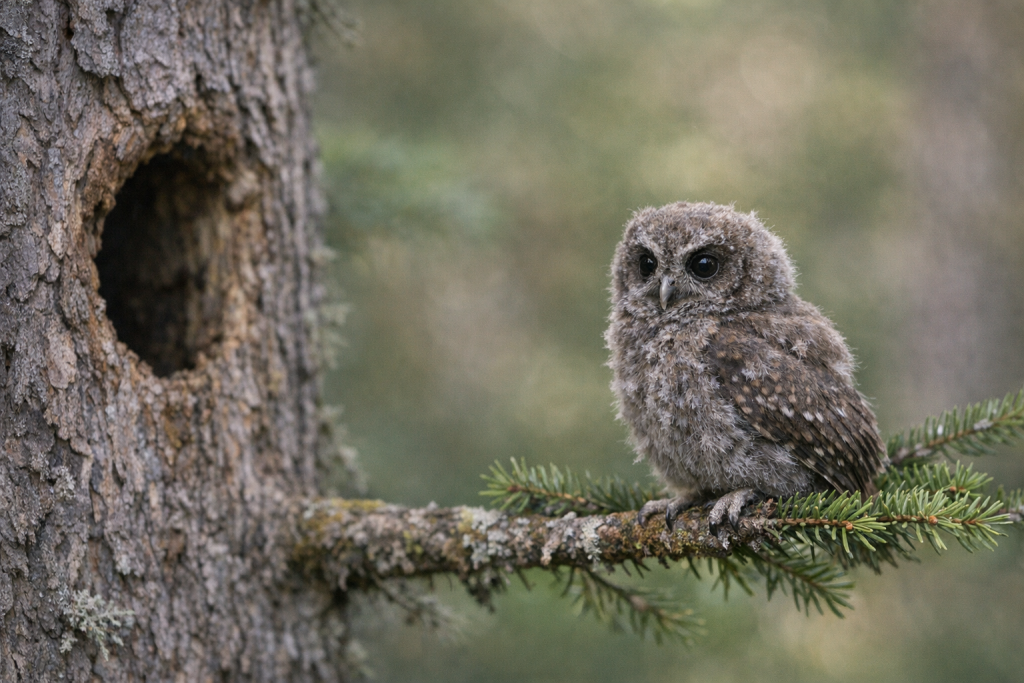
Newly hatched owlets are covered in pale down and depend completely on their parents. As they grow, gray-brown juvenile feathers replace the down, initially giving them a softer, less intricately patterned appearance than in adults. Dark eyes are evident early.
Young typically leave the cavity at around three to four weeks of age, before their flight skills are fully polished. They remain nearby, moving among branches and calling for food. Both parents may continue feeding fledglings for several weeks while the young improve their hunting and flight abilities. A grounded fledgling is not necessarily abandoned; unless it is injured or in immediate danger, observation from a distance is usually best.
Where to See
Search in western mountain forests containing mature ponderosa pine, Douglas-fir, aspen, or mixed conifers. Productive locations often have an open canopy, large trunks, old woodpecker holes, and nearby meadows or forest gaps. The species is easiest to detect from late spring through midsummer, when males call regularly.
Listen after full darkness on mild, relatively calm nights. Stop at safe, legal pullouts or walk established forest routes quietly. Because the call carries unevenly through trees, changing position slightly may help determine its direction. Finding the bird visually is much harder and should not involve trampling vegetation, approaching cavities, or shining a bright light for extended periods.
Similar Species
Western Screech-Owl: Larger and heavier, with prominent ear tufts, yellow eyes, and bold vertical streaking below. Its bouncing-ball or accelerating series of notes differs from the Flammulated Owl’s isolated low hoots.
Northern Saw-whet Owl: Slightly larger, with a round head, no visible ear tufts, yellow eyes, and a strongly streaked or spotted appearance. Its repeated, high piping whistle is faster and much less bass-like.
Northern Pygmy-Owl: Similar in compactness but active partly by day. It has yellow eyes, a longer-looking tail, a spotted crown, and dark false eye spots on the back of the head. Its call is a series of clear, evenly spaced toots.
Elf Owl: Smaller and mainly associated with the southwestern United States and Mexico. It has yellow eyes, a short tail, and no ear tufts. Its vocalizations include yapping or chuckling series rather than the characteristic low Flammulated Owl hoot.
Conservation
The Flammulated Owl is commonly classified as Least Concern globally, but local populations may be affected by habitat loss, removal of snags and cavity trees, severe wildfire, and changes in forest structure. Because it relies on cavities made by decay or woodpeckers, management that retains mature trees and standing deadwood can support nesting habitat.
Climate-driven changes in fire patterns, insect communities, and montane forest distribution may pose longer-term challenges, though effects will vary by region. Nighttime surveys are specialized, and apparent absence does not always mean a site is unused. Protecting connected forest across elevations may help accommodate both migration and shifting habitat conditions.
Field Identification Tips
- Begin with the voice. A slow, low, ventriloquial hoot in western conifer forest is the best initial clue.
- Confirm the eyes. Dark eyes strongly support Flammulated Owl when visible; most similar small western owls have yellow eyes.
- Check the scale. Expect a remarkably small owl with a short tail and broad wings.
- Look for subtle tufts. Ear tufts may appear briefly but can vanish when flattened.
- Note the pattern. Barklike gray and rusty mottling is more complex and less boldly arranged than on many small owls.
- Use habitat and season. Mature western conifer forest in late spring or summer is more suggestive than low desert or open grassland.
- Document carefully. Record several call sequences and note spacing, pitch, habitat, date, and whether more than one bird was present.
Interesting Facts
- It is among the smallest owls in North America, yet its low voice can suggest a much larger species.
- Its dark brown eyes are unusual among the small owls most commonly encountered in western North America.
- Gray and rufous plumage forms occur, with many birds showing intermediate coloration.
- It is one of North America’s more strongly migratory owls.
- Its genus, Psiloscops, contains only this species; older sources may place it in the genus Otus.
- Dependence on preexisting cavities links its breeding success to woodpeckers, decay processes, and the retention of old trees.
Frequently Asked Questions
Why is it called a Flammulated Owl?
“Flammulated” refers to the flame-like rusty markings visible in many individuals. The intensity varies, and some birds are predominantly gray.
Are Flammulated Owls rare?
They can be locally regular in suitable western forests, but their nocturnal habits, camouflage, quiet winter behavior, and patchy habitat make them seem rare. Population density differs greatly among regions.
Do Flammulated Owls migrate?
Many do. Birds breeding in Canada and much of the United States generally move south for winter, mainly toward Mexico and Central America. Some southern populations may make shorter movements.
What do they eat?
They eat mostly large insects and other arthropods, including moths, beetles, crickets, katydids, and spiders. Small vertebrate prey is reported but is not usually dominant.
Can they be attracted to nest boxes?
Yes, they sometimes use appropriately designed boxes in suitable forest habitat. Boxes should not replace retention of natural snags and cavity-bearing trees, and they require responsible placement, maintenance, and monitoring.
When is the best time to hear one?
Late spring and early summer are usually best in northern breeding areas. Listen after dark on calm nights, when territorial males are most likely to call.