

Fireweed Guide
- Scientific Name
- Chamaenerion angustifolium
- Family
- Onagraceae
- Order
- Myrtales
- Length
- Typically 0.5–2.5 m (1.5–8 ft) tall
- Conservation Status
- Globally secure and not commonly considered threatened; not evaluated by the IUCN Red List
- Habitat
- Sunny burned areas, clearings, meadows, forest edges, roadsides, gravel bars, stream margins, and other disturbed or naturally open ground
- Range Summary
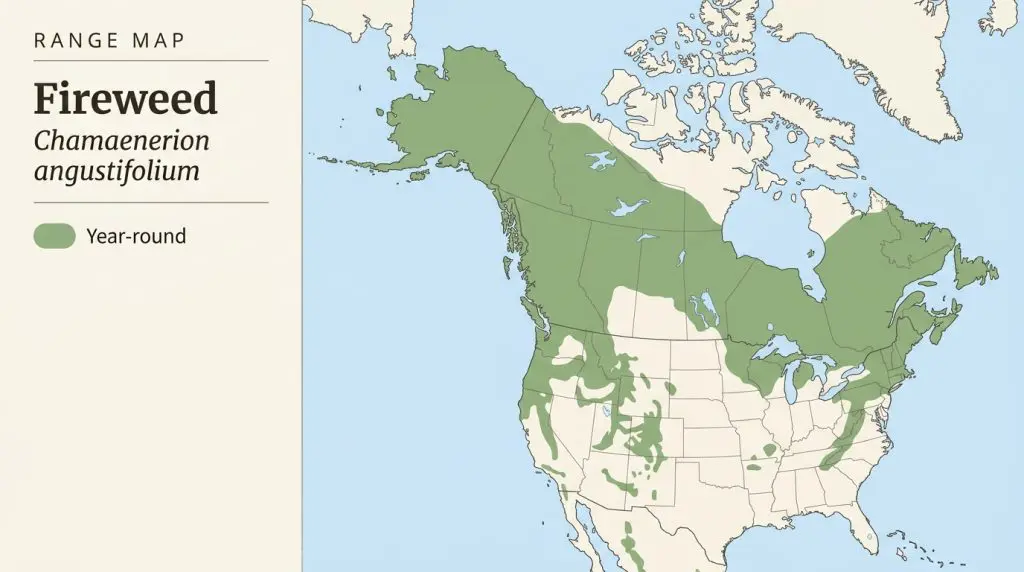
- Widespread across Alaska and Canada, extending through the western and northern United States and locally into the Great Lakes, Northeast, and Appalachian highlands
Keep Track of What You See
Create a free Wild Things Guide membership to record this Fireweed in My Sightings and build your personal wildlife list.
Join to Add This SightingIntroduction
Fireweed is a tall, conspicuous wildflower known for its bright pink-purple flower spikes and its ability to form extensive colonies after fire, logging, or other disturbance. Its accepted scientific name is Chamaenerion angustifolium, although many field guides and botanical sources use the synonyms Chamerion angustifolium or Epilobium angustifolium.
Despite its common name, fireweed is not restricted to burned ground. It also grows in meadows, forest openings, roadsides, avalanche paths, stream margins, and other sunny places. A combination of four-petaled flowers, alternate narrow leaves, bottom-to-top blooming, and long capsules makes a mature plant relatively easy to recognize.
Quick Identification Summary
- Flowers: Pink to magenta, occasionally pale pink or white, with four broad petals and four narrow sepals.
- Flower arrangement: Numerous flowers held in an elongated terminal raceme; lower flowers usually open first.
- Leaves: Alternate, narrow and lance-shaped, with short stalks and finely toothed or nearly smooth margins.
- Stems: Upright, usually unbranched below the flower cluster, often reddish.
- Height: Commonly 0.5–2.5 m (1.5–8 ft), depending on moisture and growing conditions.
- Fruit: Long, slender capsules that split open to release many silky-haired seeds.
- Growth pattern: A rhizomatous perennial that often forms dense colonies.
How to Identify the Plant
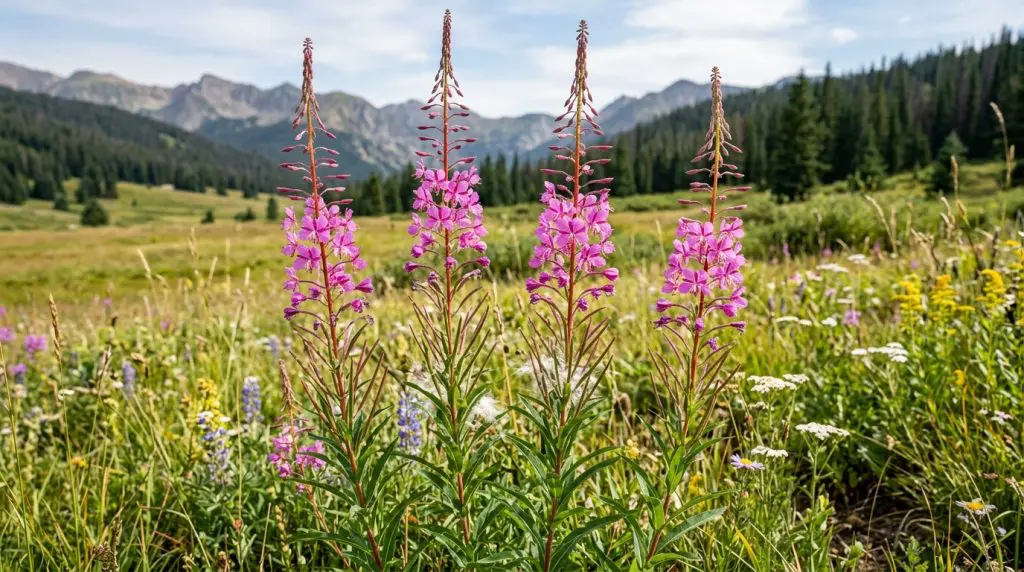
Begin with the flower. Each bloom is usually 2–4 cm (0.8–1.6 in) across and has four rounded to slightly notched petals surrounding eight stamens. Four narrow, darker sepals extend behind the petals. The style projects from the flower, and the mature stigma divides into four spreading lobes. Flowers are bilaterally symmetrical rather than perfectly radial because the lower petals and reproductive structures are arranged somewhat differently from the upper ones.
The flowers grow on short stalks in a loose terminal raceme. Buds occur near the top, open flowers occupy the middle, and developing capsules appear below. This progression is especially useful when examining a plant in midsummer.
Leaves are alternate and generally 5–20 cm (2–8 in) long. They are lance-shaped, pointed at the tip, and often paler underneath. A particularly helpful feature is the leaf venation: lateral veins curve near the margin and connect in a series of loops rather than ending directly at each tooth. This characteristic may require close inspection but helps separate fireweed from some superficially similar plants.

Size and Growth Habit
Fireweed usually grows 0.5–2.5 m tall, though exposed or nutrient-poor sites may support much shorter plants. Fertile, moist ground can produce robust stems approaching the upper end of that range. Individual stems rise from an extensive system of creeping rhizomes, allowing the plant to create broad, nearly continuous stands.
Stems are round, smooth or nearly so, and green to reddish. Most remain unbranched until the flowering portion. The upright stems and narrow leaves give a colony a vertical, evenly textured appearance. Aboveground growth dies back after frost, while the perennial underground system survives.
Blooming Season
Across much of North America, fireweed blooms from June through September. Timing varies with latitude, elevation, snowmelt, and local weather. Plants may begin flowering in early summer at lower elevations, while alpine or far-northern populations can flower considerably later.
Flowers normally open from the base of the raceme upward. A single stem may therefore bear ripe capsules, open flowers, and unopened buds at the same time. Individual flowers are short-lived, but the gradual progression extends the display of a colony.
Habitat
Fireweed favors open sites with abundant light and moist to moderately dry, well-drained soil. Typical habitats include burned forest, logged land, woodland edges, roadsides, rail corridors, gravel bars, clearings, subalpine meadows, avalanche tracks, lake shores, and stream banks. It is especially characteristic of cool temperate, boreal, and montane environments.
The plant often becomes abundant where disturbance has reduced overhead shade and exposed mineral soil. It can also persist in stable natural meadows and open riparian areas. Although frequently associated with fire, its presence alone does not prove that a site burned recently.
Geographic Range
Fireweed has a broad circumboreal distribution across the Northern Hemisphere. In North America, it is widespread in Alaska and Canada, including parts of the Arctic, and extends south through much of the western United States. It also occurs in northern states, around the Great Lakes, in New England, and locally along higher portions of the Appalachian Mountains.
Distribution becomes scattered in the warmer, drier parts of the continent. Elevation can compensate for latitude in the West so that fireweed may occur in mountain meadows well south of its principal northern range. Taxonomic names and recorded distribution can be reviewed through the USDA PLANTS fireweed profile.
Similar Species and Look-Alikes
Purple loosestrife (Lythrum salicaria) also produces tall magenta flower spikes in moist habitats. Its flowers usually have five to seven petals, and its leaves are opposite or whorled rather than alternate. Purple loosestrife is an invasive wetland plant in many regions of North America.
Great willowherb (Epilobium hirsutum) has four pink petals and elongated capsules, but it is generally conspicuously hairy. Its lower leaves are opposite, and its petals are deeply notched. It is introduced in North America and is often associated with wet ground.
Blazing stars (Liatris species) can produce similarly colored vertical displays. Their flowers are small composite heads without four distinct broad petals, and their leaves are usually much narrower.
Several smaller relatives, sometimes called dwarf fireweeds or willowherbs, share four-petaled flowers and slender capsules. They tend to be shorter, have different leaf arrangements or shapes, and lack the commanding terminal raceme typical of mature fireweed.
Wildlife Connections
Fireweed supplies nectar and pollen to bumble bees, solitary bees, syrphid flies, butterflies, and other insects. Bumble bees are particularly effective visitors because they contact the projecting anthers and stigma while seeking nectar. The flowers pass through male and female phases, a pattern that reduces but does not eliminate self-pollination.
Deer, elk, moose, and smaller herbivores may browse young leaves and shoots. Use varies by location and by the availability of other forage. The plant’s seeds are small and wind-dispersed, so they are not a major food source for most birds, although dense stands provide cover and insect-rich foraging habitat.
Ecological Importance
Fireweed is an important early-colonizing plant on disturbed ground. Its lightweight seeds can travel on air currents and reach exposed soil rapidly. Established rhizomes may also send up new shoots after the aboveground vegetation has been damaged.
Colonies protect exposed soil, contribute organic matter, and support pollinators while shrubs and trees reestablish. Fireweed does not single-handedly restore a forest, but it is one component of ecological succession. As woody vegetation grows and shade increases, flowering generally declines, although plants may persist along edges and openings.
Native, Introduced, or Invasive?
Fireweed is native across its North American range. Its aggressive-looking colonies are a natural consequence of rhizomatous growth and plentiful windborne seed. It is not generally classified as an invasive nonnative species in North America.
In a small garden, however, “native” does not mean restrained. Rhizomes can spread beyond the intended planting area, particularly in moist, fertile soil. Gardeners should choose the site carefully and manage unwanted shoots before a colony becomes difficult to contain.
Traditional and Historical Uses
Many Indigenous peoples across northern and western North America have used fireweed for food, tea, topical preparations, fiber, and other purposes. Practices differ among communities and should not be treated as a single universal tradition. Communities used young shoots and leaves seasonally, while the soft seed floss sometimes served as padding or was combined with other fibers.
Fireweed has also become a cultural symbol of renewal in northern regions because of its vivid appearance after wildfire and wartime disturbance. Historical use does not establish that every preparation is safe or appropriate, particularly when medicinal claims have not been evaluated clinically.

Is It Edible or Toxic?
Fireweed is generally regarded as edible when correctly identified. Tender spring shoots and young leaves may be cooked, and flowers have been used as garnishes or in jellies and syrups. Older leaves become fibrous and bitter. Leaves are also dried for herbal beverages, including fermented preparations sometimes known as fireweed tea.
Anyone considering wild food should confirm the identification from several features, avoid contaminated roadsides or treated land, and try only a small quantity at first. Individual reactions are possible, and concentrated extracts or medicinal use deserve additional caution. Foraging should also comply with local regulations and avoid removing plants from protected areas.
Growing It in a Native Garden
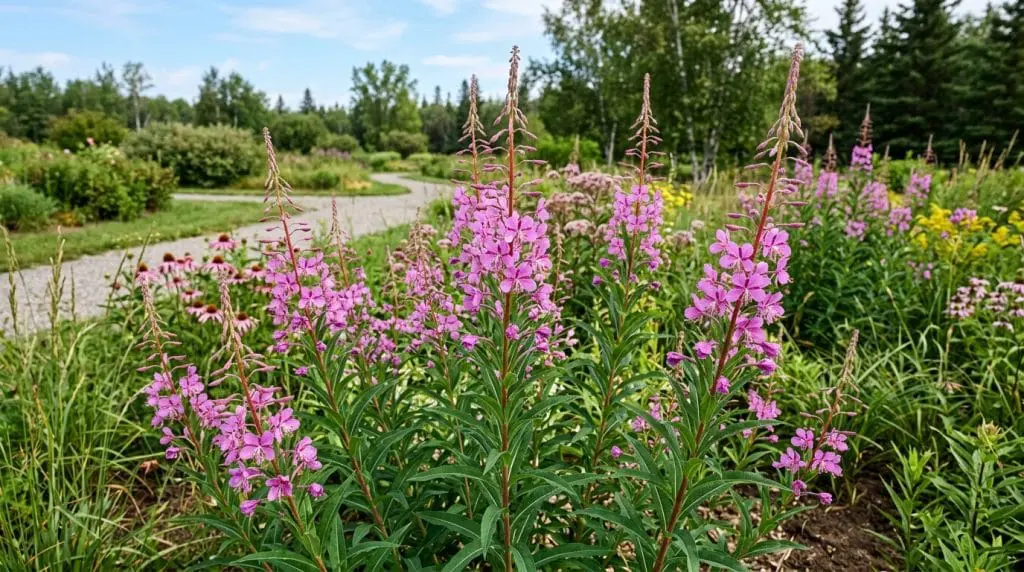
Fireweed performs best in full sun, although it tolerates light shade. It prefers moderately moist, well-drained soil and suits naturalistic plantings, rain-garden margins, meadow restorations, and large northern gardens. It may struggle in persistently hot, humid climates outside its natural range.
Seed requires light to germinate and should be surface-sown rather than deeply buried. Cold, moist stratification may improve results, though requirements vary by seed source. Rhizome divisions establish more quickly but should be taken only from cultivated plants or where collection is lawful.
Allow enough room for expansion. Removing capsules before they split reduces seed dispersal, while edging or root barriers can slow rhizomes. Pair fireweed with vigorous regional natives suited to the same conditions rather than with delicate, slow-growing species.
Conservation
Fireweed is widespread and generally secure at the species level. It is not commonly considered globally threatened, although local populations can be affected by development, herbicide use, altered hydrology, intensive roadside management, or loss of open habitat.
Because the species often responds positively to disturbance, conservation concerns are usually tied to particular habitats or regional populations rather than global scarcity. Seed and plants used in restoration should ideally come from appropriate regional sources to preserve local adaptation and avoid moving poorly matched material.
Interesting Fact
Each mature capsule splits lengthwise into four sections, releasing numerous tiny seeds attached to silky hairs. A slight breeze can carry them away in a drifting cloud. Northern folklore sometimes links the last flowers at the top of a spike with the approach of frost, but this is best treated as a seasonal observation rather than a dependable weather forecast.
Frequently Asked Questions
Why is it called fireweed?
Fireweed frequently becomes abundant after wildfire because its seeds colonize exposed soil and surviving rhizomes can produce new shoots. The name describes this association, not a requirement for fire.
Is fireweed the same as rosebay willowherb?
Yes. Rosebay willowherb is a widely used British common name for the same species. Scientific-name treatments vary so that it may appear as Chamaenerion angustifolium, Chamerion angustifolium, or Epilobium angustifolium.
Does fireweed spread aggressively?
It can. Established plants spread through rhizomes, and mature capsules release many windborne seeds. Its vigor is useful in restoration but may require management in small gardens.
How can I distinguish fireweed from purple loosestrife?
Count the petals and inspect the leaves. Fireweed has four petals and alternate leaves; purple loosestrife usually has five to seven petals and opposite or whorled leaves.
Will fireweed grow in shade?
It tolerates some light shade, but strong flowering usually requires substantial sunlight. Colonies commonly decline as a forest canopy closes above them.
Is fireweed an annual?
No. It is a perennial with an overwintering rhizome system. Its aboveground stems die back each year, and new shoots emerge during the following growing season.


