Elf Owl Guide
- Scientific Name
- Micrathene whitneyi
- Family
- Strigidae
- Order
- Strigiformes
- Length
- 12.5–14.5 cm (4.9–5.7 in)
- Wingspan
- Approximately 27 cm (10.5 in)
- Weight
- 35–55 g (1.2–1.9 oz)
- Conservation Status
- Least Concern (IUCN)
- Habitat
- Deserts, thorn scrub, dry woodland, riparian washes, and wooded canyons with suitable nest cavities.
Keep Track of What You See
Create a free Wild Things Guide membership to record this Elf Owl in My Sightings and build your personal wildlife list.
Join to Add This SightingIntroduction
The Elf Owl (Micrathene whitneyi) is a tiny, nocturnal owl of the southwestern United States and Mexico. Barely larger than a sparrow, it occupies deserts, dry woodlands, thorn scrub, and wooded canyons where old woodpecker holes and other cavities provide nesting sites. Its small size, rounded head, yellow eyes, and rapid, high-pitched calls distinguish it from the larger screech-owls that share parts of its range.
Elf Owls can be difficult to see because they become active around dusk and often remain within dense vegetation. For most observers, the first clue is a series of quick yelps, whistles, or chuckling notes coming from a saguaro grove, desert wash, or oak-lined canyon.
Quick Identification
- Tiny owl with a compact body and short tail.
- Rounded head without prominent ear tufts.
- Yellow eyes and a relatively plain, weakly defined facial disk.
- Gray-brown upperparts with pale spotting; whitish underparts with brown streaking.
- Fast, direct flight that can appear batlike in poor light.
- High-pitched yapping, whistled, or chuckling calls, often delivered after sunset.
- Frequently associated with cavity-rich desert vegetation, especially saguaros and mature trees along washes.
Appearance and Field Marks
The Elf Owl has a rounded head, no obvious ear tufts, and a subdued grayish-brown plumage pattern. Its upperparts are mottled with pale buff and whitish marks that provide camouflage against bark. The underparts are pale with irregular brown or gray-brown streaking. Pale eyebrows and markings around the eyes can suggest a faint facial pattern, but the facial disk is much less bold than that of many larger owls.
The eyes are yellow, an important distinction from the dark-eyed Flammulated Owl. The bill is small, and the feet are proportionately modest for an owl because much of the diet consists of insects and other invertebrates. Folded wings extend well down the short body, contributing to a compact silhouette.
Males and females look alike in the field. Females average somewhat larger, but the difference is rarely useful unless a pair is observed together at close range. Plumage varies with lighting: a bird illuminated by warm evening light may appear brown, while one seen in cool shade may look grayer.

Size and Measurements
Adults are typically about 12.5–14.5 cm (4.9–5.7 in) long and weigh roughly 35–55 g (1.2–1.9 oz). Wingspan is approximately 27 cm (10.5 in). Females tend to be heavier than males, although the ranges overlap.
Size is one of the strongest identification clues. An Elf Owl may appear close to sparrow-sized when perched and is substantially smaller than a Western Screech-Owl. Because distance and darkness can distort apparent size, observers should combine this impression with eye color, head shape, habitat, and voice.
Range and Distribution
In the United States, the Elf Owl breeds mainly in southern Arizona, southwestern New Mexico, western Texas, and limited parts of southeastern California and nearby desert regions. Its distribution is broader in Mexico, including portions of Baja California and extensive areas of the mainland.
Many birds breeding in the northern part of the range migrate south for winter, when they are largely absent from the United States. Some Mexican populations are resident or make shorter seasonal movements. Distribution is patchy because the species depends on suitable habitat combined with an adequate supply of nest cavities. The Cornell Lab of Ornithology’s Elf Owl account provides additional identification and range information.

Habitat
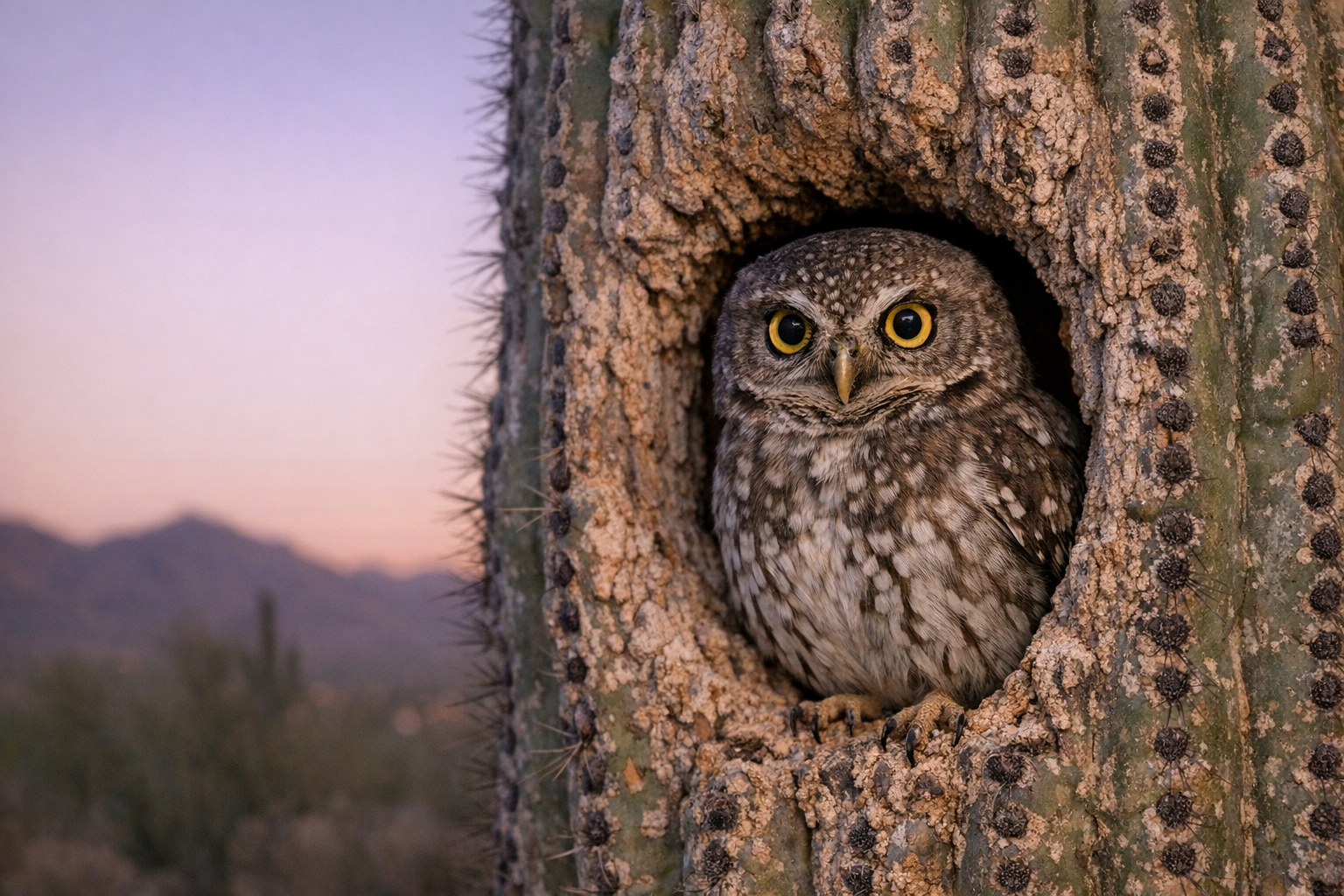
Elf Owls inhabit Sonoran and Chihuahuan desert landscapes, thorn forest, dry tropical woodland, foothill scrub, and wooded canyons. In low deserts, they are strongly associated with mature saguaros, where abandoned woodpecker cavities offer protected nesting chambers. They also use holes in sycamores, cottonwoods, mesquites, oaks, agaves, utility poles, and other suitable structures.
Desert washes can be especially productive because taller vegetation supports insects and provides nesting and roosting sites. At higher elevations, Elf Owls may occupy oak or mixed woodland. Habitat quality depends less on a single plant species than on the combination of cavities, protective cover, and abundant nocturnal prey.

Behavior
Elf Owls are primarily nocturnal, becoming active near dusk and continuing through the night. During the day, they usually roost in cavities or dense foliage, making them easy to overlook. At a cavity entrance, a disturbed bird may peer out briefly before withdrawing.
Despite their size, Elf Owls can be assertive around nest sites. Pairs may call back and forth, and neighboring birds sometimes join vocal exchanges. When threatened, an individual may freeze against bark, retreat into a cavity, or fly into cover. Flight is quick and maneuverable, with bursts of flapping and short glides.

Diet and Hunting
Large insects form much of the diet, including moths, beetles, crickets, grasshoppers, katydids, and cicadas. Elf Owls also take spiders, centipedes, scorpions, and other arthropods. Small lizards or rodents may occasionally be captured, but vertebrates generally make up a limited portion of the diet.
Hunting commonly begins from a perch. The owl watches or listens for prey, then makes a short flight to seize it from foliage, bark, or the ground. It may also catch insects in the air. Captured scorpions may have the stinger removed before they are eaten or delivered to young. Prey activity varies with temperature and rainfall, so feeding locations can shift through the season.
Vocalizations
The typical call is a rapid series of high, sharp notes that may be described as yaps, whistles, or puppy-like barks. A sequence can accelerate or change into a chuckling rhythm. Males often call repeatedly during courtship and territory establishment, particularly in spring and early summer.
Females and young give softer calls around the nest. Because several desert birds, insects, and frogs can create confusing nighttime sounds, listeners should note the call’s direction, repeated pattern, and movement. Hearing a bird from more than one position is often more reliable than trying to identify a single distant phrase.
Breeding and Nesting
Breeding begins in spring after migratory birds return to the northern range. Elf Owls do not excavate their own nest holes. They depend mainly on natural cavities or holes previously made by woodpeckers, including Gila Woodpeckers and Ladder-backed Woodpeckers. The chamber may be in a living saguaro, a dead snag, a large limb, or a wooden structure.
The female generally lays two to four white eggs, although clutch size can vary. Little or no nest material is added. The female performs most of the incubation, while the male brings food, and incubation lasts roughly three weeks. After hatching, the male initially supplies much of the prey while the female broods and feeds the nestlings. Adults may become more conspicuous as feeding trips increase.

Young and Development
Newly hatched Elf Owls are helpless and covered with sparse pale down. Their eyes open as they develop, and juvenile feathers gradually replace the natal down. Both parents contribute food as the young grow. Nestlings typically remain in the cavity for about four weeks, though timing varies with conditions and individual development.
Recently fledged birds can make short flights but remain dependent on their parents. They often perch near cover and use begging calls to maintain contact after dark. Juveniles resemble adults but may look softer, less crisply patterned, and somewhat fluffy. Family groups may remain together for a period before dispersal or migration.

Where to See
In the United States, southeastern Arizona is one of the most accessible regions for finding Elf Owls. Productive settings include saguaro desert, riparian washes, oak canyons, and foothill woodland. Southern New Mexico and western Texas also support local breeding populations, while occurrence in California is more limited.
Plan visits during the spring or early summer breeding season, when calling is most frequent. Arrive before sunset, learn the common calls in advance, and listen from established roads or trails. Scan cavity entrances only from a respectful distance. Avoid shining powerful lights into an occupied nest, playing recordings repeatedly, or blocking an adult’s approach to its young.
Similar Species
Western Screech-Owl: Much larger and heavier, with prominent ear tufts when raised, a stronger facial pattern, and a heavier-headed shape. Its bouncing-ball or accelerating trill differs from the higher, yapping phrases of an Elf Owl.
Flammulated Owl: Small but generally larger than an Elf Owl. It has dark eyes, often shows small ear tufts, and favors mountain conifers or mixed forests rather than the low desert. Its low hoots can seem surprisingly deep for its size.
Northern Pygmy-Owl: Larger, longer-tailed, and more likely to be active by day. It has yellow eyes but usually shows a more distinctly spotted head, streaked underparts, and dark false eye spots on the back of the head.
Burrowing Owl: Long-legged, ground-dwelling, and much larger. It frequents open country and often stands upright near a burrow, a posture unlike that of the compact, cavity-roosting Elf Owl.
Conservation
The Elf Owl is commonly assessed as Least Concern globally, reflecting its broad distribution and overall population size. That classification does not mean every regional population is secure. Loss of mature desert vegetation, removal of dead trees, degradation of riparian corridors, and scarcity of nest cavities can reduce local breeding opportunities.
Protecting saguaros, mature native trees, snags, and naturally wooded washes benefits Elf Owls and many other cavity users. Thoughtful placement of nest boxes may help in some managed settings, but retaining natural habitat remains more valuable. Climate-driven changes in drought, heat, wildfire, and insect abundance could also affect habitat suitability, although the results are likely to vary across the range.
Field Identification Tips
- Start with location and season. In the United States, a tiny owl heard in southwestern desert habitat during spring or summer is more plausible than one reported there in midwinter.
- Listen before searching. Calls often reveal the bird’s presence well before it can be seen.
- Confirm the eyes. Yellow eyes support Elf Owl over the dark-eyed Flammulated Owl.
- Check the head. Look for a rounded crown without obvious ear tufts and only a weak facial disk.
- Judge size carefully. Compare the owl with a cavity opening, branch, or nearby songbird rather than relying on an unsupported impression.
- Use habitat as supporting evidence. Saguaro groves, desert washes, and dry oak canyons are typical, but habitat alone is not diagnostic.
- Protect nesting birds. Observe briefly and withdraw if an owl stops approaching its cavity or gives repeated alarm calls.
Interesting Facts
- The Elf Owl is among the smallest and lightest owls in the world.
- Its genus, Micrathene, contains only this living species.
- A hard, scar-like lining forms inside a saguaro around an excavated cavity, helping isolate the chamber from living cactus tissue.
- Its relatively weak feet are well suited to an insect-heavy diet rather than the larger vertebrate prey taken by many owls.
- Northern populations undertake a seasonal migration, unusual behavior among the owl species familiar to many North American observers.
Frequently Asked Questions
How small is an Elf Owl?
An adult is about 12.5–14.5 cm long and commonly weighs 35–55 g. It is roughly sparrow-sized and noticeably smaller than a Western Screech-Owl.
Do Elf Owls live only in cacti?
No. Saguaros provide important nest cavities in the Sonoran Desert, but Elf Owls also use trees, snags, poles, and other cavity-bearing structures in dry woodland, scrub, and wooded canyons.
Are Elf Owls active during the day?
They are mainly nocturnal. A bird may appear at a cavity entrance before sunset or move if disturbed during daylight, but regular feeding and calling generally begin around dusk.
Do Elf Owls eat scorpions?
Yes. Scorpions are among the arthropods they capture, along with insects, spiders, and centipedes. An owl may remove or disable a scorpion’s stinger before feeding.
Do Elf Owls migrate?
Many individuals that breed in the United States and northern Mexico move south for the winter. Some populations farther south are resident or make less extensive seasonal movements.
Can Elf Owls be attracted to a nest box?
They may use a properly designed box in suitable habitat, particularly where natural cavities are limited. Placement, entrance dimensions, heat exposure, predator protection, and safe monitoring all matter; preserving natural cavity trees and cacti should remain the priority.