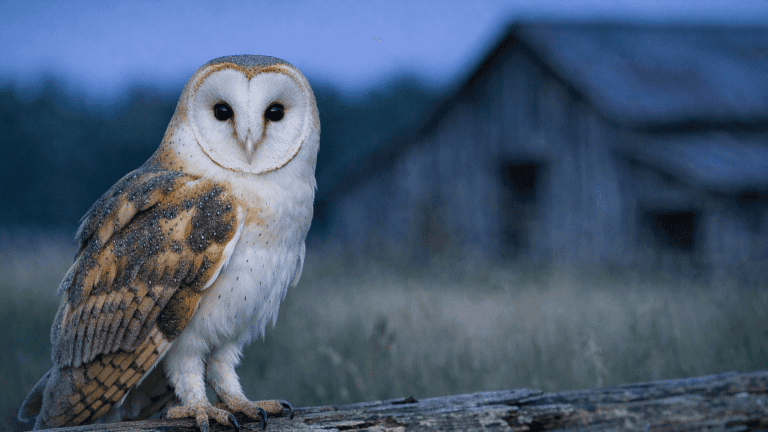
Eastern Screech-Owl Guide
- Scientific Name
- Megascops asio
- Family
- Strigidae
- Order
- Strigiformes
- Length
- 6.3–9.8 in (16–25 cm)
- Wingspan
- 18.9–24 in (48–61 cm)
- Weight
- 4.3–8.6 oz (121–244 g)
- Conservation Status
- Least Concern
- Habitat
- Deciduous and mixed woodland, wooded edges, riparian corridors, orchards, parks, and mature residential areas with cavities and nearby hunting openings.
Keep Track of What You See
Create a free Wild Things Guide membership to record this Eastern Screech-Owl in My Sightings and build your personal wildlife list.
Join to Add This SightingIntroduction
The Eastern Screech-Owl (Megascops asio) is a small, well-camouflaged owl of woodlands, suburbs, parks, and farm country across much of eastern North America. Although widespread, it is more often heard than seen. By day, it typically rests inside a tree cavity or sits motionless against the bark; after dark, it hunts from low perches.
Despite its name, this owl’s most familiar calls are not piercing screeches. Its signature sounds are a descending, horse-like whinny and a soft, trembling trill. Learning those calls—and checking cavities and bark-colored shapes at dusk—is usually the best way to find the species.
Quick Identification
- Small, compact owl: roughly robin-sized, though much broader-bodied.
- Prominent ear tufts: often raised, but sometimes flattened and nearly invisible.
- Yellow eyes: set within a rounded facial disk edged in dark feathers.
- Two main color forms: gray and reddish brown, with intermediate brown birds also occurring.
- Complex patterning: dark streaks, fine bars, and mottling create bark-like camouflage.
- Typical voice: a descending whinny or an even, quavering trill.
Appearance and Field Marks
Eastern Screech-Owls have large heads, short tails, rounded wings, and feathered legs. Their ear tufts can produce a sharply horned outline, especially when the bird is alert. These tufts are display feathers rather than external ears.
Gray-form adults are patterned in gray, blackish brown, buff, and white. Red-form birds replace much of the gray with rich rufous or chestnut tones. Both forms have pale underparts marked with dark vertical streaks and finer crossbars. This combination often creates a branching pattern resembling cracks and lichens on tree bark.
The eyes are bright yellow, the facial disk is pale to grayish with a dark border, and the relatively small bill is usually pale gray-green. The toes are feathered near their bases and end in strong, curved talons. Males and females have essentially the same plumage, although females average larger.

Size and Measurements
Adults are typically 6.3–9.8 inches (16–25 centimeters) long, with a wingspan of about 18.9–24 inches (48–61 centimeters). Weight commonly falls between 4.3 and 8.6 ounces (121–244 grams). Females tend to be heavier and larger than males, but size overlap makes sex difficult to determine in the field.
An Eastern Screech-Owl is shorter than an American Robin but considerably stockier. It is much smaller than a Barred Owl or Great Horned Owl and generally larger and broader-headed than a Northern Saw-whet Owl.
Range and Distribution
This species occupies much of eastern North America, from parts of southern Canada through the eastern and central United States and into northeastern Mexico. Its western boundary meets or approaches the range of the Western Screech-Owl in portions of the Great Plains and Texas.
Eastern Screech-Owls are generally nonmigratory. Adults may remain within the same local area throughout the year when suitable cavities, cover, and prey are available. Young birds disperse after becoming independent, and severe weather or food shortages may produce shorter local movements.

Regional occurrence details, recordings, and identification photographs are available through the Cornell Lab of Ornithology’s Eastern Screech-Owl species account.
Habitat
Eastern Screech-Owls use deciduous and mixed woodland, wooded stream corridors, orchards, farm groves, swamps, parks, cemeteries, and mature residential neighborhoods. They often favor edges and broken woodland rather than extensive, unbroken forest.
Suitable habitat usually combines mature trees containing cavities with nearby openings for hunting. Natural holes made by decay, storm damage, or woodpeckers provide roost and nest sites. The owls also use properly designed nest boxes. Suburban areas can support them when old trees, dense cover, and prey remain available.

Behavior
Mostly nocturnal, Eastern Screech-Owls become active around dusk and may continue hunting until dawn. During daylight, they conceal themselves in cavities, dense foliage, vine tangles, or against a tree trunk. A bird disturbed at its roost may stretch its body, compress its feathers, narrow its eyes, and imitate a broken branch.
At night, an owl commonly watches from a low or middle-level perch before dropping onto prey. Flight is direct and quiet, with several quick wingbeats interrupted by short glides. Pairs defend territories with calls and may remain associated outside the nesting season.
Agitated songbirds can reveal a hidden roost. Chickadees, titmice, jays, and other birds may gather and scold an owl, but observers should avoid approaching closely or prolonging the disturbance.

Diet and Hunting
The Eastern Screech-Owl is an adaptable predator with a varied diet. It takes mice, voles, shrews, small rats, bats, small birds, large insects, spiders, crayfish, frogs, lizards, snakes, and occasionally fish. The balance of prey changes with habitat, season, and local availability.
Most prey is detected from a perch through acute hearing and low-light vision. The owl then makes a short, silent flight to the ground, vegetation, or shallow water. Insects may also be caught in flight. Small prey is swallowed whole, while larger items are torn apart. Indigestible fur, feathers, teeth, and bones are later compressed into pellets and regurgitated.
Vocalizations
The best-known call is a mellow whinny that drops in pitch toward the end. Another common vocalization is a steady tremolo: a soft, bouncing trill that may continue for several seconds. These sounds can carry through woodland yet are quieter and less harsh than the name “screech-owl” suggests.
Pairs may answer each other, sometimes producing trills at slightly different pitches. Barking notes, chuckles, bill snaps, and harsher alarm calls can also be heard. Calling is often conspicuous during late winter and spring, although these resident owls may vocalize at any season.
Breeding and Nesting
Courtship generally intensifies in late winter. A male advertises with calls and may offer food to a prospective mate. Eastern Screech-Owls do not construct a conventional stick nest. Instead, they use a natural tree hollow, an enlarged woodpecker hole, or a nest box, often with little more than existing wood debris beneath the eggs.
A typical clutch contains about two to six rounded white eggs, though clutch size varies. The female performs most or all incubation, which lasts roughly 26 days, while the male supplies food. After hatching, the female broods the small young and distributes prey delivered by the male. Both adults may become defensive near an occupied cavity, so nests should be viewed only from a respectful distance.

Young and Development
Newly hatched owlets are covered in white down and depend completely on their parents for warmth and food. As they grow, they develop a fluffy gray-brown juvenile plumage with fine barring. Their ear tufts are initially short, and their rounded, wide-eyed appearance differs from the more crisply patterned adults.
Young usually leave the cavity at around four weeks of age, sometimes before they can fly strongly. They may climb on nearby trunks and branches using their feet, bill, and wings. The adults continue to feed them for several weeks as their flight and hunting skills improve. A grounded owlet is not necessarily abandoned; unless it is injured or in immediate danger, its parents are often nearby.

Where to See
Search mature neighborhoods, wooded parks, orchards, forest edges, and streamside woods with old cavity-bearing trees. At dusk, listen from a quiet trail or roadside for whinnies and tremolos. A softly calling bird may be closer than it sounds, so remain still and scan exposed branches rather than walking directly toward it.
By day, look for a small owl face at a cavity entrance, especially on sunny winter mornings. Whitewash, pellets, or small feathers below a tree may indicate a regular roost, but these signs are not unique to screech-owls. Avoid tapping trunks, playing recordings repeatedly, or shining bright lights at a bird.
Similar Species
Western Screech-Owl: Extremely similar in size and pattern, but usually separated geographically. Western Screech-Owls generally have darker bills and give a series of accelerating or bouncing notes rather than the Eastern species’ classic descending whinny. Voice is often the most useful distinction.
Whiskered Screech-Owl: A range-restricted species of mountain woodland in southeastern Arizona and southwestern New Mexico. It tends to be smaller and shows heavier feathering around the bill, but location and voice are more dependable than a brief visual impression.
Northern Saw-whet Owl: Similar in overall size but lacks ear tufts. Adults have a strongly marked pale facial pattern, brown upperparts spotted with white, and reddish streaks below rather than intricate bark-like crossbars.
Great Horned Owl: Also has ear tufts and yellow eyes but is several times heavier, with a massive body, widely spaced tufts, and a bold white throat patch. Its deep hoots are unmistakably lower.
Conservation
The Eastern Screech-Owl is commonly classified as Least Concern because it remains widespread and occupies many human-modified landscapes. Nevertheless, local numbers can be affected by removal of mature cavity trees, vehicle collisions, poorly placed netting, and exposure to pesticides or rodenticides through contaminated prey.
Landowners can help by retaining safe dead trees and large limbs where practical, preserving native understory, reducing pesticide use, and keeping cats indoors. Nest boxes may provide additional cavities, but they should be correctly sized, securely mounted, protected from predators, and cleaned only when unoccupied.
Field Identification Tips
- Start with shape: Look for a compact owl with a large head, short tail, and optional ear-tufted silhouette.
- Confirm the eyes: Eastern Screech-Owls have yellow eyes; the much larger Barred Owl has dark eyes.
- Study the pattern: Both gray and red forms show intricate streaking and fine crossbars rather than plain plumage.
- Listen carefully: A descending whinny or smooth tremolo is often more diagnostic than color.
- Use range cautiously: Geography helps separate Eastern and Western Screech-Owls, but check local records near areas of possible overlap.
- Judge size against objects: Without scale, this small owl can appear surprisingly large in photographs.
Interesting Facts
- The red and gray color forms are plumage variations, not separate sexes or species.
- Red-form birds tend to be more frequent in warm, humid portions of the range, although both forms can occur in the same area.
- Ear tufts help alter the owl’s outline and may communicate alertness or agitation; the actual ear openings are hidden beneath feathers.
- Eastern Screech-Owls sometimes bring unusual prey, including crayfish and small fish, to nest cavities.
- Their ability to use parks and mature neighborhoods makes them one of the more urban-tolerant North American owls.
Frequently Asked Questions
Do Eastern Screech-Owls actually screech?
They can make harsh alarm sounds, but their characteristic calls are a descending whinny and a soft, even tremolo.
Are red and gray Eastern Screech-Owls different species?
No. They are color forms of the same species. Intermediate brown plumages also occur, and males and females can display either form.
Do Eastern Screech-Owls migrate?
Most adults are year-round residents. Juveniles disperse from their natal areas, and individuals may make local movements when conditions change.
Will an Eastern Screech-Owl use a nest box?
Yes. A suitable box can replace a scarce natural cavity, particularly where mature trees have been removed. Placement, dimensions, drainage, and predator protection are important.
What should I do if I find a young owl on the ground?
Keep people and pets away and watch from a distance. Recently fledged owlets may climb nearby trees while their parents continue to feed them. Contact a licensed wildlife rehabilitator if the bird is visibly injured or faces immediate danger.