
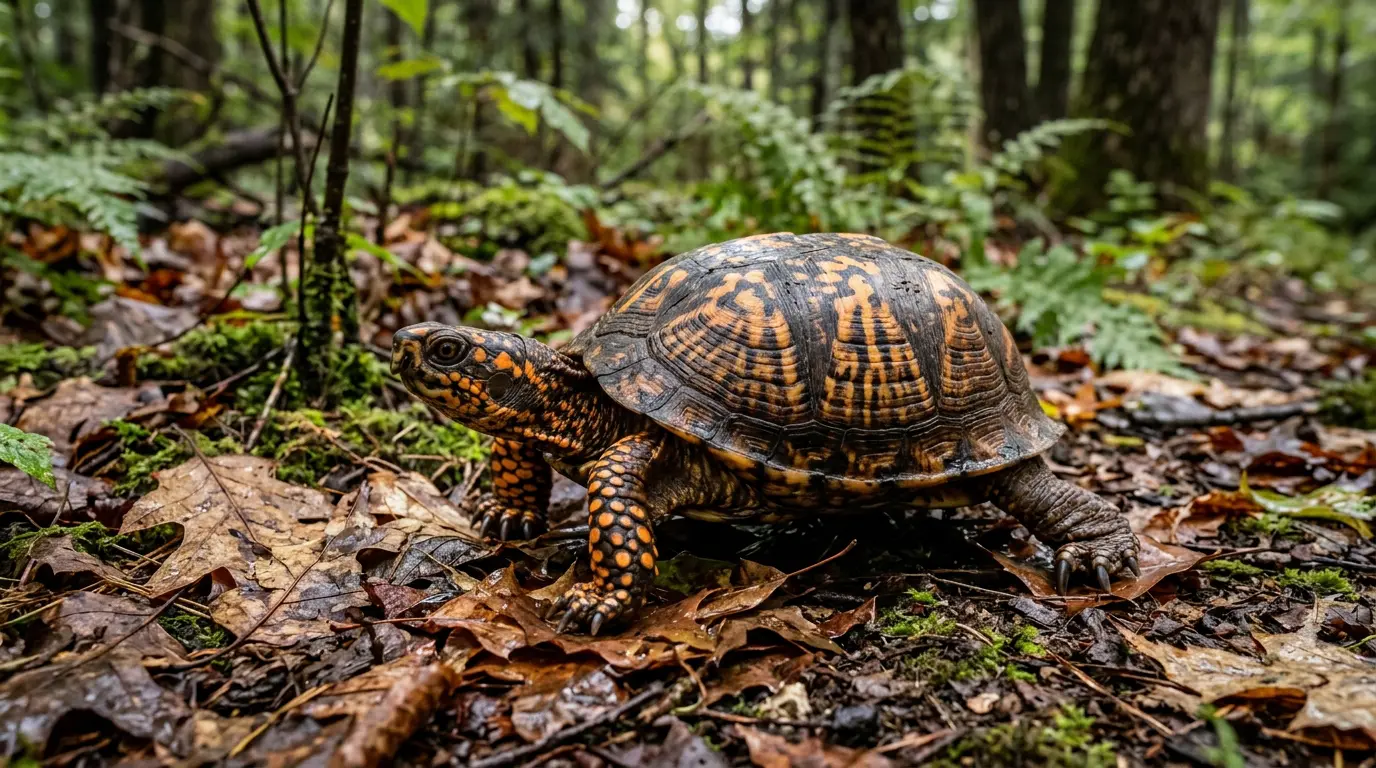
Eastern Box Turtle Guide
Keep Track of What You See
Create a free Wild Things Guide membership to record this Eastern Box Turtle in My Sightings and build your personal wildlife list.
Join to Add This SightingIntroduction
The eastern box turtle is a familiar but increasingly vulnerable woodland turtle of the eastern United States. Its high-domed shell, colorful markings, sturdy limbs, and hinged lower shell make it one of North America’s most recognizable terrestrial turtles. Although it spends most of its life on land, it often remains close to moist soil, leaf litter, shallow wetlands, and dependable cover.
The accepted species name is Terrapene carolina. The name “eastern box turtle” is often applied more specifically to the nominate subspecies, Terrapene carolina carolina. Other regional forms occur within the broader species and may intergrade where their ranges meet.
Quick Identification
- High, rounded carapace rather than a flat or streamlined shell
- Yellow, orange, or tan markings on a brown to nearly black background
- Hinged plastron that allows an adult to close the shell tightly
- Short, stout legs with strong claws and no strongly webbed feet
- Usually four toes on each hind foot and five on each front foot
- Most often encountered walking through woods, yards, or roads after rain
Color alone is not diagnostic. Some individuals are vividly patterned, while others have subdued markings or an almost uniformly dark shell.
Appearance
The carapace is strongly domed, with a central keel that may become smoother with age. Its background color ranges from light brown to dark brown or black. Irregular yellow, orange, cream, or tan spots, streaks, and blotches create a pattern unique to each turtle. The plastron is usually brown or yellowish with variable dark pigmentation.
The skin is dark gray, brown, or nearly black and commonly marked with yellow or orange spots and patches. Adult males often have brighter head and foreleg markings than females, but this varies. Male eyes are frequently red or orange, whereas female eyes are more often brown or yellowish. Eye color should be treated as a supporting clue rather than a reliable test of sex.

Size and Physical Characteristics
Adults usually have a straight carapace length of about 4.5–6 inches (11–15 cm), although unusually large individuals may approach 7 inches (18 cm). The shell is relatively heavy and deep for its length.
The plastron contains a flexible transverse hinge. A mature turtle can pull in its head, legs, and tail, bringing the front and rear portions of the plastron against the carapace. Young turtles cannot seal the shell as completely because their hinge is not fully developed.
Adult males commonly have a slight depression in the plastron, a thicker tail, and a vent positioned farther from the shell. Females generally have a flatter plastron and shorter, narrower tail. These traits are most useful when considered together.
Similar Species
The ornate box turtle has a similarly hinged shell but is typically flatter and shows numerous narrow yellow lines radiating across each dark scute. It favors prairies, grasslands, and sandy open country farther west. The three-toed box turtle usually has three toes on each hind foot and often has a plainer olive or tan carapace, although intergrades complicate identification.
Spotted turtles are smaller, flatter, and black with distinct round yellow spots; they are also more closely associated with shallow wetlands. Wood turtles lack a fully closing hinged plastron and have sculptured carapace scutes with concentric ridges. Juvenile snapping turtles have long tails and serrated rear shell margins and cannot close their shells.
Habitat
Eastern box turtles occupy deciduous and mixed forests, forest edges, wooded floodplains, shrubby fields, wet meadows, and suburban landscapes that retain connected natural cover. Productive sites usually provide loose soil, deep leaf litter, fallen logs, low vegetation, fungi, and nearby damp areas.
They are terrestrial but may soak in shallow water during hot or dry conditions. Moisture is especially important during summer, yet these turtles also use sunny openings for basking and nesting. A mosaic of shaded cover, damp refuges, and open ground is often better than one uniform habitat.

Geographic Range
The eastern form occurs across much of the eastern United States, from southern New England and parts of the Great Lakes region south through the Mid-Atlantic, Appalachians, Southeast, and northern Florida. Its western and southern boundaries overlap or intergrade with other box turtle subspecies, so regional animals do not always match a single textbook appearance.
Distribution is patchy within this broad range. Dense urban development, intensive agriculture, major roads, and unsuitable dry terrain may separate local populations even where maps show the species as present.

Behavior
Eastern box turtles usually move slowly through a familiar home area, often following seasonal routes between feeding, resting, overwintering, and nesting sites. Home ranges differ considerably with habitat quality, sex, weather, and landscape structure. Some individuals remain in the same general area for many years.
They shelter beneath leaf litter, logs, brush, or low vegetation and may dig into soft soil. During heat or drought, a turtle may remain hidden for extended periods or soak in a shallow pool. They are generally solitary, although several may gather where food, water, or suitable overwintering cover is concentrated.
Diet and Feeding
Eastern box turtles are opportunistic omnivores. They eat earthworms, slugs, snails, beetles, caterpillars, grubs, and other small invertebrates, as well as mushrooms, berries, fallen fruit, tender vegetation, and carrion. Young turtles tend to consume a greater proportion of animal food than many adults.
Feeding often occurs in damp leaf litter or after rain, when worms and mollusks are active. Their sense of smell helps them locate food. Wild mushrooms are a natural part of the diet, but people should not assume that a mushroom eaten by a turtle is safe for humans.

Activity and Seasonal Patterns
Activity is greatest from spring through early fall. Turtles may emerge on warm spring days, then become particularly conspicuous during humid weather and after rainfall. In summer they are often most active in the morning or following storms, avoiding exposed sites during intense midday heat.
In the colder parts of the range, eastern box turtles overwinter below leaf litter or in loose soil, sometimes digging several inches or more beneath the surface. The timing and depth of dormancy vary with latitude, elevation, soil, and winter severity. Southern turtles may remain intermittently active during mild periods.
Reproduction and Life Cycle
Courtship can occur from spring into fall, with much visible activity in spring and early summer. Females typically nest from late spring through midsummer, selecting an open patch of loose, well-drained soil. Using the hind feet, a female excavates a flask-shaped chamber, deposits several flexible-shelled white eggs, and carefully covers the site.
A clutch often contains roughly three to six eggs, though counts vary. Incubation commonly lasts two to three months and is strongly influenced by temperature and moisture. As in many turtles, nest temperature affects the sex of developing young. Females can store viable sperm, so mating and egg laying need not occur in the same season.

Young and Juveniles
Hatchlings are only about 1–1.5 inches (2.5–3.8 cm) long. They have flatter shells than adults, a noticeable keel, and less-developed plastral hinges. Their coloration may be muted brown with yellow markings around the shell margin.
Young box turtles spend much of their time concealed beneath leaves, woody debris, or low plants, which helps reduce water loss and predation. Growth is slow, and sexual maturity may take roughly a decade or longer depending on climate and food availability. Juveniles are seldom seen compared with adults.
Predators and Defense
Raccoons, foxes, skunks, opossums, coyotes, domestic dogs, snakes, and birds may prey on eggs or young turtles. Raccoons and other strong predators can sometimes injure or kill adults, particularly before the shell hinge is fully functional.
The primary adult defense is withdrawal into the shell. The hinged plastron closes tightly around the soft body parts, leaving few points of access. A disturbed turtle may also hiss as it expels air during withdrawal. It can bite, but biting is a secondary defense and is not usually a danger to a person handling one carefully.
Tracks, Signs, and Other Evidence
Tracks may appear as alternating prints with claw marks, sometimes accompanied by a faint central drag from the plastron or tail. Front feet have five toes; hind feet usually have four in the eastern form. Clear tracks are most likely in mud, garden soil, or damp sand.
Other evidence includes shallow resting forms in leaf litter, partially eaten berries or mushrooms, and small cylindrical droppings containing seeds or insect fragments. Nest sites are difficult to recognize once covered, although a nesting female leaves freshly disturbed soil during excavation.
Where and How to Find It
Search slowly along woodland edges, damp forest trails, old logging roads, berry patches, and meadow margins on warm, humid mornings. Rainy days in late spring and early summer can be especially productive. Scan several yards ahead so you don’t mistake shell patterns for leaves or sunlight.
Avoid turning logs unnecessarily or disturbing leaf litter around overwintering sites. If a healthy turtle is crossing a road, help only when it is safe to stop, and move it a short distance in the direction it was already traveling. Never relocate it to a distant “better” habitat; box turtles often attempt to return home and may cross additional roads.
Conservation Status and Threats
Terrapene carolina is commonly listed as Vulnerable on the IUCN Red List, with declines reported across much of its range. Major threats include road mortality, habitat loss, fragmented landscapes, mower injuries, illegal collection, disease, and heavy predation on nests in human-altered areas. Because adults mature slowly and can reproduce for decades, the repeated loss of breeding adults may have lasting effects.
Local legal protections vary, and collection may be restricted or prohibited. The Smithsonian’s National Zoo eastern box turtle profile provides additional natural-history information. Gardeners can help by retaining leaf litter, avoiding pesticides, checking tall vegetation before mowing, and creating passages rather than solid barriers between habitat patches.
Relationship with Humans
Eastern box turtles often occur in wooded neighborhoods and gardens, where they consume slugs, fallen fruit, and other available foods. Observe them without removing them from the wild. Captivity requires specialized care and a long commitment, and wild-caught turtles frequently suffer stress, dehydration, or improper nutrition.
Like other reptiles, box turtles may carry Salmonella without appearing ill. Wash hands after unavoidable handling and keep turtles away from food-preparation surfaces. Contain injured turtles in a ventilated box and refer them promptly to a licensed wildlife rehabilitator or veterinarian.
Interesting Facts
- Shell rings do not provide a dependable age count because growth varies and older shells become worn.
- Individual shell and skin patterns can remain recognizable for years and may help researchers identify turtles in long-term studies.
- Adults routinely live for several decades; some documented individuals have survived beyond 70 years, and exceptional longevity may exceed a century.
- A box turtle’s home-area knowledge may include seasonal shelters, feeding places, nesting grounds, and safe travel routes.
- The species name carolina reflects the Carolinas, part of the turtle’s historic range.
Frequently Asked Questions
Is an eastern box turtle a land turtle?
Yes. It is primarily terrestrial, although it may enter shallow water to soak, cool down, or forage. It is not adapted for prolonged swimming like pond turtles.
How can I tell a male from a female?
Males often have a concave plastron, thicker tail, and red or orange eyes. Females more often have a flat plastron, smaller tail, and brown or yellow eyes. Variation is considerable, so use several features rather than eye color alone.
Should I move a box turtle out of my yard?
Usually not. If it is not in immediate danger, allow it to continue on its own. You can move a turtle in a fenced trap or hazardous work area only far enough to reach nearby cover.
Can a box turtle close its shell completely?
A healthy adult can usually close both ends tightly. Juveniles have less-developed hinges, and an injured, chilled, or weakened adult may not close completely.
What should I do if I find a nesting turtle?
Watch from a distance, keep pets away, and avoid handling her. Do not dig up or rotate the eggs. Where a nest faces an immediate threat, contact a local wildlife agency or licensed rehabilitator for regionally appropriate advice.


