
Cumberland Slider Guide
Keep Track of What You See
Create a free Wild Things Guide membership to record this Cumberland Slider in My Sightings and build your personal wildlife list.
Join to Add This SightingIntroduction
The Cumberland slider is a regional form of pond slider associated chiefly with the Cumberland River drainage of Tennessee and Kentucky. Its scientific name is Trachemys scripta troostii; it is generally treated as a subspecies of the widespread pond slider, Trachemys scripta.
This medium-to-large freshwater turtle is most often seen basking on logs, stumps, rocks, and low banks. Identification can be difficult because Cumberland sliders resemble red-eared and yellow-bellied sliders, and captive sliders released into the wild may occur far outside their natural ranges. Interbreeding among slider forms can further blur otherwise useful field marks. The University of Michigan’s Animal Diversity Web account for pond sliders provides additional background on the species as a whole.
Quick Identification
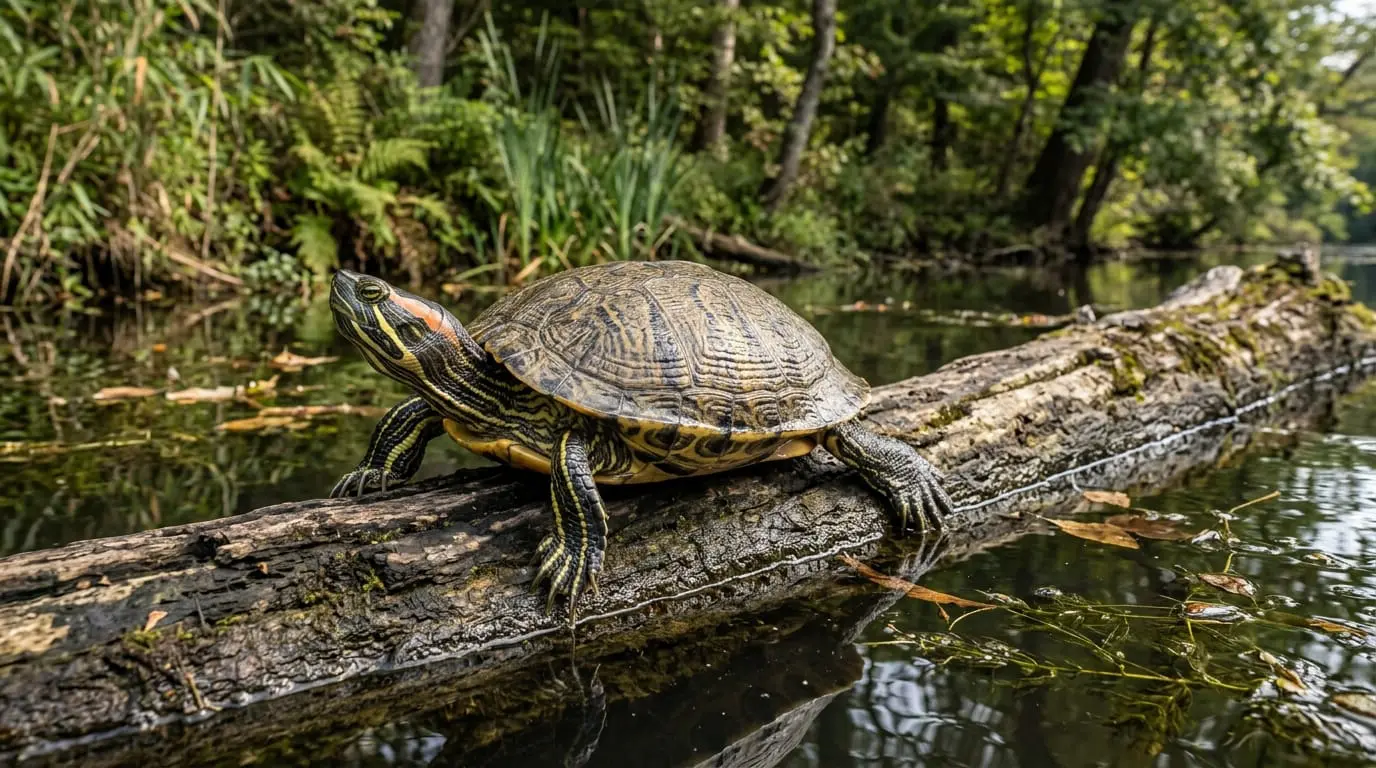
- Olive, brown, or nearly black oval carapace with yellow lines, bars, or irregular markings.
- Narrow yellow-orange to orange patch or stripe behind each eye.
- Yellow-striped head, neck, legs, and tail.
- Yellow plastron, often with dark spots or blotches.
- Adults are approximately 5–11 inches (13–28 cm) in straight carapace length; females usually grow larger.
- Commonly observed basking near quiet or slow-moving freshwater.
The postorbital mark is useful but not conclusive. It is usually less intensely red than the broad patch of a typical red-eared slider and less like the bold vertical yellow blotch of a yellow-bellied slider.
Appearance
The shell is oval, moderately domed, and streamlined for an aquatic turtle. Its upper surface, or carapace, is generally olive green in younger turtles and becomes brown or dark olive with age. Yellow lines, reticulations, and short orange-yellow bars may occur across the scutes and along the shell margin. These markings often fade in older animals.
The skin is dark green to brown or black with numerous narrow yellow stripes. Behind each eye is an elongated patch that may be yellow, orange-yellow, or muted orange. Its exact color and shape vary, so photographs taken in bright sunlight can sometimes make it appear redder than it looks in person.
The plastron is predominantly yellow. Dark rounded spots, partial rings, or irregular blotches may be present on several scutes. Very old individuals, particularly males, may become melanistic and appear almost uniformly dark, obscuring the head and shell patterns needed for subspecies-level identification.

Size and Physical Characteristics
Adult shell length is roughly 5–11 inches (13–28 cm), measured in a straight line along the carapace. Females typically occupy the upper portion of that range and have deeper bodies, while mature males are generally smaller and slimmer.
As in other sliders, males usually have conspicuously elongated claws on the front feet and a longer, thicker tail. The male’s vent lies farther beyond the shell edge. Females have shorter foreclaws and a relatively short tail, adaptations associated with nesting rather than courtship.
The feet are strongly webbed. Young turtles may show a low keel and a slightly serrated rear shell margin, but these features become less prominent as they grow. The jaws lack teeth and instead have hard, sharp-edged beaks that can cut aquatic plants and handle animal prey.
Similar Species
Red-eared slider: The red-eared slider, T. s. elegans, usually has a broader and more clearly red patch behind the eye. Nevertheless, patch color varies with age, lighting, and ancestry. Released pets and intergrades make range alone unreliable.
Yellow-bellied slider: The yellow-bellied slider, T. s. scripta, commonly shows a large, bold yellow blotch behind the eye and often has fewer, larger dark marks on the plastron. Its native range lies mainly farther southeast.
River cooters: Cooters lack the slider’s characteristic postorbital patch. They tend to have more intricate shell patterning and flatter, broader profiles, although distant basking turtles can be difficult to separate.
Painted turtles: Painted turtles usually have smooth, dark shells and conspicuous red or orange markings along the shell margins and limbs. Their head pattern lacks the Cumberland slider’s elongated orange-yellow ear patch.
Habitat
Cumberland sliders inhabit ponds, reservoirs, oxbows, river backwaters, sloughs, marshy coves, and slow sections of rivers and streams. They favor water with abundant basking structures, submerged vegetation, nearby shallows, and soft bottoms. Although strongly aquatic, females travel over land to nest, and individuals may move between water bodies during wet weather or drought.
Sunny logs surrounded by water are especially valuable because they let turtles warm themselves while keeping a quick escape route. Adults tolerate modified environments and may occupy farm ponds, park lakes, canals, and impoundments when food and basking sites are available.

Geographic Range
The native distribution is centered on the Cumberland River system in Tennessee and Kentucky. Reports from neighboring drainages require care because naturally occurring intergradation, taxonomic interpretation, and introduced pet sliders can complicate identification.
Slider turtles resembling this form may be encountered elsewhere in North America, but an out-of-range sighting should not automatically be mapped as a native Cumberland slider population. Photographs of both sides of the head, the carapace, and the plastron are particularly useful when documenting such records.

Behavior
Cumberland sliders alternate between swimming, foraging, resting underwater, and basking. Several turtles may share a log, sometimes stacking or crowding together where suitable sites are limited. They are alert while basking and often slide rapidly into the water when approached—the behavior behind the common name “slider.”
They generally avoid close contact with people, but captured turtles may withdraw, scratch with their claws, release musk, or bite. In water, they can remain submerged for extended periods, surfacing quietly to breathe with only the nostrils and eyes exposed.
Diet and Feeding
Cumberland sliders are opportunistic omnivores. Juveniles tend to consume more animal material, including aquatic insect larvae, small snails, worms, tadpoles, small crustaceans, carrion, and occasionally small fish. Adults usually incorporate a greater proportion of aquatic plants, algae, seeds, and fallen fruit.
Most prey is swallowed underwater because aquatic turtles have limited ability to move food through the mouth on land. Diet varies with season, habitat, body size, and local availability. They may investigate dead animals or discarded fishing bait, but feeding wild turtles is discouraged because it can alter behavior and unnaturally concentrate animals.

Activity and Seasonal Patterns
Activity is greatest during warm daylight hours, with basking often conspicuous in the morning and again when sun reaches favored logs. Turtles may remain in the water during the hottest part of summer days. Cloud cover, wind, water temperature, and disturbance all affect whether they are visible.
In colder parts of the range, Cumberland sliders become inactive during winter and shelter underwater in mud, beneath banks, or among submerged debris. They may briefly emerge during unusually warm weather. Spring warming brings renewed basking, feeding, courtship, and movement.
Reproduction and Life Cycle
Courtship is most evident from spring into early summer, although timing varies with weather and latitude. A male may swim in front of a female and vibrate his elongated foreclaws near her face. Females can store sperm, allowing fertilization to occur well after mating.
Nesting generally takes place from late spring through summer. A female leaves the water, often after rain, and digs a flask-shaped chamber with her hind feet in open soil. She deposits a clutch of several flexible-shelled white eggs, covers the chamber, and departs without providing parental care. More than one clutch may be produced in a favorable year.
Incubation commonly lasts several weeks to a few months, depending strongly on soil temperature and moisture. As in many turtles, incubation temperature influences hatchling sex. Survivors grow slowly and may live for several decades, although a precise typical lifespan for wild Cumberland sliders is not well documented.

Young and Juveniles
Hatchlings are approximately coin-sized, with brighter green shells and sharper yellow striping than most adults. The carapace may show a central keel, circular markings, and a more noticeably toothed rear edge. Young turtles usually remain close to shallow margins rich in vegetation and small invertebrates.
Some hatchlings emerge soon after development; others may remain in the nest through cold weather and emerge later. Their small size makes them vulnerable to fish, wading birds, snakes, and mammals. Color and pattern generally become duller as the turtle matures.
Predators and Defense
Eggs and hatchlings experience the heaviest predation. Raccoons, skunks, foxes, opossums, rodents, snakes, large fish, herons, and other predators may raid nests or capture young turtles. Adults have fewer natural enemies, though large mammals, alligators where ranges overlap, and vehicles can kill them.
The primary defense is to retreat rapidly into the water. On land, a turtle pulls its head and limbs partly into the shell and may bite or scratch. The shell provides substantial protection but does not close as tightly as a box turtle’s.
Tracks, Signs, and Other Evidence
Tracks are most likely along muddy pond margins or on nesting ground. A walking turtle leaves alternating clawed footprints, often with a central drag mark made by the plastron or tail. Nesting females produce broader trails and paired scrape marks around a patch of recently disturbed soil.
Opened nests may contain leathery eggshell fragments, but identifying the turtle from a raided nest alone is seldom possible. The most dependable evidence is a basking or swimming animal photographed closely enough to show the head patch and shell markings.
Where and How to Find It
Search quiet coves, backwaters, park ponds, and reservoir margins within the Cumberland drainage. On mild sunny mornings, scan partly submerged logs and exposed rocks with binoculars before approaching. Move slowly, remain low, and avoid casting a shadow across the basking site.
Late spring offers good opportunities because adults bask frequently and females may cross roads or trails on nesting trips. Never move a turtle to a different pond. If one is crossing a safe-to-access road, assistance should be limited to placing it off the roadway in the direction it was already traveling.
Conservation Status and Threats
The pond slider species is commonly listed as Least Concern globally, and the Cumberland slider is not generally given a separate global assessment. Local populations may nevertheless be affected by wetland loss, shoreline hardening, road mortality, water pollution, fishing-hook injuries, nest predation, and illegal collection.
Released red-eared sliders are an additional concern because they may compete, interbreed, or make native forms difficult to recognize. Protecting connected wetlands, natural nesting ground, clean water, and undisturbed basking structures benefits Cumberland sliders and other freshwater turtles.
Relationship with Humans
Cumberland sliders sometimes enter the pet trade, but ownership requires decades of commitment, substantial filtered water, appropriate heat and ultraviolet lighting, and careful hygiene. Captive turtles should never be released. Released animals can spread disease, disrupt native populations, and may not survive.
Like other reptiles, sliders can carry Salmonella without appearing ill. Wild turtles should be observed rather than handled. Anyone who must handle one for an authorized rescue should wash thoroughly afterward and keep the turtle away from food-preparation areas.
Interesting Facts
- The name “Cumberland” refers to the river system at the center of its native range.
- The subspecific name troostii honors naturalist Gerard Troost.
- A slider’s vivid juvenile pattern often darkens substantially with age.
- Long male foreclaws function in courtship rather than in digging nests.
- Basking supports thermoregulation and may help maintain the shell and skin.
Frequently Asked Questions
Is a Cumberland slider the same as a red-eared slider?
No. They are usually treated as different subspecies of Trachemys scripta. Their markings can overlap, however, especially where released turtles or intergrades occur.
How can I recognize the ear patch?
Look for a relatively narrow yellow-orange or orange stripe behind the eye. Do not use that feature alone; also examine the shell, plastron, body striping, and geographic location.
Do Cumberland sliders live entirely in water?
No. They feed, rest, and escape predators in water but regularly bask above the surface. Females also travel over land to nest.
Are Cumberland sliders dangerous?
They are not dangerous when left alone. A handled turtle can bite or scratch, and standard precautions are necessary because turtles may carry Salmonella.
Should I relocate one found on a road?
If conditions are safe, move it only across the road in the direction it was heading. Do not take it to another water body, and never place yourself in danger near traffic.


