

Cape May Warbler Guide
Keep Track of What You See
Create a free Wild Things Guide membership to record this Cape May Warbler in My Sightings and build your personal wildlife list.
Join to Add This SightingIntroduction
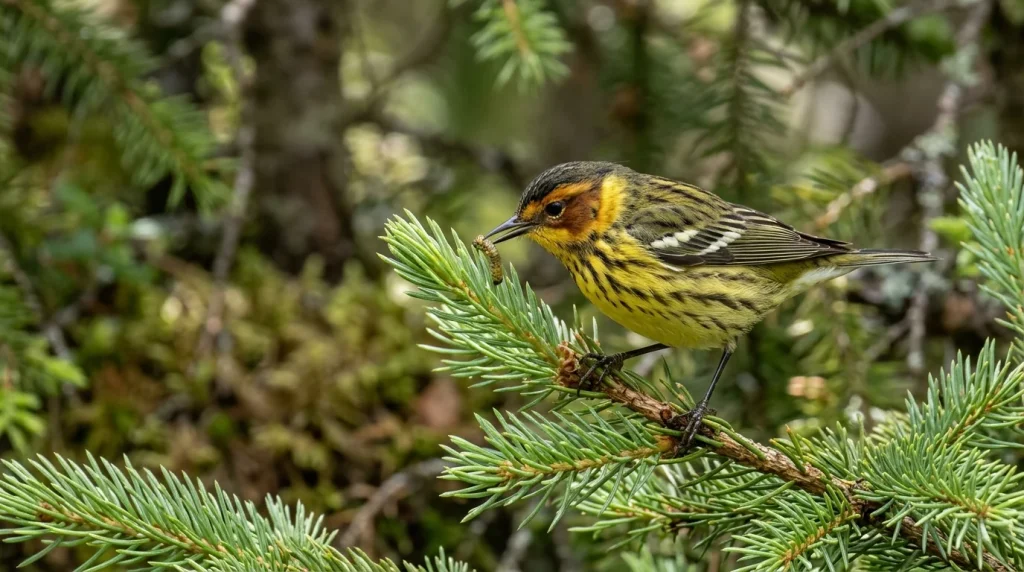
The Cape May Warbler (Setophaga tigrina) is a small, active wood-warbler associated with North America’s boreal forests. A breeding male is strikingly patterned, with a chestnut cheek, yellow neck and underparts, and dense black streaking that gives the species its scientific epithet, tigrina. Females, immature birds, and fall adults are subtler and can be challenging to identify.
Although it nests mainly in northern spruce forests, the Cape May Warbler passes through much of eastern North America during migration. Its movements and breeding success can vary with spruce budworm outbreaks, an important seasonal food source. The species also has an unusual brush-tipped tongue that helps it take nectar while wintering in the Caribbean.

Quick Identification
- Overall shape: Small, compact warbler with a fine, sharply pointed bill and relatively short tail.
- Breeding male: Yellow breast heavily marked with black streaks, chestnut cheek patch, dark crown, yellow rump, and a large white wing patch.
- Female and immature: Olive-gray to yellowish overall, with a yellow rump, pale wing patch or wingbars, and variable streaking below.
- Behavior: Forages actively among outer branches, often high in spruce or fir trees; may hover briefly while taking insects.
- Voice: A very high, thin series of repeated notes that can be difficult for some listeners to hear.
The combination of a yellow rump, pale wing patch, fine bill, and streaked underparts is particularly useful when identifying nonbreeding birds.
Appearance
Adult males in breeding plumage are among the most distinctive eastern warblers. The face shows a rich chestnut cheek bordered by yellow around the side of the neck, while the crown and eyeline appear dark. The breast and flanks are yellow with numerous narrow black streaks. The back is olive with darker markings, the rump is bright yellow, and the dark wings carry a conspicuous white patch.
Females are less strongly patterned. They are generally grayish olive above and pale yellowish below, with finer streaking on the breast and sides. The cheek is gray or olive and may show a slight rusty wash. Females usually retain a noticeable yellow rump and a pale patch or paired bars on the wing.
Fall males become duller as pale feather edges soften the head and body pattern. Immature birds can be quite gray and may show only a yellow rump, faint yellow around the neck, subdued breast streaking, and pale wing markings. Plumage varies, so identify them by several features rather than color alone.

Size and Wingspan
Cape May Warblers are small songbirds, typically measuring about 4.7–5.5 inches (12–14 centimeters) in length. Their wingspan is approximately 7.5–8.7 inches (19–22 centimeters). They are compact compared with some long-tailed warblers, with a small head, short tail, and thin, slightly decurved bill.
Range and Distribution
The breeding range lies mainly across Canada’s boreal forest, extending from parts of western and central Canada east through Quebec and the Maritime provinces. In the United States, breeding is concentrated around the western Great Lakes and in portions of northern New England and nearby northeastern forests.
Migration occurs primarily through the eastern half of North America. The species is generally less numerous along the Pacific coast and across much of the arid West, where sightings are noteworthy. Most Cape May Warblers winter in the Caribbean, including the Bahamas and Greater Antilles, with smaller numbers occurring elsewhere around the Caribbean basin.
Seasonal maps and regional timing information are available in the Cornell Lab of Ornithology’s Cape May Warbler account.

Habitat
During the breeding season, Cape May Warblers favor mature coniferous and mixed boreal forests, particularly stands containing spruce and balsam fir. They may become locally abundant where spruce budworms are plentiful. Birds typically forage in the canopy and along outer limbs, making them easier to hear than see.
During migration, they use a wider variety of wooded habitats, including parks, lakeshores, woodland edges, shelterbelts, and leafy urban neighborhoods. Winter habitats include dry or semi-humid woodland, forest edges, scrub, gardens, shade-grown agricultural areas, and flowering trees.

Behavior
This warbler moves quickly through foliage, gleaning insects from needles, leaves, twigs, and bark. It frequently works along the outer portions of branches and may make short flights to seize prey or hover near a cluster of foliage. In migration, it sometimes joins loose mixed-species flocks.
Males sing from high perches in breeding territories. Cape May Warblers are not usually conspicuous on open ground, although migrants may descend to low shrubs or flowering plants. Their fine bill and specialized tongue allow them to exploit nectar more effectively than most North American warblers.
Diet
Insects and other small arthropods form the core of the breeding-season diet. Caterpillars are especially important, and spruce budworms can be a major food source for both adults and nestlings. Cape May Warblers also consume flies, beetles, moths, spiders, and other small invertebrates gathered from vegetation.
During migration and winter, the diet becomes more varied. Birds may eat small fruits and drink nectar from flowers or from holes in fruit. At hummingbird feeders, migrants occasionally pierce fruit or approach nectar ports, though such visits are irregular. Keep feeders clean, and never use dye or sweeteners other than plain white sugar.
Vocalizations
The male’s song is an exceptionally high, thin sequence of repeated notes, often rendered as seet-seet-seet-seet-seet. The notes may remain nearly level in pitch or change slightly through the series. The song can resemble other high-pitched warbler songs and may be inaudible to listeners with reduced sensitivity to high frequencies.
Call notes include a sharp, fine sip or tsip. During migration, these brief calls may reveal a bird moving through dense foliage before its plumage is visible.
Breeding and Nesting
Cape May Warblers are generally monogamous within a nesting season. The female builds a compact open cup, usually positioned on a horizontal branch close to the trunk of a spruce or fir. Nests are often high above the ground and hidden by dense conifer foliage, making them difficult to observe.
The cup is constructed from small twigs, bark strips, grasses, plant fibers, and other fine material, with a softer inner lining. A typical clutch contains several creamy white eggs marked with reddish-brown or darker speckles, often concentrated near the larger end. Reported clutch sizes vary, and larger clutches may occur when caterpillar food is exceptionally abundant.
The female performs most or all incubation. Both parents may feed the young, carrying caterpillars and other soft-bodied insects to the nest.

Young and Development
Nestlings hatch helpless, with limited down and closed eyes. They depend on adults for warmth, protection, and a steady supply of insects. Growth is rapid, as in other migratory wood-warblers, and the young leave the nest before reaching full adult size and coordination.
Recently fledged birds remain near cover and continue receiving food from their parents. Juvenile plumage is dull and lightly marked so that young Cape May Warblers can be confused with other immature warblers during late summer and fall migration.
Where to See
In summer, search mature spruce-fir forest within the boreal zone and around the northern Great Lakes. Listen for the male’s thin song, then scan high outer branches. Because the sound is difficult to locate, watching for small movements against open gaps in the canopy can be more effective than searching dense foliage directly.
For many birders, migration offers the best opportunity. Productive locations include wooded Great Lakes shorelines, Atlantic coastal migrant traps, ridges, city parks, and flowering trees. Spring males are easiest to recognize, while fall birds require closer attention to the rump, wing pattern, streaking, and facial color.
Similar Species
- Yellow-rumped Warbler: Also has a yellow rump, but usually shows yellow side patches, a different facial pattern, and less extensive fine streaking. Cape May Warblers have a thinner bill and a more obvious pale wing patch.
- Blackburnian Warbler: Breeding males have a brilliant orange throat and bold black-and-white head pattern. Females can appear yellowish but usually have prominent pale eyebrow markings and lack the Cape May’s combination of fine breast streaks and concentrated wing patch.
- Bay-breasted Warbler: Fall birds may be buffy or greenish and can show pale wingbars. Bay-breasted Warblers are typically less streaked below, have a stouter bill, and often show buff-colored flanks or undertail coverts rather than a crisp yellow rump.
- Blackpoll Warbler: Females and fall birds are streaked and may show wingbars, but Blackpoll Warblers generally have longer wings, a bolder facial pattern, and pale or white undertail coverts. Their legs and feet can also appear more orange-toned.
- Pine Warbler: Often looks heavier and longer-billed, with blurrier wingbars and less sharply defined streaking. Pine Warblers are also more likely to forage slowly on trunks, large limbs, or the ground.
Conservation
The Cape May Warbler is commonly classified as Least Concern on the IUCN Red List. Its population can fluctuate considerably with spruce budworm cycles, complicating short-term trend interpretation.
Potential pressures include loss or alteration of boreal forest, pesticide exposure, collisions with windows and illuminated structures during migration, and degradation of Caribbean winter habitat. Conserving mature conifer forest, maintaining diverse stopover sites, reducing unnecessary nighttime lighting, and treating windows to prevent collisions can benefit this and other migratory songbirds.
Field Identification Tips
- Check the rump: A yellow rump is often visible when the bird flicks its wings or changes branches.
- Study the wing: Look for a broad pale or white patch rather than two narrow, evenly separated wingbars.
- Assess the streaking: Cape May Warblers usually show fine, numerous streaks across the breast and flanks.
- Note the bill: It is fine, pointed, and subtly downcurved, especially compared with a Pine or Bay-breasted Warbler.
- Use season and location: Bright chestnut-cheeked males are most likely in spring and early summer; subdued females and immatures dominate many fall observations.
- Listen high: On breeding grounds, the thin song often comes from the upper canopy of spruce or fir.
- Photograph multiple angles: Views of the face, rump, underside, and folded wing are more useful than a single distant image.
Frequently Asked Questions
Why is it called the Cape May Warbler?
The English name comes from an early specimen collected near Cape May, New Jersey. The species migrates there rather than being restricted to the Cape May area.
Is the Cape May Warbler rare?
It is widespread but unevenly distributed. It can be common in suitable northern breeding habitat and at productive migration sites, but scarce elsewhere. Numbers may vary with spruce budworm abundance.
Do Cape May Warblers visit feeders?
Occasionally. Migrants may investigate nectar feeders, fruit, or flowering trees, but they are not dependable feeder visitors. Clean sugar-water feeders and native flowering plants are best.
What is the best field mark on a female?
No single mark is foolproof. Look for the combined effect of a yellow rump, pale wing patch, fine breast streaking, olive-gray face, and slender bill.
When does the Cape May Warbler migrate?
Northbound movement occurs mainly in spring, often peaking in May across much of the United States. Southbound migration begins in late summer and continues through fall, with exact timing varying by latitude and weather.
Does it breed in Cape May, New Jersey?
It is primarily a passage migrant there. Its regular breeding range lies much farther north in boreal and northern coniferous forests.


