
Bay-breasted Warbler Guide
Keep Track of What You See
Create a free Wild Things Guide membership to record this Bay-breasted Warbler in My Sightings and build your personal wildlife list.
Join to Add This SightingIntroduction
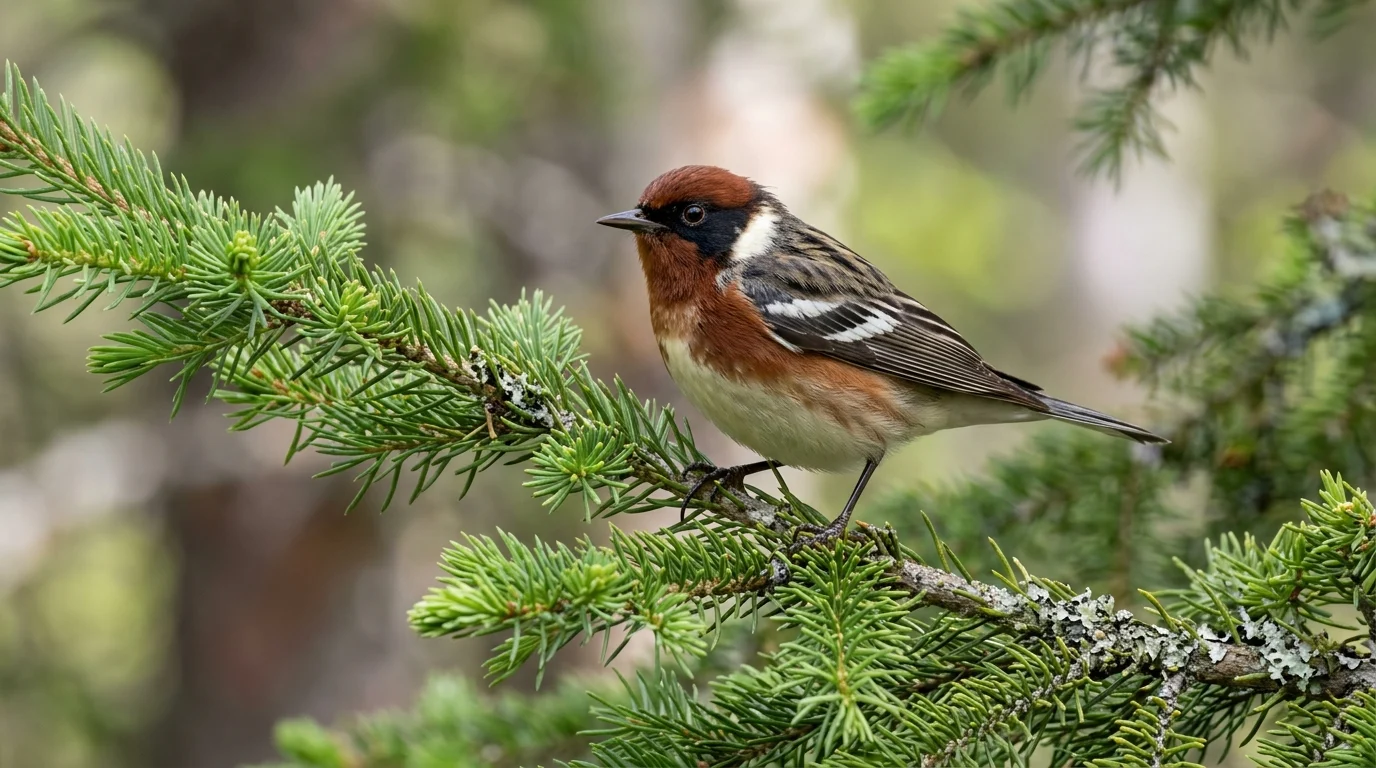
The Bay-breasted Warbler (Setophaga castanea) is a long-distance migrant associated with the boreal forests of North America. Breeding males are striking combinations of chestnut, black, and cream, but females and fall birds are considerably subtler. During migration, the species often feeds high in leafy trees, making identification a useful test of plumage details, shape, and behavior.
Its abundance can vary markedly from year to year, partly in response to outbreaks of spruce budworms and other forest caterpillars. As a result, it may be numerous during one migration season and scarce during another.
Quick Identification
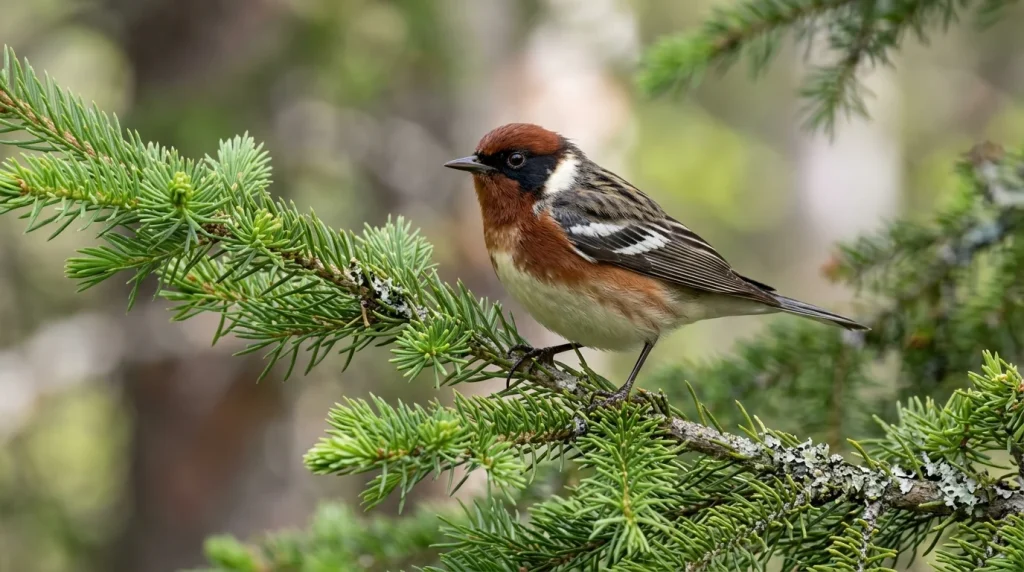
- Breeding male: Black face; rich chestnut crown, throat, and flanks; pale buff or cream neck patch; dark, streaked back; and two pale wing bars.
- Female: Olive-gray above with a streaked back, pale wing bars, muted chestnut or buff along the flanks, and sometimes chestnut on the crown.
- Fall plumage: Greenish to olive upperparts, pale underparts, buffy flanks, and two distinct wing bars.
- Structure: A compact, somewhat sturdy warbler with a relatively full body and short, straight bill.
- Behavior: Usually searches leaves and branch tips in the middle or upper canopy.
- Best field mark outside spring: Concentrated buff or chestnut color on the flanks rather than heavy streaking across the breast.
Appearance
An adult male in breeding plumage is among the most distinctive wood-warblers. The face is black, while the crown, throat, and sides of the breast are deep chestnut. A broad cream-colored patch lies on each side of the neck. The back is blackish with pale streaks, the wings show two light bars, and the central belly is pale.
Females replace the male’s sharp black-and-chestnut pattern with softer olive, gray, buff, and cream. They usually have a streaked back and two wing bars. Some show obvious chestnut flanks or crown feathers, while others have only a warm buff wash.
After the late-summer molt, males also become less dramatic. Fall Bay-breasted Warblers may look greenish above and creamy below, with blurry buff flanks. Immatures can be especially plain. Plumage varies with age, sex, molt, lighting, and feather wear, so no single color patch should be used by itself.

Size and Wingspan
Adults are approximately 13–15 cm (5.1–5.9 in) long, with a typical wingspan of about 21–22 cm (8.3–8.7 in). They are small songbirds, although their rounded body can make them look heavier than many similarly sized warblers.
Range and Distribution
Bay-breasted Warblers breed across Canada’s boreal zone, from western Canada eastward to the Atlantic provinces. Their breeding range also reaches parts of the northern Great Lakes region and northern New England.
Migration carries them through much of the central and eastern United States. Most travel through the Caribbean or Central America to wintering areas centered on Panama and northwestern South America. They are generally uncommon in western North America outside their regular migration corridor. Seasonal distribution details and identification media are available from the Cornell Lab of Ornithology’s Bay-breasted Warbler account.
Habitat
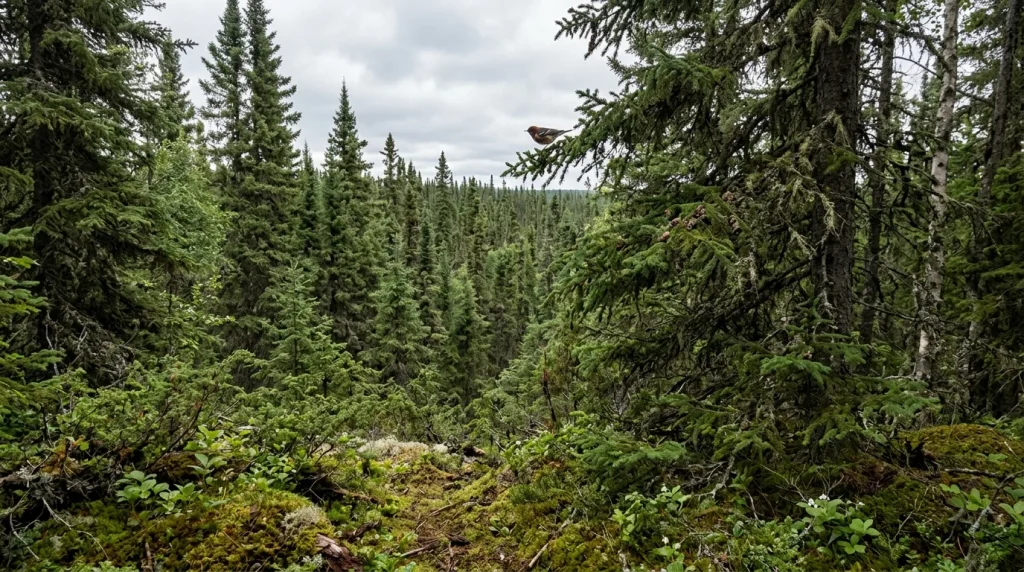
On the breeding grounds, this Warbler favors mature boreal coniferous or mixed forest, particularly stands containing spruce and fir. It often becomes more abundant where caterpillars are plentiful.
During migration, it uses a wider range of wooded habitats, including deciduous forests, lakeshores, wooded parks, mature gardens, and forest edges. Wintering birds occupy humid tropical forests, secondary woodland, shade-grown agricultural landscapes, and forest borders. Across seasons, they frequently remain well above eye level.
Behavior
Bay-breasted Warblers move deliberately among leaves and fine branches, gleaning prey from foliage and sometimes hovering briefly to reach an insect. They may make short aerial sallies but are not persistent flycatchers.
Breeding birds defend territories and are often encountered singly or in pairs. Migrants may join mixed-species feeding flocks. Their tendency to forage in the canopy can make them difficult to follow, especially when leaves are moving or several warbler species are present.
Diet
Insects and other small arthropods dominate the diet. Caterpillars are especially important during the breeding season, including spruce budworms during outbreaks. The birds also take beetles, flies, moths, insect eggs, and spiders. During migration and winter, they may supplement animal prey with small fruits or berries.

Vocalizations
The male’s song is a thin, high-pitched series of repeated notes. It may sound even and slightly buzzy, with changes in emphasis or pitch near the end. The song is easily overlooked among other high-frequency boreal bird sounds and may be difficult for some listeners to hear.
Calls include a sharp, fine contact note typical of small wood-warblers. Because several related species give similar calls, visual confirmation is usually advisable.
Breeding and Nesting
Breeding begins after adults return to northern forests in late spring. The female builds a compact open-cup nest, generally placed on a horizontal branch within a spruce or fir. It is made from plant fibers, bark, twigs, and other fine material and is lined with softer fibers.
A typical clutch contains about four or five pale eggs marked with brownish or purplish spots, although clutch size varies. The female performs most or all incubation. Both parents generally contribute food after hatching. Nest height and concealment differ with local forest structure, and nests can be difficult to observe from the ground.

Young and Development
Chicks hatch helpless, sparsely covered, and dependent on adults for warmth and food. Their diet consists largely of soft-bodied insects and larvae. The nestling period is relatively short, as in many migratory warblers. After leaving the nest, fledglings remain dependent while learning to move through branches and capture prey. Families later disperse and prepare for southbound migration.
Where to See
In summer, search mature spruce-fir forests in boreal Canada, northern Minnesota and the Great Lakes region, northern New England, and nearby areas. Listening for singing males is often more effective than scanning the canopy at random.
Elsewhere, spring and fall migration provide the best opportunities. Productive locations include wooded lake shores, river corridors, ridges, coastal migrant traps, and parks with mature trees. Spring passage is concentrated mainly in May across much of the United States; fall movement begins in late summer and continues into autumn. Timing varies by latitude and weather.
Similar Species
- Blackpoll Warbler: The most important fall comparison. Blackpolls generally show clearer streaking on the breast and sides, paler or yellowish legs and feet, and less concentrated buff on the flanks. Bay-breasted Warblers usually have dark legs and a less streaked central breast.
- Cape May Warbler: Often has sharper breast streaking, a yellow rump, yellowish underparts, and a finer, slightly decurved bill. Females and immatures can still be challenging.
- Blackburnian Warbler: Breeding males have fiery orange on the throat and face rather than a chestnut crown-and-flank pattern. Fall birds often retain a strong facial pattern and pale back streaks.
- Chestnut-sided Warbler: Breeding adults have chestnut restricted mainly to the sides, with a yellow crown and white underparts. Fall Chestnut-sided Warblers are bright lime-green above and usually lack the Bay-breasted Warbler’s wing-bar and flank combination.
When views are brief, assess leg color, wing bars, back streaking, flank color, breast pattern, and overall structure together.
Conservation
The Bay-breasted Warbler is commonly classified globally as Least Concern. Nevertheless, it depends on extensive forest habitat across several countries, and regional trends may differ.
Breeding numbers can rise during spruce budworm outbreaks and decline when caterpillar abundance falls, complicating short-term population assessment. Potential pressures include loss or fragmentation of boreal breeding forest, collisions during migration, pesticide exposure, and alteration of tropical winter habitat. Conserving connected forests throughout the annual cycle is likely to provide the greatest long-term benefit.
Field Identification Tips
- Start with season. Expect crisp chestnut-and-black males mainly in spring and early summer; expect greener, less patterned birds in fall.
- Check the flanks. Look for buff or chestnut concentrated along the sides of the body.
- Inspect the breast. Bay-breasted Warblers usually lack the extensive dark breast streaking typical of a fall Blackpoll.
- Look at the legs. Dark legs support Bay-breasted, while paler yellowish feet favor Blackpoll. Light can distort this feature, so do not rely on it alone.
- Confirm the wing bars and back. Two pale wing bars and a streaked upper back are useful supporting marks.
- Watch patiently. A bird feeding overhead may briefly expose its flanks, undertail, or face as it turns.
Frequently Asked Questions
Why is it called the Bay-breasted Warbler?
“Bay” refers to a rich reddish-brown color. Breeding males display this chestnut or bay coloration across the throat and along the sides of the breast.
Is the Bay-breasted Warbler rare?
It is not globally rare, but local numbers vary greatly. It can be common in suitable boreal habitat and during some migration years, but difficult to find outside its main route.
How can I separate a fall Bay-breasted Warbler from a Blackpoll?
Favor Bay-breasted when the bird has dark legs, buffy flanks, limited breast streaking, and a slightly robust appearance. Favor Blackpoll when streaking extends across the underparts and the legs or feet look pale or yellowish. Use several features together.
Does it visit bird feeders?
It is not a regular seed-feeder visitor. Native trees, shrubs, and pesticide-free plantings may attract insect prey and occasionally bring migrants into yards.
When is the best time to see one?
May is often the best month for colorful northbound migrants in the United States. Late August through September can produce fall birds, although their subdued plumage makes identification more demanding.


