
Black-and-white Warbler Guide
Keep Track of What You See
Create a free Wild Things Guide membership to record this Black-and-white Warbler in My Sightings and build your personal wildlife list.
Join to Add This SightingIntroduction
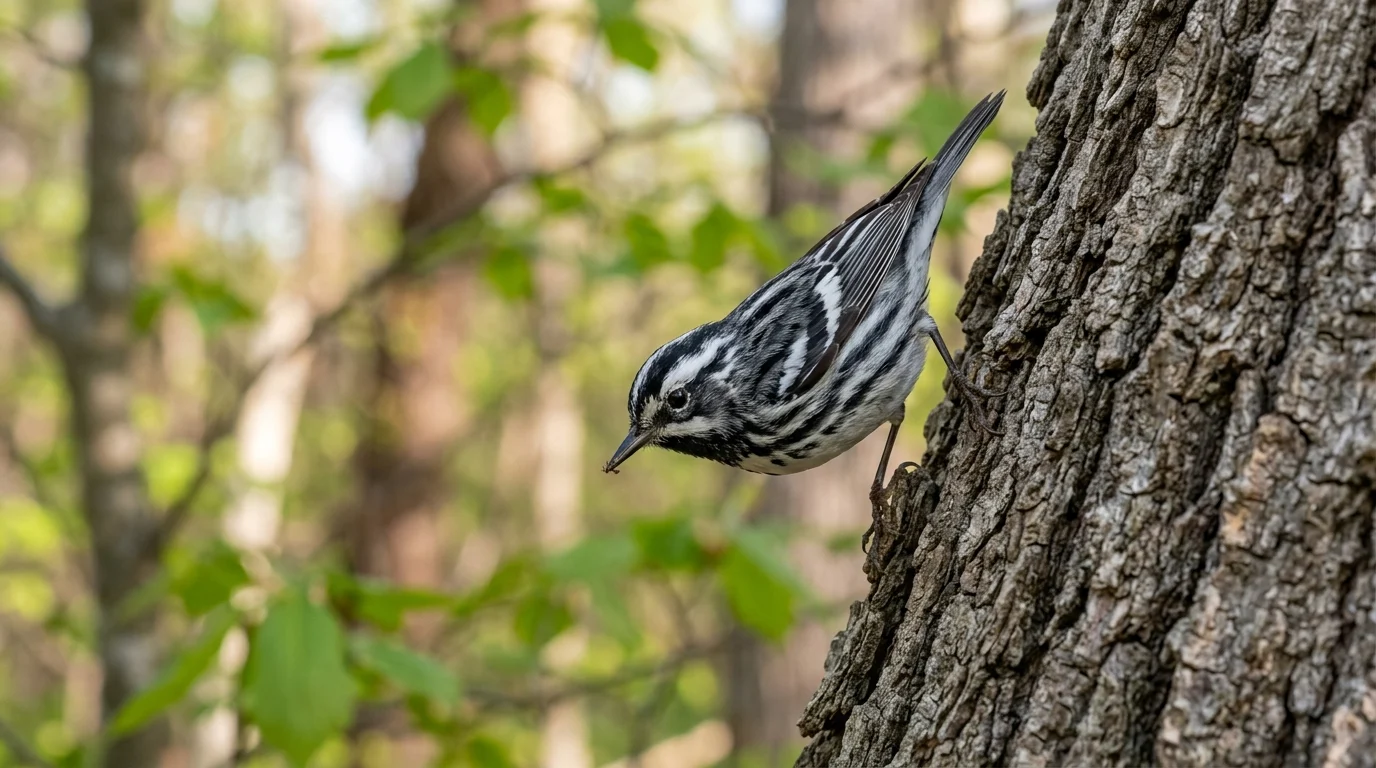
The Black-and-white Warbler (Mniotilta varia) is a small North American songbird with an unusual way of finding food. Instead of moving mainly among leaves like many warblers, it creeps along trunks and branches, probing bark in a manner reminiscent of a nuthatch. Its boldly striped plumage, short tail, and deliberate climbing behavior make it one of the more distinctive members of the wood-warbler family.
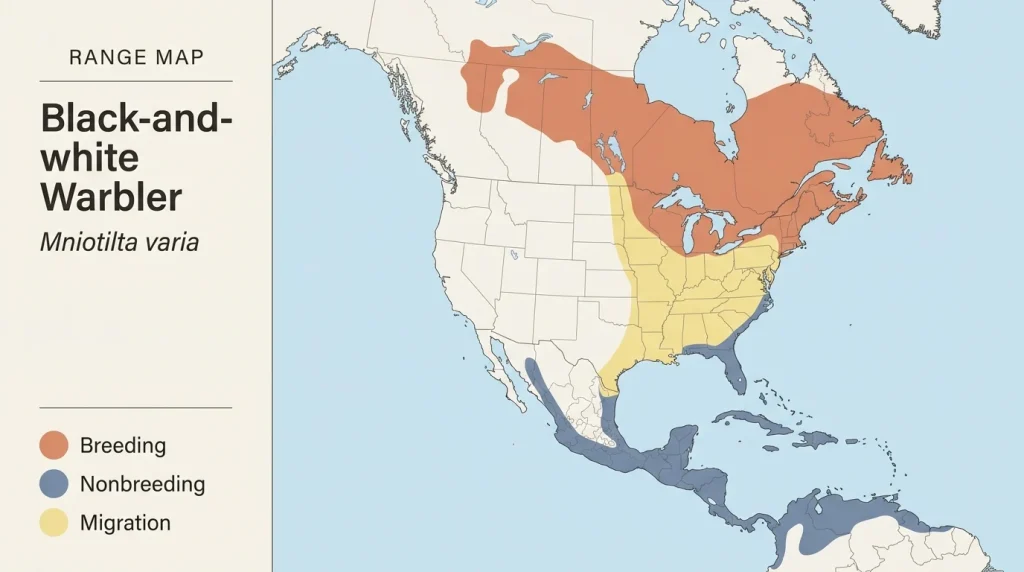
This species breeds across much of the eastern and boreal forests of North America. It migrates to the southeastern United States, the Caribbean, Mexico, Central America, and northern South America for winter. Although often easy to recognize in clear view, it can disappear surprisingly well against patterned bark.
Quick Identification
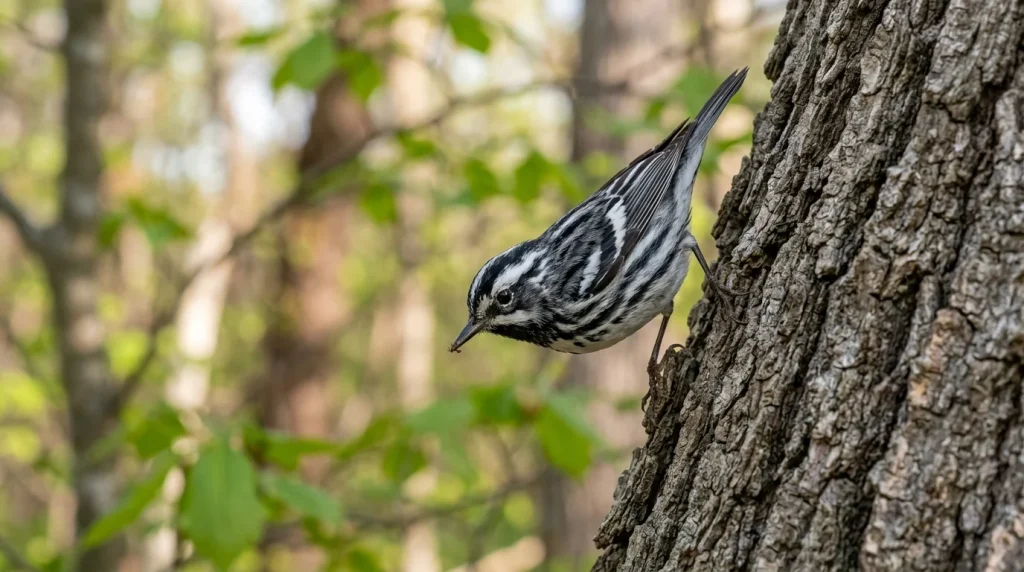
- Overall pattern: Strong black-and-white stripes extending across the crown, back, wings, and underparts.
- Shape: Small, compact warbler with a relatively long bill, short tail, and sturdy-looking feet.
- Behavior: Creeps upward, sideways, and sometimes downward along trunks and large limbs.
- Male: Usually shows a black cheek and throat, especially in breeding plumage.
- Female: Paler below, with a whitish throat and cheek and sometimes a buff wash on the flanks.
- Song: A thin, high series of repeated notes, commonly rendered as wee-see, wee-see, wee-see.
- Habitat: Mature or mixed woodland, especially where rough-barked trees offer abundant feeding surfaces.
Appearance
Both sexes have a lengthwise striped appearance unlike the smoother plumage patterns of most other warblers. The crown is marked with black and white, the back is streaked, and the wings are dark with two prominent white wing bars. White spotting along the tail edges may become visible when the bird spreads or flicks its tail.
An adult breeding male generally has a black throat, black cheek, and strong black streaking across otherwise white underparts. A narrow white eyebrow contrasts with the dark face. The female has the same basic striped upperparts but usually shows a white or pale throat, a lighter cheek, and less extensive black below. Some females have buff-colored flanks, particularly outside the breeding season.
Immature birds resemble females and may look softer brownish-black or buff compared with a sharply patterned spring male. Plumage varies with age, sex, season, wear, and lighting, so behavior and structure can be more dependable than throat color alone.

Size and Wingspan
The Black-and-white Warbler is a small songbird, though its elongated posture while climbing can make it appear larger.
- Length: About 4.3–5.1 inches (11–13 centimeters)
- Wingspan: About 7.1–8.7 inches (18–22 centimeters)
- General build: Compact body, short tail, slender pointed bill, and comparatively strong legs and feet
It is close in length to many other wood-warblers but differs in proportions and posture. A bird pressed close to a trunk may look flatter-bodied and less upright than a typical foliage-gleaning warbler.
Range and Distribution
The breeding range extends across a broad part of eastern and central North America. It reaches from portions of the southeastern and south-central United States north through the Great Lakes, New England, and much of southern Canada, with breeding occurring westward into parts of the Canadian boreal forest and the northern Great Plains.
During migration, Black-and-white Warblers can appear throughout much of the eastern United States and along routes through the central states. Some also occur farther west as uncommon migrants or vagrants. Wintering birds are found in Florida, the Caribbean, Mexico, Central America, and parts of northern South America.
This is often among the earlier warblers to return during spring migration and among the earlier species to begin moving south later in the year. Regional timing varies with latitude, weather, and annual conditions. The Cornell Lab of Ornithology species account provides additional identification and distribution information.
Habitat
On the breeding grounds, Black-and-white Warblers occupy deciduous, mixed, and some coniferous forests. They are often associated with mature woodland, but they may also use younger forest where suitable trunks, understory structure, and ground-level nesting cover are available. Wooded slopes, ravines, swamp edges, and forests containing a mixture of tree sizes can be productive.
During migration, the species uses a broader range of wooded places, including parks, stream corridors, shelterbelts, coastal woodlots, and well-planted urban areas. Winter habitat includes tropical and subtropical forest, shade-grown agricultural landscapes, scrubby woodland, and forest edges. In every season, trees with furrowed or irregular bark provide important foraging surfaces.

Behavior
The bird’s trunk-climbing behavior is its most useful field mark. It lands low or midway up a tree, then creeps over the bark while inspecting cracks and crevices. Individuals move headfirst upward, sideways beneath limbs, and occasionally downward. The feet and relatively long hind claw help the bird cling to near-vertical surfaces.
Movements are active but often more methodical than those of warblers darting through outer foliage. The tail may be held close to the bark, flicked, or partly spread. Short flights carry the bird between trunks and heavy branches. During migration, it may join mixed-species feeding flocks, although it frequently remains closer to bark than its companions.
Males sing and forage through a breeding territory, sometimes using exposed branches for vocal displays. When alarmed near a nest, adults may give sharp calls and move restlessly through low vegetation.
Diet
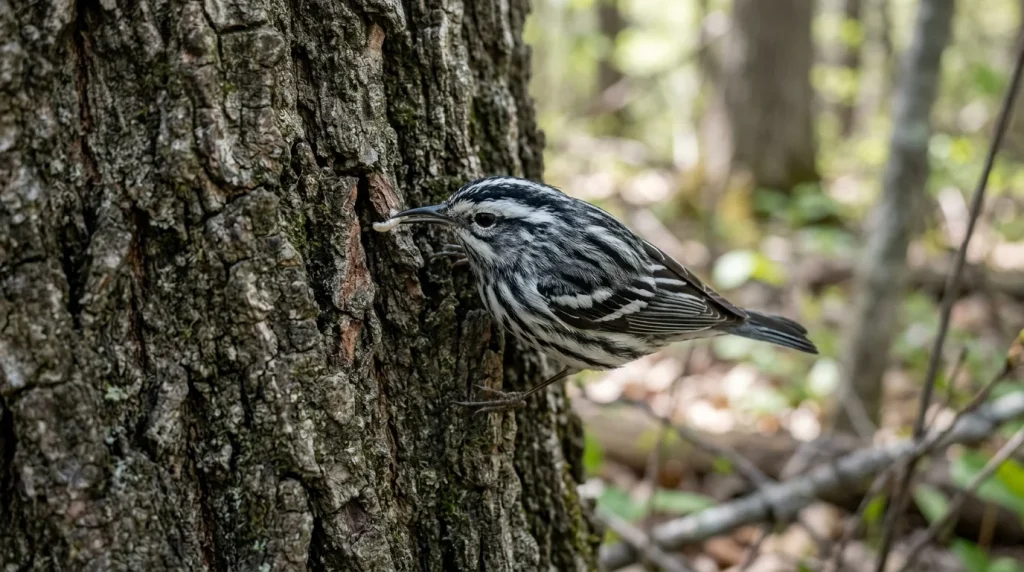
Black-and-white Warblers eat mostly insects, spiders, and other small arthropods. Their bark-foraging technique allows them to reach prey overlooked by species that concentrate on foliage. Foods may include:
- Beetles and beetle larvae
- Moths, caterpillars, and other larvae
- Ants, flies, leafhoppers, and small wasps
- Spiders and insect eggs
The bird picks prey from bark surfaces and probes into shallow crevices with its slightly decurved bill. It may also inspect branches, leaves, and clusters of dead vegetation. Diet composition changes with season and local prey availability; plant food is not considered a major part of its normal diet.
Vocalizations
The common song is very high, thin, and repetitive. It is frequently described as a series of paired notes: wee-see, wee-see, wee-see. The pitch can be difficult for listeners with reduced sensitivity to high frequencies, and the song may seem to come from farther away than it does.
A longer or more varied song may be given in some breeding contexts. Calls include a sharp, dry chik or tsip, used during movement, disturbance, or contact with other birds. Because several woodland birds make thin calls, a vocal identification is best confirmed by observing the striped bird moving along bark.
Breeding and Nesting
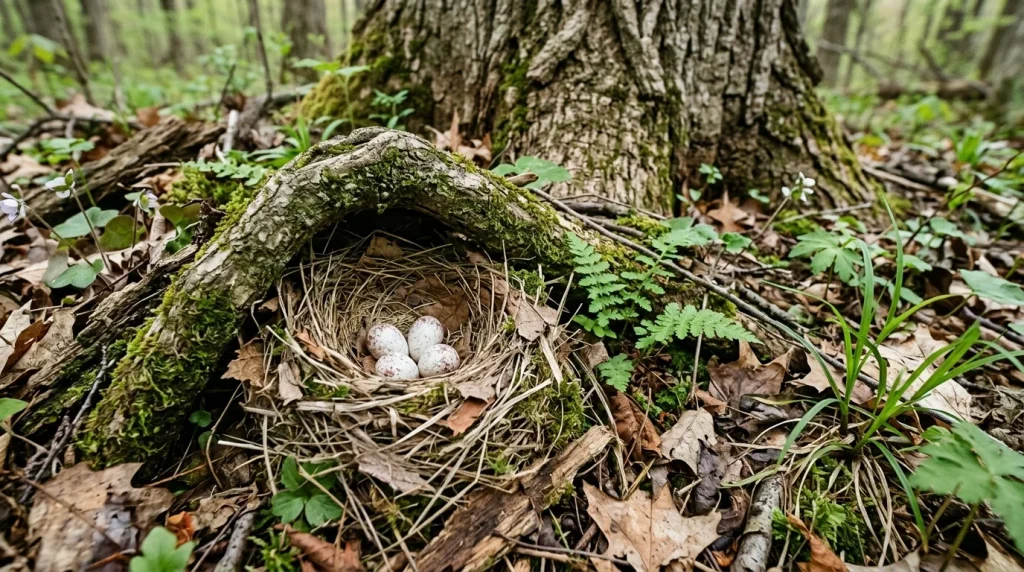
Despite spending much of its time on trees, the Black-and-white Warbler normally nests on or very close to the ground. The female selects a concealed site beside a tree trunk, fallen log, root, rock, stump, or clump of vegetation. An overhanging root or bark projection may form a partial roof.
The cup is built from dry leaves, grasses, bark fibers, and other plant material, with a finer inner lining. Dead leaves around the rim help disguise it against the forest floor. A typical clutch contains four or five eggs, although clutch size varies. The eggs are whitish or creamy and marked with brown, reddish-brown, or grayish spots, often concentrated toward the larger end.
The female incubates the eggs, generally for about a week and a half. The male may bring her food and help feed the nestlings after hatching. Ground nests are vulnerable to snakes, small mammals, severe weather, and accidental disturbance.
Young and Development
Hatchlings are helpless and require regular brooding and feeding. Both parents deliver small insects and larvae, making frequent trips between nearby foraging trees and the concealed nest. Nestlings develop quickly and commonly leave the nest after approximately 8–12 days, sometimes before they can fly strongly.
Recently fledged young may remain low in dense vegetation or on fallen branches while adults continue to feed them. Their plumage is subdued compared with that of an adult male, but the emerging stripes and pale wing bars are usually evident. Observers should avoid approaching calling adults or grounded fledglings, because prolonged attention can expose them to predators.
Where to See
In spring and summer, search mature woods with rough-barked trees, wooded slopes, and a moderately open understory. Listen for the thin repeated song, then scan trunks and main limbs rather than only the leafy canopy. The bird often works around the far side of a trunk, so waiting quietly can be more effective than pursuing it.
During migration, visit woodland edges, city parks, lakeshore groves, river corridors, and coastal migrant traps. An early-morning walk after favorable migration weather can be productive. Look at lower and middle tree levels first, especially on oaks, maples, pines, and other trees with textured bark.
Similar Species
- Blackpoll Warbler: A breeding male is black and white, but it has a black cap, white cheek, and a more conventional branch-perching posture. Females and fall birds often show yellow-green tones.
- Blackburnian Warbler: Females and immatures can be streaked, but they usually show yellowish facial markings and forage mainly among branches and leaves rather than creeping over trunks.
- White-breasted Nuthatch: Also moves headfirst down trees, but it is larger, has a broad black or gray crown, plain blue-gray back, and lacks the warbler’s full-body striping.
- Brown Creeper: Climbs trunks and is similarly bark-associated, but its brown mottled upperparts, pale underparts, longer curved bill, and habit of spiraling upward are distinctive.
- Downy Woodpecker: Shares the black-and-white palette but is larger, has a stiffer tail, and has a heavier, chisel-like bill.
Conservation
The Black-and-white Warbler is commonly classified as Least Concern globally, reflecting its extensive range and still-substantial population. Nevertheless, long-term monitoring indicates declines in parts of its range. A broad global category does not mean that every regional population is stable.
Potential pressures include forest loss and fragmentation, degradation of tropical winter habitat, collisions with buildings and communication structures, pesticide exposure, and predation by free-ranging domestic cats. Because the species depends on habitats for breeding, migration, and wintering, conservation requires coordinated efforts across countries.
Maintaining forests with varied tree sizes, standing live trees, fallen wood, leaf litter, and a diverse native understory can support both nesting cover and insect prey. Turning off unnecessary lights during peak migration and treating reflective windows can reduce collision risk.
Field Identification Tips
- Watch the trunk. A tiny striped bird creeping close to bark is more likely to be this species than a warbler merely landing briefly on a branch.
- Confirm lengthwise stripes. Look for the striped crown and back, two white wing bars, and streaking on the underparts.
- Check the face and throat carefully. Extensive black suggests an adult male, but females and young birds can be much paler.
- Notice posture. The body is often held nearly parallel to the bark, with strong feet gripping the surface.
- Learn the song before spring outings. The repeated high notes can reveal a bird that remains hidden on the opposite side of a tree.
- Use several marks together. Plumage, behavior, shape, habitat, season, and voice provide a safer identification than any one feature.
Frequently Asked Questions
Is the Black-and-white Warbler actually a warbler?
Yes. It belongs to the New World wood-warbler family, Parulidae. Its climbing behavior resembles that of a nuthatch or creeper, but its anatomy, genetics, vocalizations, and life history place it among the wood-warblers.
Do Black-and-white Warblers climb down trees?
They can move downward as well as upward and sideways. This versatility is unusual among North American warblers and is one of the species’ best behavioral field marks.
Are males and females easy to distinguish?
Breeding males generally have a black throat and cheek, while females are paler in those areas. Outside fresh breeding plumage, age, molt, and wear can complicate sex identification, so it’s best to leave some individuals unsexed in the field.
Do they visit bird feeders?
They rarely use conventional seed feeders because they primarily eat arthropods. A yard with mature native trees, leaf litter, reduced pesticide use, and safe windows is more likely to provide suitable stopover habitat.
Why is the bird called “black-and-white”?
The name refers to the conspicuous contrasting stripes covering much of its plumage. Females and immature birds can include buff or gray-brown tones, but they retain the characteristic striped pattern.


