Bridled Titmouse Guide
Keep Track of What You See
Create a free Wild Things Guide membership to record this Bridled Titmouse in My Sightings and build your personal wildlife list.
Join to Add This SightingIntroduction
The Bridled Titmouse (Baeolophus wollweberi) is a small, energetic songbird of oak and pine-oak woodlands in the southwestern United States and Mexico. Its pointed crest and sharply patterned black-and-white face make it one of North America’s most distinctive titmice.
Within the United States, this species is most readily found in the mountain ranges of Arizona and southwestern New Mexico. It remains in its breeding range year-round, although individuals and family groups may shift locally with weather and food availability. Birders often detect Bridled Titmice by voice before seeing them among dense oak foliage.
Despite the elaborate head pattern, identification can be challenging when a bird moves quickly or is viewed against a bright sky. Crest shape, facial markings, habitat, behavior, and range are the most useful field marks.

Quick Identification
- Overall shape: Small, compact songbird with a rounded body, short bill, moderately long tail, and pointed crest.
- Head: Bold black-and-white pattern resembling a bridle around the pale cheek.
- Upperparts: Soft gray back, wings, and tail.
- Underparts: Mostly pale gray to whitish, sometimes with warm buff or rusty tones along the sides.
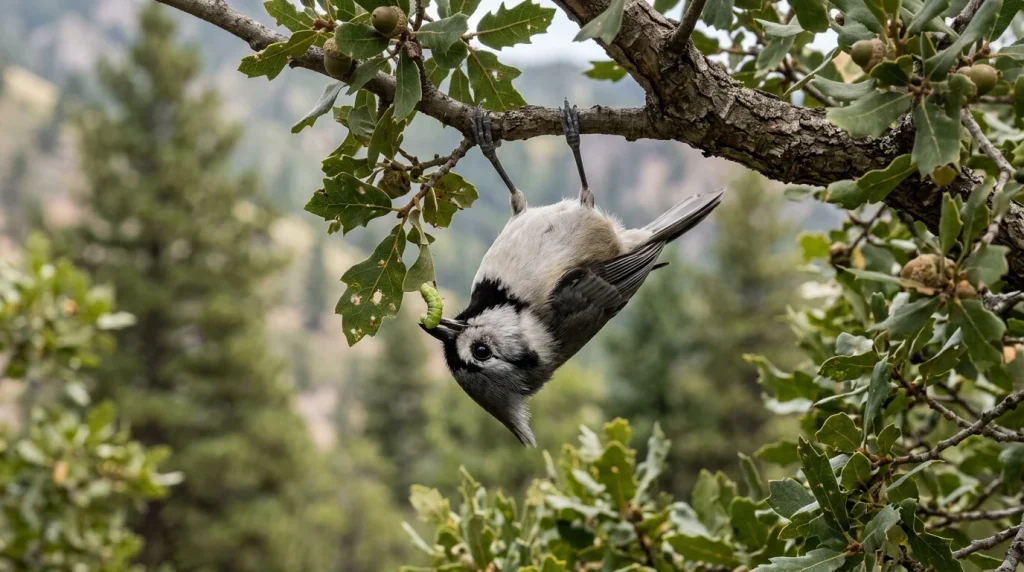
- Behavior: Active and acrobatic; frequently hangs beneath twigs while searching leaves and bark.
- Habitat: Oak-dominated canyons, pine-oak woodland, and wooded mountain slopes.
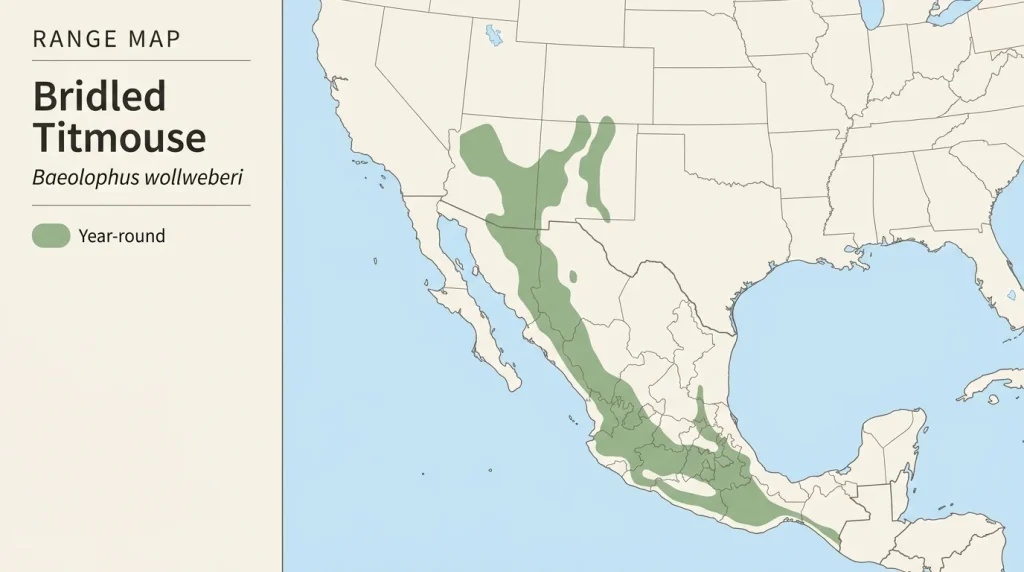
- Range: Resident from central and southeastern Arizona and southwestern New Mexico south through the Mexican highlands.
Appearance
The Bridled Titmouse has a more intricate face pattern than any other regularly occurring North American titmouse. Its dark, pointed crest is bordered by contrasting pale areas. A black line passes through or near the eye and curves around the pale cheek, creating the characteristic “bridled” appearance. The chin and upper throat are black, while the forehead and portions of the face are white.
The back is medium gray, and the wings and tail are similar in color, usually without conspicuous wing bars. Underparts are pale gray or off-white. Some birds show buffy or rusty coloration along the flanks, although this may be subtle in poor light or worn plumage.
Males and females look essentially alike in the field. Plumage alone generally does not allow a reliable determination of sex. Juveniles resemble adults but tend to appear softer and less crisply marked, with a shorter or less pronounced crest and duller facial contrasts.

Size and Wingspan
Bridled Titmice are smaller than many familiar backyard birds and are similar in size to chickadees.
- Length: About 4.3–4.7 inches (11–12 centimeters)
- Wingspan: Approximately 7.5–7.9 inches (19–20 centimeters)
- Weight: Roughly 0.3–0.4 ounces (9–12 grams)
The rounded body can make the bird appear larger when its feathers are fluffed in cold weather. Its narrow, pointed crest adds apparent height but little actual bulk. Compared with a Juniper Titmouse, the Bridled Titmouse is slightly smaller and much more strongly patterned.
Range and Distribution
The species occupies mountain woodlands from central and southeastern Arizona and southwestern New Mexico south through much of western and central Mexico, reaching the southern Mexican highlands. Its distribution follows suitable oak and pine-oak habitat rather than forming a continuous range across lowland deserts.
In the United States, well-known populations occur in Arizona’s mountain ranges and in the “sky island” region near the Mexican border. In New Mexico, the species is more localized, principally in the southwestern part of the state. It is generally nonmigratory, but birds may move downslope or wander short distances outside the breeding season.
The Cornell Lab of Ornithology’s Bridled Titmouse account provides additional identification material and an overview of its North American distribution.
Habitat
Bridled Titmice are strongly associated with mature woodland containing oaks. Typical settings include shaded canyons, mountain slopes, riparian woodland, and mixed pine-oak forest. In Arizona and New Mexico, they are often found where evergreen or deciduous oaks grow beneath taller pines, sycamores, junipers, or other mountain trees.
They require trees not only for foraging but also for nesting cavities. Woodlands with standing dead limbs, old woodpecker holes, and natural cavities can therefore provide especially valuable breeding habitat. Although birds sometimes visit developed areas, they are less characteristic of open suburbs than some other titmice.

Behavior
This titmouse remains still for long. It hops along branches, probes bark crevices, and examines clusters of leaves with quick, deliberate movements. Like chickadees, it can hang upside down to inspect the undersides of twigs and foliage. Its short, sturdy bill suits picking small prey from vegetation and opening seeds.
Pairs maintain contact through frequent calls. After breeding, adults and young may travel as a family group, sometimes joining mixed-species flocks with chickadees, nuthatches, kinglets, warblers, and other woodland birds. When alarmed, a group may gather near a predator and give repeated scolding notes.
Bridled Titmice are active throughout the day, but early morning is often the best time to hear calling birds. They may pause long enough to be seen clearly when investigating a suspected owl, snake, or human observer.
Diet and Hunting
Insects, spiders, and other small arthropods form much of the diet, especially during spring and summer. Caterpillars are important food for growing nestlings. Adults also take beetles, bugs, insect eggs, larvae, and small spiders from leaves, bark, and fine branches.
Seeds, nuts, and other plant foods become more important when insects are scarce. Birds may hammer a seed while holding it between their feet, and they sometimes store individual food items for later use.
Most prey is found by gleaning rather than by prolonged aerial pursuit. A titmouse may make a short flight to capture a moving insect, but it typically searches methodically through foliage and along branches. Because much of this activity occurs in the canopy, watching a calling flock often produces better views than following a single silent bird.
Vocalizations
The Bridled Titmouse has a varied collection of thin whistles, rapid chips, trills, and nasal or buzzy calls. Its songs commonly consist of repeated clear notes delivered in a measured or accelerating series. The exact rhythm varies, and different individuals may sound noticeably different.
Contact calls help pairs and family groups remain together in dense woodland. Agitated birds give harsher, more rapid notes, particularly when mobbing a predator. These calls may attract other small songbirds, creating a conspicuous cluster around an otherwise hidden threat.
Because songs can overlap in quality with those of chickadees and other titmice, listeners should confirm the identification visually whenever possible. Range and oak-woodland habitat provide useful supporting clues.
Breeding and Nesting
Breeding usually occurs in spring and early summer, with timing influenced by elevation, latitude, and seasonal conditions. Bridled Titmice nest in enclosed cavities. They may use natural hollows, old woodpecker excavations, or other openings in trunks and dead limbs. They generally do not excavate a complete cavity in sound wood, although they may remove loose or decayed material.
The nest is a soft cup assembled from materials such as grass, moss, bark fibers, plant down, hair, or fur. Clutches often contain several white eggs marked with reddish-brown speckles, commonly concentrated toward the larger end. Reported clutch size varies, and local conditions may affect the number of eggs.
The female incubates, while the male commonly brings her food. Incubation lasts roughly two weeks. Once the eggs hatch, both parents deliver insects and remove waste from the cavity. Adults can become quiet and cautious near an active nest, so observers should avoid prolonged attention to a nest tree.

Young and Development
Newly hatched young are helpless and dependent on adults for warmth and food. Their diet is rich in small insects and spiders, with soft-bodied caterpillars often forming an important component. The nestlings grow rapidly and usually leave the cavity after roughly two to three weeks, although fledging timing varies.
Recently fledged birds have short tails, less distinct head patterns, and conspicuous pale gape edges. They may sit quietly within cover while giving persistent begging calls. The parents continue feeding them after they leave the nest and guide them through familiar foraging areas.
Family groups may remain together for a period after fledging. A young bird that is fully feathered and able to perch normally is usually best left where it is unless it faces an immediate hazard.
Where to See
In the United States, southeastern Arizona offers the most accessible opportunities. Look in oak-rich mountain canyons and pine-oak woodland in ranges such as the Chiricahua, Huachuca, Santa Rita, and Santa Catalina Mountains. Central Arizona’s appropriate mountain woodlands may also hold the species. In southwestern New Mexico, search wooded canyons and uplands near the Arizona-Mexico border.
Productive locations generally contain mature oaks, broken canopy, shaded drainage corridors, and standing dead wood. Walk slowly, listen for high contact calls, and inspect mixed feeding flocks. Winter can be especially useful because family groups and other woodland birds may forage together at lower or more accessible levels.
Similar Species
- Juniper Titmouse: Plain gray overall, with a crest but no bold black-and-white facial pattern. It favors dry pinyon-juniper woodland.
- Oak Titmouse: Also plain gray-brown and lacks the Bridled Titmouse’s contrasting face. Its principal range is in California and northwestern Baja California.
- Black-crested Titmouse: Larger, with a black crest and pale forehead but without the complete bridle-like cheek border. It occurs mainly farther east in Texas and northeastern Mexico.
- Mountain Chickadee: Has a black cap, white cheeks, and a white eyebrow, but lacks a pointed crest. Its black throat patch is broader, and its overall head pattern is arranged differently.
- Mexican Chickadee: Overlaps locally in high-elevation forests. It has a black cap and bib with white cheeks but no crest or ornate bridle pattern.
Conservation
The Bridled Titmouse is commonly classified as Least Concern on the IUCN Red List because of its broad overall distribution and substantial population. It can nevertheless be locally uncommon, particularly near the northern edge of its range.
Potential pressures include the loss or degradation of mature oak and pine-oak woodland, removal of dead trees and limbs, severe wildfire, prolonged drought, and changes in forest structure. Fire effects depend on intensity and landscape context: low-intensity fire can maintain open woodland, while extensive high-severity fire may remove nesting and foraging habitat.
Retaining native oaks, mature trees, snags, and safe cavity-bearing limbs supports this and other cavity-nesting birds. Landowners should assess hazardous dead wood carefully but preserve nonhazardous snags where practical.
Field Identification Tips
- Start with the face: look for a pale cheek enclosed by narrow black markings.
- Confirm the pointed crest; chickadees have rounded caps rather than true crests.
- Use habitat as supporting evidence. Oak or pine-oak canyon woodland is highly characteristic.
- Watch the undersides of branches, where birds frequently hang while feeding.
- Scan mixed flocks after hearing thin whistles, chips, or scolding calls.
- Do not attempt to sex adults by plumage; males and females are visually very similar.
- In backlit views, wait for the bird to turn its head so the cheek border and throat pattern become visible.
Frequently Asked Questions
Is the Bridled Titmouse a chickadee?
No. Titmice and chickadees are close relatives in the family Paridae, but the Bridled Titmouse belongs to the crested titmouse genus Baeolophus.
Does the Bridled Titmouse mTitmouse
It is primarily a year-round resident. Some birds make local elevational movements or wander short distances in response to cold, drought, or changing food supplies.
Can males and females be distinguished in the field?
Usually not with confidence. The sexes have essentially the same plumage, and behavior at an active nest may provide better clues than appearance.
Will Bridled Titmice visit bird feeders?
They may visit feeders within or near suitable woodland, especially for sunflower seeds, suet, or nuts. Feeder use varies by location and should not be expected far from established habitat.
What is the best single identification feature?
The combination of a pointed crest and a black line enclosing the pale cheek is diagnostic within its normal North American range. Gray plumage and oak-woodland habitat provide additional confirmation.
Do Bridled Titmice use nest boxes?
They may occasionally accept a suitably designed cavity box, but natural tree cavities and old woodpecker holes are typical nest sites. Any box should be securely mounted, protected from excessive heat, and cleaned outside the breeding season.