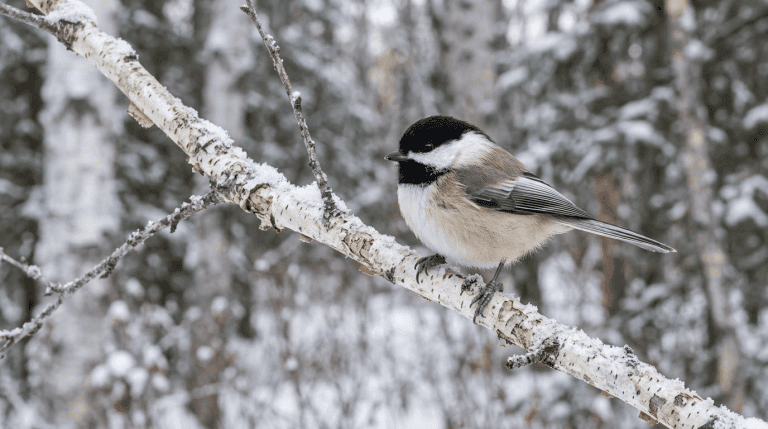
Black-crested Titmouse Guide
Keep Track of What You See
Create a free Wild Things Guide membership to record this Black-crested Titmouse in My Sightings and build your personal wildlife list.
Join to Add This SightingIntroduction
The Black-crested Titmouse (Baeolophus atricristatus) is a lively, crested songbird of Texas, northeastern Mexico, and neighboring areas. It frequents oak-juniper woodland, thorny scrub, streamside groves, ranches, parks, and well-vegetated neighborhoods. Its bold face pattern, pointed crest, and active behavior make it conspicuous, although separating females and hybrids from the closely related Tufted Titmouse can require care.
Black-crested Titmice usually occur in pairs or small groups. They investigate branches, bark, seed feeders, and nest cavities with an alert, almost restless manner. Throughout much of their range, they remain year-round residents.
Quick Identification
- Shape: Small, compact songbird with a prominent pointed crest, rounded body, short neck, and moderately long tail.
- Face: Broad white cheek contrasts with a dark forehead and crest.
- Color: Gray upperparts, pale underparts, and warm buff to rusty flanks.
- Sexes: Adult males generally have a distinctly black crest; females typically have a grayer crest and can resemble Tufted Titmice.
- Behavior: Active and acrobatic, often hanging sideways or briefly upside down while searching foliage and bark.
- Voice: Whistled phrases and scolding, chickadee-like calls often reveal the bird before it is seen.

Appearance
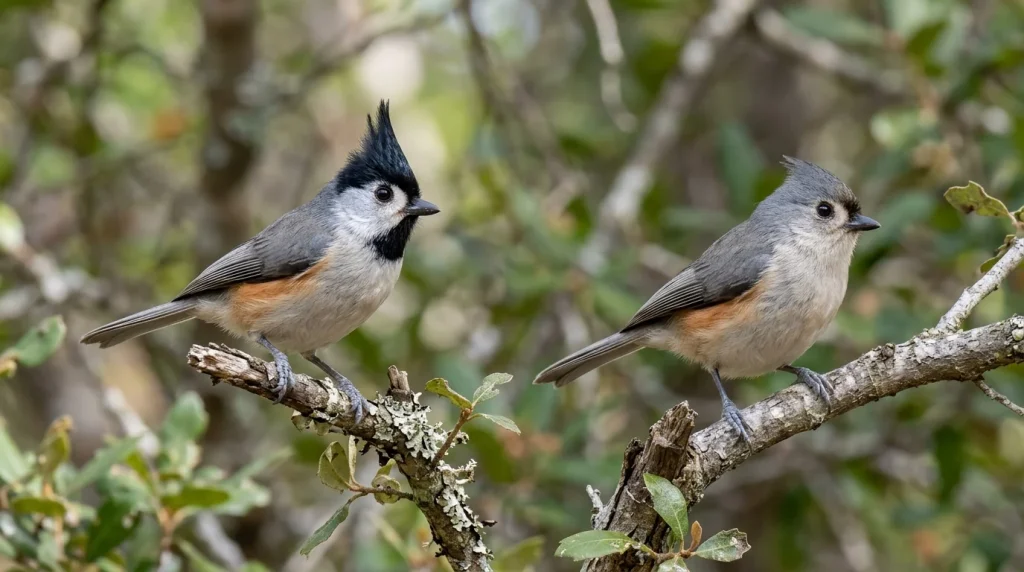
The Black-crested Titmouse has a pale gray back, darker flight feathers, whitish face, and pale gray-white breast and belly. A wash of buff, peach, or rusty color marks the sides and flanks. The bill is short, stout, and dark, while the legs are bluish gray to dark gray.
An adult male’s glossy black crest is the strongest field mark. The dark coloration extends across the forecrown, producing a sharp contrast with the white cheek. Females are similarly patterned but usually have a gray or dusky crest rather than a fully black one. Plumage appearance varies with lighting, wear, age, and possible hybrid ancestry, so crest color should be assessed together with range and voice.
Juveniles look softer and less crisply marked than adults. Their crests may be shorter, and the warm flank color can be subdued.
Size and Wingspan
Adults are typically about 5.9–6.7 inches (15–17 centimeters) long, with a wingspan of roughly 9–11 inches (23–28 centimeters). They are larger-bodied than chickadees but smaller than most jays and thrashers. Their apparent size changes considerably as the crest is raised or flattened.
Range and Distribution
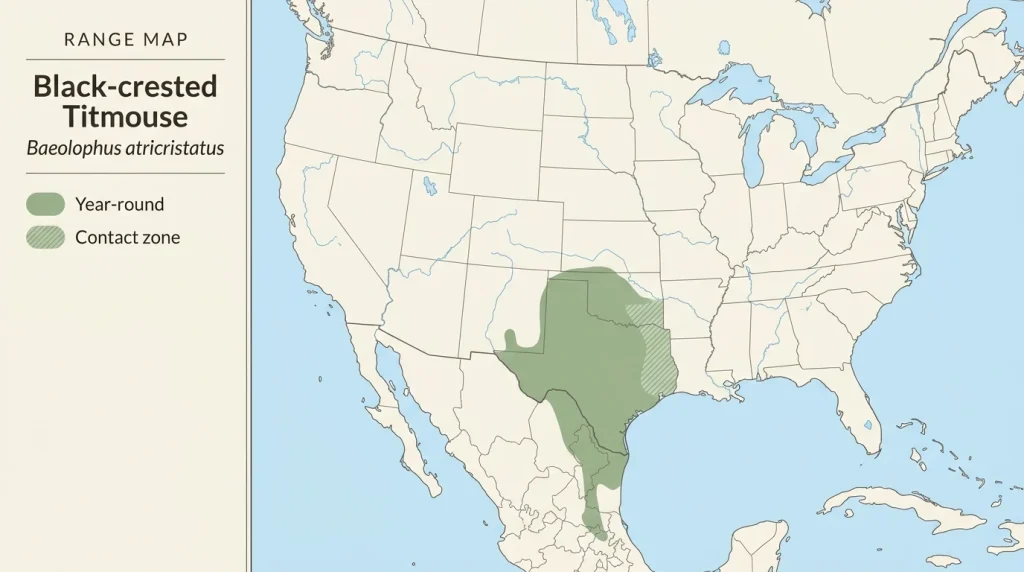
The species is centered in central, western, and southern Texas and extends into southwestern Oklahoma and northeastern Mexico, continuing south into parts of central Mexico. It may also occur locally near adjoining portions of southeastern New Mexico. Distribution is strongly associated with suitable woodland and scrub rather than forming a perfectly continuous block.
Along the eastern edge of its range—especially in central Texas and southwestern Oklahoma—the Black-crested Titmouse meets and hybridizes with the Tufted Titmouse. Birds in this contact zone may show intermediate crest color or mixed vocal and plumage features. The Cornell Lab of Ornithology species account provides additional identification and range information.
Habitat
Black-crested Titmice use open woodland and wooded scrub, particularly landscapes containing oaks, junipers, mesquite, hackberry, or mature streamside trees. They are common in the Texas Hill Country, where mixed oak-juniper vegetation provides feeding sites and nesting cavities.
They also adapt well to human-modified settings when mature trees and dense cover remain. Suitable places include ranch yards, city parks, cemeteries, shelterbelts, wooded suburban neighborhoods, and gardens with native vegetation. Completely open grassland and treeless agricultural fields are generally unsuitable.

Behavior
This titmouse moves rapidly through the middle and upper parts of trees, hopping along branches and probing clusters of leaves. It frequently uses strong feet to hold a seed or insect against a perch while opening it with repeated blows of the bill.
Pairs maintain close contact, and family groups may remain together after nesting. Outside the breeding season, individuals sometimes join loose mixed-species flocks with chickadees, kinglets, warblers, or other woodland birds. Curiosity is characteristic: a titmouse may approach a quiet observer, investigate an unfamiliar sound, or inspect a potential feeder from several nearby perches.
Diet and Hunting
The diet changes seasonally but normally includes:
- Caterpillars and other insect larvae
- Beetles, true bugs, wasps, and grasshoppers
- Spiders and other small arthropods
- Acorns, nuts, and wild seeds
- Small fruits and berries
- Sunflower seeds, peanuts, and suet at feeders
Most prey is gleaned from leaves, twigs, bark, or hanging vegetation. They may use short hovering movements to reach an insect or fruit. In colder weather, vegetable foods become more important, and individuals may carry seeds away to open or cache them.

Vocalizations
The song consists of clear, repeated whistles, often rendered as peter-peter-peter or a similarly rhythmic phrase. Notes may sound slightly rough, slurred, or hurried, and both pattern and pace vary among individuals and regions.
Calls include nasal scolds, thin contact notes, and rapid chickadee-like sequences. Vocalizations overlap with those of the Tufted Titmouse, particularly near the hybrid zone, so a heard-only identification should account for location and the exact quality of the notes.
Breeding and Nesting
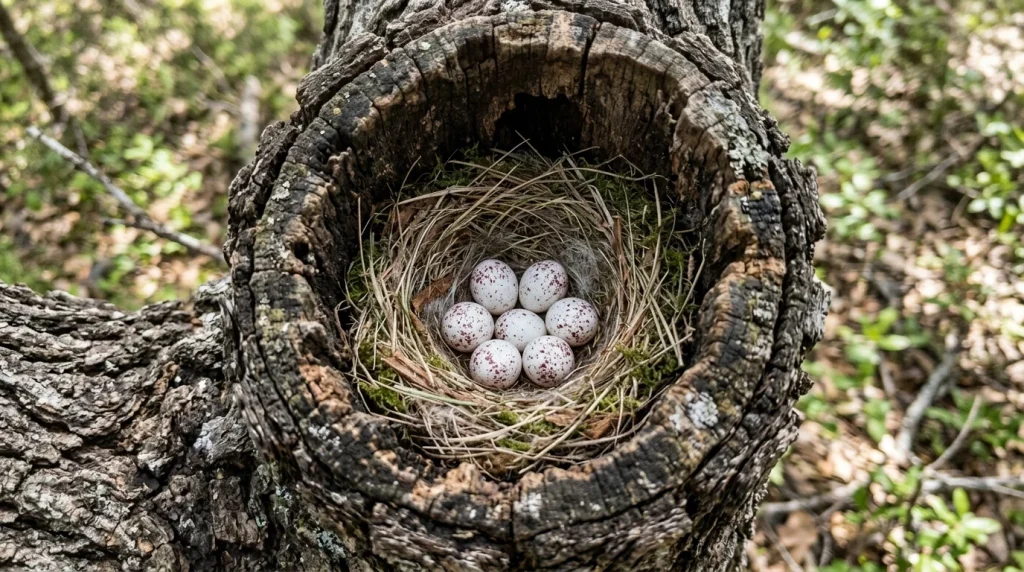
Black-crested Titmice are cavity nesters. A pair may use a natural hollow, an old woodpecker hole, a decayed opening in a limb, or a properly sized nest box. They can remove loose material but do not normally excavate a deep cavity in sound wood.
The female builds a cup of leaves, grass, moss, bark strips, and similar plant fibers, often lining it with hair or fur. A typical clutch contains about four to seven white eggs marked with reddish-brown or purplish spots. The female performs most or all incubation, while the male brings food. Incubation generally lasts around two weeks, although timing can vary.
Young and Development
Hatchlings are helpless and require frequent brooding and feeding. Both parents deliver insects, and caterpillars are an especially valuable protein source. Nestlings usually leave the cavity roughly two weeks after hatching, but recently fledged young still depend on adults.
Fledglings have short crests, loose-looking plumage, and prominent pale mouth edges. They follow their parents through nearby vegetation while giving persistent begging calls. Family members may remain associated for weeks as the young improve their flight and foraging skills.
Where to See
In the United States, central and southern Texas offer the most dependable viewing. Search wooded parks, oak-juniper slopes, mesquite groves, mature ranch properties, and riparian corridors. The Edwards Plateau and surrounding Hill Country are particularly productive.
Listen for whistles during calm mornings, then scan the middle canopy for a crested bird moving in short hops. In towns, check feeders near mature trees. Black oil sunflower seed, unsalted peanut pieces, and suet may attract titmice, especially outside the nesting season.
Similar Species
Tufted Titmouse: The most important comparison. A typical adult has a gray crest and a black forehead patch rather than the male Black-crested Titmouse’s extensive black crest. Females and hybrid-zone birds can be difficult to separate. Consider range, voice, and multiple plumage features
Bridled Titmouse: Found farther west in parts of Arizona, New Mexico, and Mexico. It has a strongly patterned black-and-white face, including a dark eye stripe and pale crest markings, unlike the simpler white-cheeked face of the Black-crested Titmouse.
Mountain Chickadee: Smaller, with a black cap, black throat bib, and a conspicuous white eyebrow. It lacks the tall, sharply pointed titmouse crest.
Conservation
The Black-crested Titmouse is commonly classified as Least Concern by the International Union for Conservation of Nature. It remains widespread and can tolerate moderate residential development when mature trees, native shrubs, and nesting cavities persist.
Local habitat loss, removal of dead limbs, pesticide use, and competition for cavities can still affect breeding opportunities. Retaining safe snags, planting native oaks and shrubs, reducing insecticide use, and maintaining clean nest boxes can support local populations. Retain dead trees only where they do not create a safety hazard.
Field Identification Tips
- Start with shape: Look for a compact gray bird with a pointed crest and stout bill.
- Check the cheek: The broad white cheek should contrast strongly with the darker crown and forehead.
- Assess crest color: A fully black crest favors an adult male Black-crested Titmouse; gray-crested birds require greater caution.
- Look at the flanks: Warm peach or rusty sides support titmouse identification but do not alone separate it from a Tufted Titmouse.
- Use geography: Identification is most straightforward away from the Tufted Titmouse contact zone.
- Listen carefully: Record repeated whistles or scolding calls when possible, but avoid relying on a single phrase.
- Allow for hybrids: In central Texas and southwestern Oklahoma, some birds cannot be confidently assigned from a brief view.
Frequently Asked Questions
Is the Black-crested Titmouse a chickadee?
No. Titmice and chickadees belong to the same family, Paridae, but they are placed in different genera. They share many behaviors, including cavity nesting, bark gleaning, and chickadee-like calls.
Do Black-crested Titmice migrate?
They are generally year-round residents. Individuals may move locally in response to food, weather, or the breeding season, but regular long-distance migration is not typical.
How can I distinguish a female from a Tufted Titmouse?
This can be difficult because a female Black-crested Titmouse usually has a grayish crest. Location, forehead pattern, vocalizations, and association with a known male may help. Identification can remain uncertain within the hybrid zone.
Will they use nest boxes?
Yes. They may accept a nest box placed near suitable woodland, particularly where natural cavities are limited. The box should have appropriate drainage, ventilation, and protection from intense afternoon sun and predators.
What feeder foods attract them?
Black oil sunflower seeds, peanut pieces, and suet are effective choices. Clean feeders regularly, and preserve natural vegetation because insects remain essential, especially when adults are feeding young.