Black-capped Chickadee Guide
Keep Track of What You See
Create a free Wild Things Guide membership to record this Black-capped Chickadee in My Sightings and build your personal wildlife list.
Join to Add This SightingThe Black-capped Chickadee is one of North America’s most beloved small songbirds. Friendly, curious, energetic, and easy to recognize, this tiny bird brings life to winter woods, backyard feeders, parks, and forest edges. Its black cap and bib, white cheeks, soft gray back, and familiar “chick-a-dee-dee-dee” call make it a favorite for beginner birdwatchers and experienced naturalists alike.
This guide is written for the general public, birdwatchers, photographers, gardeners, and backyard nature lovers. It uses the same structured format as the Northern Cardinal and Blue Jay profiles, so you can easily compare bird species across the site.

Quick Facts
- Common name: Black-capped Chickadee
- Scientific name: Poecile atricapillus
- Bird family: Paridae, the tit and chickadee family
- Size: Small songbird, about 4.5 to 5.5 inches long
- Diet: Insects, spiders, seeds, berries, suet, and cached food
- Best places to look: Mixed forests, woodland edges, parks, backyards, thickets, and feeders
- Best field clue: Black cap and bib, bright white cheeks, tiny round body, and chick-a-dee calls
Identification
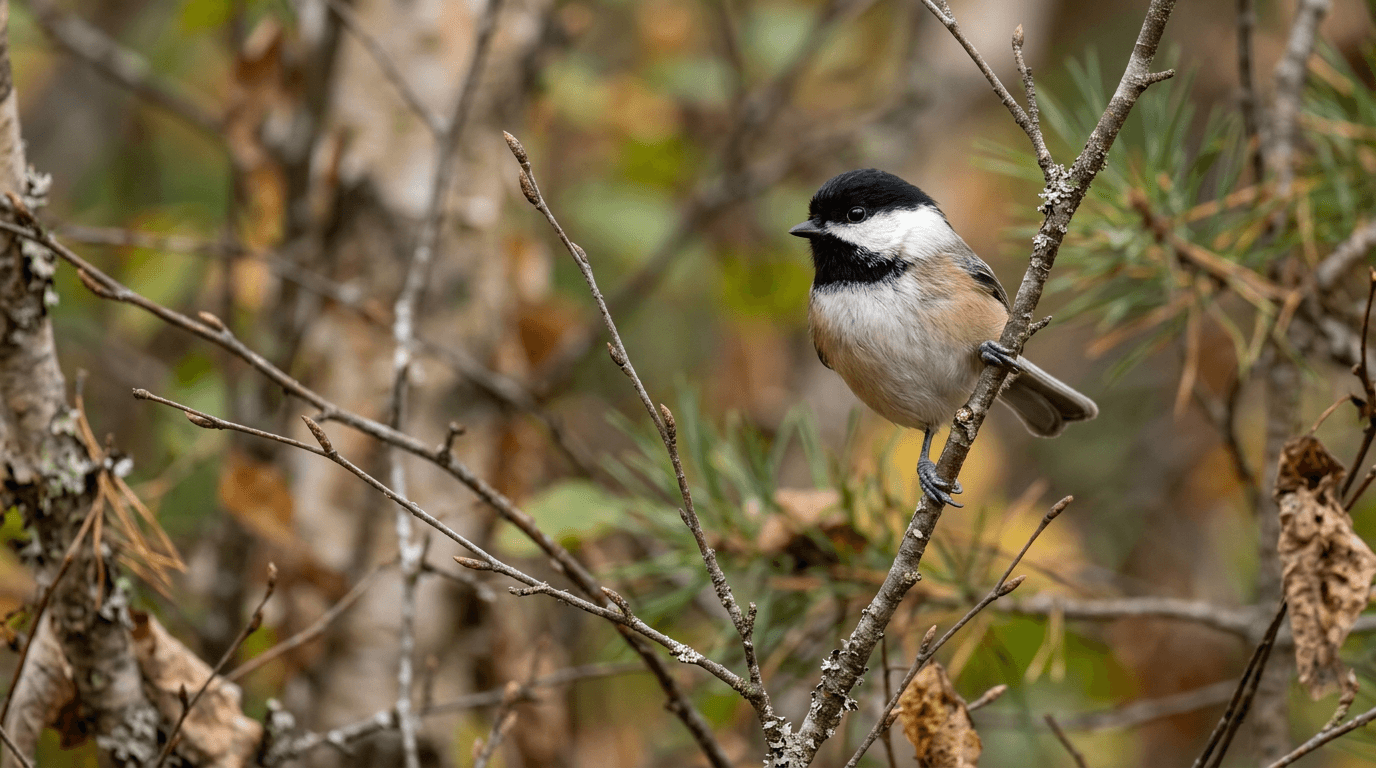
Black-capped Chickadees are compact birds with large-looking heads, short necks, small bills, and long tails. Their pattern is crisp and distinctive: a black cap on the head, a black bib beneath the bill, bright white cheeks, gray wings and back, and pale underparts with buffy sides. Their rounded shape and quick movements make them look almost constantly active.
In the field, behavior helps confirm identification. Chickadees often cling to twigs, hang upside down, inspect bark, and make quick flights between branches. They frequently travel in small flocks and may appear with nuthatches, titmice, woodpeckers, and kinglets in winter feeding groups.
Male vs. Female
Male and female Black-capped Chickadees look nearly identical. Both sexes show the same black cap and bib, white cheeks, gray back, and pale underparts. Size differences are subtle and are not reliable for most field observations.
During the breeding season, behavior may offer clues, but it is still difficult to identify sex with certainty. Males sing to establish territories and attract mates, while both members of a pair may visit a nest cavity and feed young. For most birdwatchers and photographers, the species is best appreciated by watching behavior rather than trying to separate males from females.
Juveniles
Juvenile Black-capped Chickadees resemble adults but may look softer, duller, and less sharply marked. Their black cap and bib can appear slightly sooty rather than crisp, and their feathers may look fluffy as they grow. Young chickadees often follow adults through trees and shrubs, begging with fluttering wings and soft calls.
By late summer and fall, young birds become difficult to separate from adults. They join small flocks and quickly learn the feeding routes, hiding places, and food sources that will help them survive winter.
Range and Distribution
Black-capped Chickadees are found across much of northern North America, including Alaska, Canada, the northern United States, and parts of the Appalachian region. They are strongly associated with colder climates and are among the most familiar winter birds in many northern backyards.
Their range overlaps with other chickadee species in some areas, especially the Carolina Chickadee in the eastern United States. Where ranges meet, identification can be challenging, and songs, calls, location, and subtle plumage clues may all be useful.
Habitat
Black-capped Chickadees live in deciduous forests, mixed woods, woodland edges, willow thickets, parks, shelterbelts, orchards, suburban neighborhoods, and backyards with trees and shrubs. They are especially common where mature trees provide natural cavities and where shrubs or understory plants support insects and cover.
In winter, chickadees use a variety of wooded and brushy habitats. They are highly adaptable and may visit feeders regularly, but they still depend on natural habitat for shelter, roosting cavities, insects, and cached food.
Diet
Black-capped Chickadees eat insects, spiders, caterpillars, beetles, eggs of insects, seeds, berries, and small bits of animal fat. During spring and summer, insects are especially important, particularly for feeding nestlings. Caterpillars and other soft-bodied insects provide the protein young birds need to grow.
In fall and winter, seeds and cached food become more important. Chickadees are famous for taking food and hiding it in bark crevices, dead leaves, moss, and other small spaces. Their memory helps them relocate many of these stored meals later.
Behavior
Black-capped Chickadees are bold, curious, and social. They often investigate people quietly from nearby branches and may be among the first birds to discover a new feeder. Their small winter flocks have social rankings, and the birds communicate constantly with calls and body movements.
In cold weather, chickadees use several survival strategies. They fluff their feathers for insulation, roost in cavities, lower their body temperature during cold nights, and rely on cached food. Their ability to stay active through harsh winters is one reason northern birdwatchers admire them.
Song and Calls
The Black-capped Chickadee’s most famous call is the clear “chick-a-dee-dee-dee.” The number of “dee” notes can vary and may communicate information about threats or social situations. This call is used year-round and is one of the easiest bird sounds for beginners to learn.
The song is different from the call. It is a sweet, whistled two-note phrase often described as “fee-bee” or “hey, sweetie.” In many northern areas, this simple song is a welcome sound of late winter and early spring as breeding territories form.
Nesting and Breeding
Black-capped Chickadees nest in tree cavities, rotten stubs, old woodpecker holes, or nest boxes. They can excavate their own cavity in soft, decayed wood, which makes dead trees and snags valuable habitat. The nest is usually lined with moss, fur, plant fibers, and other soft materials.
A typical clutch contains several small white eggs marked with reddish-brown speckles. The female does most of the incubation, while the male brings food. After the eggs hatch, both parents feed the young. Nest cavities should never be disturbed, and photographers should keep a respectful distance to avoid attracting predators or stressing the birds.

Migration
Black-capped Chickadees are generally non-migratory. Most remain in the same region throughout the year, even through very cold winters. Instead of migrating long distances, they rely on flocking, food caching, sheltered roosts, and flexible foraging.
Some local movements can occur, especially in response to food availability or harsh conditions, but they are not long-distance migrants like many warblers or thrushes. This year-round presence makes them dependable birds for backyard observation.
Similar Species
The Carolina Chickadee is the most important similar species in the southeastern part of the Black-capped Chickadee’s range. Carolina Chickadees are slightly smaller and often have a faster, higher-pitched song, but the two can be difficult to separate where their ranges meet. Hybrids may occur in contact zones.
Mountain Chickadees have a bold white eyebrow stripe and live mainly in western mountain forests. Boreal Chickadees have a brown cap and are found in northern coniferous forests. White-breasted Nuthatches may join chickadee flocks but are larger, longer-billed, and often climb headfirst down tree trunks.
Interesting Facts
- Black-capped Chickadees can remember many places where they cache food.
- They may lower their body temperature on cold nights to conserve energy.
- The “chick-a-dee” call can communicate different levels of alarm.
- They often join mixed-species winter flocks with nuthatches and woodpeckers.
- Dead trees and soft snags are important because chickadees use cavities for nesting and roosting.
Conservation Status
Black-capped Chickadees are widespread and generally common across much of their range. They are not considered globally threatened, but like all small birds, they benefit from healthy forests, native plants, safe nesting sites, and reduced hazards around homes.
Helpful conservation actions include preserving dead trees where safe, planting native shrubs and trees, keeping cats indoors, reducing pesticide use, cleaning feeders regularly, and preventing window collisions. Supporting insect-rich habitat is especially important during nesting season.
How to Attract Them
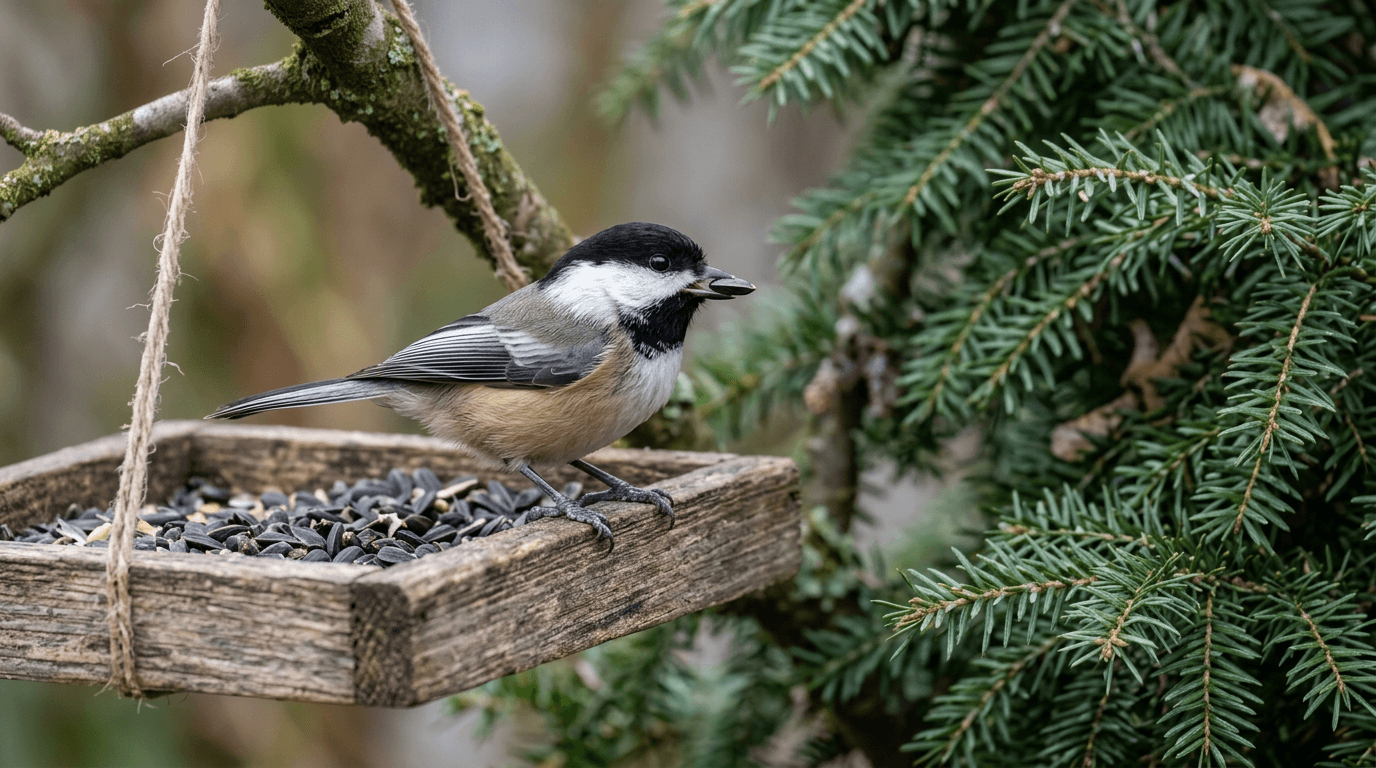
Black-capped Chickadees are among the easiest birds to attract to feeders. They readily visit for black oil sunflower seeds, hulled sunflower, peanuts, and suet. Because they often take one seed and fly away to eat or cache it, they may make many quick visits throughout the day.
To make your yard more chickadee-friendly, provide native trees and shrubs, leave some natural leaf litter, avoid pesticides, and keep a clean birdbath. Nest boxes can also help if placed in suitable wooded or edge habitat. A small entrance hole helps reduce competition from larger birds, and wood shavings inside can encourage excavation-like behavior.
Frequently Asked Questions
Do Black-capped Chickadees migrate?
Most Black-capped Chickadees do not migrate. They remain in their home range through winter and survive by caching food, joining flocks, and using sheltered roosts.
What do Black-capped Chickadees eat?
They eat insects, spiders, caterpillars, seeds, berries, suet, peanuts, and sunflower seeds. Insects are especially important for feeding young during the breeding season.
How can I tell a Black-capped Chickadee from a Carolina Chickadee?
Range is often the best clue, but where they overlap, identification can be difficult. Black-capped Chickadees are generally more northern, slightly larger, and often have a slower two-note song, while Carolina Chickadees are more southern and usually have a faster song.
How can photographers get better chickadee photos?
Use soft light, choose natural perches near feeders, and be patient. Chickadees move quickly, so a fast shutter speed and pre-focused perch can help capture sharp images while keeping the bird comfortable.